
Differences Between HTV, LSR, and RTV Silicone Rubber
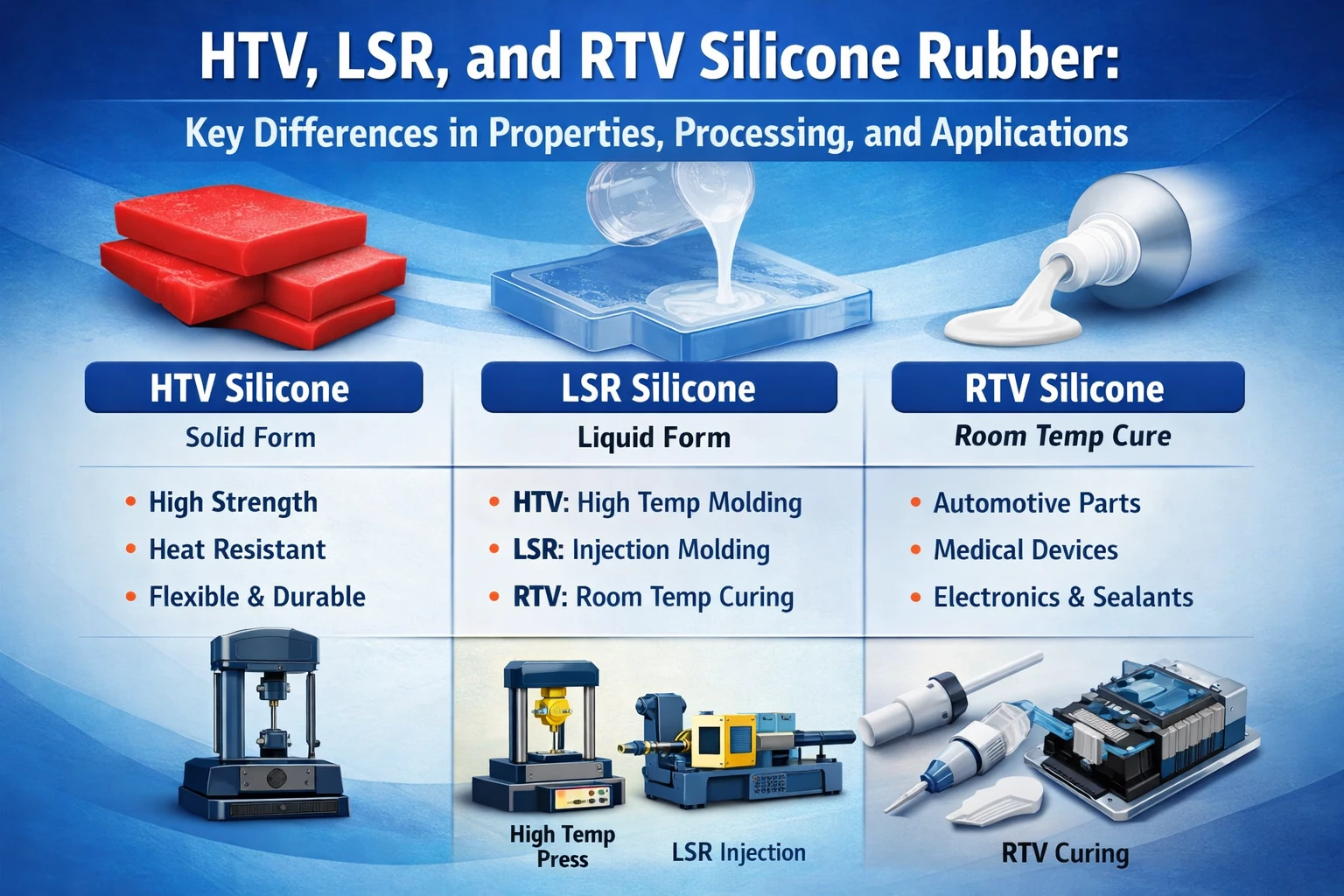
Caoutchouc de silicone is not a single material with one fixed processing method. In industrial applications, it is commonly classified into three major types according to its physical form and curing process: HTV silicone rubber, LSR silicone rubber, and RTV silicone rubber.
HTV stands for High Temperature Vulcanized silicone rubber. It is also known as HTV rubber, HTV silicone, or solid silicone rubber. LSR stands for Liquid Silicone Rubber, a two-component liquid material designed for precision injection molding. RTV stands for Room Temperature Vulcanized silicone rubber, which cures at room temperature and is widely used for sealing, bonding, potting, and encapsulation.
Although these materials all belong to the silicone rubber family, they differ significantly in molecular weight, curing conditions, processing equipment, mechanical strength, and application suitability. Understanding these differences helps engineers, buyers, and product designers choose the right silicone material for automotive parts, medical components, electronics, insulators, gaskets, seals, and industrial molded products.
Differences in Chemical Structure and Molecular Weight
The High-Temperature Vulcanized Silicone Rubber (HTV) is a solid rubber compound made from high molecular weight polysiloxane as the main polymer backbone. The molecular weight of HTV ranges between 400,000 and 800,000 g/mol. This high molecular weight allows HTV to create a dense, 3D crosslinked network when exposed to high temperatures and pressure, providing an HTV product with superior mechanical and thermal properties.
HTV is typically sold as solid products in the form of sheets, blocks, or strips with a relatively high Mooney viscosity of 30- 80 MU. Due to its low plasticity, HTV products require high processing temperatures during their molding process.
The Liquid Silicone Rubber (LSR), on the other hand, is classified as a sub-category of RTV silicone rubber, but is often considered a separate category due to its distinct liquid-forming properties and injection molding capabilities. Unlike HTV products, the molecular weight of LSR is much lower (i.e., typically between 10,000 - 80,000 g/mol) and therefore maintain their excellent flowability and viscosity at room temperature (i.e., between 1,000 - 100,000 mPa.s at 25°C), making them ideal candidates for injection molding.
LSR is usually supplied as a two-component system:
Component A contains a platinum catalyst
Component B contains a hydride-functional crosslinker
Curing occurs via a platinum-catalyzed hydrosilylation (addition) reaction.
RTV (Room-Temperature Vulcanized Silicone Rubber) is also based on a polysiloxane backbone and can be divided into two types according to its curing mechanism:
Condensation-type RTV: Polymer chains terminate (and sometimes branch) with hydroxyl functional groups. Crosslinking occurs through condensation reactions with silane crosslinkers at room temperature, releasing small-molecule byproducts such as alcohols or acids.
Addition-type RTV: Similar to LSR, it cures via a platinum-catalyzed hydrosilylation reaction without byproduct release, although its flowability is generally lower than that of LSR.
Comparison of Curing Mechanisms and Reaction Conditions
| Silicone Type | Curing Mechanism | Curing Temperature | Pressure Requirement | Curing Time | Byproducts |
|---|---|---|---|---|---|
| HTV | Peroxide-initiated crosslinking or hydrosilylation | 160–180 °C | 10–20 MPa | 3–10 min | Small molecules released during peroxide curing |
| LSR | Platinum-catalyzed hydrosilylation | 80–120 °C | Not required | 30–180 s | None |
| RTV (Condensation) | Hydroxyl–silane condensation | Room temperature | Not required | 24–72 h | Alcohols or acids |
| RTV (Addition) | Platinum-catalyzed hydrosilylation | Room temperature or 80–100 °C | Not required | 5–30 min | None |
Silicone Rubber that Cures at High Temperatures (HTV)
Silicone rubber that cures at high temperatures (HTV) can be formed with a compression molding press. When curing HTV silicone rubber with a compression molding press, the silicone rubber must be subjected to elevated temperatures and pressures in order to cure approximately 160-180 °C and 10-20 MPa, for approximately 3-10 minutes. After the curing process has completed, some HTV silicone products are placed into ovens at approximately 200 °C, for approximately 4 hours, to remove residual low-molecular weight compounds and to stabilize the HTV materials against environmental deterioration over time. There are two types of curing mechanisms used in curing HTV silicone, which include peroxide chemical reaction and hydrosilylation (addition type curing). The use of peroxide in curing HTV silicone rubber produces low-molecular-weight by-products, which may require additional treatments for the materials.
Silicone Rubber in Liquid Form (LSR) and Addition-Type RTVs
Liquid silicone rubber (LSR) and addition type RTV silicones cure primarily through a process of platinum-catalyzed hydrosilylation reactions and, as a result, do not produce by-products during curing. LSR is a specific form of addition type RTV silicone that is designed to provide fast and accurate filling of injection molds, using silicone rubber with low viscosity and the capacity to flow through the mold cavity quickly and easily. As a result, LSR silicone rubber typically cures rapidly between approximately 80 and 120 °C in approximately 30-180 seconds. Addition type RTV silicones utilize the same remain chemical reaction as hydrosilylation but generally produce longer curing times, between approximately 5 and 30 minutes.
Condensation Type RTV
RTV silicone rubber that cures via condensation is generally formed by the interaction between ambient moisture and hydroxyl functional groups in the RTV silicone rubber, which require exposure to air for this curing process to occur and as such, it takes much longer to cure compared to the addition type RTV silicone. The average curing times for condensation type RTV's typically are 24-72 hours. By-products produced during curing may have a negative impact on other materials or components around the cured RTV silicone.
Differences in Physical Properties and Processing Characteristics
Significant differences exist among the three silicone rubber types in terms of physical performance and processing behavior:
Mechanical Properties
The mechanical strength of HTV is typically greater than other silicone elastomers. This can be attributed to its high molecular weight, high molecular weight curing method (high temperature, high pressure) and therefore more significant bonding of the polymer chains. TEAR STRENGTH of HTV materials is typically between 15 and 45 kN/m, TENSILE STRENGTH of HTV materials ranges from 4 -12 MPa, and HARDNESS FOR HTV is generally between 10 and 90 Shore A.
Overall, LSRs are somewhat weaker than HTVs. LSR TEAR STRENGTH ranges from 15-30 kN/m, LSR TENSILE STRENGTH ranges from 4 -10 MPa, and LSR HARDNESS would typically be between 10 and 70 Shore A.
RTV materials produced by condensation curing will be less mechanically strong than addition curing methods for similar conditions. RTV produced by addition curing will produce mechanical properties approaching that of LSRs.
Thermal Resistance
All three materials perform similarly in long-term service temperatures, maintaining elasticity from approximately –50 °C to 200 °C. However, HTV has superior short-term heat resistance and can withstand temperatures of 250–300 °C for several hours. LSR has slightly lower thermal stability but meets the requirements of most applications. Addition-type RTV performs similarly to LSR, while condensation-type RTV may experience performance degradation at elevated temperatures due to byproduct release.
Processing Precision
Processing precision represents one of the most pronounced differences. HTV compression molding typically achieves dimensional tolerances of ±0.1 mm. LSR injection molding enables extremely high precision, with tolerances as tight as ±0.02 mm. RTV materials are generally applied by coating, potting, or encapsulation, offering lower dimensional precision but greater operational simplicity.
Process Characteristics
HTV processing involves multiple steps, including compounding, preforming, high-temperature vulcanization, and post-curing.
LSR processing relies on precision injection molding systems equipped with dual-component metering units, static mixers, and vacuum degassing, enabling fast and highly automated production.
RTV-1 (single-component) products can be directly applied and cure upon exposure to air, offering maximum convenience. RTV-2 (two-component) systems require accurate mixing ratios but allow better control over curing speed and working time.
Technical Suitability and Application Scenarios
The differences in structure, curing mechanism, and processing behavior give each silicone rubber type its own ideal application range.
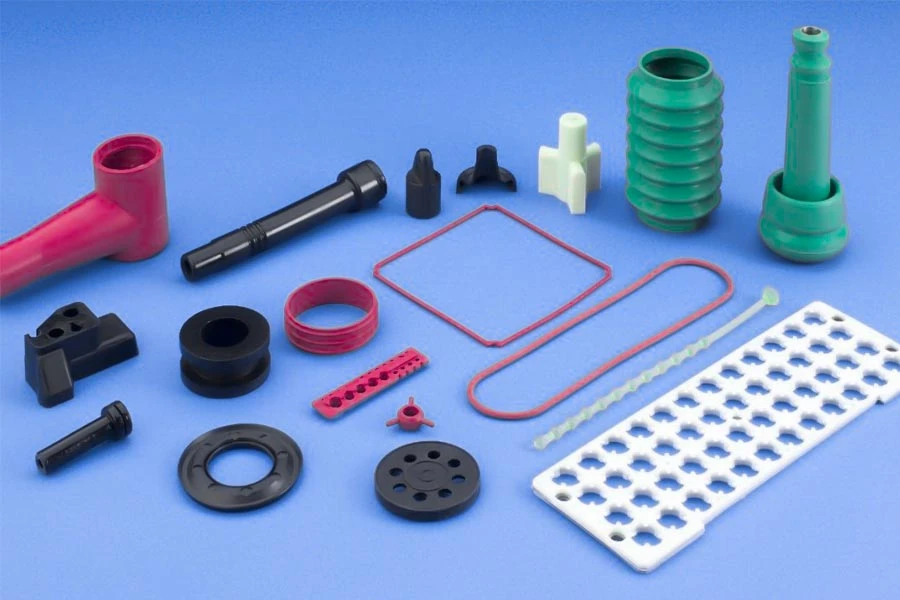
Caoutchouc silicone HTV is most suitable for standardized and high-volume production where mechanical strength, thermal resistance, and long-term durability are required. It is widely used in automotive sealing systems, engine compartment components, wire and cable insulation, electrical insulators, industrial gaskets, and high-temperature silicone parts.
In vehicle and automotive applications, the term HTV usually refers to High Temperature Vulcanized silicone rubber. This material is used because it can maintain elasticity and sealing performance under heat, vibration, weathering, and long-term mechanical stress. For new energy vehicles, HTV silicone rubber is also used in insulation components, connector seals, cable accessories, and high-temperature protective parts.
LSR silicone rubber is designed for precision injection molding. It is suitable for complex shapes, tight tolerances, clean production, and fast curing cycles. Common applications include medical devices, electronic components, sensors, wearable devices, baby products, keypads, and high-precision molded silicone parts.
RTV silicone rubber is more flexible in application because it can cure at room temperature. Condensation-type RTV is commonly used for construction sealing, general gap filling, temporary bonding, and mold making. Addition-type RTV is widely used in electronic potting, insulation, bonding, power modules, automotive electronics, and applications requiring byproduct-free curing.
Conclusion
The chemical structure and molecular weights of HTV, LSR & RTV silicone rubbers represent only a few of the many differences they have. They also have very different curing processes, curing conditions (temperatures, pressures), and ways in which they can be processed (techniques). Therefore, the way that silicone rubbers are used in technical applications is mostly determined by the combination of these different factors.
- The traditional method of producing silicone rubber is using HTV silicone rubber, which is a high-strength and high-heat resistant silicone rubber produced by high-pressure curing at elevated temperatures. This process allows for the manufacture of large quantities of HTV silicone rubber in a standardized manner.
- LSR silicone rubber is a liquid medium that has been modified to optimize it for injection molding, which allows for rapid, accurate molding of LSR silicone rubber to provide high volumes of LSR silicone rubber to meet the high demands of modern manufacturing.
The various types of RTV silicone rubbers are cured using room temperature and consist of two different curing process categories: Condensation and Additive (i.e. Additive Without Byproducts). While both types can be easily used in establishing on-site construction or as components in specialized electronic encapsulations, there are differences in the caution needed for their formulation when curing is performed with RTV silicone rubbers, the ease of use with condensation RTV silicone rubbers due to additional byproducts generated during the curing process.
Frequently Asked Questions (FAQs)
The fundamental difference lies in their physical form, curing mechanism, and processing method.
HTV is a solid rubber cured at high temperature and pressure, LSR is a liquid material designed for injection molding and rapid curing, while RTV cures at room temperature, typically used for sealing, potting, and on-site applications.
Yes. LSR is technically a subtype of addition-cure RTV silicone rubber, but it is classified separately due to its ultra-low viscosity, two-component delivery system, and injection-molding-specific processing technology. In industrial practice, LSR is treated as a distinct material category.
Caoutchouc silicone HTV generally provides the highest mechanical strength due to its high molecular weight et high-temperature, high-pressure vulcanization process. It is preferred for applications requiring superior tear strength, durability, and long-term mechanical stability.
LSR (Liquid Silicone Rubber) is the best choice for high-precision components. Injection molding enables tight dimensional tolerances (±0.02 mm), excellent surface finish, and the ability to mold complex geometries, making LSR ideal for medical, electronic, and consumer applications.
Condensation-cure RTV releases small-molecule byproducts (such as alcohols or acids) during curing and requires moisture from the air.
Addition-cure RTV uses platinum-catalyzed hydrosilylation, produces no byproducts, and offers better electrical, thermal, and long-term stability.
Addition-cure RTV is preferred for electronics and high-reliability applications
Addition-cure RTV silicone rubber is the preferred choice for electronic potting due to its byproduct-free curing, excellent insulation performance, and dimensional stability. LSR may also be used for molded electronic components, but RTV is more suitable for direct encapsulation.