
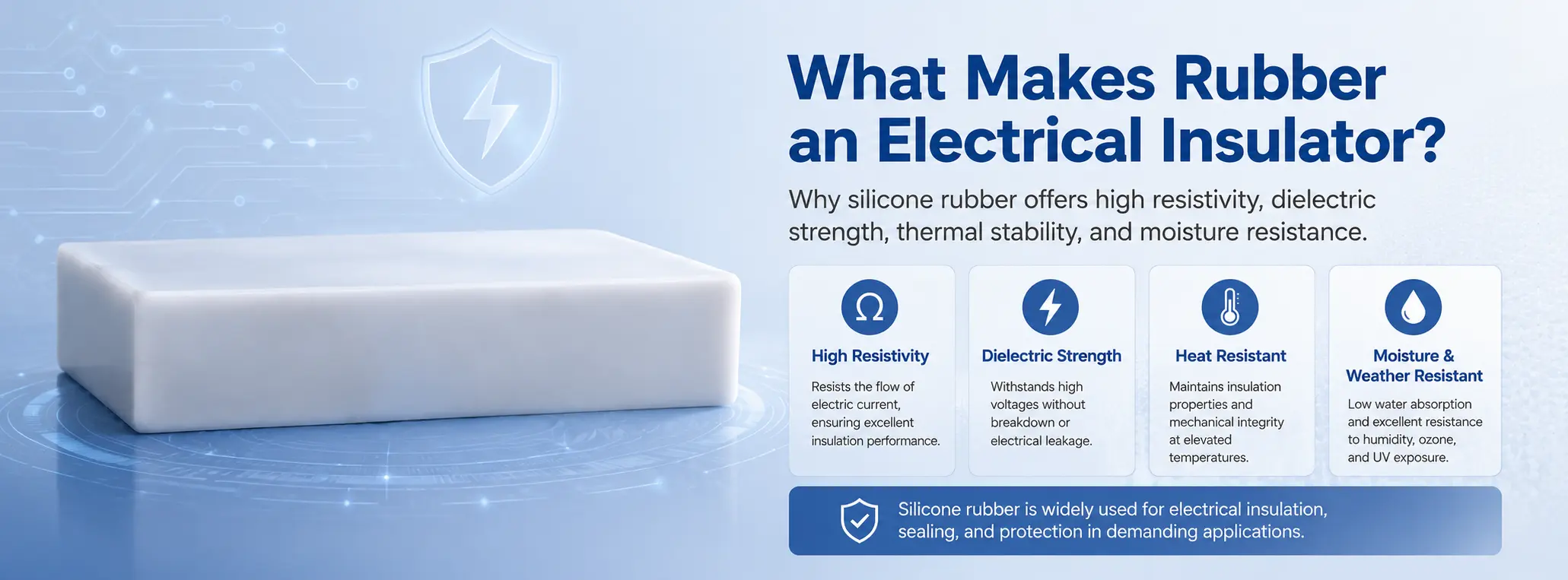
Pourquoi le caoutchouc est-il un isolant électrique ?
Caoutchouc Il est largement utilisé comme matériau isolant électrique dans les câbles, les connecteurs, les joints d'étanchéité, les manchons, les soufflets, les coussinets, les tapis, les pièces moulées et les capots de protection. Dans les produits électriques et électroniques, le caoutchouc est apprécié non seulement pour sa résistance au courant électrique, mais aussi pour sa souplesse, ses propriétés d'étanchéité, sa capacité à absorber les chocs et sa durabilité dans des environnements exigeants. Cependant, tous les caoutchoucs ne constituent pas automatiquement un isolant électrique fiable. Ses performances dépendent du type de polymère, de la formulation du composé, du choix de la charge, de l’épaisseur, de la propreté de la surface, de la température, de l’humidité, du niveau de tension et des conditions de vieillissement à long terme. Parmi les différents caoutchoucs, le caoutchouc de silicone est l’un des plus couramment utilisés pour l’isolation électrique, car il allie une résistance électrique élevée à une résistance à la chaleur, une bonne résistance aux intempéries, une grande souplesse et une protection contre l’humidité.
Les principes scientifiques fondamentaux de l'isolation en caoutchouc
Le caoutchouc agit comme un isolant électrique car sa structure moléculaire ne permet pas aux charges électriques de se déplacer librement. Les métaux conduisent l'électricité car ils contiennent des électrons libres qui peuvent se déplacer facilement à travers le matériau. Le caoutchouc, en revanche, est constitué de longues chaînes polymères dans lesquelles les électrons sont fortement liés à la structure moléculaire. Comme il y a très peu de porteurs de charge libres, le courant électrique ne peut pas traverser facilement le caoutchouc. Cela confère au caoutchouc une résistance électrique élevée et en fait un matériau utile comme barrière entre des pièces conductrices.
En termes simples, le caoutchouc empêche le passage du courant électrique. Lorsqu’une tension est appliquée à un matériau en caoutchouc, seul un courant de fuite très faible peut le traverser si le caoutchouc est propre, sec, correctement formulé et suffisamment épais. C'est pourquoi le caoutchouc est couramment utilisé autour des fils, des bornes, des connecteurs, des interrupteurs, des outils électriques, des tableaux électriques et des composants électriques extérieurs. L'effet isolant n'est pas seulement une propriété chimique, mais aussi une propriété de conception. Un bon isolant en caoutchouc doit présenter une composition adéquate, une épaisseur de paroi suffisante, une géométrie adaptée et des performances stables dans des conditions réelles d'utilisation.
Le caoutchouc de silicone présente un avantage particulier, car il repose sur un squelette silicium-oxygène, également appelé structure polysiloxane. Cette structure confère au caoutchouc de silicone une grande stabilité thermique, une flexibilité sur une large plage de températures, une résistance à l’ozone et aux rayons ultraviolets, ainsi qu’une excellente résistance aux intempéries. Ces caractéristiques sont importantes car l’isolation électrique doit souvent résister simultanément à la chaleur, à l’humidité, aux vibrations, à la compression, au rayonnement solaire et au vieillissement.
Les propriétés électriques qui font du caoutchouc un isolant
Les performances isolantes du caoutchouc sont généralement évaluées à l’aide de plusieurs propriétés électriques. Les plus importantes sont la résistivité volumique, la résistivité superficielle, la rigidité diélectrique, la constante diélectrique, le facteur de dissipation, la résistance au cheminement et la résistance à l’arc. La résistivité volumique décrit la capacité du caoutchouc à s’opposer au passage du courant à travers son volume. La résistivité superficielle décrit la résistance du caoutchouc au passage du courant à sa surface. La rigidité diélectrique décrit le champ électrique maximal que le matériau peut supporter avant qu'une rupture diélectrique ne se produise. La norme ASTM D149 est une méthode d'essai couramment utilisée pour déterminer la tension de claquage diélectrique et la rigidité diélectrique des matériaux isolants électriques solides aux fréquences du réseau électrique commercial.
En ce qui concerne le caoutchouc silicone de qualité électrique, les données publiées indiquent souvent une résistivité très élevée et d’excellentes performances diélectriques. Par exemple, un tableau de données sur un composé isolant à base de silicone mentionne des valeurs de résistivité volumique de 4,236 × 10¹⁴ Ω·cm et 1,75 × 10¹⁵ Ω·cm, ainsi que des valeurs de rigidité diélectrique de 20,55 kV/mm et 26,32 kV/mm pour différentes qualités destinées à la haute tension. La présentation générale des matériaux en caoutchouc silicone proposée par MatWeb mentionne également une large plage de rigidité diélectrique, avec une valeur moyenne d’environ 21,3 kV/mm pour de nombreuses qualités, ce qui démontre que le caoutchouc silicone peut être conçu pour offrir une isolation électrique performante.
Ces chiffres sont utiles, mais ils ne doivent pas être appliqués aveuglément. Une fiche technique de matériau repose généralement sur des échantillons d’essai normalisés, testés dans des conditions de laboratoire contrôlées. Une pièce moulée en caoutchouc réelle peut présenter des angles, des sections minces, des zones de compression, des joints, des inserts, des impuretés ou des poches d’air. Par conséquent, le produit final doit être évalué dans sa configuration réelle, en particulier s’il est utilisé à proximité de sources de haute tension, d’équipements électriques extérieurs, de systèmes critiques pour la sécurité ou d’ensembles électriques à longue durée de vie.
Pourquoi le caoutchouc de silicone est-il un excellent isolant électrique ?
Le caoutchouc de silicone est particulièrement adapté à l'isolation électrique, car il offre à la fois des avantages sur les plans électrique, thermique, mécanique et environnemental. Sur le plan électrique, de nombreux composés de caoutchouc de silicone présentent une résistivité volumique élevée et une rigidité diélectrique utile. Sur le plan mécanique, le caoutchouc silicone reste souple et élastique, ce qui lui permet d’absorber les vibrations, de maintenir la pression d’étanchéité et de protéger les pièces conductrices contre les mouvements ou les chocs. Sur le plan thermique, le caoutchouc silicone offre de bonnes performances sur une large plage de températures, ce qui le rend adapté aux applications à proximité de moteurs, de systèmes d’éclairage, de transformateurs, d’alimentations électriques, de batteries, d’appareils électroménagers et de composants électriques automobiles.
Un autre avantage important est la résistance à l’humidité. Le caoutchouc silicone est naturellement hydrophobe, ce qui signifie qu’il a tendance à repousser l’eau plutôt qu’à l’absorber. Dans le domaine de l’isolation électrique en extérieur, cette propriété est très précieuse, car les films d’eau à la surface d’un isolant peuvent augmenter le courant de fuite et créer des chemins de traçage. Les recherches sur le caoutchouc de silicone utilisé pour l’isolation électrique haute tension décrivent l’hydrophobicité comme une résistance à la formation de pistes conductrices d’eau susceptibles d’augmenter le courant de fuite et le risque de claquage. Cela explique pourquoi le caoutchouc de silicone est largement utilisé pour la protection électrique en extérieur, les accessoires de câbles, les joints de connecteurs, les capots isolants et les composants haute tension.
Le caoutchouc silicone résiste également mieux à l’ozone, aux rayons ultraviolets, à l’oxydation et aux intempéries que de nombreux caoutchoucs à usage général. C’est un aspect important, car la défaillance d’une isolation n’est souvent pas due uniquement à l’électricité. Elle peut être causée par des fissures, un durcissement, la pénétration d’humidité, une contamination de surface, une perte d’élasticité ou des dommages mécaniques. Un matériau en caoutchouc qui reste souple et stable pendant des années peut offrir une meilleure isolation à long terme qu’un matériau présentant de bonnes caractéristiques électriques initiales mais qui se dégrade rapidement à l’extérieur.
Le caoutchouc silicone par rapport aux autres matériaux isolants à base de caoutchouc
Différents types de caoutchouc peuvent être utilisés pour l'isolation électrique, mais leurs performances varient. Le caoutchouc naturel, l'EPDM, le néoprène et le caoutchouc silicone possèdent tous des propriétés utiles, mais leurs atouts sont différents. Le caoutchouc naturel est très élastique et est utilisé dans la fabrication de gants isolants et de produits de sécurité souples. L'EPDM est largement utilisé dans les accessoires de câbles et les applications électriques en extérieur en raison de sa résistance aux intempéries et à l'ozone. Le néoprène offre une bonne ténacité mécanique et une bonne résistance à l'huile dans certains environnements industriels. Le caoutchouc silicone se distingue lorsque la résistance à la chaleur, la souplesse à basse température, l'hydrophobie, la résistance aux intempéries et l'étanchéité à long terme sont requises.
| Matériau en caoutchouc | Caractéristiques d'isolation électrique | Principaux avantages | Applications électriques courantes |
|---|---|---|---|
| Caoutchouc de silicone | Résistivité volumique élevée ; de nombreuses nuances électriques présentent une rigidité diélectrique d’environ 15 à 25 kV/mm selon la formulation. | Résistance à la chaleur, résistance aux intempéries, résistance aux UV, souplesse, surface hydrophobe. | Joints électriques, manchons de câbles, joints d'étanchéité pour connecteurs, cales isolantes, capots moulés, pièces de protection haute tension. |
| caoutchouc EPDM | Bonnes performances d'isolation lorsqu'il est correctement formulé. | Résistance à l'ozone, résistance au vieillissement en extérieur, résistance à l'humidité. | Accessoires pour câbles, joints d'étanchéité électriques pour l'extérieur, composants moyenne tension, passe-câbles. |
| Caoutchouc naturel | Bonnes propriétés diélectriques dans les nuances adaptées. | Grande élasticité, souplesse, capacité de retour élastique. | Gants isolants, tapis en caoutchouc, produits de sécurité électrique flexibles. |
| Caoutchouc néoprène | Isolation modérée selon la formulation. | Résistance à l'abrasion, résistance à l'huile, résistance mécanique. | Gaines de câbles, manchons de protection, housses industrielles. |
| Caoutchouc conducteur | Résistance volontairement réduite grâce à des charges conductrices. | Blindage contre les interférences électromagnétiques, contrôle antistatique, mise à la terre, détection. | Claviers conducteurs, joints de blindage, pièces antistatiques. |
Cette comparaison montre pourquoi le choix d’un produit doit se fonder sur l’application concrète. Le “ caoutchouc ” n’est pas un matériau universel. Certains composés de caoutchouc sont conçus pour isoler électriquement, tandis que d’autres sont spécialement formulés pour conduire l’électricité ou dissiper les charges statiques. Par exemple, le caoutchouc silicone conducteur peut contenir du noir de carbone, du graphite, des particules métalliques ou d’autres charges conductrices. Il peut ressembler au caoutchouc silicone isolant, mais sa fonction électrique est totalement différente. C’est pourquoi les pièces destinées à l’isolation électrique doivent être fabriquées à partir de mélanges de caoutchouc de qualité électrique présentant des propriétés diélectriques clairement définies.
Quels sont les facteurs susceptibles de réduire les performances isolantes du caoutchouc ?
Les propriétés isolantes du caoutchouc peuvent être réduites par une formulation inadéquate, une contamination, l'humidité, une épaisseur insuffisante, une température élevée, le vieillissement, des dommages mécaniques et une conception inappropriée. L'un des facteurs les plus importants dans la formulation est le choix des charges. Les produits en caoutchouc sont rarement constitués de polymère pur. Ils contiennent souvent des charges de renforcement, des agents de vulcanisation, des pigments, des adjuvants de mise en œuvre, des retardateurs de flamme et d'autres additifs. Certains additifs améliorent la résistance mécanique ou la résistance au vieillissement thermique, mais d’autres peuvent réduire la résistance d’isolation s’ils introduisent des particules conductrices ou des contaminants ioniques. Le noir de carbone, le graphite, les poudres métalliques et certains additifs antistatiques peuvent rendre le caoutchouc plus conducteur. Cela est utile pour les pièces antistatiques ou de blindage, mais ne convient pas aux pièces isolantes.
La contamination de surface constitue un autre problème majeur. Même si le caoutchouc lui-même présente une résistivité volumique élevée, sa surface peut devenir conductrice lorsqu’elle est recouverte de poussière, de sel, d’huile, de particules métalliques, de résidus de flux ou d’humidité. Dans les environnements humides ou côtiers, le sel et l’eau peuvent créer des chemins de fuite à la surface d’un isolant. Dans les systèmes haute tension, cela peut entraîner des traînées de fuite, des arcs électriques, un dégagement de chaleur, une érosion de surface ou un claquage. La surface hydrophobe du caoutchouc silicone contribue à réduire ce risque, mais elle ne dispense pas d’une conception adéquate, du respect des distances de fuite et d’isolement, d’un nettoyage rigoureux et de la réalisation d’essais appropriés.
L'épaisseur et la géométrie sont également des facteurs essentiels. La rigidité diélectrique est souvent exprimée en kV/mm, mais l'évaluation d'une pièce d'une épaisseur donnée ne peut se limiter à une simple multiplication. Les champs électriques réels ne sont pas toujours uniformes. Les arêtes métalliques vives, les angles en caoutchouc fins, les poches d’air, les défauts de moulage et les zones de mauvais contact peuvent concentrer les contraintes électriques. Cela peut entraîner une rupture locale à une tension inférieure à celle prévue. Pour une isolation électrique professionnelle, les pièces en caoutchouc doivent être conçues avec des transitions lisses, une épaisseur suffisante, une compression stable et un espacement adéquat entre les composants conducteurs.
La température et le vieillissement peuvent également réduire la fiabilité de l'isolation. Certains caoutchoucs durcissent, deviennent cassants ou se fissurent après une longue exposition à la chaleur, à l'ozone, aux rayons ultraviolets ou à des contraintes mécaniques. Dès l'apparition de fissures, l'humidité et les contaminants peuvent atteindre les parties conductrices. Le caoutchouc silicone présente ici un avantage, car il conserve généralement mieux sa souplesse et sa résistance aux intempéries que de nombreux caoutchoucs à usage général. C'est pourquoi il est souvent choisi pour les connecteurs électriques destinés à un usage extérieur, les systèmes d'éclairage, les composants automobiles, les équipements de chauffage et les produits de contrôle industriel.
Exemple concret : le caoutchouc silicone dans la protection électrique en extérieur
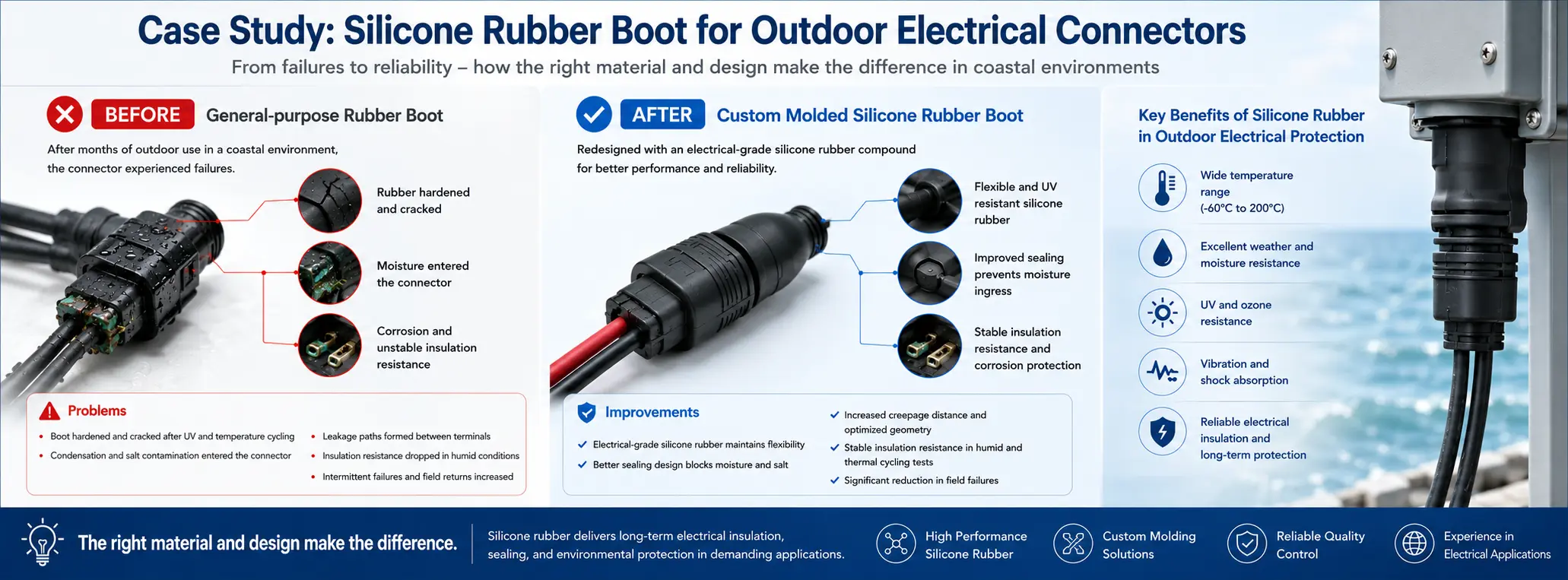
Un exemple concret permet d’illustrer l’importance du choix des matériaux. Prenons le cas d’un connecteur d’éclairage LED extérieur utilisé dans un environnement côtier. Ce connecteur comporte des bornes métalliques qui doivent être protégées de l’humidité, de la poussière, des vibrations et de tout contact accidentel. Dans la première version, un capuchon en caoutchouc polyvalent et peu coûteux avait été utilisé pour recouvrir les bornes. Au début, la pièce fonctionnait bien. Cependant, après plusieurs mois d’exposition à l’extérieur, le capuchon a commencé à durcir et à se fissurer près de la zone d’entrée du câble. De la condensation s’est infiltrée dans le connecteur lors des matins humides, et la contamination par le sel a créé des chemins de fuite entre les bornes. Certains luminaires ont présenté des défaillances intermittentes, de la corrosion et une résistance d’isolement instable.
Le fabricant a repensé le composant en utilisant un manchon en caoutchouc silicone moulé sur mesure. La nouvelle pièce utilise un composé de caoutchouc silicone de qualité électrique offrant une meilleure résistance à la chaleur et aux UV, ainsi qu’une flexibilité à long terme. La lèvre d'étanchéité a été améliorée afin de maintenir la compression autour du câble, et la forme interne a été modifiée pour éviter l'accumulation d'eau près des bornes. La conception a également permis d'augmenter la distance de surface entre les zones conductrices. Après avoir été soumis à des essais d'exposition à l'humidité, de cycles thermiques, de vibrations et de mesure de la résistance d'isolement, le connecteur repensé a démontré une meilleure stabilité et un nombre réduit de défaillances sur le terrain.
Ce cas montre que le caoutchouc peut constituer un excellent isolant électrique, mais uniquement lorsque le matériau et la conception appropriés sont utilisés. La défaillance initiale n’était pas due au principe même de l’isolation en caoutchouc. Elle résultait de l’utilisation d’un caoutchouc inadapté à l’environnement et d’une conception permettant à l’humidité et aux impuretés d’atteindre les contacts électriques. Le caoutchouc silicone a résolu le problème car il offrait à la fois isolation, étanchéité, souplesse et résistance aux conditions environnementales dans un seul composant moulé.
Choix du caoutchouc silicone pour les pièces d'isolation électrique sur mesure
Lors du choix d’un caoutchouc silicone destiné à l’isolation électrique, la première étape consiste à définir les conditions d’utilisation. Le concepteur doit tenir compte de la tension de service, de la plage de température, de l’utilisation en intérieur ou en extérieur, de l’exposition à l’humidité, aux UV, à l’ozone et aux produits chimiques, de la compression, des vibrations, des exigences en matière de résistance au feu, ainsi que de la durée de vie prévue. Les propriétés électriques requises doivent également être définies, notamment la rigidité diélectrique, la résistivité volumique, la résistivité superficielle, la résistance au cheminement et la résistance à l'arc électrique si l'application implique une haute tension ou une exposition en extérieur.
La deuxième étape consiste à choisir le composé de caoutchouc silicone approprié. Pour les applications d’isolation, le composé doit être de qualité électrique et ne doit pas contenir de charges conductrices, sauf si la conductivité est requise de manière intentionnelle. La fiche technique doit fournir les valeurs pertinentes telles que la dureté Shore A, la résistance à la traction, l'allongement, la résistance à la déchirure, la déformation rémanente après compression, la rigidité diélectrique, la résistivité volumique et la plage de températures de fonctionnement. Si la pièce est utilisée dans le domaine de l'électronique, une faible volatilité, une faible contamination ionique et un comportement non corrosif peuvent également être importants.
La troisième étape consiste à valider la pièce finie, et pas seulement la matière première. Un joint, un manchon, un soufflet, un capot ou un coussin moulé en caoutchouc silicone peut présenter des performances différentes de celles d’une feuille d’essai plate. La conception finale doit être testée dans des conditions réalistes, telles que l'humidité, le vieillissement thermique, les cycles thermiques, la compression, les vibrations, le brouillard salin et les charges électriques. Pour les produits haute tension ou critiques en matière de sécurité, il convient de respecter les méthodes d'essais électriques reconnues et les exigences de conformité.
Du point de vue de la fabrication, le caoutchouc silicone est particulièrement adapté à la fabrication de pièces d'isolation électrique sur mesure, car il peut être moulé, extrudé, découpé ou transformé en de nombreuses formes. Parmi les produits courants, on trouve les feuilles de caoutchouc silicone, les coussinets isolants, les manchons de câbles, les joints d'étanchéité, les rondelles, les joints de connecteurs, les manchons de protection, les capuchons, les couvercles, les tubes et les composants moulés sur mesure. Ces pièces assurent à la fois l'isolation électrique et l'étanchéité environnementale, ce qui les rend utiles dans les équipements électriques, l'électronique, les systèmes automobiles, l'éclairage LED, l'électroménager, les machines industrielles et les produits liés aux énergies renouvelables.
Conclusion finale
Le caoutchouc agit comme isolant électrique car sa structure polymère limite le mouvement des charges électriques libres. Cela confère au caoutchouc une grande résistance au passage du courant et lui permet de servir de barrière protectrice autour des pièces conductrices. Toutefois, les performances réelles d'isolation dépendent du type de matériau, de la formulation du composé, de l'épaisseur, de la géométrie, de la contamination, de l'humidité, de la température et des conditions de vieillissement.
Le caoutchouc silicone est l'un des meilleurs choix en matière d'isolation électrique, car il allie une résistivité élevée, une rigidité diélectrique utile, une grande souplesse, une résistance à la chaleur, une bonne résistance aux intempéries et des propriétés hydrophobes. Il est particulièrement apprécié dans la fabrication de pièces sur mesure devant assurer à la fois l'isolation et l'étanchéité, telles que les joints électriques, les manchons de câbles, les capuchons de connecteurs, les coussinets isolants, les capots moulés et les composants de protection.
La conclusion principale est simple : le caoutchouc peut constituer un isolant électrique fiable, mais les applications électriques professionnelles exigent un mélange de caoutchouc adapté et une conception de produit adéquate. Pour les applications exigeantes, le caoutchouc silicone est souvent privilégié car il ne se contente pas de bloquer l'électricité. Il protège également contre la chaleur, l'humidité, les vibrations, l'exposition aux UV et le vieillissement environnemental à long terme. Lorsqu'il est correctement spécifié, fabriqué et testé, le caoutchouc silicone peut offrir une isolation et une protection fiables pour une large gamme de produits électriques et électroniques.