
HTV Silicone Rubber—The Unsung Hero of Industrial Durability
Silicone rubber can be found virtually anywhere throughout the home to outer space. Its unique properties allow it to withstand heat and cold. When it comes to durability, precision, and larger volume capabilities, though, a lot of silicone materials will not suffice.
That is where High-Temperature Vulcanizing (HTV) Silicone Rubber comes in. HTV silicone can be considered the toughest silicone grade. This material takes a conventional rubber formulation to the next level for strength and reliability through intense process heat and pressure. When there needs to be a component that stays, HTV is the option generally selected.
What Exactly Is HTV Silicone?
Form and Function
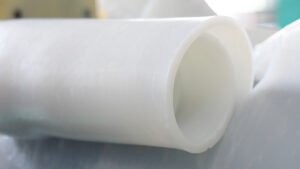
HTV silicone initially comes in a raw material format called "gum stock" or sheeting, before it is cured. It has a high molecular weight, leaving it feeling stiff and gummy, similar to uncured tire rubber. The underlying chemical base is Polydimethylsiloxane (PDMS).
The Curing Secret: High Heat
The term "HTV" equals superior performance. To properly cure (vulcanize) there are two non-negotiable requirements:
- High Temperatures. The material must be heated, usually between 120 and 200, typically in a compression mold.
- Curing Agents. A chemical booster, usually an organic peroxide (or for super clean grades a platinum catalyst).
This heat and pressure combination forces the molecules to form a compact three-dimensional shape. This tightly woven structure gives HTV its strength and stability you won't see in room-curing materials.
The Core Strengths of HTV Silicone (Toughness and Temperature)
Manufacturers rely on HTV because its properties are far superior for demanding jobs:
- Unmatched Mechanical Strength
- Tear Resistance: This is usually the strongest point. The HTV is really resistant to tearing or nicking, which is key for seals or gaskets that are often bent or stretched.
- Tensile Strength: It can sustain pulling stress much greater than urethane before it breaks, which gives HTV critical attributes for long life, durable parts.
- Resilience: The material returns completely to its original shape with certainty even after extended periods of compression.
- Extreme Thermal Tolerance
- HTV is regarded as the most temperature-stable type of silicone. As such, you can rest assured using HTV parts in extreme north pole conditions (as low as -60C), as well as continuous high heat applications (up to +250C).
- Reliable Electrical Insulation
- It maintains excellent insulation properties which is why you see it used often in the high-voltage and electronic applications.
Part III: Popular HTV Types and Locations You Will Find Them
Because the same formulation can be modified with varying fillers, HTV fulfills many specialty markets:
HTV Grades for Specific Needs
Grade | Key Feature | Common Use Case |
High Strength Grade | Maximum physical toughness and endurance. | Heavy-duty industrial seals and bumpers. |
Flame Retardant Grade | Formulated to resist burning (e.g., meeting UL94 V-0 standards). | Mass transit cables and fire-barrier seals. |
Conductive Grades | Modified to either dissipate heat or conduct electricity. | Thermal management pads, electronic keypads. |
Food/Medical Grade | Cured with non-toxic platinum catalyst (meets FDA/USP standards). | Baby bottle nipples, surgical tubes, baking molds. |
Where HTV is Used
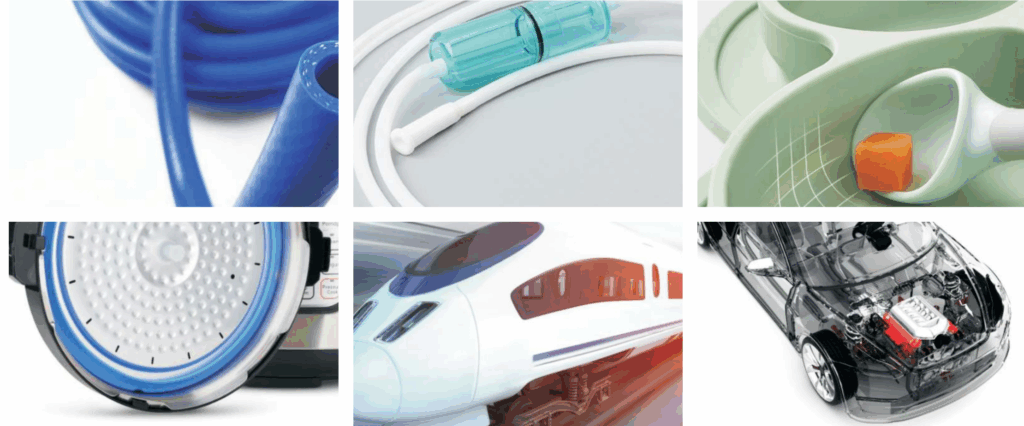
- Automotive: Spark plug boots, important engine gaskets, and high-temperature O-rings.
- Consumer Electronics & Power: Durable keypads for remotes, insulation for high-voltage cables.
- Household Appliance & Goods: Oven door seals, usable kitchen utensils.
- Medical: High-precision tubing and components for devices.
HTV vs. RTV Silicone: Choosing the Right Tool
When selecting silicone, the choice often boils down to HTV or RTV (Room-Temperature Vulcanizing). Here is a practical look at where they differ:
Characteristic | HTV (High-Temperature Vulcanizing) | RTV (Room-Temperature Vulcanizing) |
Curing Requirement | Requires High Heat (120-20C) and pressure to mold. | Cures at Room Temperature (20-4C) by reacting with moisture/air. |
Starting Material | Solid, stiff gum stock. | Liquid or paste (like a tube of caulk). |
Manufacturing | Best for Factory Production (molding, extrusion) and high volumes. | Best for On-Site Jobs (sealing, caulking, repairs) and small batches. |
Final Strength | Superior (Best mechanical and tear resistance). | Good (Adequate for sealing and bonding, but less durable). |
Main Use | Durable, engineered parts, keypads, precision seals. | Adhesives, sealants, gap filling, electronic potting. |
Conclusion: Making Your Silicone Choice Simple
The choice is simple: Select HTV when your job calls for a part with excellent mechanical strength, dimensional stability, and tolerance for extreme conditions, all made reliably and in high volume. Choose RTV when you need to seal a joint, adhere two surfaces, or coat an electronic circuit without the need for special equipment in the manufacturing facility.
Yes, absolutely. HTV stands for High-Temperature Vulcanizing. Without the necessary heat (typically 120C to 20C), the curing agents cannot activate the cross-linking process required to give the silicone its characteristic strength and durability.
HTV starts as a solid gum, and LSR starts as a two-part liquid. HTV uses older methods (molding/extrusion) and is often stronger. LSR is used in modern injection molding, known for high automation and speed, making it suitable for delicate, complex parts.
Yes, specifically the platinum-cured grade. This process is exceptionally clean and ensures the silicone is non-toxic and odorless, allowing it to meet stringent regulatory standards like those set by the FDA for use in food and medical devices.
HTV starts with higher-quality raw materials (high molecular weight polymers) and undergoes a high-pressure, high-heat curing process. This creates a much denser, more uniform internal network of cross-links compared to the slow, atmospheric curing of RTV, resulting in far superior tear and tensile strength.