
Silicone Rubber in Composite Insulators
Silicone rubber has become one of the most important materials in modern power transmission and distribution systems. As utilities worldwide continue upgrading electrical grids to improve reliability, reduce maintenance costs, and withstand increasingly harsh environmental conditions, silicone rubber has emerged as the preferred housing material for composite insulators. Yet one question continues to appear among engineers, procurement teams, and industrial buyers: Is silicone rubber conductive?
The short answer is that standard silicone rubber is generally non-conductive and acts as an excellent electrical insulator. However, the complete answer is more nuanced, especially when silicone rubber is engineered for use in high-voltage composite insulators, outdoor electrical systems, polluted industrial environments, and specialized electrical applications.
At Yakows, we work closely with utilities, EPC contractors, and industrial power system operators who require long-term insulation reliability under demanding service conditions. Through years of manufacturing and field application experience in composite insulator technology, we have seen how the electrical behavior of silicone rubber directly affects insulation coordination, flashover resistance, leakage current performance, and overall grid stability.
Understanding the Electrical Nature of Silicone Rubber
Silicone rubber is fundamentally an insulating material. Its molecular structure contains silicon-oxygen bonds combined with organic groups that create a stable polymer network with high electrical resistance. Because free electrons cannot move easily through this structure, electrical current flow is extremely limited.
Typical high-temperature vulcanized (HTV) silicone rubber used in composite insulators has a volume resistivity ranging from 10¹² to 10¹⁵ ohm-centimeters. This extremely high resistivity allows silicone rubber to prevent unintended current leakage across the insulator surface and through the housing material itself.
In practical terms, this means silicone rubber can safely isolate energized conductors from grounded structures even under severe environmental stress.
The dielectric strength of silicone rubber is also impressive. Depending on formulation and filler content, high-quality silicone rubber used in electrical insulation applications often achieves dielectric strengths between 20 kV/mm and 30 kV/mm. This enables relatively compact insulation designs while maintaining excellent electrical safety margins.
For power system applications, these electrical characteristics are critical because insulators must continuously withstand operating voltage, temporary overvoltage, switching surges, and lightning impulses for decades.
At Yakows, our composite insulator silicone formulations are designed specifically to maintain stable dielectric performance under long-term UV exposure, humidity cycling, contamination, salt fog, and thermal aging.
Why Silicone Rubber Is Preferred for Composite Insulators
Traditional porcelain insulators dominated transmission and distribution systems for decades. However, as grid infrastructure expanded into coastal, desert, industrial, and high-pollution regions, utilities began facing increasing problems related to contamination flashover, mechanical failure, and maintenance intensity.
Composite insulators using silicone rubber housings solved many of these challenges.
A composite insulator typically consists of three major components:
- Fiberglass reinforced epoxy (FRP) core rod
- Silicone rubber housing and sheds
- Metal end fittings
Among these components, silicone rubber plays the most important role in environmental insulation performance.
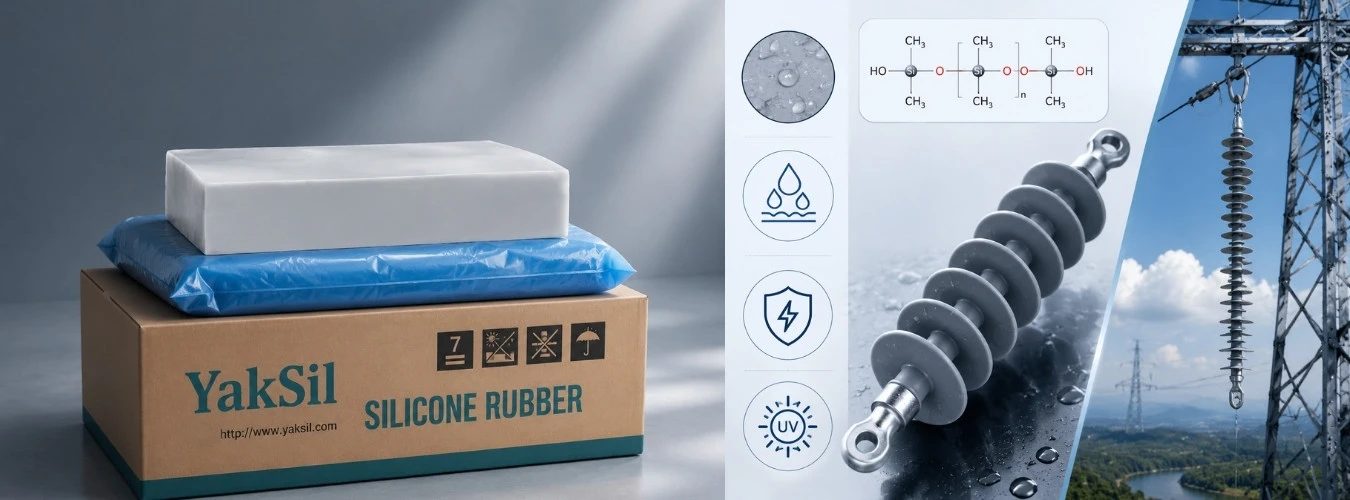
The primary reason silicone rubber became the dominant material for composite insulator housings is its hydrophobicity. Unlike ceramic surfaces that allow continuous water films to form, silicone rubber naturally repels water. Instead of creating conductive paths, moisture beads into discrete droplets.
This significantly reduces surface leakage current and improves flashover resistance.
Even more importantly, silicone rubber demonstrates hydrophobicity transfer. Low molecular weight silicone chains migrate to the surface and even transfer hydrophobicity to contamination layers such as salt, dust, or industrial pollutants.
This characteristic provides enormous advantages in heavily contaminated service environments.
At Yakows, our composite insulators are engineered to maximize long-term hydrophobicity retention because we understand that real-world grid performance depends not only on laboratory dielectric strength but also on surface behavior under pollution stress.
Is Silicone Rubber Ever Conductive?
Although standard silicone rubber is insulating, conductivity can be intentionally introduced through formulation engineering.
By adding conductive fillers such as carbon black, silver particles, nickel powders, graphite, or metal-coated particles, manufacturers can create conductive silicone rubber compounds for specialized applications.
These applications may include:
- EMI shielding
- Static discharge control
- Conductive gaskets
- Sensor systems
- Flexible electronic components
- Grounding interfaces
However, conductive silicone rubber is entirely different from the silicone rubber used in composite insulators.
For high-voltage insulation applications, conductivity is undesirable because excessive surface conduction increases leakage current, dry-band arcing, erosion risk, and flashover probability.
This distinction is extremely important because some buyers mistakenly assume all silicone rubbers behave similarly.
At Yakows, we focus specifically on high-performance insulating-grade silicone rubber optimized for outdoor high-voltage applications. Our material systems are engineered for:
- High dielectric strength
- Low leakage current
- Strong tracking resistance
- Superior erosion resistance
- Long-term weatherability
- Excellent hydrophobicity retention
These properties are essential for transmission and distribution reliability.
The Relationship Between Leakage Current and Conductivity
One of the most misunderstood aspects of silicone rubber performance is leakage current.
Some engineers observe measurable leakage current on energized insulators and incorrectly conclude that silicone rubber itself is conductive.
In reality, leakage current is influenced by environmental conditions, contamination severity, wetting behavior, and electric field distribution.
Even highly insulating materials can exhibit surface leakage current under contaminated wet conditions.
The key issue is not whether some leakage current exists, but whether the material can prevent the formation of continuous conductive films that trigger flashover.
This is where silicone rubber performs exceptionally well.
In comparative pollution tests conducted under salt fog conditions, silicone rubber composite insulators consistently demonstrate lower leakage current than porcelain insulators exposed to the same contamination levels.
For example, several field studies in coastal transmission systems have shown:
- Porcelain insulators often develop continuous wet contamination films
- Leakage current amplitudes can rise rapidly during fog events
- Dry-band arcing becomes more frequent
- Flashover probability increases significantly
Meanwhile, silicone rubber composite insulators maintain discrete water droplets and interrupted conduction paths, resulting in lower average leakage current and improved insulation stability.
At Yakows, we perform routine hydrophobicity and leakage current evaluations during product development to ensure stable outdoor performance under real operating conditions.
Real-World Case Study: Coastal Transmission Environment
A utility operating a 220 kV coastal transmission corridor experienced repeated contamination-related outages due to salt deposition and high humidity exposure.
The original porcelain insulators required frequent washing cycles, particularly during monsoon seasons when salt fog conductivity increased dramatically.
Measured leakage current values on heavily contaminated porcelain strings regularly exceeded 150 mA under wet conditions. Flashover incidents caused costly interruptions and maintenance dispatches.
The utility initiated a phased replacement program using silicone rubber composite insulators.
After installation, several improvements were observed over a three-year monitoring period:
- Leakage current levels dropped by more than 60%
- Scheduled cleaning frequency decreased significantly
- Flashover incidents were nearly eliminated
- Insulator string weight was reduced substantially
- Maintenance costs decreased year over year
The key performance factor was not conductivity in the traditional sense, but rather silicone rubber’s ability to maintain hydrophobicity and suppress continuous conductive film formation.
This case reflects one of the reasons why utilities worldwide continue transitioning toward silicone rubber composite insulation technologies.
Yakows has supplied composite insulation solutions for coastal, desert, industrial, and high-humidity environments where contamination control is a critical operational challenge.
Silicone Rubber Performance Under Pollution Conditions
Outdoor insulators operate in some of the harshest environments imaginable. Dust, salt, industrial emissions, acid rain, cement particles, fertilizers, and airborne pollutants accumulate continuously on insulator surfaces.
When moisture combines with these contaminants, conductive layers may form.
The effectiveness of silicone rubber depends on several interconnected properties:
Hydrophobicity
Hydrophobicity prevents water film continuity.
Tracking Resistance
Tracking occurs when electrical discharge gradually carbonizes the material surface, creating conductive pathways.
High-quality silicone rubber resists tracking under long-term electrical stress.
Erosion Resistance
Dry-band arcing can erode polymer surfaces over time.
Advanced silicone formulations resist thermal degradation and surface erosion.
UV Resistance
Outdoor insulators experience constant ultraviolet exposure.
Poor-quality silicone compounds may crack, chalk, or lose hydrophobicity.
Recovery Ability
After temporary contamination or wetting events, silicone rubber should recover hydrophobicity rapidly.
At Yakows, our silicone rubber systems are formulated with optimized ATH (aluminum trihydrate) filler content and carefully controlled polymer structures to balance mechanical strength, electrical performance, and environmental resistance.
How Material Quality Influences Conductivity Behavior
Not all silicone rubber materials deliver the same insulation performance.
The electrical behavior of silicone rubber depends heavily on formulation quality, manufacturing process control, filler dispersion, curing conditions, and long-term aging resistance.
Low-cost silicone compounds sometimes contain excessive inorganic fillers, recycled materials, or poorly dispersed additives.
These shortcuts can lead to:
- Increased leakage current
- Reduced dielectric strength
- Inferior hydrophobicity
- Premature aging
- Surface cracking
- Accelerated erosion
In severe cases, poor-quality silicone housing materials may carbonize under electrical stress, creating localized conductive pathways.
This is why supplier selection matters significantly in composite insulator procurement.
At Yakows, we maintain strict quality management throughout raw material selection, silicone compounding, molding, vulcanization, and finished product testing.
Our quality verification process includes:
- Hydrophobicity classification testing
- Tracking and erosion resistance evaluation
- Tensile strength testing
- Hardness measurement
- Leakage current analysis
- Visual defect inspection
- Interface bonding verification
- Dimensional consistency checks
By controlling the entire production process, we help customers achieve long-term field reliability instead of merely meeting minimum specification requirements.
Silicone Rubber vs EPDM in Composite Insulators
Another common question in the power industry concerns the difference between silicone rubber and EPDM (ethylene propylene diene monomer).
Both materials have been used in polymer insulator systems, but silicone rubber has become dominant in many high-voltage applications.
EPDM offers good mechanical properties and weather resistance, but it lacks the inherent hydrophobicity of silicone rubber.
Under contaminated wet conditions, EPDM surfaces are more likely to form continuous conductive films.
This can increase leakage current and reduce contamination flashover performance.
Silicone rubber’s hydrophobicity transfer capability provides a major operational advantage.
Several long-term utility evaluations have demonstrated superior contamination performance for silicone rubber composite insulators compared with EPDM alternatives.
For transmission systems operating in coastal or industrial pollution zones, this difference becomes especially important.
Yakows primarily focuses on silicone rubber insulation systems because of their superior field performance in demanding outdoor environments.
Mechanical and Electrical Coordination in Composite Insulators
A composite insulator is not merely an electrical product.
Its long-term reliability depends on the coordination of mechanical, electrical, thermal, and environmental performance.
Silicone rubber must function effectively alongside the FRP core rod and metal fittings.
Poor interface bonding can allow moisture ingress.
Internal moisture penetration may lead to:
- Electrical treeing
- Interface discharge
- Brittle fracture risk
- Core degradation
- Internal tracking
Therefore, silicone rubber housing quality alone is insufficient.
The entire composite insulator manufacturing process must be engineered carefully.
At Yakows, we optimize:
- Housing-to-core bonding
- Seal integrity
- End fitting crimping
- Interface stress distribution
- Shed geometry
- Creepage distance design
This systems-level approach helps ensure long-term operational reliability under real grid conditions.
Industry Standards for Silicone Rubber Composite Insulators
Reliable composite insulator performance requires compliance with international testing standards.
Important standards include:
- IEC 61109
- IEC 62217
- ANSI C29 series
- IEC 60587 tracking and erosion testing
- IEC 60815 pollution design guidelines
These standards evaluate critical characteristics such as:
- Wet power frequency withstand
- Lightning impulse withstand
- Mechanical tensile load
- Tracking resistance
- Erosion resistance
- Weather aging
- Interface integrity
- Pollution performance
At Yakows, our composite insulator products are developed and tested according to relevant international standards to ensure compatibility with global utility requirements.
Case Study: Industrial Pollution Environment
A steel manufacturing region in Southeast Asia experienced persistent insulation problems due to airborne conductive dust and chemical contamination.
Substation insulators accumulated layers of metallic particles mixed with moisture and industrial emissions.
Conventional ceramic insulators required extensive maintenance and periodic replacement due to contamination flashover incidents.
The utility deployed silicone rubber composite insulators in selected high-risk sections.
Field monitoring over five years revealed several measurable benefits:
- Outage frequency declined significantly
- Maintenance intervention intervals increased
- Leakage current stability improved
- Pollution flashover incidents decreased sharply
- Inspection workload was reduced
Infrared inspection data also indicated more stable operating conditions during high-humidity periods.
The utility later expanded composite insulator deployment across multiple substations.
Experiences like this demonstrate why silicone rubber insulation systems are increasingly important for modern industrial power networks.
Yakows continues supporting customers operating in high-pollution industrial environments where insulation reliability directly affects production continuity.
Temperature Resistance and Electrical Stability
Another important reason silicone rubber performs well in composite insulators is thermal stability.
Silicone rubber can maintain electrical insulation properties across a wide temperature range.
Typical operating capability spans from approximately -50°C to +200°C depending on formulation.
This stability matters because outdoor insulators experience:
- Solar heating
- Rapid temperature cycling
- Winter icing
- Thermal shock
- Electrical heating from leakage current
Materials with poor thermal stability may harden, crack, or lose electrical integrity over time.
At Yakows, we engineer silicone rubber systems capable of maintaining consistent insulation performance under severe climatic conditions.
Why Utilities Prefer Silicone Rubber Composite Insulators
The global shift toward silicone rubber composite insulators is driven by operational economics as much as by material science.
Compared with traditional porcelain systems, composite insulators offer:
- Lower weight
- Easier transportation
- Reduced installation labor
- Better seismic resistance
- Improved contamination performance
- Lower maintenance requirements
- Higher vandal resistance
- Enhanced safety during handling
In remote transmission corridors, these advantages can significantly reduce total lifecycle cost.
Utilities today increasingly evaluate insulator technology not only by initial purchase price but also by long-term reliability and maintenance savings.
Yakows works closely with customers to optimize insulation solutions according to:
- Voltage level
- Pollution severity
- Climatic conditions
- Mechanical loading
- Altitude
- Switching surge requirements
- Project lifecycle expectations
Common Misconceptions About Silicone Rubber Conductivity
Several misconceptions continue circulating within the market.
One common misconception is that any measurable leakage current means the silicone rubber is conductive.
In reality, all outdoor insulation systems exhibit some surface leakage behavior under contamination and wetting conditions.
The critical question is whether the material can control leakage pathways and prevent flashover.
Another misconception is that all silicone rubber materials are equivalent.
Actual field performance depends heavily on formulation engineering, manufacturing quality, and long-term aging characteristics.
Low-grade silicone compounds may initially appear acceptable but degrade rapidly under ultraviolet radiation, electrical stress, or contamination exposure.
A third misconception is that conductivity alone determines insulator performance.
Successful composite insulation design requires balancing:
- Electrical insulation
- Hydrophobicity
- Mechanical integrity
- Environmental resistance
- Thermal stability
- Interface reliability
At Yakows, we emphasize complete lifecycle reliability rather than isolated laboratory specifications.
Conclusion
So, is silicone rubber conductive?
Under standard conditions, silicone rubber is an excellent electrical insulator with very high resistivity and strong dielectric properties. This is precisely why it has become the preferred housing material for modern composite insulators.
Although specially engineered conductive silicone rubbers exist for niche applications, the silicone rubber used in high-voltage composite insulation systems is specifically formulated to minimize conductivity, suppress leakage current, resist tracking, and maintain hydrophobicity under severe environmental conditions.
The true value of silicone rubber in composite insulators lies not merely in low conductivity, but in its ability to maintain stable insulation performance under contamination, moisture, UV exposure, temperature cycling, and long-term electrical stress.
At Yakows, we understand that reliable insulation performance depends on more than simply selecting a material. It requires deep expertise in silicone rubber formulation, composite insulator design, manufacturing precision, quality control, and real-world application engineering.
By combining advanced silicone rubber technology with strict production standards and extensive field experience, Yakows provides composite insulator solutions that help utilities and industrial operators improve reliability, reduce maintenance costs, and ensure stable power system operation in challenging environments.
For customers seeking dependable composite insulator performance, understanding the true electrical behavior of silicone rubber is the first step toward making the right insulation investment.