
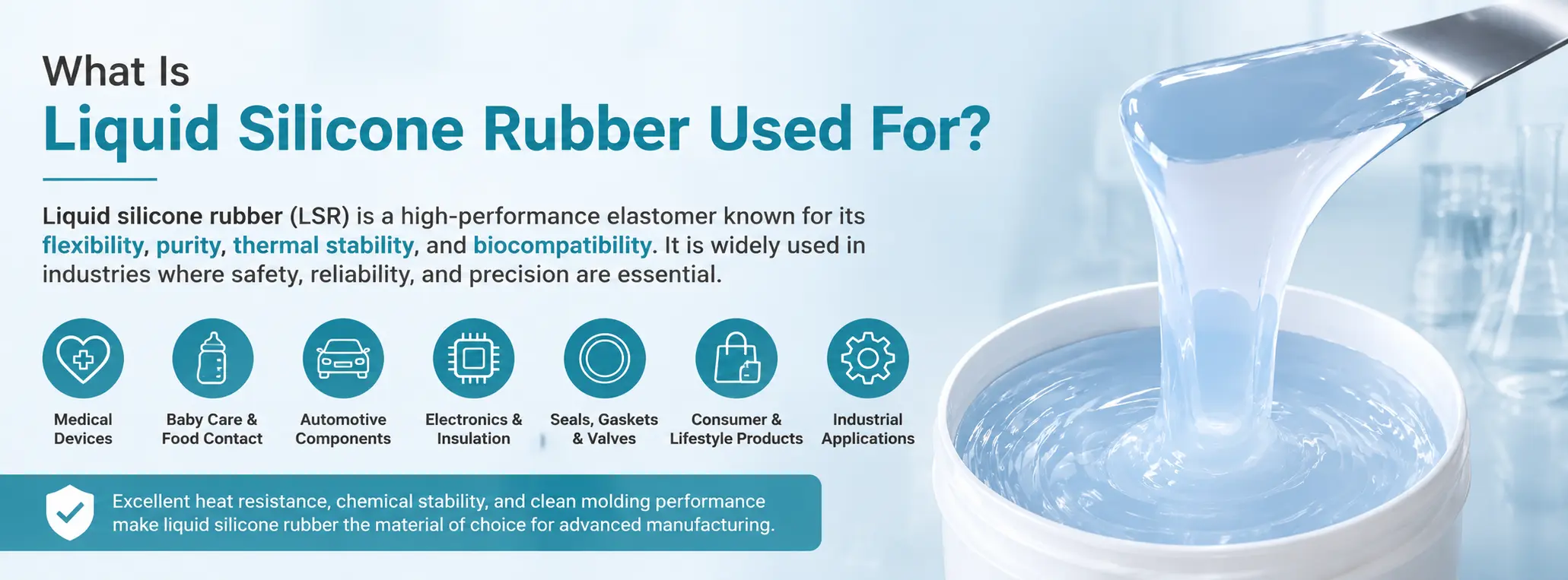
What Is Liquid Silicone Rubber Used For?
Liquid silicone rubber is a high-performance elastomer used in medical devices, automotive systems, electronics, consumer products, industrial sealing, and many other demanding applications. Its unique combination of flexibility, purity, thermal stability, and manufacturing precision makes it one of the most important engineering materials in modern product design.
1. Introduction to Liquid Silicone Rubber
Liquid silicone rubber, often abbreviated as LSR, is a two-component silicone elastomer designed for liquid injection molding and other precision manufacturing processes. Unlike conventional solid silicone rubber, liquid silicone rubber has a low-viscosity, flowable form before curing. This allows it to fill complex mold cavities, reproduce fine details, and produce parts with consistent dimensional accuracy.
The term liquid silicone rubber refers not only to the physical state of the material before curing, but also to a specific class of platinum-cured silicone elastomers. These materials are typically supplied as Part A and Part B systems. When mixed in a controlled ratio, they undergo an addition-curing reaction that forms a stable, crosslinked elastomer.
Because liquid silicone rubber is chemically stable, physiologically inert, and resistant to extreme temperatures, it is widely used in industries where safety, cleanliness, and reliability are critical. From implantable medical components to waterproof electronic seals, LSR provides a balance of mechanical performance and long-term environmental resistance that many organic rubbers and thermoplastics cannot easily match.
2. Key Properties That Make Liquid Silicone Rubber Useful
The broad application range of liquid silicone rubber is mainly determined by its molecular structure. Silicone polymers are based on a silicon-oxygen backbone, which provides excellent thermal and oxidative stability. This structure differs significantly from carbon-based organic rubbers, giving LSR a distinctive set of properties.
Important material characteristics include:
- High flexibility and elasticity over a wide temperature range
- Excellent resistance to heat, cold, ozone, and ultraviolet radiation
- Good electrical insulation performance
- Low compression set for sealing applications
- Biocompatibility in selected medical and food-grade formulations
- Chemical resistance to many aqueous solutions and environmental agents
- High transparency or easy pigmentation depending on formulation
- Clean, repeatable processing through liquid injection molding
These properties explain why liquid silicone rubber is frequently selected for parts that must remain soft, elastic, and stable under conditions that would cause other polymers to harden, crack, deform, or degrade. In addition, LSR can be molded into very small, intricate, or thin-walled parts, making it suitable for advanced technical applications.
3. Medical and Healthcare Applications
One of the most important uses of liquid silicone rubber is in the medical and healthcare industry. Medical-grade LSR is valued because it can be formulated to meet strict requirements for biocompatibility, cleanliness, and sterilization resistance. It is commonly used in devices that come into contact with skin, bodily fluids, or sensitive tissues.
Liquid silicone rubber is used in respiratory masks, catheter components, syringe seals, valves, infusion system parts, wound care products, medical tubing connectors, and wearable health-monitoring devices. In some specialized grades, it may also be used for implantable or long-term body-contact components, provided the material has been tested and approved for the specific medical application.
The softness of LSR makes it comfortable for patient-contact products. Its resistance to repeated sterilization also makes it suitable for reusable medical devices. Depending on the formulation, liquid silicone rubber may withstand steam sterilization, ethylene oxide sterilization, gamma radiation, or other common sterilization methods.
Another advantage is the high purity of platinum-cured liquid silicone rubber. Compared with some peroxide-cured elastomers, platinum-cured LSR generally produces fewer by-products during curing. This is especially important in medical applications where extractables, leachables, and biological safety must be carefully controlled.
4. Baby Care and Food-Contact Products
Liquid silicone rubber is widely used in baby care products and food-contact applications because selected grades are odorless, tasteless, flexible, and resistant to high temperatures. Common products include baby bottle nipples, pacifiers, teething toys, feeding spoons, breast pump components, food storage seals, kitchen tools, baking molds, and reusable drinking accessories.
In these applications, consumer safety is the primary design consideration. LSR is often selected because it can be made without plasticizers and can maintain softness without the migration concerns associated with some flexible plastics. Its heat resistance also allows many products to be boiled, steam-cleaned, or dishwasher-safe.
For food-contact products, manufacturers must use grades that comply with applicable food safety regulations in the target market. The phrase “food-grade liquid silicone rubber” should therefore be understood as a regulatory and formulation-specific description, not as a universal property of all LSR materials.
5. Automotive Applications
The automotive industry uses liquid silicone rubber in many components that must resist heat, vibration, moisture, chemicals, and long service life requirements. Modern vehicles contain numerous rubber parts, and LSR is particularly useful where conventional elastomers may fail under elevated temperatures or complex sealing conditions.
Typical automotive applications include connector seals, ignition system components, sensor housings, gaskets, O-rings, turbocharger-related seals, lighting seals, battery pack components, and weather-resistant protective covers. In electric and hybrid vehicles, liquid silicone rubber is also used in high-voltage connector seals, thermal management components, and insulation-related parts.
LSR’s electrical insulation properties are particularly valuable in vehicle electronics. As automobiles become more electrified and electronically controlled, materials that can protect sensors, circuits, connectors, and power systems from moisture and temperature fluctuations are increasingly important.
6. Electronics and Electrical Insulation
Liquid silicone rubber is widely used in the electronics and electrical industries because it provides good dielectric properties, environmental resistance, and flexibility. It can be used to protect delicate components from moisture, dust, vibration, and mechanical stress.
Common electronic applications include waterproof seals, cable connectors, keypad membranes, wearable device components, smartphone seals, earbud parts, insulating sleeves, sensor encapsulation, and soft-touch interface components. In many cases, LSR is chosen because it can be molded into precise geometries while maintaining long-term elasticity.
Liquid silicone rubber is also suitable for overmolding onto plastics, metals, and electronic assemblies when proper material compatibility and surface preparation are used. This allows manufacturers to combine rigid structural parts with soft sealing or cushioning features in a single integrated component.
7. Industrial Seals, Gaskets, and Valves
Sealing is one of the most common uses of liquid silicone rubber. Because LSR has a low compression set and remains elastic under thermal stress, it is well suited for gaskets, O-rings, diaphragms, valve components, and custom sealing elements.
Industrial seals made from liquid silicone rubber are used in fluid handling systems, pumps, filtration equipment, appliances, HVAC systems, and laboratory instruments. The material helps prevent leakage while maintaining flexibility over long periods of compression.
The selection of LSR for sealing applications depends on temperature, pressure, chemical exposure, compression requirements, and regulatory needs. While liquid silicone rubber performs well in many environments, it is not universally resistant to all oils, fuels, solvents, or aggressive chemicals. Proper material testing is necessary before use in demanding chemical conditions.
8. Consumer Goods and Lifestyle Products
Liquid silicone rubber is also common in consumer products because it provides a soft touch, attractive appearance, durability, and color flexibility. It can be transparent, translucent, or pigmented into a wide range of colors. Its pleasant tactile feel makes it popular in products that are frequently handled.
Examples include watch straps, wearable device bands, protective cases, buttons, grips, household tools, personal care accessories, sports equipment, and reusable containers. In these applications, liquid silicone rubber contributes both function and user experience.
LSR is particularly useful for products that require repeated bending, stretching, cleaning, or exposure to outdoor conditions. Its resistance to ultraviolet light and ozone helps maintain appearance and performance better than many conventional rubbers.
9. Aerospace and High-Performance Engineering
In aerospace and other high-performance engineering fields, materials must function reliably under extreme temperature changes, vibration, and environmental exposure. Liquid silicone rubber can be used in seals, grommets, vibration-damping parts, insulation components, and protective covers where flexibility and stability are required.
Aerospace applications often require specialized grades and extensive qualification testing. Factors such as flame behavior, outgassing, thermal cycling, and mechanical durability must be evaluated before a material is approved for use. Liquid silicone rubber is useful in this context because its chemistry provides strong resistance to thermal and environmental aging.
10. Manufacturing Advantages of Liquid Silicone Rubber
The usefulness of liquid silicone rubber is not limited to its final material properties. Its processing advantages are equally important. LSR is commonly processed by liquid injection molding, a highly automated manufacturing method that supports high-volume production with excellent repeatability.
During production, the two components of liquid silicone rubber are metered, mixed, and injected into a heated mold. The material cures quickly inside the mold, forming a finished elastomeric part. This process can reduce manual labor, minimize contamination, and produce complex geometries with tight tolerances.
Key processing benefits of liquid silicone rubber include:
- Fast cycle times for high-volume production
- Excellent reproduction of fine details
- Low material waste in optimized molding systems
- Ability to mold small and complex components
- Compatibility with automation and cleanroom manufacturing
- Potential for multi-shot molding and overmolding
These manufacturing advantages make LSR especially valuable in industries where large quantities of consistent, high-quality parts are required. Medical devices, electronics, and automotive components all benefit from the precision and cleanliness of liquid injection molding.
11. Why Liquid Silicone Rubber Is Used Instead of Other Materials
Engineers often choose liquid silicone rubber when a component must combine softness, heat resistance, environmental stability, and precision molding. Compared with thermoplastic elastomers, LSR usually offers better high-temperature stability and long-term resistance to compression. Compared with natural rubber or many synthetic organic rubbers, it provides superior resistance to ozone, ultraviolet exposure, and thermal aging.
However, liquid silicone rubber is not always the best material for every application. It may be more expensive than some commodity elastomers, and its resistance to certain oils, fuels, or solvents may be limited. Material selection should therefore be based on a complete understanding of the operating environment, regulatory requirements, mechanical loads, and expected product lifetime.
12. Limitations and Design Considerations
Although liquid silicone rubber is highly versatile, successful application requires careful design and testing. Engineers must consider hardness, tensile strength, elongation, tear resistance, compression set, shrinkage, bonding requirements, and exposure conditions. A grade suitable for a baby bottle nipple may not be suitable for an automotive connector seal, and a medical-grade LSR may not automatically meet the needs of a high-temperature industrial valve.
Mold design is also important. Because LSR has low viscosity before curing, it can flow into very thin sections but may also flash if tooling is not precise. Venting, gate location, parting line design, and cold-runner or hot-runner systems must be engineered carefully for stable production.
For applications requiring adhesion to plastic or metal substrates, surface treatment or self-bonding LSR grades may be necessary. The compatibility between the silicone and the substrate should be validated through mechanical testing and aging studies.
13. Future Trends in Liquid Silicone Rubber Applications
Demand for liquid silicone rubber is expected to grow as industries continue to require safer, cleaner, smaller, and more durable components. Medical wearables, electric vehicles, smart devices, robotics, and advanced healthcare technologies are all creating new opportunities for LSR materials.
In wearable electronics, liquid silicone rubber provides skin-friendly softness, sweat resistance, and flexibility. In electric vehicles, it supports sealing, insulation, and thermal management needs. In medical technology, it enables high-precision components for minimally invasive devices, drug delivery systems, and patient-monitoring equipment.
Sustainability is also becoming more important. While silicone materials are not biodegradable in the same way as some natural materials, their durability, long service life, and potential to replace less stable materials can contribute to product reliability and reduced replacement frequency. Manufacturers are also exploring more efficient processing, waste reduction, and improved lifecycle management for silicone products.
Conclusion
Liquid silicone rubber is used in a wide range of applications because it offers a rare combination of flexibility, heat resistance, chemical stability, biocompatibility, electrical insulation, and manufacturing precision. Its most important uses include medical devices, baby care products, food-contact components, automotive seals, electronic parts, industrial gaskets, consumer goods, and high-performance engineering components.
The value of liquid silicone rubber lies not only in its physical properties but also in its compatibility with automated liquid injection molding. This allows manufacturers to produce clean, complex, and highly consistent parts at scale. As industries continue to demand safer, more reliable, and more precise materials, liquid silicone rubber will remain an essential material in advanced manufacturing.