
Composite Insulator Material Guide
How to Choose Silicone Rubber For Composite Insulator?
Choosing silicone rubber for a composite insulator requires more than comparing hardness, tensile strength or price. The housing material must maintain hydrophobicity, resist tracking and erosion, protect the fiberglass core, bond reliably at every interface and remain processable during mass production.
Start with the Composite Insulator Application
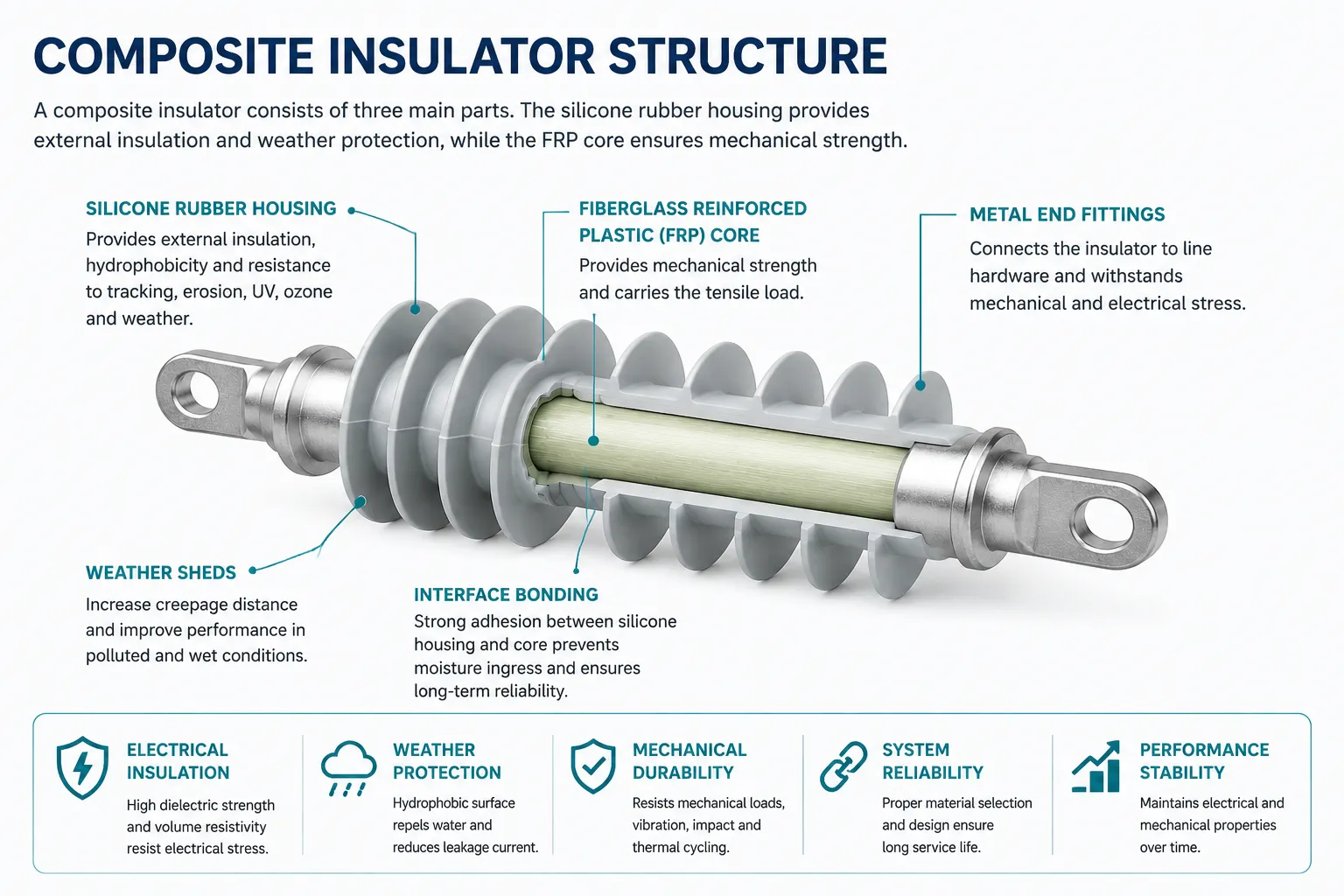
A composite insulator is a complete insulation system consisting of a load-bearing fiberglass-reinforced polymer core, a polymer housing with weather sheds and metal end fittings. The silicone rubber housing protects the core from moisture and environmental damage while providing the external insulation surface.
Because the housing performs several functions at the same time, the silicone compound should be selected according to the complete insulator design. A material that performs well in a laboratory plaque may still be unsuitable if it does not bond to the core, fill the mold correctly or maintain a reliable seal around the end fittings.
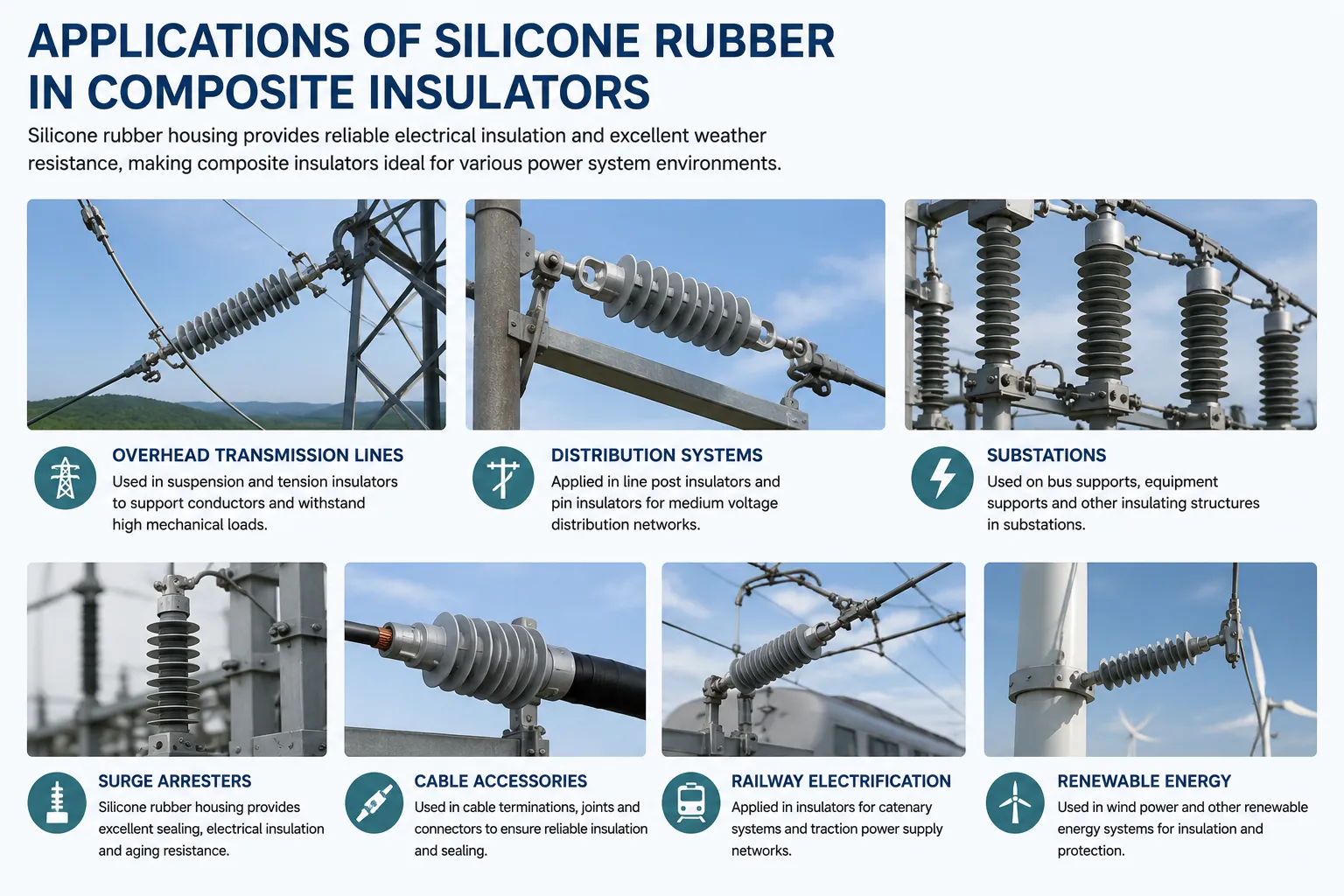
The first step is therefore to define the type of composite insulator. Suspension and tension insulators experience continuous tensile loading. Line-post insulators may experience bending and torsion. Hollow-core insulators have larger molded surfaces and different interface requirements. Surge-arrester housings may require different wall thicknesses and processing conditions.
The operating voltage must also be defined. Material selection for a distribution-class line post may differ from selection for an extra-high-voltage long-rod insulator. Higher electrical stress can increase the importance of housing thickness, shed geometry, electric-field control, interface quality and resistance to tracking and erosion.
Evaluate the Installation Environment
Environmental conditions strongly influence silicone rubber selection. Outdoor composite insulators may be exposed to ultraviolet radiation, ozone, rain, humidity, salt, industrial pollution, sand, temperature cycling and biological contamination.
Coastal environments can deposit conductive salt on the housing. Industrial locations may expose the insulator to cement dust, fly ash, chemicals or carbon-containing pollution. Desert areas combine ultraviolet radiation, heat, sand abrasion and large temperature changes. Tropical locations may involve persistent humidity and biological growth.
The same silicone rubber grade should not automatically be used for every location. The expected pollution severity, washing practices, maintenance interval, altitude and operating temperature should be included in the material specification.
| Service condition | Main material risk | Selection priority |
|---|---|---|
| Coastal salt pollution | Surface leakage current, dry-band arcing and erosion | Hydrophobicity transfer, tracking resistance and suitable shed design |
| Heavy industrial pollution | Conductive deposits and difficult-to-clean contamination | Tracking resistance, erosion resistance and long-term hydrophobic behavior |
| High ultraviolet exposure | Surface chalking, cracking and loss of mechanical strength | UV stability, pigment stability and weather-aging performance |
| Cold climate | Hardening, reduced flexibility and interface stress | Low-temperature flexibility and thermal-cycle resistance |
| High-temperature environment | Accelerated aging, softening and compression deformation | Heat-aging resistance and stable mechanical properties |
| Desert or dusty region | Abrasion, contamination accumulation and intense sunlight | Tear strength, weather resistance and appropriate shed profile |
| High altitude | Reduced air-insulation strength and increased electrical stress | Insulator dimensioning, creepage design and electric-field control |
Choose a Silicone Rubber Designed for High-Voltage Insulators
General-purpose silicone rubber should not be treated as equivalent to high-voltage insulation silicone. A suitable composite-insulator compound is normally formulated to provide weather resistance, hydrophobicity, electrical insulation and resistance to tracking and erosion.
The formulation commonly contains a silicone polymer, reinforcing silica, curing ingredients, pigments and mineral fillers. Alumina trihydrate or other functional fillers may be used to improve resistance to electrical erosion and heat generated by surface discharges.
Filler concentration must be balanced carefully. Functional fillers may improve electrical performance, but excessive loading can increase density, reduce elongation, change tear behavior and make processing more difficult. The finished formulation should therefore be evaluated as a complete compound rather than by the percentage of one ingredient.
The material should also be supplied with consistent formulation control. Changes in polymer, filler, catalyst, pigment or processing aid can affect cure behavior, hydrophobicity, mechanical properties and long-term aging.
Hydrophobicity Is Essential but Not Sufficient
Hydrophobicity is one of the main reasons silicone rubber is used for outdoor composite insulators. A hydrophobic surface causes water to form separate droplets rather than a continuous conductive film. This can reduce surface leakage current under wet and polluted conditions.
Outdoor silicone housings should also demonstrate hydrophobicity recovery. Electrical discharge, contamination or cleaning may temporarily reduce surface hydrophobicity. A suitable silicone formulation can gradually recover part of this behavior as low-molecular-weight silicone species migrate toward the surface.
Hydrophobicity transfer is another important characteristic. Silicone species can migrate into a contamination layer and make the pollution deposit less wettable. This behavior can improve polluted-condition performance, but it should not be used as a substitute for adequate creepage distance and appropriate shed design.
Material comparison should therefore consider initial hydrophobicity, recovery after stress and transfer through representative contamination. A single water-beading photograph does not provide enough information to predict long-term field performance.
Require Strong Tracking and Erosion Resistance
Tracking is the formation of a permanent conductive path across an insulating surface. Erosion is the gradual loss of housing material caused by heat, electrical discharge and chemical attack. Both processes can reduce insulation performance and eventually expose the fiberglass core.
Tracking and erosion become more likely when the insulator operates under a combination of voltage, moisture and conductive pollution. Leakage current can dry part of the wet surface and create dry-band arcing. Repeated arcing can carbonize or erode a poorly formulated polymer housing.
IEC 60587 inclined-plane testing is commonly used to compare insulating materials under severe accelerated conditions. The test is useful for material screening, but it does not reproduce every field condition. The complete insulator design still requires applicable design, type and pollution-performance evaluation.
Compare Mechanical Properties as a Group
Composite-insulator housings must survive demolding, handling, installation, transportation and long-term outdoor exposure. Mechanical properties should therefore be evaluated together.
Hardness affects shape retention, sealing pressure and resistance to handling damage. A harder compound may retain shed geometry well, but excessive hardness can reduce flexibility and make demolding difficult. A softer material may provide high elongation and easier deformation around complex interfaces, but it must still resist tearing and permanent deformation.
Tensile strength measures resistance to being pulled apart, while elongation indicates how much the material stretches before breaking. Tear strength is especially important around thin sheds, mold lines, sharp transitions and areas that may contain small surface defects.
High elongation alone does not guarantee good durability. A compound can stretch significantly but still have inadequate tear resistance. Similarly, high hardness does not prove that the material will resist erosion, weathering or interface separation.
| Propriedade | Why it matters | Common selection mistake |
|---|---|---|
| Shore A hardness | Affects flexibility, demolding, sealing and shape retention | Selecting the hardest available compound without evaluating processing |
| Tensile strength | Indicates resistance to bulk mechanical failure | Using tensile strength as the only mechanical requirement |
| Elongation at break | Shows the ability to deform before rupture | Assuming high elongation automatically means high tear resistance |
| Tear strength | Important for sheds, edges, mold seams and local damage | Ignoring the test-piece geometry and test method |
| Compression set | Relevant to seals and compressed interface regions | Testing only at room temperature |
| Heat aging | Shows whether properties remain stable after thermal exposure | Comparing only unaged material data |
Typical Data from High-Voltage Silicone Rubber Grades
The following table compares two commercial silicone rubber grades developed for high-voltage applications. One is a high-consistency molding compound and the other is a liquid silicone rubber. The values demonstrate that suitable insulator materials can have substantially different hardness and mechanical behavior.
| Typical property | HCR example | LSR example |
|---|---|---|
| Material type | High-consistency silicone molding compound | Two-component liquid silicone rubber |
| Typical application | Suspension insulators, line posts, surge arresters and terminators | Insulator housings, weather sheds, hollow-core insulators and cable accessories |
| Densidade | 1.57 g/cm³ | 1.11 g/cm³ |
| Shore A hardness | 72 | 40 |
| Tensile strength | 5.5 MPa | 9.0 MPa |
| Elongation at break | 250% | 770% |
| Tear strength | 16 N/mm | 40 N/mm |
| Volume resistivity | 1 × 10¹⁵ Ω·cm | 5 × 10¹⁵ Ω·cm |
| Dielectric strength | Not listed in the referenced data sheet | 25 kV/mm |
| Dielectric constant at 50 Hz | 3.6 | 2.7 |
| Dissipation factor at 50 Hz | 0.02 | 0.001 |
| IEC 60587 tracking result | Class 1A 4.5 | Class 1A 4.5 |
Data note: These are supplier-published typical values measured under specified laboratory conditions. They are comparison examples rather than universal acceptance limits. Production specifications should be agreed with the silicone supplier and verified on the selected grade.
Select HCR or LSR According to the Manufacturing Process
High-consistency rubber and liquid silicone rubber can both be used for composite-insulator housings. The better option depends on the insulator geometry, production volume, available equipment and required interface quality.
Borracha de silicone de alta consistência
High-consistency rubber, also called HCR or HTV silicone, has a firm gum-like form. It can be used in compression, transfer or specialized injection-molding processes. Pre-catalyzed grades may simplify production control, while other materials require controlled addition and mixing of the curing agent.
HCR compounds can provide high hardness and good dimensional stability. They may be appropriate for established molding processes and robust shed profiles. Manufacturers must control preform weight, mold filling, venting, cure temperature and demolding.
Borracha de silicone líquida
LSR is supplied as two pumpable components that are metered, mixed and injected into a heated mold. It can provide rapid molding, consistent mixing and good filling of detailed or large components.
LSR equipment requires accurate metering and protection against cure-inhibiting contamination. Mold sealing, venting and injection parameters must be controlled to avoid flash, trapped air and incomplete filling.
| Selection factor | HCR / HTV silicone | LSR silicone |
|---|---|---|
| Forma não curada | Firm, high-consistency compound | Líquido de dois componentes bombeável |
| Material feeding | Preforms, strips or specialized HCR feeding | Metering and mixing from containers |
| Flow behavior | Lower flow, dependent on pressure and preform preparation | High flow into detailed mold areas |
| Automation | Depends on the selected molding process | Well suited to automated injection molding |
| Contamination concern | Mixing consistency and catalyst distribution | Platinum-cure inhibition and mixing-ratio control |
| Best choice | Established HCR equipment and suitable insulator geometry | Controlled high-volume molding and complex shapes |
Do Not Separate the Material from the Shed Design
The silicone compound and the external profile work together. Increasing creepage distance without considering shed spacing, overhang, diameter and orientation may not improve performance as expected.
Closely spaced sheds can trap contamination and make natural washing more difficult. Very thin sheds may deform or tear during demolding and handling. Large overhangs increase mechanical stress at the shed root. The housing thickness over the fiberglass core must also be sufficient to protect the core and tolerate manufacturing variation.
For polluted environments, the required creepage distance and profile should be selected using site pollution severity, insulator orientation, altitude and material behavior. Hydrophobicity-transfer materials may permit different design considerations, but the decision should follow the applicable pollution-selection guidance and project requirements.
Electric-field distribution must also be reviewed. High field concentrations near end fittings can increase corona, housing erosion and interface aging. Grading rings, end-fitting geometry and housing design should be evaluated as part of the complete insulator system.
Check Adhesion to the Fiberglass Core
The interface between silicone rubber and the fiberglass-reinforced core is a critical part of the composite insulator. Poor adhesion can allow moisture to travel along the interface, leading to electrical discharge, loss of insulation performance and potential damage to the core.
Adhesion depends on the core surface, primer, silicone chemistry, molding temperature, contamination control and storage time between preparation and molding. The process should be validated using the actual core, primer and silicone combination rather than generic test plaques.
The housing should also seal reliably around the metal end fittings. Small gaps, trapped air or incomplete bonding near the fittings can become entry points for moisture. These areas may experience high electrical and mechanical stress, making process control especially important.
When evaluating a silicone supplier, ask whether the compound has been tested with the intended core resin, primer system and molding process. Changing the core supplier or surface preparation may require renewed interface qualification.
Review Electrical Properties in the Finished Design
Volume resistivity, dielectric strength, dielectric constant and dissipation factor help characterize the silicone compound. However, material data alone cannot determine the voltage capability of a complete composite insulator.
Dielectric breakdown is influenced by housing thickness, air voids, interfaces, electric-field concentration and contamination. A high dielectric-strength value measured on a uniform laboratory specimen does not compensate for a thin housing area or an internal molding defect.
The dielectric constant of the housing also interacts with the core, air and surrounding hardware. Differences between materials can affect electric-field distribution, particularly around end fittings and triple-interface regions.
Electrical properties should therefore be used for material screening and simulation inputs, followed by testing of the finished insulator design.
Control Pigment and Color Formulation
Grey silicone rubber is commonly used for outdoor composite insulators because it provides a neutral appearance and can help disguise surface contamination. Other colors can be produced, but the pigment system should be qualified as part of the complete compound.
Pigments can influence curing, ultraviolet stability, electrical resistance and tracking behavior. Adding an unapproved color paste at the factory can change the performance of an otherwise qualified silicone grade.
The preferred approach is to purchase a ready-to-use, pre-pigmented compound or use only pigment systems approved by the base-material supplier. Pigment concentration, mixing time and dispersion should be controlled in the production specification.
Verify Manufacturing Consistency
A technically suitable silicone rubber can still produce unreliable insulators when manufacturing is poorly controlled. Compound storage, mixing, mold temperature, injection pressure, cure time and contamination control all affect the finished housing.
Incoming inspection should confirm material identity, batch number, color, shelf life and certificate-of-analysis results. Storage temperature and container-sealing requirements should follow the supplier's instructions.
During molding, the manufacturer should monitor critical parameters and retain traceable production records. Significant variation in cure temperature or time can cause under-cure, excessive brittleness, surface defects or inconsistent adhesion.
Finished housings should be inspected for air bubbles, flow marks, incomplete filling, flash, tears, exposed core, surface contamination and poor sealing around end fittings.
| Process stage | Control item | Possible consequence if uncontrolled |
|---|---|---|
| Material storage | Temperature, shelf life and sealed packaging | Changed viscosity, contamination or unstable curing |
| Core preparation | Cleaning, abrasion, primer and handling time | Poor housing-to-core adhesion |
| Mixing or metering | Catalyst distribution or component ratio | Incomplete or nonuniform cure |
| Mold filling | Pressure, flow, venting and material quantity | Voids, short filling or excessive flash |
| Cura | Mold temperature and cure time | Under-cure, property variation or difficult demolding |
| Demolding | Tool condition and handling method | Torn sheds or surface damage |
| Final inspection | Surface, interfaces, dimensions and traceability | Defective insulators entering service |
Build a Qualification and Testing Plan
A purchase specification should distinguish between material tests and complete-insulator tests. Material testing confirms the silicone compound's basic properties, while complete-product testing evaluates interfaces, geometry, mechanical performance and electrical behavior.
The qualification plan should use the applicable product standard for the insulator type. Polymeric-insulator design testing should also address the housing material, core, interfaces and end-fitting connections.
| Reference | Main relevance | How it supports selection |
|---|---|---|
| IEC 62217:2025 | Common definitions, design tests and acceptance criteria for polymeric high-voltage insulators | Evaluates the polymer housing, core and important interfaces as part of a complete design |
| IEC 61109:2025 | Composite suspension and tension insulators for overhead lines | Provides product-specific testing and acceptance requirements |
| IEC 60587:2022 | Inclined-plane tracking and erosion testing of insulating materials | Supports comparison of housing compounds under accelerated severe conditions |
| IEC TS 60815-3:2025 | Selection and dimensioning of polymer insulators in polluted AC environments | Connects site pollution severity with creepage distance, profile and correction factors |
Additional tests may include hardness, tensile strength, elongation, tear strength, heat aging, ultraviolet exposure, flammability, dielectric properties, hydrophobicity, adhesion and production-process validation.
The required tests should be chosen according to the insulator design and service conditions. Passing one material test should not be presented as proof that the complete insulator satisfies every application requirement.
Questions to Ask a Silicone Rubber Supplier
- Is the compound specifically formulated for outdoor high-voltage insulators?
- Is it an HCR, HTV or LSR material, and which molding process is recommended?
- What are the typical hardness, tensile, elongation and tear values?
- What tracking and erosion test results are available?
- Does the material demonstrate hydrophobicity recovery and transfer?
- What dielectric properties are provided, and which test methods were used?
- Which pigments and primers are approved for use with the compound?
- Has the material been tested with the intended fiberglass core system?
- What cure temperature, cure time and post-cure conditions are required?
- What storage conditions and shelf life apply?
- Which batch test results appear on the certificate of analysis?
- What changes require notification or renewed qualification?
- Can the supplier support production trials and failure analysis?
Common Silicone Rubber Selection Mistakes
Choosing Only by Hardness
Hardness is easy to compare, but it does not describe hydrophobicity, erosion resistance, dielectric behavior, adhesion or weather aging. Two qualified insulator compounds can have very different hardness values.
Using General-Purpose Silicone
A material designed for seals, kitchen products or general molding may not contain the formulation required for high-voltage outdoor insulation.
Ignoring the Interface
Strong bulk silicone properties cannot prevent failure caused by poor adhesion to the fiberglass core or inadequate sealing around end fittings.
Copying a Creepage Distance Without Site Data
Pollution severity, altitude, orientation, shed profile and material behavior influence external insulation design. A value copied from a different project may be inappropriate.
Changing Pigment or Primer Without Testing
Color pastes and primers are part of the material system. Uncontrolled substitutions can affect curing, bonding and electrical performance.
Relying Only on Supplier Data
Technical data sheets provide useful screening information, but production trials and tests on the finished insulator are still necessary.
Choose the Complete Material and Process System
Choosing silicone rubber for a composite insulator is a system-engineering decision. The compound must provide hydrophobicity, tracking and erosion resistance, mechanical durability, dielectric performance and long-term weather stability.
The selected silicone must also match the molding process, fiberglass core, primer, end-fitting design, shed geometry and production controls. A material with impressive laboratory data can still fail if the interfaces or manufacturing process are not properly qualified.
The most reliable approach is to define the service environment, compare insulator-grade HCR and LSR materials, verify relevant test data, complete production trials and qualify the finished composite insulator under the applicable standards.