
Silicone Rubber in High-Voltage Applications
Silicone rubber has become an important insulating material in modern high-voltage systems because it combines electrical insulation, flexibility, weather resistance and long-term outdoor performance. Composite insulators, cable systems, electrical connectors and EV components, however, place much greater demands on an elastomer than ordinary molded products. Heat, moisture, pollution, corona, electrical stress and mechanical aging can act on the material at the same time. The real challenge is not whether the rubber performs well when it is new, but whether it can maintain the properties required after years of service.
Why High-Voltage Applications Are Difficult for Rubber Materials
High-voltage equipment rarely exposes an elastomer to only one type of stress. An outdoor insulator may experience rain, ultraviolet radiation, dust, salt contamination, temperature cycling and electrical discharge. Cable insulation may face continuous heat, bending and electrical fields. An EV connector seal can experience compression, vibration, elevated temperature and high voltage simultaneously.
This combination of conditions is what makes material selection difficult. A rubber can show excellent initial dielectric strength and still become unreliable if its surface loses water repellency, if leakage current begins to damage the surface, or if thermal aging causes the material to harden and crack.
Estresse elétrico
High electric fields, corona, leakage current and surface discharge.
Environmental Stress
Rain, humidity, pollution, salt, ultraviolet exposure and outdoor aging.
Estresse térmico
Continuous operating heat and repeated temperature cycling.
Tensão mecânica
Vibration, compression, bending, installation force and tearing.
For this reason, electrical-grade silicone must be treated as a complete engineering material rather than as a general-purpose elastomer that happens to have good insulation properties.
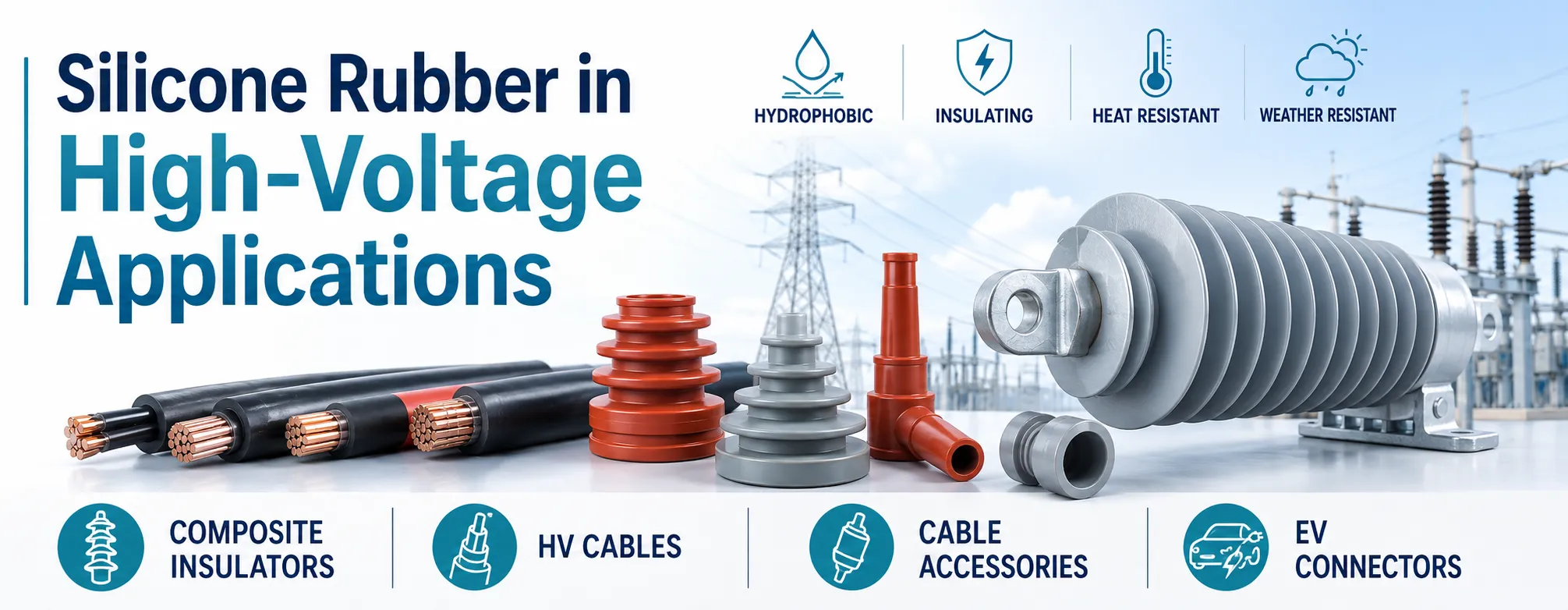
Why Silicone Rubber Is Used on Composite Insulators
Composite insulators are one of the most demanding outdoor applications for silicone rubber. The elastomeric housing protects the internal fiberglass rod while also forming the external insulating surface exposed directly to the environment.
One of silicone's most valuable characteristics in this application is its hydrophobic surface. When rain, fog or condensation reaches the insulator, water tends to remain as droplets instead of spreading immediately into a continuous film. This can help limit surface conductivity under contaminated wet conditions.
Silicone housings are also lightweight, flexible and resistant to many forms of outdoor aging. These properties make the material suitable for transmission and distribution equipment where long-term weather exposure and pollution performance are major concerns.
Why Hydrophobicity Matters
Surface hydrophobicity plays an important role in outdoor insulation because contamination becomes much more dangerous when it is wet. Dust, salt and industrial pollution can accumulate on an insulator surface. When moisture creates a continuous conductive film across this contamination, leakage current can increase significantly.
Local heating may then dry parts of the surface and create dry bands. Electrical stress across these dry regions can produce discharge activity, which gradually damages the material.
Silicone can also exhibit hydrophobic recovery. After pollution or electrical stress temporarily reduces surface water repellency, low-molecular-weight silicone species can migrate toward the surface and help restore hydrophobic behavior. The effectiveness and durability of this mechanism depend strongly on formulation quality and aging conditions.
Hydrophobicity should be evaluated as a long-term property.A material that looks strongly water-repellent when new may behave differently after years of corona exposure, contamination, heat and weather aging.
Tracking and Erosion Are Major Failure Risks
Tracking occurs when repeated electrical activity creates a conductive path along the surface of an insulating material. In outdoor service, contamination and moisture can produce surface leakage current, while repeated discharge gradually damages or carbonizes the insulation.
Erosion is related but physically different. Instead of forming only a conductive track, repeated discharge and localized heating remove material from the surface. The housing can become rough, pitted or locally thinner.
For a composite insulator, severe erosion is especially important because the silicone housing must continue protecting the internal fiberglass structure. Progressive material loss can eventually reduce both environmental protection and electrical reliability.
| Failure Mode | Typical Cause | Possible Result |
|---|---|---|
| Tracking | Repeated leakage current and surface discharge | A conductive path develops along the insulation surface |
| Erosion | Discharge activity and localized thermal damage | Progressive loss of housing material |
| Perda de hidrofobicidade | Electrical stress, contamination and weather aging | Greater surface wetting and increased leakage current |
| Rachaduras | Thermal, mechanical or environmental aging | Reduced protection against moisture and contamination |
Why the Compound Formulation Matters
High-voltage performance is not determined by the silicone polymer alone. The finished compound contains reinforcing fillers, functional additives, stabilizers, pigments and a curing system, all of which influence the way the material behaves during processing and service.
In composite-insulator formulations, the filler system can strongly influence resistance to tracking and erosion. At the same time, filler loading also changes viscosity, hardness, elongation, tensile strength and molding behavior. Increasing one property without considering the others can create a material that performs well in a laboratory test but is difficult to process or mechanically unbalanced.
The same principle applies to curing. Crosslink density must provide sufficient strength and dimensional stability without making the material excessively hard or reducing elongation beyond the requirements of the finished component.
Polímero de silicone
Provides the elastomeric siloxane backbone and basic thermal behavior.
Sílica de reforço
Supports tensile strength, tear strength and overall compound structure.
Functional Fillers
Can be used to improve electrical and thermal performance in demanding formulations.
Sistema de cura
Controls crosslink formation, dimensional stability and mechanical recovery.
Silicone Rubber in High-Voltage Cable Applications
High-voltage cables create a different set of problems from outdoor insulators. Cable materials must provide reliable electrical insulation while remaining flexible enough for extrusion, installation and long-term movement.
Silicone is useful in specialized cable systems because it can retain flexibility across a broad temperature range while offering good dielectric properties. It can be used in high-temperature wiring, insulating components, cable accessories and other products where electrical and thermal performance must work together.
Heat aging is especially important. Conductors generate heat during operation, and the surrounding insulation may experience elevated temperature continuously for years. A compound that gradually becomes hard and brittle may eventually crack during movement, vibration or maintenance.
What Causes Silicone Cable Insulation to Fail?
Cable insulation failure is rarely caused by one property alone. Excessive temperature can reduce elongation over time, while poor tear resistance can allow damage to spread from a small cut or processing defect. Repeated bending may accelerate cracking once the material has hardened through aging.
Processing consistency is equally important. Uneven extrusion, contamination, trapped air or dimensional variation can create weak points in the insulating layer. At high voltage, small imperfections matter because electric fields can become concentrated around defects.
| Problema | O que acontece | Important Material Requirement |
|---|---|---|
| Thermal Aging | Hardness may increase while elongation decreases | Stable property retention after heat exposure |
| Rachaduras | Insulation opens during bending, vibration or installation | Good elongation and tear resistance |
| Dielectric Breakdown | The insulation can no longer withstand the applied electrical field | Controlled dielectric performance and material cleanliness |
| Extrusion Defects | Weak zones or dimensional irregularities appear | Stable compound processing and extrusion behavior |
A good cable compound therefore needs both reliable electrical properties and predictable processing behavior.
Which Electrical Properties Matter Most?
Describing silicone simply as an electrical insulator does not provide enough information for high-voltage design. Several properties need to be considered together because they describe different parts of the material's electrical behavior.
Volume resistivity indicates how strongly the bulk material resists electrical current. Dielectric strength helps describe resistance to electrical breakdown under defined test conditions. Dielectric constant influences electric-field distribution, while tracking and erosion resistance become particularly important when insulation is exposed to moisture and contamination.
| Electrical Property | Por que isso é importante |
|---|---|
| Resistividade volumétrica | Indicates resistance to current flowing through the bulk material |
| Rigidez dielétrica | Helps evaluate resistance to electrical breakdown |
| Constante dielétrica | Influences electrical-field distribution in insulation design |
| Acompanhamento da resistência | Important when contaminated surfaces are exposed to moisture and voltage |
| Resistência à erosão | Helps the housing withstand repeated surface discharge |
None of these properties should be considered alone. The material still needs enough tear strength, tensile strength, elongation and thermal stability to survive manufacturing, installation and service.
Thermal Aging Changes Electrical Reliability
High-voltage insulation does not operate permanently at room temperature. Cables, connectors and electrical equipment can remain warm or hot throughout much of their operating life.
As silicone ages, hardness, elongation and tensile behavior can change. Excessive thermal exposure can eventually lead to embrittlement or cracking. Mechanical damage can then become an electrical problem because moisture and contamination may enter regions that were previously protected.
For this reason, a short peak-temperature test does not fully describe long-term performance. Engineers need to know how well the compound retains the properties that matter after prolonged thermal aging.
Borracha de silicone em sistemas de alta tensão de veículos elétricos
Electric vehicles add another demanding set of operating conditions. High-voltage connectors, charging components and cable systems combine electrical stress with temperature cycling, vibration, sealing requirements and repeated assembly loads.
Connector seals may need to keep moisture away from conductive interfaces while remaining compressed for long periods. Cable components must retain flexibility close to heat-generating equipment. Battery-related assemblies may expand and contract repeatedly as operating temperature changes.
Shore hardness therefore becomes a design parameter rather than a simple material specification. A seal that is too hard can require excessive installation force, while a compound that is too soft may not provide sufficient dimensional support. Tear resistance also matters because complex connector geometries often contain thin lips and narrow sealing features.
What Usually Fails First on a Composite Insulator?
There is no universal failure sequence because climate, pollution level, voltage stress and design all differ. In many cases, however, surface deterioration appears well before catastrophic electrical failure.
Reduced hydrophobicity, local discharge activity, small erosion marks or surface roughness can indicate that the housing is experiencing increasing electrical and environmental stress. Continued exposure may eventually lead to deeper erosion, tracking or cracking.
The interface between the silicone housing, fiberglass rod and end fittings is also critical. Moisture penetration into a poorly protected interface can create a more serious reliability problem than superficial discoloration on the external housing.
Wet Pollution
Moisture increases conductivity across a contaminated surface.
→
Leakage Current
Current flows along the external insulation surface.
→
Dry-Band Discharge
Localized drying creates regions of concentrated electrical stress.
→
Danos superficiais
Repeated activity can lead to tracking and erosion.
Electrical Performance Alone Is Not Enough
A compound can have excellent electrical test values and still be unsuitable if its mechanical properties are weak. Housing materials and cable components must survive molding, handling, installation, vibration and long-term deformation.
Tear strength is especially important for complex molded products because shed edges, connector seals and thin sections can concentrate stress. Tensile strength and elongation influence how much deformation the material can tolerate before failure, while hardness affects assembly force and dimensional support.
Permanent deformation can also affect electrical systems indirectly. A seal that no longer recovers after long-term compression may lose contact pressure, allowing moisture to enter an electrical connector even though the rubber itself remains electrically insulating.
How to Choose Silicone Rubber for High-Voltage Use
Material selection should begin with the actual risks faced by the component rather than with one specification on a datasheet. Outdoor insulators are strongly affected by pollution, moisture, corona and weather aging. Cable materials must balance dielectric performance with heat aging, flexibility and stable extrusion. EV connectors add compression, tear resistance and temperature cycling.
Choosing only by hardness or tensile strength is therefore not enough. Voltage level, operating temperature, environment, geometry, processing method and expected service life should all be considered before the compound is selected.
| Inscrição | Main Concerns | Important Material Characteristics |
|---|---|---|
| Isolador composto | Pollution, rain, corona, tracking and erosion | Hydrophobic behavior, tracking resistance, erosion resistance and mechanical durability |
| Cabo de alta tensão | Heat aging, bending and electrical stress | Dielectric performance, elongation, thermal stability and extrusion consistency |
| Cable Accessory | Installation stress and dimensional stability | Elastic recovery, tear resistance and stable mechanical properties |
| EV Connector | Heat cycling, sealing, vibration and electrical insulation | Compression behavior, tear resistance and dielectric performance |
| Outdoor Electrical Component | UV, weather, moisture and long-term aging | Environmental resistance, insulation and mechanical stability |
Electrical Silicone Rubber from Yakows
Yakows provides silicone compounds for demanding electrical applications, including materials used in composite insulators, cable systems, molded insulation components and EV high-voltage assemblies.
Material development requires a balance between electrical, mechanical and processing performance. Depending on the final application, the important parameters may include dielectric strength, volume resistivity, tracking and erosion resistance, hardness, tensile strength, elongation, tear strength and heat-aging performance.
Processing behavior is also part of the material design. Compounds used in insulator housings, cable components or molded electrical parts need predictable molding or extrusion performance so that finished products remain consistent from batch to batch.
Perguntas frequentes
Why is silicone rubber used in high-voltage applications?
It combines electrical insulation, flexibility, thermal stability, weather resistance and useful surface hydrophobicity, making it suitable for many outdoor and enclosed electrical systems.
Why is silicone rubber used for composite insulators?
Its hydrophobic surface helps limit continuous water films on contaminated surfaces, while its low weight and weather resistance are useful for long-term outdoor insulation.
What is electrical tracking?
Tracking is the progressive formation of a conductive path along the surface of an insulating material due to repeated leakage current and discharge activity.
What is erosion on a silicone insulator?
Erosion is physical loss or damage of the housing material caused by repeated electrical discharge, local heating and severe environmental stress.
Can silicone lose hydrophobicity?
Yes. Pollution, corona and aging can reduce surface water repellency. Suitable formulations may recover part of this behavior over time, depending on service conditions.
Is silicone electrically insulating?
Standard electrical-grade compounds are highly insulating, although specialized conductive and semiconductive silicone formulations can also be produced.
Can silicone be used in high-voltage cables?
Yes. Suitable grades are used where flexibility, temperature resistance and electrical insulation are required together.
Why can cable insulation crack after aging?
Long-term thermal exposure can increase hardness and reduce elongation. Bending or vibration can then make aged material more susceptible to cracking.
Which properties are important for composite insulator housing?
Important considerations include hydrophobic behavior, tracking and erosion resistance, tear strength, elongation, weather resistance and stable molding performance.
What should be considered for EV connector seals?
Electrical insulation needs to be combined with appropriate hardness, compression recovery, tear resistance, thermal aging and sealing performance.