
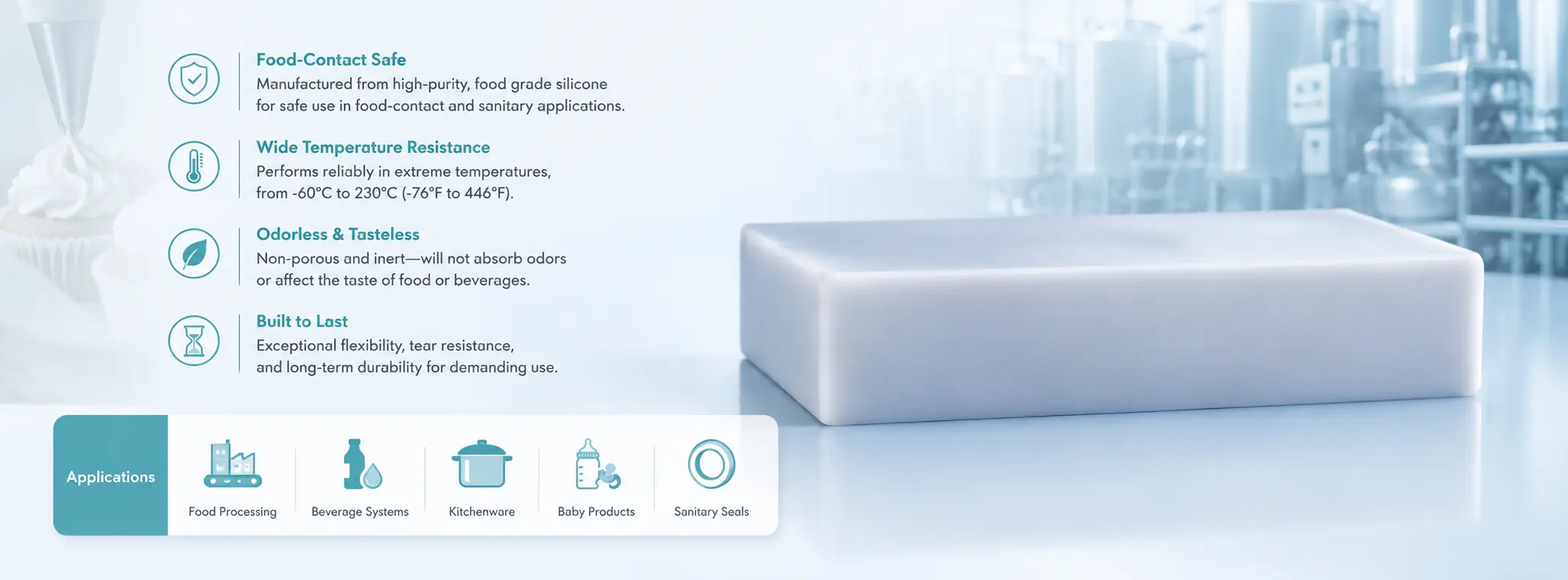
Food Grade Silicone vs Ordinary Silicone
Пищевой силикон is often considered more reliable than ordinary silicone in applications that require safety, cleanliness, temperature resistance, and long-term material stability. However, whether food grade silicone is more durable depends on the formulation, curing process, hardness, operating temperature, chemical exposure, mechanical stress, and application environment. In general, high-quality food grade silicone offers better purity, stronger compliance, excellent aging resistance, and more stable performance in food-contact and sanitary applications.
Understanding Food Grade Silicone
Food grade silicone is a type of silicone rubber designed for direct or indirect contact with food, beverages, drinking water, pharmaceutical products, and other sensitive materials. It is commonly used in seals, gaskets, tubing, hoses, baking mats, kitchenware, bottle nipples, food processing equipment, beverage dispensing systems, and sanitary components.
The main difference between food grade silicone and ordinary silicone is not only the appearance or softness of the material. Food grade silicone must be manufactured with carefully selected raw materials and controlled production processes to reduce harmful impurities, odor, taste transfer, and contamination risks. It is expected to maintain stable performance while meeting strict safety and hygiene requirements.
Ordinary silicone, on the other hand, is a broader category. It may be used for industrial sealing, insulation, waterproofing, cushioning, construction, automotive parts, electrical components, and general-purpose applications. Some ordinary silicone materials can be very durable, but they may not be suitable for food-contact use because their additives, pigments, fillers, or curing residues may not meet food safety requirements.
Is Food Grade Silicone More Durable?
Food grade silicone can be more durable than ordinary silicone in specific environments, especially when the application involves repeated washing, high temperature, steam, food oils, weak acids, moisture, and hygienic cleaning. Its durability comes from stable silicone polymer structure, good thermal resistance, flexibility, and resistance to aging. High-quality food grade silicone can remain elastic and functional over a long period when used within its designed operating conditions.
However, food grade silicone is not automatically stronger in every situation. Some industrial-grade silicone materials are specially formulated for high tear strength, extreme temperature, flame resistance, electrical insulation, or chemical resistance. In those specific industrial applications, an ordinary or technical-grade silicone may outperform a standard food grade silicone. Therefore, durability should be evaluated based on the actual working conditions rather than material name alone.
For food processing, kitchenware, beverage systems, baby products, and sanitary sealing applications, food grade silicone is usually the better choice because it combines durability with safety. It resists hardening, cracking, deformation, and odor retention better than many lower-quality general-purpose silicone products.
Main Advantages of Food Grade Silicone
High Safety for Food Contact
The most important advantage of food grade silicone is its suitability for food-contact applications. It is designed to minimize contamination risk and maintain stable contact with food, beverages, and drinking water. This makes it suitable for food processing machinery, kitchen tools, sealing rings, beverage hoses, coffee machine parts, and other products that must remain clean and safe during repeated use.
In food and beverage industries, material safety is just as important as mechanical performance. A gasket or hose may appear durable, but if it releases unwanted odor, taste, or unsafe substances into the product, it is not suitable for the application. Food grade silicone is selected because it supports both functional performance and sanitary requirements.
Excellent Temperature Resistance
Food grade silicone has excellent temperature resistance compared with many plastics and rubber materials. It can remain flexible in low-temperature environments and stable under high-temperature conditions. This makes it suitable for baking, steaming, sterilization, refrigeration, freezing, hot water systems, and food processing lines with frequent temperature changes.
Temperature resistance is one of the reasons food grade silicone is commonly used in bakeware, oven seals, steam equipment, high-temperature gaskets, and hot beverage systems. Unlike some plastics, silicone does not easily melt or deform under moderate high-temperature conditions. It also maintains elasticity better than many conventional rubber materials after repeated heating and cooling cycles.
Good Aging and Weather Resistance
Food grade silicone offers good resistance to aging, ozone, ultraviolet exposure, and environmental stress. It does not easily become brittle under normal use. This is important for seals, mats, tubing, and flexible components that need to maintain elasticity over time.
Ordinary low-grade silicone may lose flexibility, discolor, or develop surface cracking when exposed to heat, oxygen, cleaning agents, or outdoor conditions for a long period. High-quality food grade silicone is usually more stable because it is produced with stricter material control and fewer unwanted impurities.
Flexibility and Elastic Recovery
Food grade silicone is valued for its flexibility and elastic recovery. It can be compressed, bent, stretched, or folded repeatedly while returning close to its original shape. This property is important for sealing rings, bottle parts, flexible hoses, kitchen tools, and food machine components.
Good elastic recovery helps maintain sealing performance. For example, a food grade silicone gasket used in a beverage machine must resist compression set, meaning it should not become permanently flattened too quickly. A high-quality silicone gasket can maintain sealing pressure and reduce leakage risk after repeated use.
Odorless and Tasteless Performance
In food-contact applications, odor and taste transfer are major concerns. Food grade silicone is designed to be odorless, tasteless, and stable when used correctly. This is especially important for baby products, drinking water systems, coffee machines, beverage equipment, and food storage products.
Some ordinary silicone products may have a strong smell due to curing residues, additives, or lower-quality raw materials. Even if the material looks similar, it may not be acceptable for food-contact use. Food grade silicone is preferred when the final product must not affect the taste or smell of food and beverages.
Food Grade Silicone vs Ordinary Silicone
Food grade silicone and ordinary silicone may look similar, but they can differ greatly in purity, safety, durability, and application suitability. The following table provides a practical comparison.
| Comparison Item | Пищевой силикон | Ordinary Silicone |
|---|---|---|
| Material Safety | Designed for food-contact, beverage, drinking water, and sanitary applications. | May be suitable for general industrial or household use, but not always safe for food contact. |
| Purity | Produced with stricter control of raw materials, additives, pigments, and curing residues. | Purity varies widely depending on grade, manufacturer, and intended application. |
| Durability | Usually offers strong aging resistance, temperature stability, and long-term flexibility in sanitary environments. | Can be durable in general use, but performance depends heavily on formulation and quality level. |
| Temperature Resistance | Suitable for repeated heating, cooling, steaming, baking, and cleaning cycles when properly specified. | May resist temperature well, but some lower-grade products can deform, harden, or degrade faster. |
| Odor and Taste | Generally odorless and tasteless after proper curing and post-treatment. | May have odor or transfer unwanted smell depending on raw materials and curing process. |
| Typical Applications | Food processing equipment, kitchenware, baby products, beverage tubing, sanitary seals, baking products. | Construction sealing, industrial parts, electrical insulation, automotive components, general waterproofing. |
Why Durability Depends on Formulation
Silicone durability is strongly affected by formulation. Two silicone products may both be called food grade, but their performance can still differ. Important factors include base polymer quality, filler type, curing system, hardness, tensile strength, tear resistance, compression set, pigment stability, and post-curing process.
A high-quality food grade silicone product usually has better consistency, fewer impurities, and more stable mechanical properties. It may resist cracking, deformation, odor formation, and discoloration better than a low-cost general-purpose silicone. However, a special industrial silicone designed for extreme mechanical stress may still have higher tear strength or abrasion resistance than a standard food grade product.
Therefore, it is more accurate to say that food grade silicone is often more reliable for sanitary and food-contact applications, while ordinary silicone may be suitable for non-food applications where safety certification is not required.
Common Types of Food Grade Silicone Products
Food Grade Silicone Gaskets
Food grade silicone gaskets are used to create seals in food processing machines, beverage equipment, storage tanks, pumps, valves, and pipelines. They must maintain elasticity, resist compression set, and prevent leakage during repeated cleaning and operating cycles.
Food Grade Silicone Tubing
Food grade silicone tubing is widely used for transferring liquids, air, beverages, dairy products, purified water, and other sensitive media. It is flexible, transparent or translucent in many designs, and suitable for systems that require cleanliness and easy inspection.
Food Grade Silicone Hose
Silicone hoses are used in beverage dispensing, food processing, pharmaceutical systems, and sanitary transfer lines. Reinforced silicone hoses may be selected when higher pressure resistance or stronger mechanical durability is required.
Food Grade Silicone Kitchenware
Kitchen products made from food grade silicone include baking molds, spatulas, sealing lids, ice trays, storage containers, and cooking accessories. These products benefit from silicone’s flexibility, heat resistance, non-stick surface, and easy cleaning.
Food Grade Silicone Seals for Valves
Food grade silicone seals are also used in sanitary valves and food-contact equipment. They help maintain clean sealing performance in systems that handle beverages, dairy products, sauces, purified water, and other sensitive materials.
Key Performance Factors to Evaluate
Hardness
Silicone hardness is commonly measured by Shore A. Softer silicone provides better flexibility and sealing against uneven surfaces, while harder silicone may offer better dimensional stability and pressure resistance. The correct hardness depends on the application.
Tensile Strength
Tensile strength indicates how much pulling force the material can withstand before breaking. For tubing, hoses, flexible parts, and molded components, tensile strength is an important durability factor.
Tear Resistance
Tear resistance is important for products that may be stretched, pulled, folded, or installed under stress. A silicone part with poor tear resistance may fail during assembly or repeated use.
Compression Set
Compression set measures how well silicone recovers after being compressed for a long time. For gaskets, seals, and O-rings, low compression set is critical because the part must maintain sealing force after repeated compression.
Chemical Compatibility
Food grade silicone has good resistance to water, air, many food products, and mild cleaning agents. However, it is not compatible with every chemical. Oils, solvents, strong acids, strong alkalis, or aggressive cleaning chemicals may affect performance depending on concentration, temperature, and exposure time.
When Food Grade Silicone Is the Better Choice
Food grade silicone is the better choice when the product or component will contact food, beverages, drinking water, baby products, medical-related items, or sanitary processing equipment. In these cases, safety and cleanliness are essential. Ordinary silicone should not be used unless it is clearly confirmed to meet the required food-contact standards.
Food grade silicone is also preferred when the application involves repeated heating and cooling, frequent washing, steam cleaning, or long-term contact with moisture. It is commonly selected for food factories, beverage plants, dairy production, home kitchen products, coffee machines, water dispensers, and sanitary valve systems.
When Ordinary Silicone May Be Enough
Ordinary silicone may be sufficient for non-food applications such as general sealing, waterproofing, cushioning, insulation, automotive parts, construction joints, electronic protection, and industrial dust covers. If the material does not contact food or sensitive media, food grade certification may not be necessary.
In some technical applications, ordinary industrial silicone may even be specially engineered for higher flame resistance, electrical insulation, abrasion resistance, or mechanical strength. For this reason, the correct material should always be selected according to application requirements rather than assuming that food grade silicone is always the strongest option.
How to Choose the Right Silicone Material
Choosing the right silicone material requires careful evaluation of use conditions. The first question is whether the silicone will contact food, beverages, drinking water, skin, or sensitive products. If the answer is yes, food grade silicone should be selected.
The second question is the operating environment. Temperature, pressure, cleaning method, chemical exposure, mechanical stress, and service life expectations all affect material selection. A food grade silicone gasket used in a hot beverage machine will have different requirements from a silicone baking mold or a sanitary hose in a food factory.
The third question is performance data. Buyers should review hardness, tensile strength, elongation, tear resistance, compression set, temperature range, color stability, odor level, and compliance documents. Reliable suppliers should be able to provide material specifications and relevant test information.
Maintenance and Use Tips
To extend the service life of food grade silicone products, they should be used within the recommended temperature and chemical exposure range. Avoid sharp tools, excessive stretching, strong solvents, and unsuitable cleaning chemicals. For gaskets and seals, proper installation is important to prevent cutting, twisting, or uneven compression.
Food grade silicone parts should be cleaned regularly according to the application. In food processing systems, cleaning procedures should be designed to remove residue without damaging the material. If the silicone becomes sticky, cracked, strongly discolored, hardened, swollen, or permanently deformed, it should be replaced.
Conclusion
Food grade silicone is generally more reliable than ordinary silicone for food-contact, sanitary, high-cleanliness, and repeated-use applications. It offers excellent safety, temperature resistance, flexibility, aging resistance, odorless performance, and long-term stability when properly selected and used.
However, food grade silicone is not automatically more durable in every possible environment. Some industrial silicone materials are formulated for special mechanical, electrical, or chemical requirements. The best choice depends on the actual application, safety requirements, working temperature, chemical exposure, mechanical stress, and expected service life.
In short, food grade silicone is the better choice when safety, cleanliness, and stable long-term performance are required. For food processing, beverage systems, kitchenware, baby products, sanitary seals, and clean equipment, it provides a strong balance of durability and material safety. For non-food industrial applications, ordinary silicone may still be suitable if it meets the required performance standards.