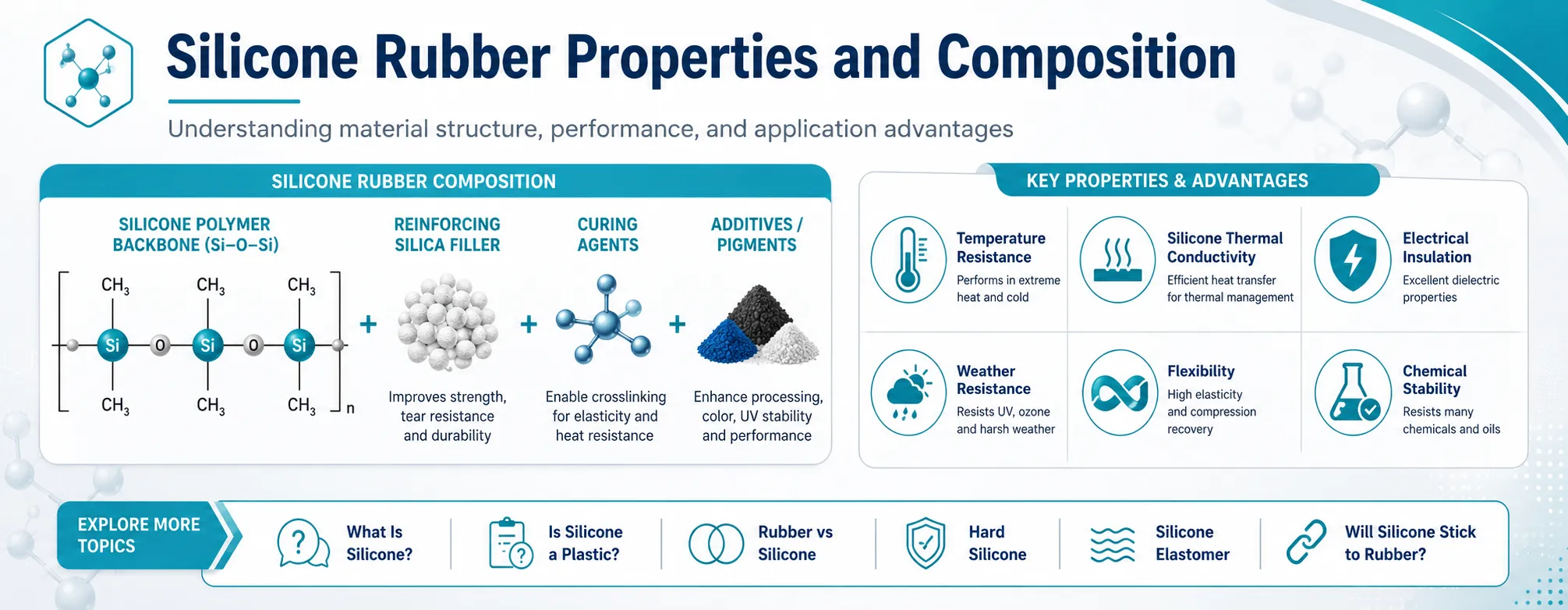
Tính chất và thành phần của cao su silicone
Cao su silicone là một loại chất đàn hồi tổng hợp đa năng, được biết đến với tính linh hoạt, khả năng chịu nhiệt, tính cách điện và độ ổn định môi trường lâu dài. Việc hiểu rõ các tính chất và thành phần của cao su silicone sẽ giúp các kỹ sư, nhà sản xuất và người mua lựa chọn vật liệu phù hợp cho các sản phẩm như gioăng, miếng đệm, vật liệu cách điện, linh kiện y tế, linh kiện công nghiệp và sản phẩm tiêu dùng.
Silicone là gì?
Nhiều người mua bắt đầu tìm hiểu bằng cách đặt câu hỏi: “Silicone là gì?”. Silicone là một nhóm các vật liệu tổng hợp được cấu tạo từ các nguyên tử silic và oxy lặp lại. Các nhóm hữu cơ được gắn vào chuỗi chính silic-oxy này để điều chỉnh độ linh hoạt, quá trình đóng rắn, khả năng chống hóa chất và tính năng cơ học.
Silicone không phải là một loại vật liệu duy nhất. Thuật ngữ này bao gồm các chất lỏng silicone, nhựa silicone, gel silicone, chất bịt kín và chất đàn hồi. Cao su silicone là dạng đàn hồi của silicone, đã được liên kết chéo để tạo thành một mạng lưới polymer ba chiều linh hoạt.
Cấu trúc phân tử này mang lại cho cao su silicone một tổ hợp các tính chất mà nhiều loại cao su hữu cơ thông thường khó có thể đạt được. Loại cao su này vẫn giữ được độ dẻo dai trong một dải nhiệt độ rộng, có khả năng chống lại tác động của ánh sáng mặt trời và ôzôn, đồng thời đảm bảo khả năng cách điện đáng tin cậy.
Cao su silicone được ứng dụng rộng rãi trong các hệ thống ô tô, thiết bị điện, thiết bị y tế, máy móc chế biến thực phẩm, sản phẩm chiếu sáng, thiết bị gia dụng, gioăng công nghiệp và các bộ phận xây dựng.
Cao su silicone – Giải thích một cách đơn giản
Cao su silicone là một loại vật liệu tổng hợp dẻo dai, được sản xuất từ các polyme silicone, chất độn gia cường và chất xúc tác đóng rắn. Hiệu suất của nó có thể được điều chỉnh thông qua công thức, độ cứng, các chất phụ gia và phương pháp gia công.
Công thức cao su silicone
Thành phần của cao su silicone quyết định độ bền, độ cứng, màu sắc, tính chất nhiệt và khả năng chống lại tác động của môi trường của nó. Một hỗn hợp điển hình bao gồm polymer silicone cơ bản, chất độn gia cường, hệ thống đóng rắn và các chất phụ gia cải thiện tính năng.
Polyme silicone
Thành phần chính là một loại polymer silicon, thường có gốc là polydimethylsiloxane. Cấu trúc xương sống silicon-oxygen của nó mang lại tính linh hoạt và độ ổn định nhiệt, trong khi các nhóm hữu cơ gắn liền ảnh hưởng đến tính tương thích và tính chất gia công.
Các loại polymer đặc biệt có thể được sử dụng khi vật liệu cần có độ dẻo dai ở nhiệt độ thấp, khả năng chống dầu, khả năng chống cháy hoặc tính chất hóa học được cải thiện. Ví dụ, fluorosilicone được sử dụng trong những trường hợp mà khả năng chống lại nhiên liệu và một số loại dầu là yếu tố quan trọng.
Chất độn gia cường
Polyme silicon chưa qua xử lý thường có độ bền quá thấp để ứng dụng trong hầu hết các lĩnh vực kỹ thuật. Các chất độn gia cường, đặc biệt là silica, được bổ sung để cải thiện độ bền kéo, khả năng chống rách và độ ổn định kích thước.
Lượng và loại chất độn ảnh hưởng đến độ nhớt, độ cứng, độ giãn dài và độ nhẵn bề mặt. Các hợp chất có hàm lượng chất độn cao có độ bền cao hơn, trong khi các công thức mềm hơn có thể chứa lượng chất độn thấp hơn hoặc các chất phụ gia gia công bổ sung.
Chất làm đông cứng
Chất đóng rắn tạo ra các liên kết chéo giữa các chuỗi polymer và biến hỗn hợp chưa đóng rắn thành một loại cao su silicone bền bỉ. Các hệ thống đóng rắn phổ biến bao gồm đóng rắn bằng peroxit, đóng rắn bằng phản ứng cộng với bạch kim và đóng rắn bằng độ ẩm.
Silicone đóng rắn bằng peroxide được sử dụng rộng rãi trong đúc và đùn công nghiệp. Các vật liệu đóng rắn bằng bạch kim thường được ưa chuộng trong các ứng dụng yêu cầu mùi nhẹ, độ sạch cao và hiệu suất được kiểm soát. Silicone đóng rắn bằng độ ẩm thường được cung cấp dưới dạng chất trám kín ở nhiệt độ phòng.
Chất màu và phụ gia cải thiện tính năng
Chất màu có thể mang lại các đặc tính nhận dạng, ngoại quan hoặc kiểm soát ánh sáng. Các chất phụ gia khác có thể giúp cải thiện khả năng chống cháy, độ dẫn điện, độ dẫn nhiệt, độ biến dạng nén, tính chất gia công hoặc khả năng chống lại các hóa chất cụ thể.
Do cao su silicone có thể được pha chế theo nhiều cách khác nhau, nên hai sản phẩm trông giống nhau có thể lại có hiệu suất hoàn toàn khác biệt. Do đó, thông số kỹ thuật của vật liệu không chỉ nên bao gồm màu sắc và độ cứng.
Tính chất vật liệu của silicone
Các tính chất vật liệu của silicone khiến nó phù hợp cho cả các sản phẩm dùng hàng ngày lẫn các hệ thống công nghiệp có yêu cầu khắt khe. Hiệu suất cụ thể phụ thuộc vào công thức, hệ thống đóng rắn, độ cứng và môi trường sử dụng.
Khả năng chịu nhiệt
Cao su silicone vẫn giữ được độ dẻo dai ở nhiệt độ thấp và có thể hoạt động ở nhiệt độ cao – nơi mà nhiều loại chất đàn hồi truyền thống bị cứng lại hoặc bị phân hủy.
Khả năng chống chịu thời tiết
Sản phẩm này có khả năng chống lại ánh nắng mặt trời, ozone và quá trình lão hóa ngoài trời rất tốt, nhờ đó rất hữu ích cho các bộ phận làm kín tiếp xúc trực tiếp với môi trường bên ngoài, các linh kiện điện và các sản phẩm xây dựng.
Cách điện
Cao su silicone mang lại hiệu suất điện môi đáng tin cậy và được sử dụng rộng rãi trong cáp, đầu nối, vật liệu cách điện, bàn phím và vỏ thiết bị điện tử.
Tính linh hoạt
Ngay cả sau nhiều lần biến dạng, silicone được pha chế đúng cách vẫn có thể phục hồi hình dạng ban đầu và duy trì khả năng kín khít.
Tính ổn định hóa học
Silicone có khả năng chống nước, hóa chất loãng và nhiều chất gây ô nhiễm môi trường rất tốt, mặc dù cần phải kiểm tra tính tương thích với dầu, nhiên liệu và dung môi.
Độ biến dạng vĩnh viễn thấp
Các hợp chất silicone đặc biệt có thể duy trì lực làm kín sau thời gian dài chịu lực nén, điều này rất quan trọng đối với các miếng đệm và các bộ phận làm kín tĩnh.
Độ bền cơ học
Cao su silicone tiêu chuẩn không phải lúc nào cũng có khả năng chống mài mòn tương đương với cao su tự nhiên, polyurethane hoặc một số loại chất đàn hồi chuyên dụng. Tuy nhiên, các công thức gia cường và có độ bền xé cao có thể mang lại hiệu suất cơ học vượt trội cho các chi tiết đúc, ống dẫn và gioăng.
Độ bền kéo, độ bền xé và độ giãn dài có sự chênh lệch rất lớn. Một sản phẩm được thiết kế cho bàn phím mềm có thể có các tính chất cơ học hoàn toàn khác biệt so với một miếng đệm công nghiệp được gia cố.
Độ bền môi trường
Cao su silicone đặc biệt hữu ích trong các ứng dụng phải chịu tác động của thời tiết ngoài trời, sự thay đổi nhiệt độ lặp đi lặp lại hoặc các khoảng thời gian bảo dưỡng kéo dài. Loại vật liệu này không phụ thuộc vào chất làm dẻo như một số loại nhựa dẻo khác, do đó có thể duy trì độ dẻo dai trong thời gian dài.
Tính chất nhiệt của cao su silicone
Điểm nóng chảy của silicone
Cụm từ tìm kiếm “điểm nóng chảy của silicone” có thể gây hiểu lầm vì cao su silicone đã đóng rắn thường không nóng chảy như nhựa nhiệt dẻo. Đây là vật liệu có cấu trúc liên kết chéo, do đó khi tiếp xúc với nhiệt độ cực cao, nó có xu hướng mềm ra, mất độ bền cơ học hoặc phân hủy thay vì chảy thành chất lỏng.
Nhiệt độ sử dụng tối đa phụ thuộc vào công thức, thời gian tiếp xúc, áp suất và môi trường xung quanh. Cao su silicone tiêu chuẩn thường được lựa chọn cho các ứng dụng ở nhiệt độ cao, trong khi các loại cao su silicone chuyên dụng được phát triển để đáp ứng các điều kiện nhiệt độ khắc nghiệt hơn.
Khả năng chịu nhiệt trong thời gian ngắn có thể cao hơn giới hạn hoạt động liên tục được khuyến nghị. Để đảm bảo thiết kế đáng tin cậy, các kỹ sư nên sử dụng dữ liệu về hoạt động liên tục do nhà cung cấp công bố thay vì chỉ dựa vào một con số duy nhất về điểm nóng chảy.
Độ dẫn nhiệt của silicone
Độ dẫn nhiệt tiêu chuẩn của silicone tương đối thấp, điều này khiến silicone thông thường trở thành vật liệu cách nhiệt hữu ích. Tuy nhiên, có thể sản xuất các hợp chất silicone dẫn nhiệt đặc biệt bằng cách bổ sung các chất độn gốm hoặc khoáng chất.
Các vật liệu đã được cải tiến này được ứng dụng trong miếng tản nhiệt, hệ thống pin, thiết bị điện tử công suất, hệ thống chiếu sáng LED và các lớp giao diện truyền nhiệt. Chúng có khả năng truyền nhiệt đồng thời vẫn đảm bảo tính cách điện và độ dẻo dai.
Không nên đánh giá độ dẫn nhiệt chỉ dựa vào cảm giác khi chạm vào hoặc hình thức bên ngoài. Mật độ, hàm lượng chất độn, độ dày, áp suất tiếp xúc và chất lượng bề mặt đều ảnh hưởng đến hiệu suất truyền nhiệt trong thực tế.
Khả năng uốn dẻo ở nhiệt độ thấp
Cao su silicone vẫn giữ được độ dẻo dai ở những nhiệt độ mà nhiều loại cao su thông thường trở nên cứng. Đặc tính này khiến nó trở nên hữu ích trong các thiết bị ngoài trời, hệ thống hàng không vũ trụ, sản phẩm làm lạnh và các ứng dụng làm kín trong điều kiện khí hậu lạnh.
Silicone cứng và việc lựa chọn độ cứng
Silicone cứng thường dùng để chỉ cao su silicone có độ cứng Shore A cao hơn. Độ cứng mô tả khả năng chống lại lực lõm, nhưng nó không trực tiếp xác định độ bền kéo, độ bền xé hay độ cứng.
Silicone mềm thường được sử dụng trong các ứng dụng đòi hỏi khả năng uốn cong, tính đệm hoặc tiếp xúc nhẹ nhàng. Silicone cứng hơn mang lại độ ổn định kích thước cao hơn và thường được lựa chọn cho các con lăn, gioăng kết cấu, nút bịt, linh kiện công nghiệp và các bộ phận phải chịu tác động lặp đi lặp lại trong quá trình thao tác.
Một vật liệu có độ cứng cao hơn không nhất thiết phải bền hơn. Độ cứng tối ưu phụ thuộc vào lực nén, chuyển động, tình trạng bề mặt, lực kín khít và phương pháp lắp đặt.
So sánh silicone với các vật liệu khác
Silicone có phải là nhựa không?
Một câu hỏi thường gặp là liệu silicone có phải là nhựa hay không. Silicone là một loại polymer, nhưng cao su silicone đã qua quá trình đóng rắn thường được phân loại là chất đàn hồi (elastomer) chứ không phải là nhựa thông thường. Cấu trúc phân tử và tính chất đàn hồi của nó khác với các loại nhựa nhiệt dẻo phổ biến như polyethylene, polypropylene và PVC.
Nhựa nhiệt dẻo sẽ mềm ra và thường có thể được định hình lại khi được làm nóng. Cao su silicone đã đóng rắn chứa các liên kết chéo vĩnh viễn, do đó thông thường nó không thể nóng chảy lại và định hình lại theo cách tương tự.
Một số sản phẩm làm từ silicone, chẳng hạn như nhựa, có thể mang lại cảm giác cứng và giống như nhựa. Tuy nhiên, cao su silicone dẻo được mô tả chính xác hơn là một loại chất đàn hồi tổng hợp.
Cao su so với silicone
Việc so sánh giữa cao su và silicone phụ thuộc vào loại cao su cụ thể đang được xem xét. Cao su tự nhiên, nitrile, EPDM và neoprene đều mang lại những ưu điểm về tính năng khác nhau.
Cao su silicone nói chung có hiệu suất hoạt động ở nhiệt độ cao tốt hơn, độ dẻo dai ở nhiệt độ thấp, khả năng chống tia UV và độ bền trước các tác động của thời tiết. Các loại cao su truyền thống có thể có khả năng chống mài mòn, chống dầu tốt hơn hoặc chi phí thấp hơn.
Đối với các ứng dụng như gioăng kín ngoài trời, cách điện, các bộ phận tiếp xúc với thực phẩm và các ứng dụng nhạy cảm với nhiệt độ, silicone thường được ưa chuộng. Đối với hệ thống nhiên liệu, các bộ phận chịu mài mòn cao hoặc các ứng dụng thông thường có yêu cầu về chi phí, một loại cao su khác có thể phù hợp hơn.
Chất đàn hồi so với silicone
Cụm từ “chất đàn hồi so với silicone” không phải là một so sánh trực tiếp về vật liệu, bởi vì cao su silicone bản thân nó đã là một loại vật liệu đàn hồi. Thuật ngữ “đàn hồi” dùng để mô tả khả năng biến dạng và phục hồi hình dạng ban đầu của vật liệu.
Silicone, EPDM, nitrile và cao su tự nhiên đều có thể là các loại chất đàn hồi. So sánh chính xác thường là giữa chất đàn hồi silicone với một loại chất đàn hồi cụ thể khác.
Khi lựa chọn giữa các loại vật liệu đàn hồi, cần xem xét dải nhiệt độ, tác động của hóa chất, độ biến dạng vĩnh viễn do nén, độ bền xé, khả năng chống mài mòn, các yêu cầu quy định và tuổi thọ dự kiến.
Elastomer silicone
Elastomer silicone là vật liệu silicone đã qua quá trình đóng rắn, có tính chất tương tự như cao su. Chất liệu này có thể co giãn, nén lại và trở về hình dạng ban đầu. Elastomer silicone có thể ở dạng rắn, xốp, đúc từ chất lỏng hoặc được cung cấp dưới dạng chất bịt kín.
Các tính chất của chúng có thể được điều chỉnh để phù hợp với các ứng dụng trong lĩnh vực y tế, thực phẩm, điện, ô tô và công nghiệp nói chung. Sự linh hoạt trong công thức này là một trong những lý do khiến silicone được sử dụng rộng rãi trên nhiều thị trường.
Silicone có bám dính vào cao su không?
Một câu hỏi thường gặp khác là liệu silicone có bám dính vào cao su hay không. Câu trả lời phụ thuộc vào loại silicone, chất nền cao su, cách xử lý bề mặt và điều kiện vận hành.
Chất trám khe silicon có thể bám dính vào một số vật liệu cao su, nhưng không đảm bảo độ bám dính. Cao su silicon có năng lượng bề mặt thấp, và nhiều loại chất đàn hồi khác chứa dầu, sáp hoặc các chất phụ gia chế biến có thể làm giảm độ bền liên kết.
Trước khi dán, bề mặt cần được làm sạch và làm khô. Một số trường hợp yêu cầu xử lý mài mòn, xử lý plasma hoặc sử dụng lớp sơn lót chuyên dụng. Keo silicone được pha chế riêng cho việc dán cao su tổng hợp thường cho hiệu quả tốt hơn so với keo trám khe xây dựng đa năng.
Các thử nghiệm độ bám dính cần được thực hiện trong điều kiện nhiệt độ, độ ẩm và cơ học thực tế. Một mối bám dính có vẻ chắc chắn ngay sau khi đông cứng có thể bị hỏng sau khi lão hóa nhiệt, tiếp xúc với nước hoặc chịu các chuyển động lặp đi lặp lại.
Khuyến nghị về việc kết dính
Đừng cho rằng một loại keo silicone nào đó cũng có thể kết dính được với mọi loại cao su. Hãy xác nhận tính tương thích của vật liệu nền và tiến hành thử nghiệm toàn bộ cụm lắp ráp trước khi đưa vào sản xuất.
Silicone hiệu suất cao dành cho các ứng dụng chuyên dụng
Silicone hiệu suất cao là các công thức được phát triển để đáp ứng các yêu cầu vượt ra ngoài phạm vi làm kín và cách điện thông thường. Chúng có thể mang lại các đặc tính như độ dẫn nhiệt cao hơn, khả năng chống cháy, độ dẫn điện, ít khói, khả năng chống hóa chất hoặc tính tương thích sinh học.
Silicone dẫn nhiệt
Các loại vật liệu dẫn nhiệt giúp tản nhiệt khỏi pin, bộ xử lý, mô-đun nguồn và các linh kiện LED. Chúng thường được cung cấp dưới dạng miếng đệm, chất lấp khe hở, gel và vật liệu bao bọc.
Silicone chống cháy
Silicone chống cháy được sử dụng trong lĩnh vực giao thông vận tải, điện tử và thiết bị công nghiệp – những lĩnh vực mà khả năng chống bắt lửa và tính chất cháy có kiểm soát là rất quan trọng.
Silicone dẫn điện
Silicone dẫn điện có thể chứa carbon, bạc, niken hoặc các chất độn dẫn điện khác. Các vật liệu này được sử dụng trong các ứng dụng che chắn điện từ, nối đất và các ứng dụng cảm biến chuyên dụng.
Silicone y tế và silicone dùng trong thực phẩm
Các công thức dành cho lĩnh vực y tế và tiếp xúc với thực phẩm được sản xuất theo các tiêu chuẩn nghiêm ngặt về thành phần và quy trình chế biến. Các yêu cầu quy định cụ thể phụ thuộc vào từng sản phẩm, thị trường và điều kiện tiếp xúc dự kiến.
Silicone có độ bền cao
Các hợp chất có độ bền cao khi bị rách được thiết kế dành cho các bộ phận phải chịu lực kéo, uốn cong hoặc lắp ráp lặp đi lặp lại. Chúng có thể nâng cao độ bền cho màng ngăn, đầu nối linh hoạt và các chi tiết đúc có hình dạng phức tạp.
Cách chọn loại cao su silicone phù hợp
1. Xác định phạm vi nhiệt độ
Kiểm tra nhiệt độ liên tục và ngắn hạn, bao gồm các điều kiện khi khởi động, vệ sinh và tình huống khẩn cấp.
2. Xác định tình trạng phơi nhiễm hóa chất
Liệt kê tất cả các chất lỏng, chất tẩy rửa, dầu, khí và các chất gây ô nhiễm môi trường có thể tiếp xúc với cao su silicone.
3. Chọn độ cứng phù hợp
Chọn độ cứng phù hợp với các yêu cầu về lực làm kín, độ nén, độ linh hoạt và độ ổn định kích thước.
4. Kiểm tra tải trọng cơ học
Cần xem xét các yếu tố như ứng suất, rách, mài mòn, uốn lặp đi lặp lại, rung động và độ biến dạng vĩnh viễn do nén.
5. Xác nhận các yêu cầu về nhiệt
Đối với các ứng dụng truyền nhiệt, vui lòng chỉ định hệ số dẫn nhiệt của silicone, độ dày và các yêu cầu về cách điện.
6. Kiểm tra các yêu cầu về liên kết
Xác định xem chi tiết đó sẽ được cố định bằng cơ học, đúc trực tiếp tại vị trí hay được dán bằng chất lót và keo dán.
7. Chọn mẫu sản phẩm
Cao su silicone có thể được cung cấp dưới dạng tấm, xốp, ống, thanh định hình, chi tiết đúc, hỗn hợp lỏng hoặc chất bịt kín.
8. Kiểm tra các tiêu chuẩn
Trước khi đặt hàng, hãy xác nhận các yêu cầu về chứng nhận liên quan đến thực phẩm, y tế, điện, chống cháy hoặc các yêu cầu chứng nhận đặc thù của ngành.
Các ứng dụng phổ biến của cao su silicone
Trong các hệ thống điện, cao su silicone được sử dụng để cách điện, làm gioăng kín cho đầu nối, phụ kiện cáp và ống bảo vệ. Khả năng chống chịu thời tiết và tính chất điện môi của nó giúp đảm bảo hoạt động ổn định cho cả thiết bị trong nhà lẫn ngoài trời.
Các ứng dụng trong ngành ô tô bao gồm gioăng, linh kiện hệ thống đánh lửa, gioăng chống thấm cho hệ thống chiếu sáng, ống mềm và bộ phận bảo vệ ắc-quy. Vật liệu này thể hiện hiệu suất tốt trong các điều kiện mà các bộ phận phải chịu nhiệt, rung động và tác động của môi trường.
Các ứng dụng trong lĩnh vực y tế và thực phẩm có thể bao gồm ống dẫn, gioăng, các bộ phận đúc và bề mặt tiếp xúc linh hoạt. Các công thức chuyên dụng có thể đảm bảo độ tinh khiết được kiểm soát và tính nhất quán trong quá trình gia công.
Người dùng trong ngành công nghiệp sử dụng cao su silicone trong lò nướng, máy sấy, máy móc, máy bơm, gioăng kín vỏ thiết bị và hệ thống quản lý nhiệt. Loại hợp chất phù hợp nhất phụ thuộc vào sự kết hợp giữa nhiệt độ, áp suất, tác động hóa học và chuyển động cơ học.
Các câu hỏi thường gặp
Cao su silicone được làm từ gì?
Cao su silicone được sản xuất từ polyme silicone kết hợp với các chất độn gia cường, chất đóng rắn, chất màu và các chất phụ gia cải thiện tính năng.
Silicone là nhựa hay cao su?
Silicone dẻo đã qua xử lý thường được phân loại là chất đàn hồi tổng hợp chứ không phải là loại nhựa nhiệt dẻo thông thường.
Cao su silicone có điểm nóng chảy không?
Cao su silicone đã đóng rắn thường không tan chảy như nhựa nhiệt dẻo. Ở nhiệt độ cực cao, nó sẽ mềm ra, mất đi các tính chất và cuối cùng bị phân hủy.
Cao su silicone có phải là chất dẫn nhiệt tốt không?
Silicon tiêu chuẩn là chất dẫn nhiệt tương đối kém. Các hợp chất được cải tiến bằng chất độn đặc biệt có thể mang lại độ dẫn nhiệt cao hơn nhiều.
Silicone có bám dính vào một loại cao su khác không?
Chất này có thể bám dính vào một số loại cao su, nhưng độ bám dính phụ thuộc vào bề mặt nền, chất kết dính, phương pháp làm sạch, lớp sơn lót và điều kiện sử dụng.
Silicone cứng được dùng để làm gì?
Silicone cứng được sử dụng trong những trường hợp cần khả năng giữ hình dạng tốt hơn, độ biến dạng thấp hơn và khả năng làm kín chắc chắn.
Sự khác biệt giữa silicone và elastomer silicone là gì?
Silicone là một họ vật liệu rất đa dạng. Elastomer silicone là dạng silicone có tính đàn hồi, được liên kết chéo và có đặc tính giống cao su.
Tìm hiểu về cao su silicone trước khi lựa chọn loại sản phẩm
Các tính chất và thành phần của cao su silicone quyết định khả năng chịu đựng của vật liệu khi tiếp xúc với nhiệt độ cao, nhiệt độ thấp, áp lực nén, hóa chất, điều kiện thời tiết và tác động điện. Polyme nền mang lại tính ổn định, trong khi các chất độn, chất đóng rắn và phụ gia tạo nên các tính chất cơ học và chức năng cuối cùng của vật liệu.
Bằng cách xem xét các yếu tố như độ cứng, độ dẫn nhiệt, tính tương thích hóa học, yêu cầu về khả năng kết dính và điều kiện sử dụng dự kiến, người mua có thể lựa chọn loại cao su silicone mang lại hiệu suất đáng tin cậy và tuổi thọ sử dụng lâu hơn.