
Is Rubber a Conductor?
Is Rubber a Conductor?
Ordinary rubber is generally not a good electrical conductor. Most natural and synthetic rubber compounds have high electrical resistance, which is why rubber is widely used to separate energized components and protect cables, connectors, tools and electrical equipment.
However, not every rubber material is electrically insulating. Manufacturers can add conductive fillers such as carbon black, graphite, metal particles, carbon fibers or conductive coatings to produce conductive rubber.
The correct answer is therefore that standard rubber is usually an insulator, while specially formulated rubber can be conductive, antistatic or static dissipative.
Simple Answer
Most rubber resists electrical current, but conductive additives can transform rubber into a controlled electrical conductor.
Understanding Rubber Electrical Conductivity
Rubber electrical conductivity describes how easily electrical current can move through a rubber material. Conductivity is influenced by the base polymer, fillers, moisture, temperature, thickness, pressure and manufacturing process.
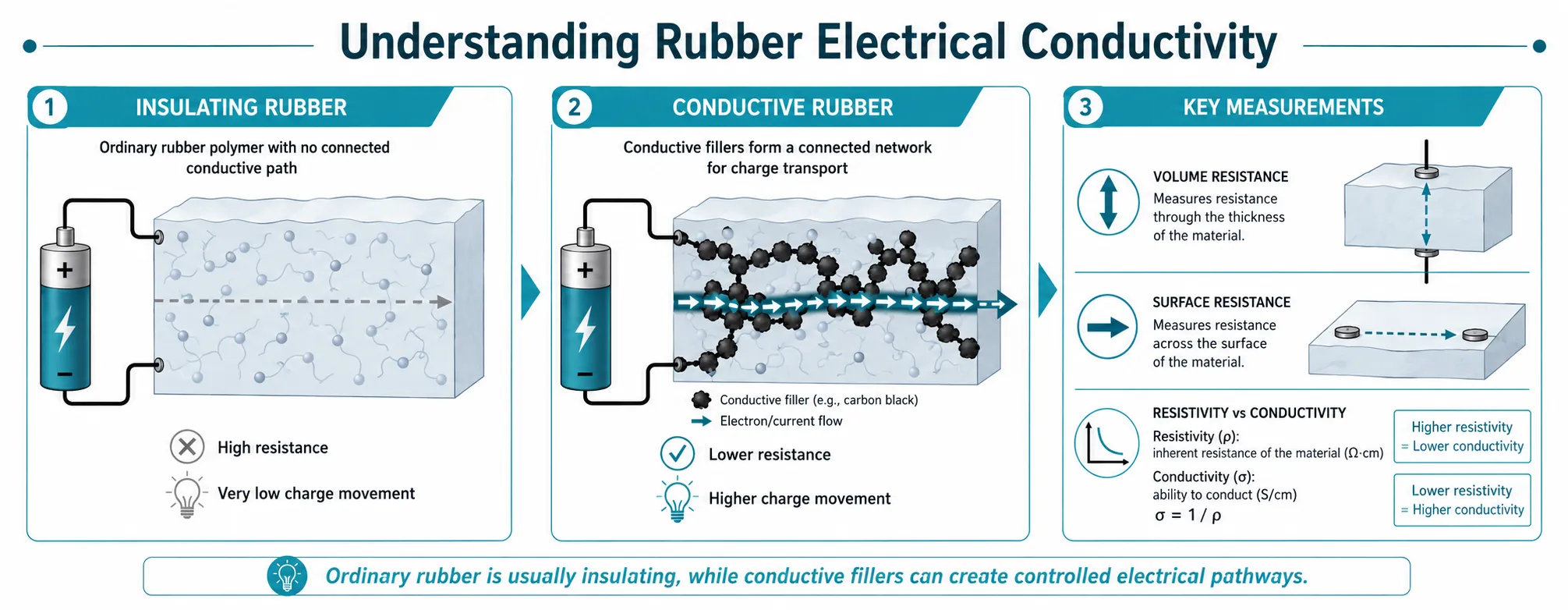
Pure rubber polymers generally contain very few freely moving electrical charge carriers. Their molecular structures hold electrons tightly, limiting the movement of current through the material.
When conductive particles are added in sufficient quantity, they can form connected pathways through the rubber. Electrical current can then move from one conductive particle to another across the material.
Volume Resistance
Volume resistance describes how strongly the complete rubber body resists current passing through its thickness. Electrical insulation materials normally require high volume resistance.
Surface Resistance
Surface resistance measures current movement across the outer surface of the rubber. Moisture, dirt, oils and contamination can reduce surface resistance even when the internal material remains highly insulating.
Resistivity and Conductivity
Electrical resistivity describes resistance to current flow within a material. Conductivity is the opposite characteristic: as resistivity decreases, conductivity increases.
For product selection, manufacturers often specify surface resistivity, volume resistivity or resistance across a defined geometry rather than using the word conductive alone.
Why Is Rubber an Electrical Insulator?
A rubber electrical insulator works because the rubber structure does not allow electrical charges to move freely under normal operating conditions. This creates a high-resistance barrier around wires, terminals and energized equipment.
Rubber also provides flexibility, impact resistance, sealing and environmental protection. These properties allow one component to provide both electrical insulation and mechanical protection.
Low Free-Electron Movement
Metals contain electrons that can move easily through their structure. Rubber polymers do not provide the same continuous pathway for mobile electrons, so current flow is significantly restricted.
Dielectric Properties
The dielectric strength of rubber refers to its ability to withstand an electric field without electrical breakdown. Dielectric strength depends on formulation, thickness, temperature, defects and testing conditions.
Flexible Cable Protection
Electrical insulating rubber can bend with cables and equipment without cracking as easily as many rigid materials. This makes it useful for wire jackets, connector boots, flexible seals and protective covers.
Environmental Sealing
Rubber insulation can block moisture, dust and contaminants from reaching electrical contacts. The sealing function may be as important as the electrical resistance itself.
What Is Conductive Rubber?
Conductive rubber is an elastomer compound formulated to carry or control electrical current. It combines the flexibility and sealing properties of rubber with a defined level of electrical conductivity.
The base polymer may be silicone, EPDM, nitrile, fluorosilicone or another elastomer. Conductive fillers are dispersed throughout the compound until they form an electrical network.
Carbon Black Filled Rubber
Carbon black is one of the most common conductive fillers. Different carbon-black grades and loading levels can produce antistatic, static-dissipative or conductive properties.
Carbon-filled compounds are often black because of the filler. They are generally more economical than metal-filled conductive elastomers.
Graphite Filled Rubber
Graphite can improve electrical conductivity while also influencing friction, hardness and thermal behavior. It may be used in seals, contacts and industrial components.
Metal Filled Rubber
Silver, nickel, aluminum, copper and other metallic fillers can produce highly conductive elastomers. These materials are commonly used for electromagnetic shielding and electrical grounding.
Metal-filled compounds can be more expensive and may require careful control of corrosion, particle distribution and mechanical properties.
Conductive Fibers and Coatings
Some conductive elastomers use carbon fibers, metal-coated particles or conductive surface coatings. The best system depends on conductivity, shielding, flexibility and environmental requirements.
Cao su silicone có dẫn điện không?
Standard silicone rubber is generally an electrical insulator. It is widely used in cable insulation, high-voltage components, connectors, keypads, electrical seals and composite insulator housings.
However, silicone rubber can also be formulated as a conductor. The phrase silicone rubber conductivity therefore depends on the specific material grade rather than the silicone polymer name alone.
Electrical Insulating Silicone Rubber
Electrical-grade silicone rubber provides high resistance, weather stability and flexibility over a broad temperature range. It is used where insulation must remain reliable under heat, cold, moisture, ozone and ultraviolet exposure.
Conductive Silicone Rubber
Conductive silicone rubber contains electrically conductive fillers dispersed through the silicone matrix. It can provide electrical contact, grounding or electromagnetic shielding while remaining flexible and compressible.
Carbon Filled Silicone Rubber
Carbon filled silicone rubber is frequently used for antistatic components, flexible contacts, sensor parts, conductive keypads and general grounding applications.
Its resistance is normally higher than that of metal-filled silicone, but it can offer a practical balance between conductivity, flexibility and cost.
Metal Filled Silicone Rubber
Silver-plated, nickel-coated or other metal-filled silicone compounds are used when lower resistance or stronger EMI shielding is required.
These materials are commonly supplied as molded gaskets, extruded profiles, sheets and die-cut sealing components.
Insulating, Antistatic and Conductive Rubber
Electrical rubber materials can be divided into several broad performance categories. Exact resistance limits should be defined by the project specification and test method.
Antistatic Rubber
Antistatic rubber is designed to reduce the accumulation of electrostatic charge. It does not necessarily conduct current as efficiently as a fully conductive material.
This material is useful for belts, rollers, flooring, footwear and equipment used near sensitive electronics or combustible dust.
Static-Dissipative Rubber
Static-dissipative rubber releases electrical charge at a controlled rate. It is selected when rapid discharge could damage electronics or create an unwanted spark.
Conductive Elastomer
A conductive elastomer provides a more direct electrical pathway while maintaining elastic recovery. It may be used for electrical contacts, grounding gaskets, sensors and shielding.
Common Applications of Conductive and Insulating Rubber
Wire and Cable Insulation
Electrical insulating rubber surrounds conductors to prevent accidental contact, short circuits and current leakage. Silicone rubber is frequently selected for high-temperature or flexible cables.
Connector Seals
Rubber seals protect electrical connectors from moisture and dust. Conductive versions can also provide grounding or electromagnetic shielding between enclosure sections.
Conductive Keypads
Remote controls, industrial panels and electronic devices may use silicone keypads with conductive carbon contacts. Pressing a key connects conductive areas on a circuit board.
EMI Shielding Gaskets
EMI shielding rubber seals gaps in electronic enclosures while maintaining electrical continuity. The gasket helps reduce electromagnetic interference entering or leaving the enclosure.
Antistatic Flooring
Special rubber flooring controls static charge in electronics facilities, laboratories, factories and areas containing sensitive equipment.
Flexible Sensors
Conductive rubber can change resistance when compressed, stretched or bent. This behavior is used in pressure sensors, wearable devices and flexible controls.
Automotive Components
Automotive systems use insulating boots, conductive grounding parts, ignition seals, battery components and EMI shielding gaskets.
Medical and Wearable Electronics
Flexible conductive silicone may be used in wearable sensors, electrode interfaces and device housings where softness and electrical performance are required.

Rubber vs Common Conductive Materials
Conductive rubber does not usually replace copper when large electrical currents must be carried efficiently. Its main advantage is combining conductivity with flexibility, compression sealing and vibration tolerance.
How to Select Electrical Rubber
1. Define the Electrical Function
Determine whether the component must insulate, dissipate static charge, conduct current, provide grounding or block electromagnetic interference.
2. Specify Resistance Requirements
Define the acceptable surface resistance, volume resistivity or resistance across the finished component.
3. Select the Base Elastomer
Choose silicone, EPDM, nitrile, fluorosilicone or another rubber according to temperature, chemicals and environmental exposure.
4. Choose the Conductive Filler
Carbon fillers suit many general applications, while metal fillers are selected for lower resistance and stronger shielding.
5. Review Mechanical Properties
Check hardness, compression set, tensile strength, elongation, tear resistance and sealing force.
6. Evaluate Temperature Range
Electrical resistance and mechanical performance may change with temperature, so test the material across the actual operating range.
7. Check Environmental Exposure
Consider humidity, water, salt, oils, fuels, cleaning agents, ultraviolet radiation and ozone.
8. Test the Finished Component
Resistance depends on geometry, compression and contact area, so test the final molded, extruded or die-cut part.
How Is Rubber Conductivity Tested?
Electrical testing should use a method appropriate for the expected resistance range and product geometry. Insulating and conductive compounds may require different instruments and electrode arrangements.
Surface Resistance Testing
Electrodes are placed on the same surface of the sample to measure current movement across the material. Surface cleanliness and humidity can strongly influence the result.
Volume Resistivity Testing
Current is measured through the thickness of the sample. The result is calculated using sample dimensions and electrode geometry.
Contact Resistance Testing
For conductive gaskets, keypads and contacts, testing may measure resistance through the assembled component under a defined compression force.
Dielectric Strength Testing
For insulating rubber, voltage is increased under controlled conditions until breakdown occurs. The result depends on thickness and test configuration.
EMI Shielding Testing
Shielding effectiveness tests evaluate how well a conductive elastomer reduces electromagnetic energy across a frequency range.
Testing Conditions Matter
Electrical resistance can change with temperature, humidity, compression, aging and electrode pressure. Compare materials only when they are tested under equivalent conditions.
Common Mistakes When Evaluating Rubber Conductivity
Assuming All Black Rubber Is Conductive
Many rubber products are black because they contain carbon black, but not every carbon-black grade or concentration creates useful electrical conductivity.
Assuming All Silicone Is Insulating
Standard silicone is normally insulating, but carbon- and metal-filled conductive silicone compounds are widely available.
Ignoring Compression
A conductive gasket may show different resistance depending on compression force. Insufficient compression can prevent conductive particles from creating a stable contact path.
Using Conductive Rubber as a Power Cable
Conductive elastomers generally have much higher resistance than copper or aluminum. They are normally used for contacts, static control and shielding rather than high-current transmission.
Testing Only the Raw Material
Molding, extrusion, curing, surface treatments and component geometry can affect electrical performance. Final-product testing is important.
Ignoring Aging
Heat, moisture, chemicals and repeated compression can change conductivity over time. Long-term application testing may be required.
Các câu hỏi thường gặp
Is rubber a conductor or an insulator?
Standard rubber is usually an electrical insulator, but rubber can be made conductive by adding carbon, graphite, metal or other conductive fillers.
Can electricity pass through rubber?
A small leakage current may pass through any real material under sufficient voltage. Ordinary rubber strongly resists current, while conductive rubber allows controlled current flow.
Is silicone rubber electrically conductive?
Standard silicone rubber is generally insulating. Conductive silicone rubber contains fillers that create an electrical pathway.
Why is carbon added to rubber?
Carbon can improve strength, wear resistance, color and electrical conductivity. The result depends on the carbon grade and loading level.
What is conductive rubber used for?
It is used for grounding, flexible contacts, conductive keypads, antistatic parts, sensors and EMI shielding gaskets.
Does wet rubber conduct electricity?
Water and contamination on the surface can reduce resistance. Wet or damaged rubber should never be assumed to provide safe electrical insulation.
Is conductive rubber as conductive as metal?
Usually not. Conductive rubber has much higher resistance than copper or aluminum but provides flexibility and sealing that metals cannot provide.
What is the difference between antistatic and conductive rubber?
Antistatic rubber mainly reduces charge buildup, while conductive rubber provides a lower-resistance path for electrical current.
Rubber Can Insulate or Conduct
Standard rubber is normally an electrical insulator because its molecular structure strongly limits the movement of electrical charge. This makes rubber useful for cable insulation, connector protection and electrical sealing.
By adding carbon, graphite, metal or other conductive fillers, manufacturers can produce conductive rubber for grounding, contacts, sensors, static control and EMI shielding.
The correct material should be selected according to its measured resistance, dielectric performance, mechanical properties and actual operating environment rather than assuming that every rubber compound behaves the same way.