
Silicone Rubber Material Guide
What Is Shore Hardness?
Shore hardness is a measure of how strongly a material resists indentation under a specified test force. For silicone rubber, Shore hardness is one of the most commonly used specifications because it provides a practical way to describe whether a silicone compound is soft, flexible, medium-hard or relatively firm. However, Shore hardness does not directly measure tensile strength, tear strength, compression set or overall material quality, so it should always be considered together with other silicone rubber properties.
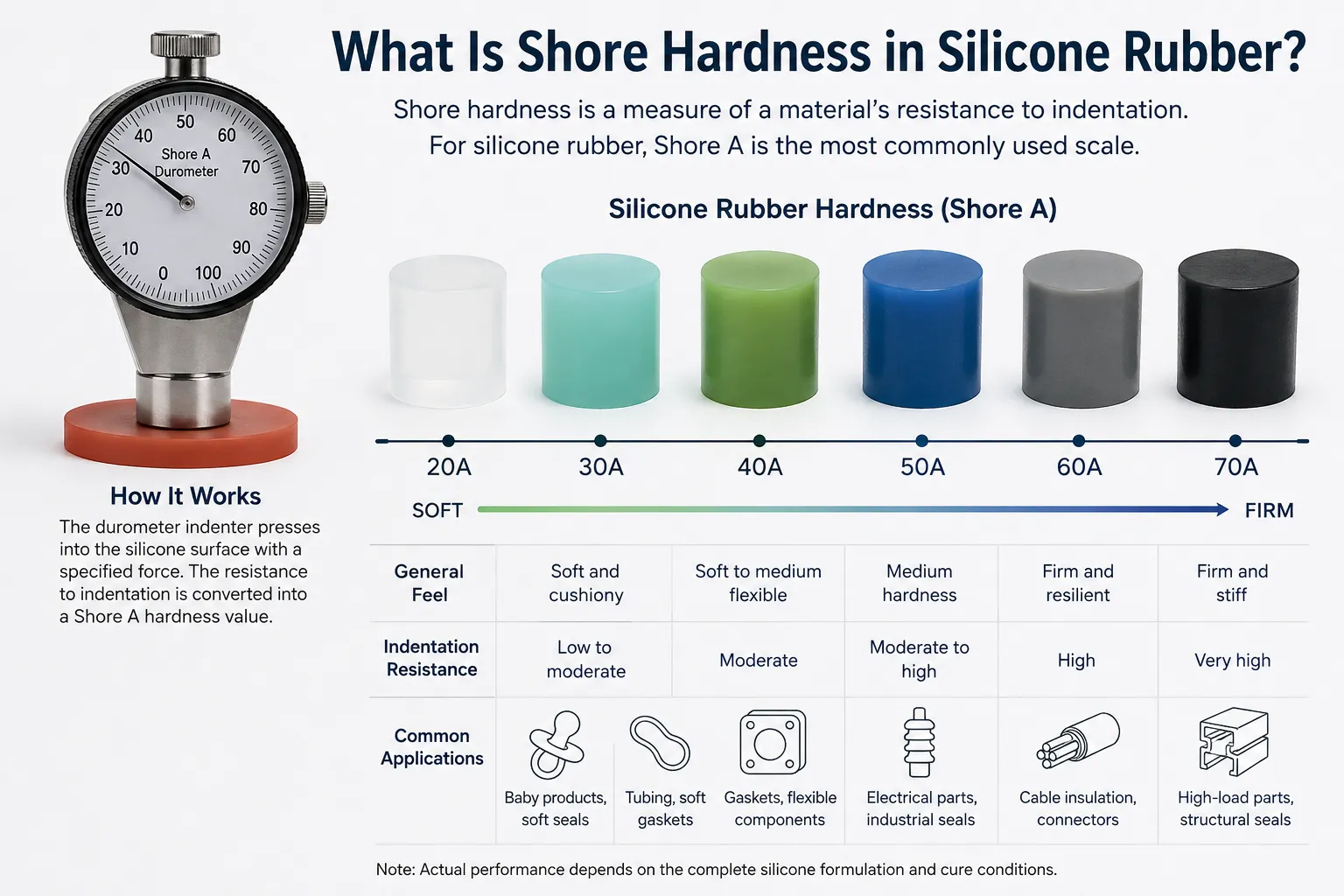
What Is Shore Hardness?
Shore hardness describes the indentation resistance of an elastomer or polymer using a Shore durometer.
During the test, a spring-loaded indenter is pressed against the surface of the material. Softer materials allow the indenter to penetrate farther, while harder materials resist indentation more strongly.
The instrument converts this indentation response into a numerical hardness value.
For silicone rubber, the most commonly encountered scale is Bờ A. A relatively soft silicone may have a low Shore A hardness, while a firmer silicone rubber compound will have a higher Shore A value.
lower Shore hardness generally means softer silicone rubber, while higher Shore hardness generally means firmer silicone rubber.
This sounds straightforward, but hardness alone does not tell the complete story of how a silicone rubber part will behave.
What Does Shore Hardness Mean for Silicone Rubber?
In silicone rubber manufacturing, Shore hardness is often one of the first properties discussed when selecting a compound.
For example, a customer may request:
- Shore A 20 silicone rubber
- Shore A 30 silicone
- 40 Shore A silicone rubber
- 50 Shore A HTV silicone
- 60 Shore A silicone rubber
- 70 Shore A high-consistency silicone
These numbers provide an initial indication of how easily the cured silicone surface can be indented.
A low-hardness silicone usually feels softer and deforms more easily under pressure. A high-hardness silicone usually feels firmer and resists local deformation more strongly.
However, two silicone compounds with the same Shore hardness can still have very different performance.
One Shore A 50 silicone may have high tear strength and high elongation, while another Shore A 50 compound may have lower tear strength, different compression set and different heat-aging behavior.
Shore hardness is a material property, not a complete material specification.
How Is Shore Hardness Measured?
Shore hardness is measured using an instrument called a durometer.
The durometer contains an indenter connected to a calibrated spring mechanism. When the instrument is pressed against a silicone rubber specimen, the indenter moves into the material according to the material's resistance.
The harder the silicone rubber, the less the indenter penetrates.
The softer the silicone rubber, the deeper the indenter can move.
The resulting value is displayed on a Shore scale.
For meaningful results, the specimen should be prepared and tested according to a defined method. Surface condition, specimen thickness, temperature, test location and reading procedure can all influence the measured value.
What Is Shore A Hardness?
Shore A hardness is the scale most commonly used for flexible rubber materials, including many silicone rubber compounds.
The Shore A scale runs from very soft elastomeric materials at the lower end to considerably firmer elastomers at the higher end.
Many commercially available silicone rubber compounds are produced across a broad Shore A hardness range so that manufacturers can select a suitable balance of flexibility, strength and dimensional stability.
For example, a soft silicone seal may require substantially lower Shore hardness than a rigidly supported high-voltage silicone component.
Shore A hardness is especially common for:
- Cao su silicone HTV
- HCR silicone rubber
- Cao su silicone lỏng
- Silicone gaskets
- Silicone O-rings
- Extruded silicone tubing
- Silicone cable insulation
- Automotive silicone seals
- Composite insulator silicone rubber
Shore A vs Shore 00 vs Shore D
Shore hardness is not limited to one scale.
Different Shore scales use different indenters and spring forces so that materials of different hardness levels can be measured more appropriately.
| Shore Scale | Typical Material Type | Silicone Rubber Relevance |
|---|---|---|
| Shore 00 | Very soft elastomers, gels and foam-like materials | May be used for extremely soft silicone systems |
| Bờ A | Flexible rubber and elastomers | Most common scale for silicone rubber |
| Shore D | Hard plastics and very firm polymer materials | Less common for conventional flexible silicone rubber |
Values from different Shore scales should not be treated as directly interchangeable.
For example, Shore A 60 and Shore D 60 do not describe the same level of material hardness.
When a silicone specification states only a number such as “50 hardness,” the Shore scale should always be confirmed.
Typical Shore Hardness of Silicone Rubber
Silicone rubber can be formulated across a wide range of hardness levels.
The following ranges provide a general practical reference rather than universal specifications.
| Approximate Shore A | General Feel | Possible Silicone Applications |
|---|---|---|
| 10–20A | Very soft and highly deformable | Soft seals, cushioning components and specialized flexible parts |
| 30A | Soft and flexible | Flexible seals, tubing and soft molded silicone parts |
| 40A | Flexible with moderate resistance | Gaskets, flexible profiles and general molded parts |
| 50A | Medium hardness | General-purpose seals, electrical parts and industrial components |
| 60A | Moderately firm | Industrial seals, cable products, molded components and electrical silicone |
| 70A | Firm | Higher-load components and dimensionally stable silicone parts |
| 80A | Very firm for an elastomer | Specialized applications requiring relatively high indentation resistance |
What Does Shore A 30 Silicone Feel Like?
Shore A 30 silicone rubber is generally considered relatively soft and flexible.
It can deform easily under finger pressure compared with medium- or high-hardness silicone.
This type of hardness can be useful where the silicone must conform closely to a mating surface or flex easily during installation.
Potential applications can include soft gaskets, flexible tubing, cushioning parts and selected sealing components.
However, lower hardness does not automatically mean better sealing. If the compound is too soft for the joint design, it may extrude, distort or provide insufficient structural support.
What Does Shore A 40 Silicone Mean?
Shore A 40 silicone is still relatively flexible but provides more resistance to indentation than Shore A 30 silicone.
It is commonly considered when a part needs good flexibility without being extremely soft.
Depending on the formulation, Shore A 40 silicone can be suitable for:
- Flexible gaskets
- Extruded seals
- Silicone tubing
- Phớt kín cho đầu nối
- Flexible electrical parts
- General industrial silicone components
What Does Shore A 50 Silicone Mean?
Shore A 50 is a common medium hardness for industrial silicone rubber.
It often provides a useful balance between flexibility and dimensional stability.
A Shore A 50 silicone component generally resists indentation more strongly than a 30A or 40A compound while remaining clearly elastomeric.
This hardness level can be suitable for molded seals, cable components, gaskets, profiles and electrical insulation products depending on the rest of the formulation.
Shore A 50 should not be treated as a universal optimum. Some applications require much softer silicone, while others need 60A, 70A or another hardness.
What Does Shore A 60 Silicone Mean?
Shore A 60 silicone rubber is firmer than many general flexible silicone compounds while still retaining elastomeric behavior.
This hardness can be useful where a component requires increased dimensional support, resistance to local indentation or a higher mechanical reaction force.
Potential uses include industrial seals, electrical components, molded silicone parts and selected HTV silicone applications.
Whether 60A is suitable depends on geometry and service conditions. Increasing hardness can improve support but may also increase the force required to compress or deform the part.
What Does Shore A 70 Silicone Mean?
Shore A 70 silicone is relatively firm for flexible silicone rubber.
It resists indentation significantly more than low-hardness silicone and is often selected where greater shape stability is required.
Higher Shore hardness can help certain parts resist deformation, but it can also make installation more difficult or require greater compression force in sealing applications.
For this reason, choosing Shore A 70 simply because it feels “stronger” is not a reliable engineering approach.
What Determines the Shore Hardness of Silicone Rubber?
Silicone rubber hardness is determined by the complete compound formulation and cure state.
The final Shore hardness can be influenced by:
- Silicone polymer structure
- Reinforcing silica content
- Filler type
- Silicone oil or processing additives
- Crosslink density
- Curing system
- Pigments
- Functional fillers
- Post-curing conditions
- Overall compound design
Silicone manufacturers therefore adjust several formulation variables rather than simply adding a single “hardness ingredient.”
How Fillers Affect Shore Hardness
Reinforcing fillers are an important part of silicone rubber formulation.
Silica is widely used because silicone polymer alone does not provide the mechanical properties required for many industrial applications.
Changes in filler type, surface treatment and loading can significantly affect the hardness, tensile strength, tear strength and processing behavior of the compound.
Increasing reinforcement can contribute to higher hardness, but formulation behavior is more complicated than a simple one-to-one relationship.
The filler also changes viscosity, extrusion behavior and mechanical performance.
How Silicone Oil Affects Shore Hardness
Silicone oils and processing aids may be used to modify the processing and physical behavior of silicone rubber compounds.
Depending on the formulation, increased softening components can reduce Shore hardness and make the cured silicone more flexible.
However, changing the level of softening ingredients may also affect tensile strength, tear strength, compression set, bleeding behavior and long-term performance.
Lower Shore hardness should therefore be achieved through a properly engineered formulation rather than simply maximizing oil content.
How Vulcanization Affects Shore Hardness
Vulcanization has a direct influence on the final Shore hardness of silicone rubber.
Before curing, HTV silicone exists as a high-consistency processable compound. During vulcanization, chemical crosslinks form between silicone polymer chains.
As the crosslinked network develops, the silicone gains its final elastic and mechanical properties.
If the silicone is significantly under-cured, its measured hardness and mechanical behavior may differ from the intended material specification.
Cure conditions therefore need to be controlled when Shore hardness is used for quality inspection.
Does More Vulcanization Always Increase Shore Hardness?
Not indefinitely.
During the normal curing process, Shore hardness may change as the silicone develops its intended crosslinked structure.
Once the required cure state has been reached, additional heating does not mean that hardness will continue increasing in a useful or predictable way.
Excessive thermal exposure can instead alter other properties or contribute to material aging.
The goal should be to achieve the specified cure state rather than simply applying the maximum possible curing time.
How Post-Curing Can Affect Shore Hardness
Some HTV silicone rubber compounds, particularly certain peroxide-cured systems, may undergo post-curing after the initial vulcanization stage.
Post-curing is an additional controlled heat treatment.
Depending on the formulation, the final material properties may change slightly after post-curing.
This means Shore hardness specifications should ideally state whether the value refers to material before or after the required post-cure condition.
When comparing supplier data, make sure the test condition is equivalent.
Shore Hardness vs Tensile Strength
Shore hardness and tensile strength measure different properties.
Shore hardness measures resistance to indentation.
Tensile strength measures how much tensile stress the silicone can withstand before breaking under specified test conditions.
| Tài sản | Chỉ số này đo lường điều gì | Can Shore Hardness Replace It? |
|---|---|---|
| Shore hardness | Indentation resistance | — |
| Độ bền kéo | Resistance to tensile failure | No |
A harder silicone is therefore not automatically a stronger silicone.
Two Shore A 60 compounds can have substantially different tensile strength.
Shore Hardness vs Elongation
Elongation describes how much a silicone specimen can stretch before breaking.
Softer silicone compounds often provide high flexibility, but Shore hardness alone cannot predict elongation.
Polymer structure, reinforcement and crosslink density all influence both properties.
A material specification should therefore list elongation separately when large deformation is important.
Shore Hardness vs Tear Strength
Tear strength measures resistance to propagation of a cut or tear.
It is particularly important for thin silicone components, molded edges, gaskets, membranes and composite insulator sheds.
Higher Shore hardness does not automatically mean higher tear strength.
High-tear silicone formulations use specialized polymer and reinforcement design to improve resistance to crack propagation.
Shore Hardness vs Compression Set
Compression set is particularly important for silicone seals.
It measures the extent to which rubber remains permanently deformed after being compressed for a defined period under specified conditions.
Shore hardness tells you how resistant the silicone is to indentation, but it does not tell you how well the material will recover after long-term compression.
| Tài sản | Main Question It Answers |
|---|---|
| Shore hardness | How easily can the silicone surface be indented? |
| Compression set | How much permanent deformation remains after prolonged compression? |
Does Higher Shore Hardness Mean Better Silicone Rubber?
No.
Higher Shore hardness simply means greater resistance to indentation on the selected Shore scale.
It does not automatically mean:
- Higher tensile strength
- Better tear strength
- Lower compression set
- Better heat resistance
- Better electrical insulation
- Better chemical resistance
- Longer service life
The best Shore hardness is the hardness that matches the mechanical design and service conditions of the application.
Is Softer Silicone Rubber Always More Flexible?
Lower Shore hardness generally corresponds to easier deformation, but flexibility is not described by hardness alone.
Part geometry has a major influence.
A thick Shore A 30 silicone block may be difficult to bend, while a very thin Shore A 60 silicone membrane may flex easily.
When evaluating the flexibility of a finished component, both the silicone material and part dimensions must therefore be considered.
Shore Hardness and Silicone Seal Design
Shore hardness is particularly important when designing silicone seals and gaskets.
A softer silicone generally requires less force to deform against the mating surfaces.
This can be useful when sealing irregular surfaces or when the assembly can provide only limited clamping force.
However, silicone that is too soft may deform excessively or extrude into gaps under pressure.
Firmer silicone provides greater resistance to deformation but generally requires greater force to achieve the required compression.
| Hardness Direction | Possible Advantage | Possible Limitation |
|---|---|---|
| Softer silicone | Easier conformity and lower compression force | Greater risk of excessive deformation |
| Firmer silicone | Greater dimensional support | Higher force may be required for sealing |
Shore Hardness for Silicone O-Rings
O-ring hardness influences sealing force, deformation and resistance to extrusion.
A softer silicone O-ring may conform more easily to the sealing surfaces, while a harder compound can provide greater resistance to deformation.
However, selecting O-ring hardness requires more than simply choosing a Shore A number.
Design factors include:
- System pressure
- Seal groove geometry
- Compression ratio
- Gap size
- Nhiệt độ
- Media compatibility
- Compression-set requirement
- Assembly conditions
Shore Hardness for Silicone Gaskets
Silicone gasket hardness should be selected according to the sealing surface and available compression force.
Soft silicone can conform to surface irregularities more easily.
Firmer silicone may provide greater structural stability in applications where the gasket must resist movement or deformation.
The gasket thickness, width and compression percentage can be just as important as Shore hardness.
Therefore, replacing a Shore A 40 gasket with Shore A 60 silicone without reviewing the joint design can significantly change sealing behavior.
Shore Hardness for Silicone Tubing
Shore hardness affects how silicone tubing bends, collapses and responds to compression.
Softer tubing is generally easier to bend and pinch, while harder tubing provides more wall support.
However, tubing performance also depends heavily on:
- Inside diameter
- Outside diameter
- Wall thickness
- Reinforcement
- Operating pressure
- Nhiệt độ
- Silicone formulation
Shore hardness should therefore be used together with dimensional and pressure requirements.
Shore Hardness for HTV Silicone Rubber
HTV silicone rubber is commonly supplied in multiple Shore A hardness levels.
The uncured high-consistency compound is processed by extrusion or molding and then vulcanized to develop the final rubber properties.
Typical HTV applications include:
- Silicone extrusion profiles
- Lớp cách điện của dây và cáp
- Miếng đệm công nghiệp
- Silicone tubing
- Automotive components
- Cách điện
- High-voltage silicone products
- Composite insulator housings
The target Shore hardness should be defined according to the finished vulcanized component rather than the uncured compound.
Shore Hardness for Liquid Silicone Rubber
Liquid silicone rubber can also be supplied in different Shore hardness levels.
Unlike high-consistency HTV silicone, LSR begins as a pumpable liquid system and is usually processed by liquid injection molding.
After crosslinking, the finished LSR part becomes an elastic silicone component whose Shore hardness can be measured using an appropriate durometer method.
Shore hardness is therefore a finished-material property that can be relevant to both HTV and LSR silicone systems.
Shore Hardness in Silicone Wire and Cable
Silicone rubber is widely used in wire and cable applications that require flexible electrical insulation and temperature resistance.
Shore hardness influences how the extruded insulation feels and deforms, but the correct hardness must also support extrusion stability and cable performance.
Cable compound selection can additionally depend on:
- Độ bền kéo
- Elongation
- Khả năng chống rách
- Dielectric strength
- Volume resistivity
- Flame performance
- Heat aging
- Extrusion processing behavior
Shore hardness is therefore only one part of an electrical silicone specification.
Shore Hardness in NEV Silicone Rubber
Silicone rubber is used in new energy vehicle systems for sealing, insulation and protection.
Shore hardness is relevant to components such as battery seals, high-voltage connector seals, cable components and flexible electrical insulation.
| Thành phần NEV | Why Shore Hardness Matters | Other Important Properties |
|---|---|---|
| Battery gasket | Controls compression behavior | Compression set and heat aging |
| Connector seal | Affects insertion force and sealing deformation | Tear strength and electrical properties |
| HV cable insulation | Affects flexibility and handling | Dielectric strength and heat resistance |
| Protective molded component | Affects dimensional support | Mechanical and thermal performance |
Shore Hardness of Silicone Rubber for Composite Insulators
Shore hardness is also an important physical property of HTV silicone rubber used for composite insulator housings and weather sheds.
The silicone must be flexible enough to tolerate mechanical and environmental stress while maintaining the geometry required by the insulator design.
However, Shore hardness alone cannot determine whether a silicone compound is suitable for high-voltage insulation.
Composite insulator silicone also needs properties such as:
- Hydrophobicity
- Hydrophobicity recovery
- Tracking resistance
- Erosion resistance
- UV resistance
- Ozone resistance
- Tear strength
- Cách điện
- Suitable adhesion to the FRP core system
A general-purpose silicone and a composite-insulator silicone can have similar hardness but very different high-voltage performance.
Does Shore Hardness Affect Electrical Insulation?
Shore hardness itself is not a direct measure of electrical insulation.
A silicone compound can be soft or firm while still being designed for electrical insulation.
Electrical properties are determined by the complete formulation.
Depending on the application, relevant properties may include:
- Volume resistivity
- Surface resistivity
- Dielectric strength
- Dielectric constant
- Dissipation factor
- Tracking resistance
Conductive and semiconductive silicone rubber can also be formulated at different Shore hardness levels.
Therefore, hardness and electrical performance should always be specified separately.
Does Shore Hardness Affect Heat Resistance?
Shore hardness does not directly define the temperature capability of silicone rubber.
A Shore A 30 silicone is not automatically less heat resistant than Shore A 70 silicone, and Shore A 70 is not automatically better for high-temperature service.
Heat resistance depends primarily on the silicone formulation, polymer system, fillers, additives, curing technology and duration of exposure.
When selecting silicone for elevated temperatures, heat-aging data should be considered separately from Shore hardness.
Can Shore Hardness Change With Temperature?
Yes. The mechanical response of silicone rubber can change with temperature.
For this reason, Shore hardness measurements should be performed under controlled and comparable test conditions.
A hardness value measured on a hot component immediately after processing should not automatically be compared with a specification measured after standardized conditioning.
For production quality control, test conditions should remain consistent from batch to batch.
Can Shore Hardness Change With Aging?
Silicone rubber properties can change after long-term thermal, chemical or environmental exposure.
Depending on the formulation and aging conditions, Shore hardness may increase or decrease together with changes in tensile strength and elongation.
Heat-aging studies therefore often compare physical properties before and after exposure.
For long-life applications, the change in Shore hardness can be more informative than the original hardness value alone.
How to Measure Shore Hardness of Silicone Rubber Correctly
Reliable Shore hardness testing requires more than simply pressing a handheld durometer onto any silicone part.
Several factors should be controlled.
Use the Correct Shore Scale
Most conventional flexible silicone rubber is measured using Shore A, while extremely soft materials may require another scale.
Use a Suitable Specimen
The specimen should provide sufficient material beneath the indenter so that the supporting surface does not distort the measurement.
Use a Flat Surface
Curved, textured or irregular surfaces can produce less reliable readings.
Avoid Edges
Measurements taken too close to an edge may not represent the bulk material response.
Control Temperature
Test specimens should be conditioned consistently because temperature can influence elastomer response.
Use a Consistent Reading Procedure
Applied force, contact time and test technique should be controlled according to the selected test method.
Can You Test Shore Hardness on a Finished Silicone Part?
Sometimes, but the geometry of the finished part can make the result less reliable.
Very thin sections, curved tubing, small seals and narrow molded ribs may not provide a suitable surface for standard hardness measurement.
In these cases, manufacturers often use standardized test specimens prepared from the same material and cure conditions.
If hardness is measured directly on the finished part, the test procedure should be clearly defined so that results can be compared consistently.
Why Shore Hardness Measurements Can Vary
Two operators can obtain different Shore hardness readings if the test procedure is not controlled.
Common causes of variation include:
- Different specimen thickness
- Different test temperatures
- Testing too close to an edge
- Curved test surfaces
- Uneven pressure on a handheld durometer
- Different reading times
- Instrument calibration differences
- Material cure-state differences
- Batch-to-batch formulation variation
This is why a production specification should define both the required Shore hardness and the measurement method.
Why a Silicone Part May Test Harder Than Expected
If a silicone rubber part shows higher Shore hardness than expected, several possible causes should be investigated.
- Incorrect compound grade
- Formulation variation
- Incorrect additive ratio
- Different filler content
- Processing or post-curing differences
- High test temperature variation
- Incorrect specimen geometry
- Incorrect Shore scale
- Durometer calibration problems
Hardness should be checked together with other physical properties before concluding that the material is incorrect.
Why a Silicone Part May Test Softer Than Expected
Lower-than-expected Shore hardness can also result from several causes.
- Incorrect silicone formulation
- Excessive softening additives
- Insufficient curing
- Cure inhibition
- Incorrect curing-agent level
- Insufficient specimen thickness
- Testing while the sample is unusually warm
- Measurement technique
If low hardness is accompanied by tackiness, poor recovery or weak mechanical properties, the cure state should be investigated.
Shore Hardness Tolerance in Silicone Rubber
Commercial silicone compounds are normally supplied with an allowable hardness range or tolerance rather than one mathematically exact value.
This is because formulation, processing and testing all introduce normal variation.
A silicone rubber specification should therefore define an acceptable range that is technically meaningful for the application.
An unnecessarily narrow hardness tolerance can increase production difficulty without providing a meaningful improvement in component performance.
The appropriate tolerance should be agreed between material supplier, processor and end user.
How to Choose the Right Shore Hardness for Silicone Rubber
Selecting silicone rubber hardness should begin with the function of the finished component.
- Define the application.
Determine whether the silicone will be used as a seal, gasket, tube, cable insulation, electrical component or structural protective part. - Determine the required deformation.
Decide how much the part needs to compress, bend or stretch. - Review available compression force.
Soft silicone generally requires less force to deform than firmer silicone. - Check dimensional stability.
Parts that need more support may benefit from a firmer compound. - Evaluate pressure.
Seals exposed to pressure may require sufficient resistance to extrusion and deformation. - Check tensile strength.
Do not assume that hardness predicts strength. - Check elongation.
This is important for highly flexible components. - Check tear resistance.
Give this special attention to thin molded or extruded sections. - Review compression set.
This is essential for long-term sealing applications. - Consider operating temperature.
Heat resistance should be evaluated separately from Shore hardness. - Review electrical requirements.
Use electrical-grade silicone where insulation performance is required. - Consider chemical exposure.
Check the actual media and operating temperature. - Produce prototypes.
Trial parts often provide much more useful information than comparing hardness numbers alone. - Test the finished component.
Validate performance under realistic service conditions.
Example: Choosing Shore Hardness for a Silicone Seal
Consider a silicone gasket installed between two plastic housings.
If the plastic structure can provide only limited clamping force, an excessively hard silicone may not compress enough to fill surface irregularities.
A softer compound may conform more easily.
However, if the seal is exposed to high pressure or a large extrusion gap, silicone that is too soft may deform excessively.
The correct selection therefore requires balancing:
- Shore hardness
- Gasket geometry
- Compression percentage
- Clamping force
- Compression set
- Operating pressure
- Nhiệt độ
This is why selecting silicone hardness from a chart alone is rarely sufficient for critical sealing applications.
Questions to Ask a Silicone Rubber Supplier About Shore Hardness
- What is the specified Shore hardness?
- Which Shore scale is used?
- What hardness tolerance applies?
- Is the value measured before or after post-curing?
- What curing conditions are used for the test specimen?
- What is the tensile strength?
- What is the elongation at break?
- What is the tear strength?
- What compression-set data are available?
- How does hardness change after heat aging?
- Is the compound HTV, HCR or LSR?
- Which curing system is used?
- Is the material suitable for extrusion or molding?
- What electrical data are available?
- What application-specific certifications or test data are available?
Frequently Asked Questions About Shore Hardness
What is Shore hardness?
Shore hardness is a measure of a material's resistance to indentation using a Shore durometer. For silicone rubber, Shore A is the most commonly used scale.
What does Shore A mean?
Shore A is a hardness scale designed for flexible elastomers such as silicone rubber, natural rubber and many other rubber materials.
Is a higher Shore hardness harder or softer?
On the same Shore scale, a higher number generally indicates greater resistance to indentation and therefore a firmer material.
What is a common Shore hardness for silicone rubber?
Silicone rubber is available across a broad hardness range. Many industrial applications use materials between relatively soft and relatively firm Shore A levels, but the correct hardness depends on the component design and required properties.
Is Shore A 30 silicone soft?
Shore A 30 silicone is generally considered relatively soft and flexible compared with 50A, 60A or 70A silicone.
Is Shore A 50 silicone hard?
Shore A 50 is generally a medium hardness for flexible silicone rubber and is commonly used in industrial molded and extruded products.
Is Shore A 70 silicone flexible?
Yes. Shore A 70 silicone is still an elastomer, but it is considerably firmer and more resistant to indentation than lower-hardness silicone compounds.
Does higher Shore hardness mean higher tensile strength?
No. Shore hardness and tensile strength are different properties. Two silicone compounds with the same Shore hardness can have different tensile strength.
Does harder silicone have better compression set?
Not necessarily. Compression set depends on the complete silicone formulation, crosslink network, temperature and test conditions, not only Shore hardness.
Does Shore hardness affect silicone sealing performance?
Yes. Hardness influences the force required to compress a seal and its resistance to deformation, but sealing performance also depends on geometry, compression set, pressure and joint design.
Can Shore hardness change after vulcanization?
Yes. Silicone develops its final hardness as the curing process creates the required crosslinked network. The measured hardness can also change slightly after post-curing or aging depending on the formulation.
Can under-cured silicone have low Shore hardness?
Yes. Significant under-curing can cause the silicone to show lower or inconsistent hardness together with poor mechanical properties and elastic recovery.
Does Shore hardness determine silicone heat resistance?
No. Heat resistance is primarily determined by the silicone formulation and aging behavior rather than the Shore hardness value alone.
Does Shore hardness determine electrical insulation?
No. Electrical performance must be specified separately. Silicone compounds with similar Shore hardness can have very different electrical properties.
What Shore hardness is best for silicone gaskets?
There is no universal best hardness. The correct Shore hardness depends on gasket geometry, available compression force, operating pressure, temperature, compression set and sealing-surface conditions.
What Shore hardness is best for silicone tubing?
The correct hardness depends on the required flexibility, wall support, pressure, dimensions and application. Shore hardness should be considered together with tube geometry.
What Shore hardness is used for composite insulator silicone?
Composite insulator compounds are selected according to the manufacturer's mechanical and electrical design requirements. Shore hardness is only one specification; hydrophobicity, tracking resistance, erosion resistance, tear strength and electrical performance are also important.
Can two silicone rubbers with the same Shore hardness perform differently?
Yes. Two silicone compounds can have the same Shore A value while having different tensile strength, elongation, tear strength, compression set, heat aging and electrical properties.