
Selecting Silicone Rubber for Stable Extrusion and Consistent Production
Silicone rubber is widely used for extruded tubing, profiles, wire and cable insulation, gaskets and other continuous elastomer products because it combines flexibility, heat resistance, electrical insulation and weather resistance.
However, choosing silicone rubber for extrusion requires more than selecting a Shore A hardness. Two silicone compounds with the same cured hardness can behave very differently inside an extruder. Plasticity, green strength, filler loading, cure system, die swell, surface quality and dimensional stability can all affect production efficiency.
A compound that produces excellent laboratory mechanical properties may still create practical extrusion problems such as unstable dimensions, rough surfaces, excessive die swell, air entrapment or poor curing behavior.
This guide explains how to choose silicone rubber for extrusion, which material properties affect processing, how HTV/HCR silicone behaves during continuous production and what manufacturers should evaluate before approving a new extrusion-grade silicone compound.
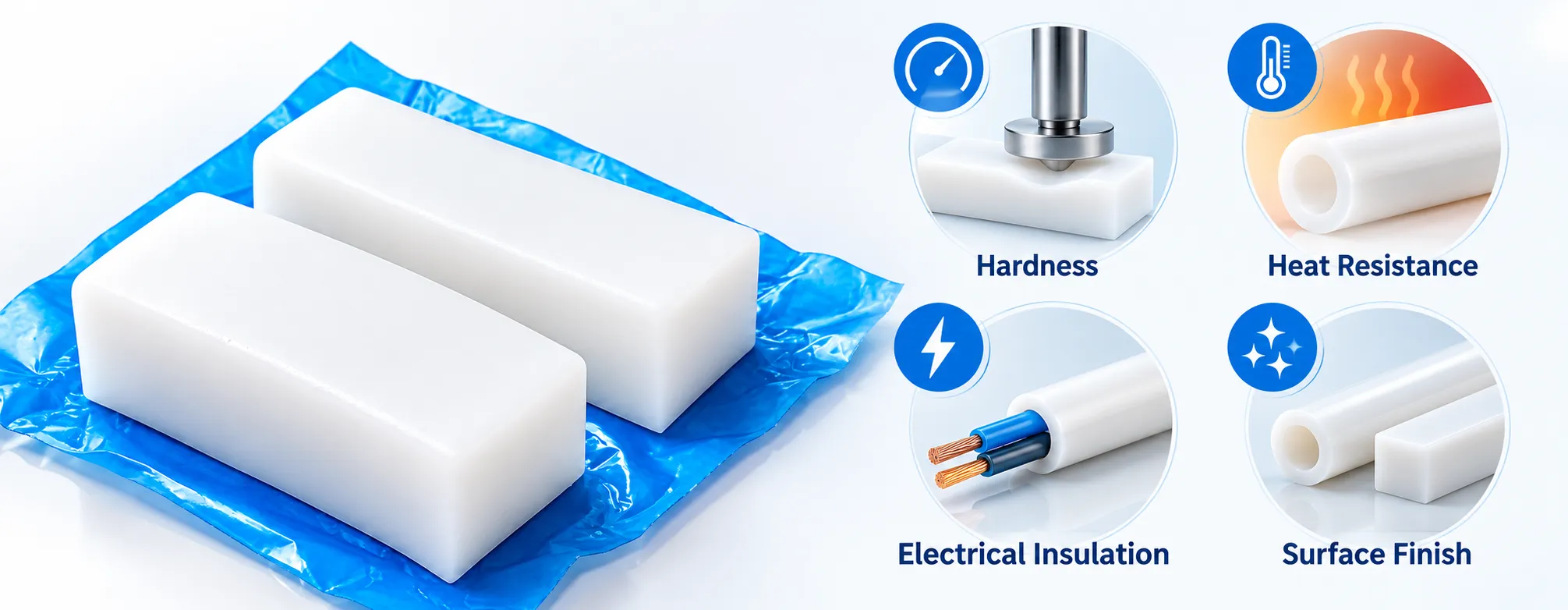
What Type of Silicone Rubber Is Used for Extrusion?
High-consistency silicone rubber, commonly called HCR or HTV silicone rubber, is the most common silicone material used for conventional continuous extrusion.
HCR silicone is supplied as a solid or gum-like compound. It can be fed into a rubber extruder, compressed and homogenized by the screw, forced through a die and then continuously vulcanized.
| Silicone Type | Quy trình xử lý tiêu biểu | Suitability for Conventional Extrusion |
|---|---|---|
| Cao su silicone HTV / HCR | Extrusion, compression molding, injection molding, calendering | Tuyệt vời |
| LSR | Liquid injection molding and specialized liquid processing | Not the normal choice for conventional HCR extrusion |
| Silicone RTV | Potting, coating, sealing and room-temperature curing | Generally not used for standard continuous extrusion |
For manufacturers producing silicone tubes, cable insulation or continuous profiles, an extrusion-specific HCR/HTV compound is usually the starting point.
Why Extrusion-Grade Silicone Rubber Is Different
A general-purpose silicone compound may be suitable for compression molding but still perform poorly during extrusion.
Extrusion places different demands on the uncured material. The compound must enter the screw consistently, move through the barrel without excessive heat buildup, pass through the die smoothly and retain enough strength to maintain its shape before curing.
1. Start with the Final Extruded Product
Silicone rubber should be selected according to the finished extrusion rather than beginning with a generic material specification.
A thin-wall cable insulation compound has different processing and mechanical requirements from a thick silicone tube or complex sealing profile.
| Extruded Product | Important Material Requirements |
|---|---|
| Silicone Tubing | Dimensional stability, smooth surface, tear strength, cleanliness |
| Wire & Cable Insulation | Electrical properties, consistent wall thickness, extrusion stability, heat resistance |
| Industrial Profiles | Shape retention, die swell control, tear resistance, weather resistance |
| Door / Oven Gaskets | Compression set, heat resistance, profile stability |
| Food-Contact Tubing | Cleanliness, regulatory documentation, surface quality and suitable cure system |
| Electrical Cable Components | Dielectric performance, thermal aging and dimensional consistency |
2. Understand Silicone Rubber Plasticity
Plasticity is one of the most important properties when evaluating silicone rubber extrusion.
It describes the deformation behavior of the uncured HCR compound and affects how the material feeds, flows and responds to pressure inside the extrusion system.
If the compound is too soft for the process, dimensional control may become more difficult. If it is too stiff, feeding and extrusion pressure may become less favorable.
There is no universal “best” plasticity value. The optimum range depends on the extruder, screw design, profile geometry, extrusion speed and curing system.
This is one reason extrusion manufacturers should evaluate actual production samples rather than choosing silicone rubber only from cured-property data.
3. Green Strength Matters Before the Silicone Is Cured
Green strength describes the ability of an uncured silicone compound to maintain mechanical integrity before vulcanization.
After the silicone exits the die, it may need to travel through air or a curing tunnel before it becomes fully crosslinked.
If uncured strength is too low, gravity, tension or handling can distort the profile.
This becomes particularly important for:
- Large or heavy silicone profiles
- Thin-wall tubing
- Complex hollow geometries
- Profiles with unsupported lips or edges
- High-speed continuous extrusion
For these products, an extrusion compound should balance flowability with enough green strength to maintain the intended geometry until curing begins.
4. Do Not Choose Silicone Rubber by Shore A Hardness Alone
Shore A hardness is one of the most common silicone rubber specifications, but it describes the cured material—not the extrusion behavior of the uncured compound.
Two 60 Shore A silicone rubber compounds can have different plasticity, filler systems, green strength, die swell and curing characteristics.
Hardness should therefore be treated as one final-product requirement among several others.
| Tài sản | What It Tells You |
|---|---|
| Shore A Hardness | Resistance of the cured silicone to indentation |
| Plasticity | Behavior of the uncured compound under deformation |
| Độ bền kéo | Resistance to tensile load after curing |
| Độ bền kéo | Resistance to tear propagation |
| Elongation | Ability to stretch before failure |
| Độ biến dạng vĩnh viễn do nén | Ability to recover after sustained compression |
5. Control Die Swell During Silicone Extrusion
When silicone rubber leaves an extrusion die, the profile may expand. This phenomenon is called die swell.
The dimensions of the uncured extrudate are therefore not always identical to the dimensions of the die opening.
Die swell is influenced by material rheology, temperature, extrusion rate, pressure and die geometry.
→
→
→
If die swell is unstable, manufacturers may experience variation in outside diameter, wall thickness or profile geometry.
For precision silicone tubing and cable insulation, predictable die swell is therefore an important part of material qualification.
6. Evaluate Dimensional Stability
An extrusion-grade silicone rubber must produce a consistent cross-section throughout continuous production.
Dimensional instability may appear as:
- Changing tube outside diameter
- Uneven wall thickness
- Profile edges losing definition
- Hollow sections collapsing
- Variation after curing
- Excessive shrinkage or expansion
Material rheology is only one factor. Screw speed, line speed, die design, curing temperature and cooling conditions also influence the final geometry.
The objective is therefore not simply to find a “low shrinkage silicone” but to achieve a stable material-process combination.
7. Choose the Right Silicone Rubber Cure System
HCR silicone rubber used for extrusion is commonly vulcanized using peroxide or addition-cure systems.
The curing system influences processing behavior, cure speed, byproducts, post-curing requirements, color and suitability for specific applications.
| Cure System | Typical Characteristics | Các yếu tố cần xem xét khi lựa chọn |
|---|---|---|
| Peroxide Cure | Widely used for industrial HCR extrusion | Evaluate peroxide type, processing temperature, byproducts and post-curing requirements |
| Platinum / Addition Cure | Low cure byproducts and useful for selected clean or regulated applications | Requires careful catalyst control and avoidance of cure inhibition |
The correct cure system should be selected according to production equipment and final application rather than automatically assuming one system is better in every case.
8. Consider Continuous Vulcanization Conditions
After leaving the extrusion die, silicone rubber must be cured continuously.
The compound should therefore be compatible with the manufacturer's curing system and line speed.
Depending on the production setup, continuous vulcanization may use heated air or other controlled heating systems.
For pressureless curing, the extrusion grade and curing chemistry must be suitable for maintaining shape and achieving sufficient crosslinking without a closed mold supporting the material.
9. Tensile Strength and Elongation Still Matter
Processing performance is important, but the final extruded product must still meet its mechanical requirements.
Tensile strength is particularly relevant where tubing, cable or profiles experience pulling forces during installation or operation.
Elongation determines how far the silicone can stretch before failure and is important for flexible products.
However, the highest tensile strength is not automatically the best choice. Increasing reinforcement can also change viscosity, plasticity and extrusion behavior.
A good extrusion compound balances final mechanical properties with production stability.
10. Tear Strength Is Critical for Many Extruded Profiles
Tear strength is particularly important when a silicone extrusion contains thin sections, sharp transitions, notches or lips.
Small cuts can become tear initiation points during installation or repeated flexing.
High-tear silicone rubber is often considered for:
- Thin-wall tubing
- Complex sealing profiles
- Cable insulation exposed to installation stress
- Profiles requiring repeated flexing
- Components with thin edges or small cross sections
Again, test method matters. Tear strength values from different test geometries should not be compared as if they were identical.
11. Select Silicone Rubber for the Required Temperature Range
One major reason manufacturers use silicone rubber is its broad temperature capability.
Many industrial HCR grades can remain flexible at low temperatures and operate continuously around elevated temperatures where many conventional elastomers age more rapidly.
However, an extrusion manufacturer should not choose a compound from maximum temperature alone.
Consider:
12. Silicone Rubber for Cable Extrusion
Silicone rubber for cable extrusion must combine electrical performance with highly stable processing.
Uneven material flow can create variations in insulation wall thickness, which is particularly undesirable for electrical cables.
| Cable Requirement | Tại sao điều này lại quan trọng |
|---|---|
| Stable Extrusion | Helps maintain uniform insulation dimensions |
| Cách điện | Supports dielectric separation around the conductor |
| Khả năng chịu nhiệt | Important for heat-resistant cable applications |
| Độ bền kéo | Reduces damage during installation and handling |
| Surface Quality | Supports consistent appearance and finished cable quality |
| Flame Performance | Required for selected cable designs and standards |
For electrical applications, the exact silicone formulation should be evaluated against the cable's required standards and operating conditions.
13. Silicone Rubber for Tubing Extrusion
Silicone tubing requires excellent dimensional stability because both outside diameter and wall thickness may be tightly controlled.
Soft tubing compounds must still have enough uncured strength to prevent excessive deformation before curing.
Important requirements may include:
- Smooth internal and external surfaces
- Stable outside diameter
- Consistent wall thickness
- Good tear strength
- Low contamination
- Suitable transparency or pigmentation
- Appropriate regulatory documentation where required
For food or medical tubing, processing cleanliness and supporting regulatory documentation may become just as important as basic extrusion behavior.
14. Silicone Rubber for Profile Extrusion
Silicone profile extrusion is used to manufacture continuous seals, gaskets and custom cross sections.
Profile geometry can significantly affect material selection.
A simple round cord is relatively easy to stabilize, while a complex hollow gasket with thin lips may require higher green strength and tighter control of die swell.
15. Flame-Retardant Silicone Rubber for Extrusion
Some cables, appliance components and industrial profiles require specified flame performance.
In these applications, flame-retardant fillers and additives can change density, mechanical properties, color and processing behavior.
A flame-retardant silicone compound should therefore be qualified as a complete formulation rather than created by simply adding flame-retardant material to a standard extrusion grade.
Manufacturers should confirm both the required flame test and extrusion performance before approval.
16. Food-Contact Silicone Rubber for Extrusion
Silicone tubing and profiles are widely used in food-processing equipment, but silicone rubber is not automatically food grade.
A food-contact extrusion compound should be selected according to the intended market, food type, temperature and contact conditions.
Manufacturers may need relevant supporting documentation and testing for requirements such as FDA 21 CFR 177.2600, LFGB or other applicable food-contact regulations.
Cure system and post-curing requirements may also be important because residual volatiles and extractable substances can affect compliance.
17. Does Platinum-Cured Silicone Extrude Better Than Peroxide-Cured Silicone?
Not necessarily. The two systems have different strengths and processing requirements.
Platinum-cured HCR is attractive for applications requiring low cure byproducts, high cleanliness, selected regulatory performance or particular visual characteristics.
Peroxide-cured HCR remains widely used for industrial extrusion because it is well established and suitable for many general-purpose profiles, cable and tubing applications.
The best cure system depends on:
- Extrusion line configuration
- Required curing speed
- Product thickness
- Regulatory requirements
- Color and appearance
- Post-curing requirements
- Final mechanical properties
18. Surface Finish and Extrusion Quality
A smooth silicone extrusion depends on both material formulation and extrusion conditions.
Rough or irregular surfaces may result from unsuitable material flow, contamination, poor die design, excessive friction, unstable extrusion conditions or incorrect curing parameters.
Sharp corners and sudden flow changes inside the die can also create uneven flow and surface defects.
19. Why Die Design Matters
The die determines the cross-sectional geometry of the extrusion, but the die opening cannot always simply copy the desired finished dimensions.
Material flow and die swell need to be compensated during tooling design.
Good extrusion-die design generally aims to maintain balanced flow throughout the cross section while avoiding unnecessary dead zones and abrupt flow-direction changes.
Complex profiles may require several die trials before the final dimensions become stable.
This means material selection and die development should ideally occur together rather than as completely separate projects.
20. Common Silicone Rubber Extrusion Problems
| Vấn đề | Possible Causes to Investigate |
|---|---|
| Unstable Dimensions | Material plasticity, screw speed, line speed, cure conditions or die swell |
| Rough Surface | Die design, contamination, extrusion conditions or unsuitable compound rheology |
| Profile Collapse | Insufficient green strength, unsupported geometry or unsuitable curing conditions |
| Excessive Die Swell | Material rheology, temperature, extrusion speed or die geometry |
| Air / Porosity | Feeding, contamination, trapped air or inadequate process control |
| Incomplete Cure | Incorrect catalyst level, line speed, curing temperature or product thickness |
| Discoloration | Cure chemistry, contamination, excessive heat or pigment stability |
| Variation Between Batches | Compound mixing consistency, plasticity variation or additive dispersion |
21. Why Batch Consistency Matters for Continuous Extrusion
Extrusion is a continuous production process, so even relatively small material changes can affect many meters of finished product.
If one batch has different plasticity or cure behavior from the previous batch, operators may need to adjust screw speed, temperature or line speed.
Frequent adjustment reduces production efficiency and increases the risk of dimensional variation.
For high-volume OEM production, stable batch-to-batch rheology can therefore be as important as nominal tensile or hardness values.
22. Should You Choose a Base Rubber or Ready-to-Use Compound?
Silicone manufacturers may supply either base materials that require further compounding or ready-to-use compounds designed for a defined process.
For manufacturers without dedicated silicone compounding equipment, a ready-to-use extrusion compound can reduce formulation variability and shorten material qualification.
23. How to Qualify a New Extrusion-Grade Silicone Rubber
A technical data sheet should be used as the first screening tool—not the final approval.
The new material should be tested on the actual extrusion line whenever possible.
24. How to Replace an Existing Silicone Extrusion Compound
Replacing an existing silicone rubber with another material should not be based only on matching Shore A hardness.
Before requesting an alternative compound, manufacturers should identify why they want to change.
The replacement material should then be selected around the failure mechanism rather than simply matching the old datasheet.
25. What Information Should You Send to a Silicone Rubber Supplier?
The more information the supplier receives, the easier it is to recommend an appropriate extrusion-grade silicone rubber.
Silicone Rubber Extrusion Selection Checklist
| Tham số | Why It Should Be Checked |
|---|---|
| HCR / HTV Grade | Confirm the compound is intended for extrusion |
| Shore A Hardness | Match finished-product mechanical requirements |
| Plasticity | Influences feeding, flow and shape retention |
| Green Strength | Supports the uncured profile before vulcanization |
| Die Swell | Affects dimensional control after the die |
| Cure System | Must match the extrusion and vulcanization line |
| Độ bền kéo | Important for thin and complex profiles |
| Lão hóa do nhiệt | Confirms performance during long-term service |
| Special Performance | Electrical, flame, food-contact or other application requirements |
| Tính nhất quán của lô | Supports stable continuous production |
Extrusion-Grade Silicone Rubber from Yakows
Yakows supplies HTV/HCR silicone rubber compounds for extrusion applications including wire and cable insulation, silicone tubing, industrial profiles, gaskets and other continuous silicone products.
Material selection can be based on Shore A hardness, plasticity, tensile strength, elongation, tear strength, temperature resistance, electrical performance and processing requirements.
For manufacturers replacing an existing compound, Yakows can evaluate the application together with the customer's extrusion method, product geometry, curing conditions and current production problem rather than simply matching hardness.
Samples can be evaluated before full production so that extrusion stability, profile dimensions, surface quality and final material properties can be compared under the customer's actual processing conditions.
Các câu hỏi thường gặp
What silicone rubber is best for extrusion?
HTV/HCR silicone rubber specifically formulated for extrusion is normally the preferred material. The exact grade should be selected according to profile geometry, hardness, plasticity, cure system and final application.
Can all silicone rubber be extruded?
No. Silicone compounds are formulated for different processes. A molding-grade compound may not provide the rheology, green strength or curing behavior required for stable continuous extrusion.
What is HCR silicone rubber?
HCR means high-consistency rubber. It is a solid silicone rubber system widely used for extrusion, compression molding, injection molding and calendering.
Is HTV silicone the same as HCR?
The terms are frequently used together for heat-cured high-consistency silicone rubber, although terminology can vary between suppliers.
Why is plasticity important in silicone rubber extrusion?
Plasticity influences feeding, flow through the extruder, die behavior and the ability of the uncured extrusion to retain its shape.
What causes silicone rubber die swell?
Die swell results from elastic recovery as the pressurized silicone leaves the die. Material rheology, temperature, extrusion rate and die geometry all influence the amount of swell.
Why does a silicone profile collapse after extrusion?
Possible causes include insufficient green strength, unsuitable material rheology, unsupported profile geometry or improper curing conditions.
Which is better for extrusion, peroxide or platinum-cured silicone?
Neither system is universally better. Selection depends on the application, curing equipment, regulatory requirements, cure speed and required finished properties.
Can silicone rubber be used for cable extrusion?
Yes. Extrusion-grade HCR silicone is widely used for selected heat-resistant and electrical cable applications where stable insulation thickness and suitable dielectric performance are required.
Can silicone rubber be used for tubing extrusion?
Yes. HCR silicone is commonly extruded into flexible tubing for industrial, food-contact and other applications when the appropriate compound and processing conditions are selected.
Why do two silicone rubbers with the same hardness extrude differently?
Shore A hardness describes the cured material. Uncured plasticity, filler system, green strength, rheology and curing chemistry can differ significantly between compounds with the same final hardness.
How should a new silicone extrusion grade be tested?
Review the technical data first, then run an extrusion trial to evaluate feeding, pressure, surface quality, dimensions, curing behavior and final mechanical or electrical properties.