
Food Grade Silicone Guide
Food grade silicone is widely used in kitchenware, baking products, food-processing equipment, seals, gaskets, tubing and other products that come into contact with food. Its flexibility, heat resistance and mechanical stability make it useful for applications where conventional rubber materials may not meet the required performance conditions.
However, not all silicone rubber is suitable for food contact. Two silicone compounds may have similar hardness, appearance and heat resistance while differing significantly in formulation, curing chemistry, extractables, processing requirements and supporting regulatory documentation.
Whether you are purchasing silicone rubber compounds or manufacturing finished food-contact products, this guide explains what food grade silicone means, how it is made, the differences between HTV, HCR and LSR, applicable FDA and European requirements, and how to select the right material for your application.
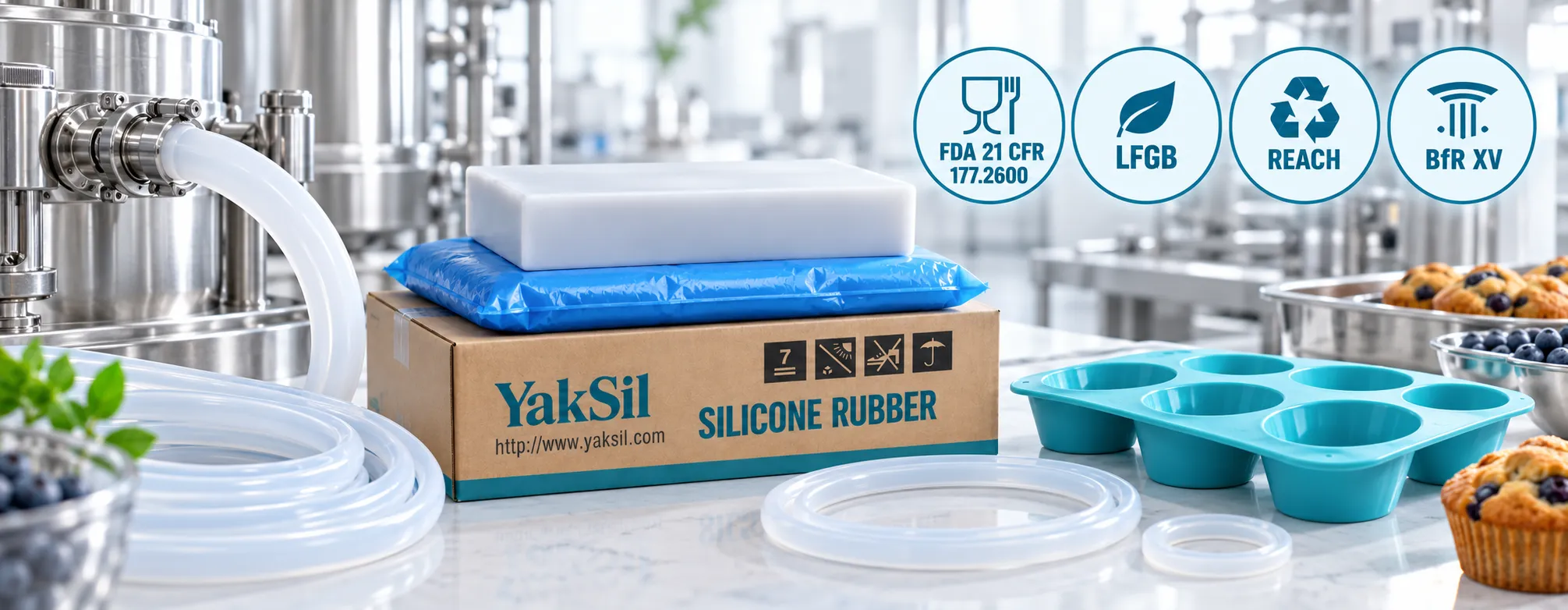
Silicone cấp thực phẩm là gì?
Food grade silicone generally refers to a silicone material formulated and evaluated for a specified food-contact application. Unlike an ordinary industrial compound, a food-contact silicone must be assessed in relation to the food it will touch, the duration of contact, the operating temperature and the regulations of its intended market.
Silicone rubber is based on organosilicon polymers containing a siloxane backbone of alternating silicon and oxygen atoms. Commercial compounds typically include reinforcing fillers, processing aids, curing ingredients and, where required, colorants or other functional additives.
Food-contact suitability depends on the complete formulation and the finished article, not simply the silicone polymer itself.
For manufacturers, this means selecting a compound that can satisfy both the required food-contact evaluation and the mechanical performance of the final part.
Is Food Grade Silicone Different from Regular Silicone?
Both food grade and general-purpose silicone rubber may use similar base polymer chemistry. The main difference lies in the complete formulation, intended application, manufacturing controls and available compliance evidence.
General-purpose silicone may be designed primarily around tensile strength, hardness, electrical properties or industrial processing. Food-contact silicone must additionally be evaluated for the substances that could transfer from the finished material into food under relevant conditions.
| Comparison | Silicone dùng trong thực phẩm | General-Purpose Silicone |
|---|---|---|
| Primary Requirement | Suitable performance and documented food-contact safety for intended use | General mechanical, thermal, electrical or industrial performance |
| Ingredients | Formulation must be evaluated against applicable food-contact requirements | Selected according to industrial performance requirements |
| Kiểm thử | May require extractables, migration and other application-specific evaluations | Typically focuses on physical and functional testing |
| Xử lý | Curing, cleanliness and possible post-curing can affect suitability | Depends on the industrial specification |
| Documentation | Food-contact declarations, test reports and traceability where applicable | Technical datasheets and general quality records |
A visually identical silicone gasket may therefore be appropriate for one application but unsuitable for direct food contact if the required evidence or formulation controls are missing.
What Are the Main Types of Food Grade Silicone?
Food grade silicone is available in several material forms. For industrial buyers, the first major selection decision is usually whether the manufacturing process requires high consistency rubber, liquid silicone rubber or a room-temperature curing system.
Food Grade HTV / HCR Silicone Rubber
High consistency rubber (HCR) is a solid, gum-like silicone compound commonly processed using extrusion, compression molding, transfer molding and calendering. HTV refers to high-temperature vulcanizing silicone; these terms frequently overlap in industrial applications.
Food-contact HTV/HCR compounds are used for products such as seals, gaskets, extruded tubing, baking components and industrial food-processing parts.
Manufacturers often choose HCR when they already operate conventional rubber-processing equipment or require continuous extruded profiles.
Food Grade Liquid Silicone Rubber (LSR)
Liquid silicone rubber is typically a two-component, platinum-cured material supplied as Part A and Part B. The components are metered, mixed and injected into a heated mold for vulcanization.
LSR is especially useful for automated manufacturing of precision silicone components, including complex seals, flexible molded products and other high-volume food-contact articles.
Its flowability allows manufacturers to fill intricate molds, while controlled metering can help improve process repeatability.
Food-Contact RTV Silicone
Room-temperature vulcanizing silicone can be used for selected mold-making, sealing and casting applications. However, an RTV material should not be assumed to be suitable for direct food contact simply because it cures into silicone rubber.
Its food-contact suitability must be established for the specific formulation, curing conditions and intended application.
| Silicone Type | Hình thức vật liệu | Quy trình xử lý tiêu biểu | Common Food-Contact Products |
|---|---|---|---|
| HTV / HCR | Solid, gum-like compound | Extrusion and compression molding | Seals, tubing, gaskets, profiles and molded parts |
| LSR | Two-component liquid | Đúc phun chất lỏng | Precision seals, kitchenware and molded components |
| RTV | Flowable or paste-like system | Room-temperature curing | Selected molds and specialized applications |
Neither LSR nor HCR is automatically more suitable for food contact. The correct choice depends on the formulation, finished-part requirements, available equipment and relevant compliance evidence.
Why Is Silicone Rubber Used in Food-Contact Applications?
Silicone rubber offers a combination of useful properties for food-processing and food-handling products. However, each property must be evaluated using the intended operating conditions.
These advantages do not mean that silicone is universally resistant to all food ingredients, cleaning agents or processing conditions. Compatibility and long-term material performance should still be checked.
What Does FDA Food Grade Silicone Mean?
In the United States, food-contact materials are evaluated under applicable FDA requirements. One commonly referenced provision for repeated-use rubber articles is 21 CFR 177.2600.
This regulation addresses rubber articles intended for repeated food-contact use and contains provisions relating to permitted ingredients, manufacturing conditions and extractables requirements for certain food-contact situations.
It is particularly relevant to many rubber and silicone components used in food-processing environments, although the exact regulatory basis must be determined for the intended article.
Why FDA 21 CFR 177.2600 Matters
Silicone rubber can contain different polymers, fillers, processing aids, curing ingredients and pigments. The use of those ingredients must be evaluated against applicable provisions and restrictions.
For specified repeated-use rubber articles, the regulation also addresses extractables from the finished food-contact surface under defined testing conditions.
Manufacturers should therefore consider the complete cured article rather than relying only on the raw silicone compound specification.
Official reference: 21 CFR 177.2600 — Rubber Articles Intended for Repeated Use.
What Are the European Requirements for Food Grade Silicone?
For products entering European markets, food-contact evaluation involves both EU-level legislation and, where applicable, national requirements.
Regulation (EC) No 1935/2004
Regulation (EC) No 1935/2004 establishes the general EU framework for materials and articles intended to come into contact with food.
The framework aims to prevent materials from transferring constituents to food in quantities that could endanger human health, cause unacceptable changes in food composition or deteriorate food taste and odor.
Silicone food-contact articles placed on the EU market fall within this general framework.
Regulation (EC) No 2023/2006
This regulation establishes good manufacturing practice requirements for food-contact materials and articles. It addresses quality assurance, quality control and documentation within the manufacturing process.
For silicone processors, appropriate production control is important because mixing, curing, contamination, handling and storage can influence the finished article.
LFGB Requirements
Germany's Food and Feed Code, commonly called LFGB, is frequently mentioned in food-contact silicone sourcing.
When buyers request "LFGB silicone," they are usually asking for evidence supporting the product's suitability for applicable German food-contact requirements. The exact test program and legal basis should be identified rather than relying on the label alone.
BfR Recommendation XV — Silicones
The German Federal Institute for Risk Assessment (BfR) publishes recommendations for food-contact materials, including Recommendation XV concerning silicones.
This recommendation provides material-specific guidance on relevant substances and conditions. BfR recommendations can support assessments of silicone food-contact materials, but they should not be confused with an independent product certification.
Official reference: BfR Recommendations on Food Contact Materials.
Is EU Regulation 10/2011 Applicable to Silicone Rubber?
Regulation (EU) No 10/2011 specifically addresses plastic food-contact materials and excludes silicone elastomers from its material scope. Silicone manufacturers should therefore avoid treating this plastics regulation as a universal standalone certification for silicone rubber.
The applicable silicone food-contact framework and relevant national requirements should be assessed for the actual market and product.
Does REACH Compliance Mean Silicone Is Food Grade?
No. REACH and food-contact requirements address different regulatory questions.
REACH is the European Union's chemicals framework for the registration, evaluation, authorization and restriction of chemical substances. It can be relevant to silicone materials and their constituent substances.
However, a REACH declaration does not by itself demonstrate that a finished silicone article is suitable for direct food contact.
| Yêu cầu | Mục đích chính | Food-Contact Significance |
|---|---|---|
| FDA 21 CFR 177.2600 | Requirements for specified repeated-use rubber food-contact articles | Relevant where its scope and conditions apply |
| EC 1935/2004 | General EU food-contact safety framework | Applies to food-contact materials within its scope |
| EC 2023/2006 | Good manufacturing practice | Requires appropriate manufacturing controls |
| LFGB | German food and consumer-product legislation | Relevant to products marketed in Germany |
| BfR XV | Material-specific recommendation for silicones | Supports silicone food-contact assessment |
| REACH | EU chemicals regulation | Does not independently establish food-contact suitability |
When purchasing food grade silicone, request documentation that addresses the actual food-contact application rather than accepting an unrelated general compliance statement.
How Is Food Grade Silicone Tested?
Food-contact testing is intended to evaluate whether substances can transfer from a material into food under relevant conditions.
The appropriate testing program depends on the regulation, material formulation, food type, exposure duration, temperature and whether the article is designed for repeated use.
Extractables Testing
Extractables testing measures substances that can be extracted from a material under defined laboratory conditions.
For certain repeated-use rubber articles, FDA 21 CFR 177.2600 specifies extractables testing involving distilled water and n-hexane under defined conditions for aqueous-food and fatty-food contact, respectively.
The result must be interpreted according to the applicable method and acceptance criteria.
Migration Testing
Migration testing evaluates the transfer of substances from a food-contact material under specified testing conditions.
Testing conditions should reflect the intended food-contact environment, including relevant food types, contact duration and temperature.
Volatile and Low-Molecular-Weight Substances
Depending on the material and applicable requirements, testing may consider volatile components or other low-molecular-weight substances that can remain after processing.
Appropriate curing and post-curing can influence the residual substances present in a finished silicone article.
Sensory Testing
Certain applications may also require evaluation of potential effects on food odor or taste.
This can be particularly relevant for reusable kitchenware, baking products, beverage components and processing equipment where the silicone contacts food repeatedly.
Why Curing and Post-Curing Matter
Silicone rubber must be properly cured to develop its final elastomeric network. Inadequate curing can affect hardness, tensile strength, elongation, tear resistance and other properties.
For food-contact applications, curing conditions also matter because the finished material may contain residual processing ingredients or low-molecular-weight substances.
Silicone đóng rắn bằng peroxide
Peroxide curing is widely used in HTV/HCR processing. Depending on the peroxide chemistry and end-use specification, post-curing may be used to help reduce relevant residual by-products and stabilize properties.
Silicone đóng rắn bằng bạch kim
Platinum addition curing is common in LSR and available in selected HCR formulations. It generally avoids the same type of peroxide decomposition by-products, although suitability still depends on the complete formulation and manufacturing process.
Platinum curing does not automatically make every compound food-contact compliant.
| Factor | What Manufacturers Should Confirm |
|---|---|
| Cure System | Compatibility with processing and food-contact requirements |
| Cure Temperature | Appropriate temperature for the formulation and part geometry |
| Cure Time | Sufficient vulcanization throughout the component |
| Post-Curing | Whether it is required by the compound specification or qualification |
| Finished Article | Compliance evidence after actual production conditions |
How Much Heat Can Food Grade Silicone Withstand?
Silicone rubber is known for good thermal stability, but food-contact suitability and heat resistance are separate questions.
Many silicone compounds can operate at temperatures above the practical limits of common organic elastomers. However, the recommended operating range varies with formulation, exposure duration, mechanical loading and the product's intended use.
A silicone compound suitable for room-temperature food contact should not automatically be considered appropriate for repeated oven exposure.
Continuous Heat
Long-term heating can influence hardness, tensile strength, elongation and compression recovery. High-temperature seals and reusable food-processing components should be evaluated for property retention after thermal aging.
Short-Term Heat
Short temperature peaks are different from continuous exposure. A material may tolerate a brief excursion but become unsuitable for long-term service at the same temperature.
Repeated Heating and Cooling
Baking molds, kitchenware and processing seals may experience repeated thermal cycles. This makes dimensional stability, elastic recovery and aging resistance important.
Always verify both the thermal limits and the food-contact qualification for the actual intended conditions.
Where Is Food Grade Silicone Used?
The applications of food grade silicone extend beyond consumer kitchenware. Industrial food production frequently requires flexible materials that can be molded, compressed or extruded into components for contact with food.
Food-Processing Seals and Gaskets
Silicone seals and gaskets are used in selected processing machines, equipment housings, closures and food-handling systems.
Material selection should consider compression set, operating temperature, cleaning conditions and compatibility with the food or process fluid.
Silicone Tubing
Extruded silicone tubing is used in suitable fluid-transfer applications. Manufacturers need to evaluate the transferred medium, pressure, temperature, tubing dimensions and food-contact requirements.
Baking Molds and Kitchenware
Silicone is widely used for reusable flexible baking molds, trays and other kitchen products where heat resistance and flexibility are important.
Finished-product evaluation should consider repeated heating, food-contact duration, formulation and potential changes after cleaning or aging.
Food Equipment Components
Custom silicone parts may be used in food-processing machinery, dispensing equipment, filling systems and other products requiring flexible sealing or protective components.
Beverage and Dairy Equipment
Appropriate silicone grades may be used for selected seals and fluid-contact components in beverage and dairy processing systems.
Cleaning chemistry, operating temperature and process-specific hygiene requirements must also be considered.
How to Choose the Right Food Grade Silicone
The best material is not necessarily the softest, the most transparent or the most heat resistant. It is the silicone compound that meets the required food-contact conditions while processing reliably and maintaining the mechanical properties of the finished component.
What Shore A Hardness Is Best for Food Grade Silicone?
Food grade silicone can be formulated across a range of Shore A hardness values. The correct hardness depends on the application rather than food-contact suitability alone.
| Illustrative Range | Material Character | Possible Application Direction |
|---|---|---|
| 30–40 Shore A | Soft and conformable | Flexible molded parts and low-force sealing |
| 40–50 Shore A | Soft to medium | Flexible gaskets and general molded parts |
| 50–60 Shore A | Medium firmness | Industrial seals, profiles and molded components |
| 60–70 Shore A | Medium firm to firm | Parts requiring greater resistance to deformation |
These are starting points rather than fixed specifications. Two compounds with the same hardness may differ significantly in processing, tear strength, compression set and regulatory documentation.
Common Mistakes When Buying Food Grade Silicone
Assuming All Silicone Is Food Grade
Silicone chemistry alone does not establish food-contact suitability. The full formulation and intended contact conditions must be evaluated.
Confusing REACH with Food-Contact Approval
REACH addresses chemicals regulation and does not replace the relevant food-contact assessment.
Relying Only on a Raw Material Certificate
The finished product may contain added colorants or be processed under conditions that affect its properties and extractables.
Ignoring Processing Compatibility
A suitable food-contact formulation can still be difficult to manufacture if its rheology, curing system or hardness does not match the production equipment.
Assuming Every Grade Is Suitable for Ovens
Food-contact suitability at room temperature does not automatically demonstrate suitability for repeated high-temperature exposure.
Comparing Suppliers Only by Price
Material price should be evaluated alongside scrap, process consistency, documentation, traceability and long-term product performance.
What Documents Should a Food Grade Silicone Supplier Provide?
Before approving a silicone compound for commercial production, manufacturers should request documentation relevant to the actual grade and intended use.
| Document | Tại sao điều này lại quan trọng |
|---|---|
| Technical Datasheet | Identifies hardness, mechanical properties, material form and other specifications |
| Food-Contact Declaration | Identifies relevant regulatory references and stated conditions of suitability |
| Test Reports | Provides evidence from testing under specified methods and conditions |
| Processing Guidance | Helps manufacturers apply suitable curing and post-curing conditions |
| Batch Identification | Supports traceability and production quality control |
| Change-Control Information | Helps evaluate the impact of formulation or processing changes on qualification |
Where a test report applies only to a particular sample or finished article, buyers should verify whether it can reasonably support their own manufacturing conditions and product design.
How to Evaluate a Food Grade Silicone Manufacturer
A qualified silicone supplier should understand both material performance and the requirements of the intended food-contact application.
For industrial customers, useful evaluation criteria include formulation capability, consistency of physical properties, traceability, document availability and technical support during production trials.
It is also important to confirm whether the supplier provides ready-to-use compounds or base materials that require further curing ingredients or processing.
For example, an HTV/HCR customer may need a compound that can be processed consistently on an existing compression-molding line, while an LSR manufacturer may require controlled viscosity, a defined A/B mixing ratio and compatibility with automatic injection equipment.
A successful supplier qualification should consider sample testing, production trials and the complete documentation package before large-volume purchasing.
What Should Be Included in a Food Grade Silicone RFQ?
A detailed RFQ helps the silicone supplier identify a material that matches the intended production process and food-contact application.
Food Grade Silicone Rubber from Yakows
Yakows supplies silicone rubber compounds for food-contact and industrial applications, including HTV/HCR silicone rubber and liquid silicone rubber.
For food-contact projects, material selection can consider the intended application, processing method, Shore A hardness, mechanical performance, curing system and applicable documentation requirements.
Customers targeting the United States and European markets can specify the applicable FDA 21 CFR, LFGB, BfR Recommendation XV, REACH or other requirements that need to be evaluated and supported for the selected grade.
Whether the project involves extruded tubing, compression-molded seals, flexible gaskets or precision molded components, the objective is to identify a silicone compound that performs reliably in production and supports the required food-contact qualification process.
Các câu hỏi thường gặp
What is food grade silicone?
Food grade silicone generally refers to silicone material formulated and evaluated for specified food-contact applications, with supporting documentation relevant to the intended market and contact conditions.
Tất cả cao su silicone đều đạt tiêu chuẩn thực phẩm sao?
No. Silicone rubber formulations vary, and food-contact suitability depends on the complete material, finished article and intended operating conditions.
Is FDA food grade silicone safe?
A silicone product supported by the applicable FDA requirements may be suitable for its defined food-contact use, provided the finished article and actual use conditions are consistent with that evaluation.
What is the difference between FDA and LFGB silicone?
These terms usually refer to different regulatory markets and evaluation requirements. Buyers should request the applicable legal reference and supporting test evidence rather than treating either term as a universal certification.
Does REACH compliance mean food-contact compliance?
No. REACH is a chemicals regulation and does not independently establish food-contact suitability.
What is the difference between food grade HCR and LSR?
HCR is a solid, high-consistency compound commonly processed through extrusion or compression molding. LSR is a flowable two-component material commonly used for automated liquid injection molding. Both can be formulated for appropriate food-contact uses.
Is platinum-cured silicone always food grade?
No. Platinum curing is a type of vulcanization chemistry, not a universal food-contact approval. The complete formulation and finished article must still be assessed.
Can food grade silicone withstand high temperatures?
Suitable grades can provide strong heat resistance, but temperature limits and food-contact suitability should both be confirmed for the intended conditions.
Does food grade silicone need post-curing?
It depends on the compound, curing system and end-use requirements. Some formulations or production processes may require post-curing to achieve specified properties or residual-substance limits.
Can colored silicone be food grade?
Yes, suitable colored silicone formulations can be evaluated for food contact. The pigment system and finished article must meet the applicable requirements.
Is food grade silicone the same as medical grade silicone?
No. Food-contact suitability and medical-device biocompatibility are different evaluations. A food-contact silicone should not automatically be assumed suitable for medical use.
What should I request from a food grade silicone supplier?
Request the technical datasheet, relevant declarations, applicable test reports, processing guidance and evidence supporting the intended food-contact conditions.
Choosing Food Grade Silicone Requires More Than a Material Label
Food grade silicone can provide an effective combination of flexibility, temperature resistance, mechanical performance and manufacturing versatility for suitable food-contact applications.
However, a successful material selection requires more than choosing an HTV, HCR or LSR grade with the correct hardness. Food-contact conditions, regulatory requirements, formulation, curing process, testing and finished-product performance must be considered together.
For manufacturers and industrial buyers, the most reliable approach is to define the application first, request the relevant supporting evidence and validate the selected silicone compound under realistic production and service conditions.