
SILICONE RUBBER MATERIALS · INDUSTRIAL APPLICATIONS
HTV and RTV Silicone Rubber: Processing, Performance and Industrial Selection
HTV silicone and RTV silicone are two important categories of silicone rubber used in industrial manufacturing, electrical insulation, sealing and customized components. Although both are based on silicone polymers, they differ significantly in material form, curing mechanisms, processing methods and typical applications.
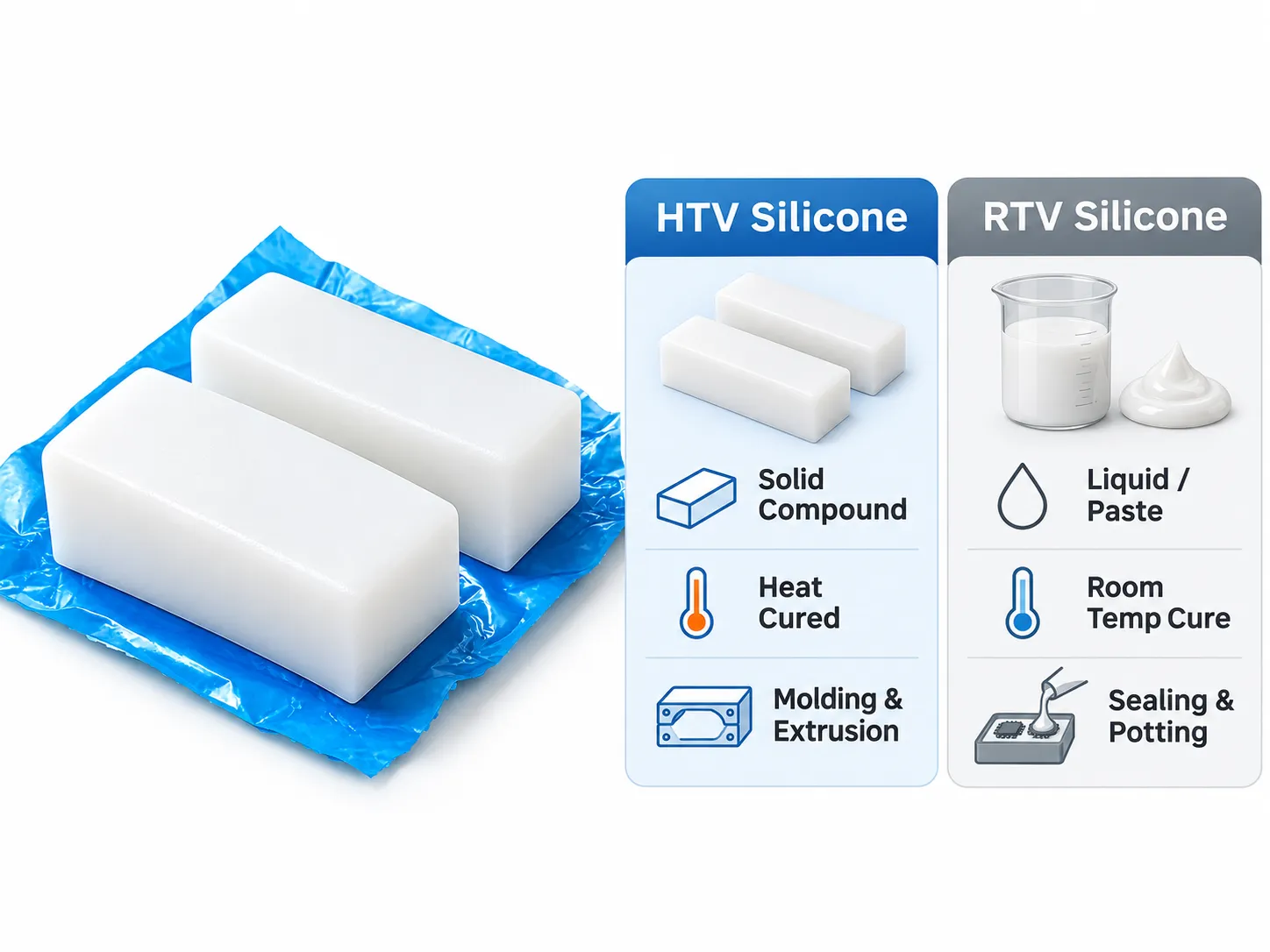
HTV (High Temperature Vulcanizing) silicone is generally supplied as a solid, high-consistency rubber compound and cured using heat. It is widely used in compression molding, transfer molding and extrusion manufacturing. RTV (Room Temperature Vulcanizing) silicone is designed to cure at or near room temperature and is commonly available in one-component and two-component systems.
For manufacturers, choosing between HTV and RTV silicone is not simply a question of curing temperature. Product geometry, mechanical requirements, production volume, equipment investment, environmental conditions and long-term performance all influence material selection.
This guide compares HTV silicone vs. RTV silicone, explains their processing differences, evaluates their material properties and explores where each type is most suitable for industrial applications.
YAKOWS · SILICONE RUBBER MANUFACTURING
Industrial HTV Silicone Rubber Compounds
Yakows specializes in silicone rubber materials for industrial manufacturing, offering HTV/HCR compounds for compression molding, extrusion and customized applications.
Different HTV silicone formulations can be developed according to hardness, tensile strength, tear resistance, electrical insulation requirements, processing conditions and end-use environments.
Industrial HTV Silicone Rubber
High-consistency silicone compounds for molded components, extruded profiles, seals, gaskets, electrical insulation products and customized industrial applications.
Electrical Grade HTV Silicone Rubber
Specialized material solutions for electrical insulation and composite insulator manufacturing, with attention to dielectric properties, hydrophobicity, tracking resistance and outdoor durability.
Customized HTV Silicone Compounds
Material selection and formulation can be evaluated according to hardness, high tear strength, high mechanical requirements, color stability and manufacturing processes.
Looking for a reliable HTV silicone rubber manufacturer for OEM or industrial production?
1. What Are HTV and RTV Silicone?
What Is HTV Silicone?
HTV stands for High Temperature Vulcanizing. HTV silicone rubber is a solid, high-consistency silicone elastomer supplied in a gum-like or compound form. It is processed through heat-assisted vulcanization to transform the uncured compound into an elastic rubber product.
HTV silicone is commonly associated with high-consistency rubber (HCR). In industrial applications, these terms are often used to describe solid silicone rubber compounds, although terminology can vary between manufacturers and material specifications.
Before curing, HTV silicone typically has a relatively high viscosity and requires mechanical processing, such as mixing, preforming and shaping. After being placed in a mold or extrusion system, heat initiates the curing reaction and produces the finished elastomer.
Common manufacturing methods include:
- Compression molding for customized solid silicone components.
- Transfer molding for more complex molded geometries.
- Extrusion for continuous profiles, tubing and sealing products.
- Calendering for sheets and continuous silicone rubber materials.
HTV silicone is widely used where manufacturers require repeatable dimensions, mechanical strength, customized hardness and consistent production of solid rubber components.
What Is RTV Silicone?
RTV stands for Room Temperature Vulcanizing. RTV silicone is designed to cure at or near room temperature through a chemical reaction, forming an elastic silicone material without requiring conventional high-temperature vulcanization equipment.
RTV silicone is generally divided into two main categories.
RTV-1 (One-Component Silicone): Supplied as a ready-to-use material that typically cures through exposure to atmospheric moisture. It is commonly used in sealants, adhesives, protective coatings and general-purpose sealing applications.
RTV-2 (Two-Component Silicone): Supplied as two separate components that must be mixed before curing. Depending on the formulation, RTV-2 can use condensation-cure or addition-cure chemistry. It is used in molding, encapsulation, potting, casting and specialized industrial applications.
Some RTV formulations can also be heat-accelerated, depending on the manufacturer's processing instructions. Room-temperature curing describes their intended curing system, not a restriction that prevents the use of additional heat.
HTV and RTV primarily describe curing and processing approaches. They do not automatically define the quality, temperature rating or electrical performance of a silicone rubber product. Actual performance depends on the specific formulation and application.
2. HTV Silicone vs. RTV Silicone: Key Differences
The main difference between HTV and RTV silicone is how the uncured material is supplied, processed and converted into an elastomer. These differences influence equipment requirements, production methods, product geometry and manufacturing efficiency.
| Comparison | HTV Silicone | Silicone RTV |
|---|---|---|
| Full Name | High Temperature Vulcanizing. | Room Temperature Vulcanizing. |
| Hình thức vật liệu | Solid, high-consistency silicone compound. | Paste, liquid or two-component material. |
| Curing Method | Heat-assisted vulcanization. | Chemical curing at or near room temperature. |
| Common Processing | Compression molding, transfer molding and extrusion. | Dispensing, casting, sealing, potting and coating. |
| Equipment | Mixing, molding or extrusion equipment. | Dispensing, mixing or application equipment, depending on grade. |
| Production Style | Well suited to repeatable, batch and continuous production. | Well suited to sealing, casting, coating and customized applications. |
| Tính chất cơ học | Can be formulated for demanding tensile, tear and compression requirements. | Varies widely according to sealant, potting or elastomer formulation. |
| Product Geometry | Molded components, extruded profiles and sheets. | Coatings, seals, encapsulated parts, casts and customized shapes. |
| Các ứng dụng điển hình | Industrial components, electrical insulation and composite insulators. | Sealants, adhesives, potting, encapsulation and protective coatings. |
There is no universal performance ranking between HTV and RTV silicone. Some specialized RTV elastomers provide excellent mechanical or electrical performance, while some HTV compounds are developed primarily for general-purpose applications. The correct comparison must always be based on specific material grades.
3. Differences in HTV and RTV Silicone Curing Mechanisms
Curing is the chemical process that transforms uncured silicone into a crosslinked elastomer. Although HTV and RTV both form silicone rubber networks, their curing systems and production requirements are different.
HTV Silicone Curing
HTV silicone generally uses a heat-activated curing system. The uncured compound is shaped and exposed to a controlled temperature so that crosslinking can take place.
Common HTV curing approaches include:
- Peroxide curing: Organic peroxide initiators generate reactive species under heat, promoting crosslinking of the silicone polymer.
- Addition curing: Platinum-catalyzed hydrosilylation reactions form crosslinks between suitable silicone components.
The appropriate curing system depends on the formulation, processing equipment, production requirements and finished-product performance targets.
For industrial molding, manufacturers need to control compound storage, preforming, mold temperature, curing time and post-curing requirements where applicable.
RTV Silicone Curing
RTV silicone uses chemical reactions that allow the material to cure at or near room temperature.
RTV-1 moisture curing: The material reacts with moisture in the surrounding environment. Depending on the chemistry, curing may release different reaction by-products. Because moisture must reach the material, the curing process generally progresses from exposed surfaces toward the interior.
RTV-2 condensation curing: Two components are mixed to initiate a crosslinking reaction. The curing process can involve the release of reaction by-products, depending on the specific chemistry.
RTV-2 addition curing: Two components are mixed and cured through a platinum-catalyzed reaction. This type of system is often selected where controlled curing and low reaction by-product formation are important.
| Hệ thống đóng rắn | Reaction Mechanism | Important Process Considerations |
|---|---|---|
| HTV Peroxide Cure | Heat-activated radical crosslinking. | Curing temperature, time and post-curing where required. |
| HTV Addition Cure | Platinum-catalyzed hydrosilylation. | Mixing, catalyst compatibility and temperature control. |
| RTV-1 Moisture Cure | Moisture-triggered crosslinking. | Humidity, exposed surface area and cure depth. |
| RTV-2 Condensation Cure | Two-component condensation reaction. | Mix ratio, working time and curing conditions. |
| RTV-2 Addition Cure | Two-component platinum-catalyzed reaction. | Mix ratio, catalyst inhibition and curing control. |
The curing time and final properties depend on the individual formulation. Manufacturers should follow the technical datasheet rather than applying one curing schedule to all HTV or RTV silicone products.
4. Processing Methods and Manufacturing Requirements
Processing requirements are one of the most important differences between HTV silicone rubber and RTV silicone. The choice of material directly affects equipment configuration, production workflow, labor requirements and product consistency.
HTV Silicone Processing
HTV silicone is generally processed as a solid compound. Before molding or extrusion, the material may require mixing, compound preparation, cutting and preforming.
Compression molding: A measured quantity of uncured HTV silicone is placed into a heated mold. Pressure and temperature help the material fill the cavity and undergo vulcanization. This process is widely used for gaskets, seals, electrical components and customized molded parts.
Transfer molding: The silicone compound is transferred into mold cavities under pressure. This approach can be suitable for more complex component geometries and certain production requirements.
Extrusion: Uncured HTV silicone is forced through a die to create continuous profiles, tubing, strips and other customized shapes. The extruded material is then cured using an appropriate vulcanization system.
Calendering: Silicone compound is processed through rollers to produce sheets or continuous materials with controlled thickness.
RTV Silicone Processing
RTV silicone is generally easier to apply in situations where the material must fill a space, seal a joint or form a coating around an existing component.
Dispensing and sealing: RTV-1 sealants are applied directly to joints, gaps and component surfaces. Moisture exposure initiates curing.
Mixing and casting: RTV-2 systems require the correct mixing ratio between components before pouring or casting into a mold.
Potting and encapsulation: Liquid RTV silicone can be poured or dispensed around electrical components to provide environmental protection, insulation or vibration cushioning, depending on the grade.
Protective coating: Certain RTV silicone formulations can be applied as coatings on surfaces or existing electrical insulation structures.
| Manufacturing Factor | HTV Silicone | Silicone RTV |
|---|---|---|
| Material Preparation | Compound preparation and preforming. | Ready-to-use material or two-component mixing. |
| Shaping | Mold cavities, extrusion dies or rollers. | Dispensing, pouring, spreading or coating. |
| Curing Control | Heat, time and curing-system control. | Moisture, mixing ratio, temperature and formulation-specific cure conditions. |
| Production Equipment | Mixers, molding presses and extrusion lines. | Dispensers, mixers, casting tools and application equipment. |
| Kiểm soát chất lượng | Compound consistency, dimensions and cure quality. | Mixing accuracy, application quality and cure completeness. |
5. Mechanical and Thermal Performance of HTV vs. RTV Silicone
Both HTV and RTV silicone can be formulated for demanding industrial environments. However, their performance characteristics depend on polymer structure, fillers, crosslink density, curing chemistry and material design.
Tensile Strength and Elongation
HTV silicone compounds can be formulated with reinforcing fillers to achieve the tensile strength and elongation required for molded and extruded industrial components.
RTV silicone properties vary considerably. Some RTV elastomers are designed for flexible sealing and general-purpose applications, while specialized RTV formulations can offer higher mechanical performance.
For products exposed to repeated stretching or mechanical loading, buyers should compare the actual tensile strength and elongation values of the specific grades.
Độ bền kéo
Tear strength is important for silicone rubber products with thin sections, sharp corners, complex profiles or repeated mechanical movement.
HTV compounds can be formulated for high tear strength to support demanding molding and extrusion applications. The actual tear resistance depends on the polymer, reinforcing system, cure conditions and test method.
Hardness and Compression Behavior
Both HTV and RTV silicone can be manufactured with different hardness levels. The required hardness should be selected according to the component's sealing, flexibility, deformation and dimensional requirements.
For compression-molded seals and gaskets, compression set and recovery characteristics may be more important than hardness alone.
Temperature Performance
Silicone rubber is known for its useful thermal stability compared with many conventional organic elastomers. However, the actual operating temperature range varies by formulation and application.
HTV silicone compounds are often selected for industrial products that experience repeated heat exposure. RTV products also include specialized grades designed for elevated-temperature sealing, encapsulation and coating applications.
The term HTV describes a heat-vulcanizing material system. It does not automatically mean every HTV compound has a higher service-temperature rating than every RTV compound.
Electrical Insulation Properties
Both HTV and RTV silicone can provide electrical insulation. However, electrical performance must be verified using the specific material grade and relevant test methods.
For high-voltage outdoor insulation applications, additional properties such as hydrophobicity, tracking resistance, erosion resistance and weathering durability must also be considered.
| Performance Property | HTV Silicone | Silicone RTV | Selection Consideration |
|---|---|---|---|
| Độ bền kéo | Can be formulated for demanding mechanical requirements. | Varies by sealant, coating or elastomer grade. | Compare grade-specific tensile test data. |
| Độ bền kéo | Specialized high-tear compounds are available. | Depends on the formulation and cured structure. | Important for thin sections and demolding. |
| Độ cứng | Available in different hardness grades. | Available in different hardness grades. | Choose according to product design. |
| Ổn định nhiệt | Suitable grades can withstand repeated heat exposure. | Specialized grades are available for thermal applications. | Check continuous and intermittent operating conditions. |
| Cách điện | Available in electrical-grade formulations. | Available in electrical potting and coating grades. | Verify dielectric and application-specific test data. |
| Khả năng chống chịu thời tiết | Suitable formulations offer outdoor durability. | Depends on the intended sealant or coating grade. | Evaluate UV, ozone, moisture and aging exposure. |
For accurate material selection, request the technical datasheet and test reports of each grade. Generic comparisons between HTV and RTV should not replace product-specific testing.
6. Industrial Applications of HTV and RTV Silicone
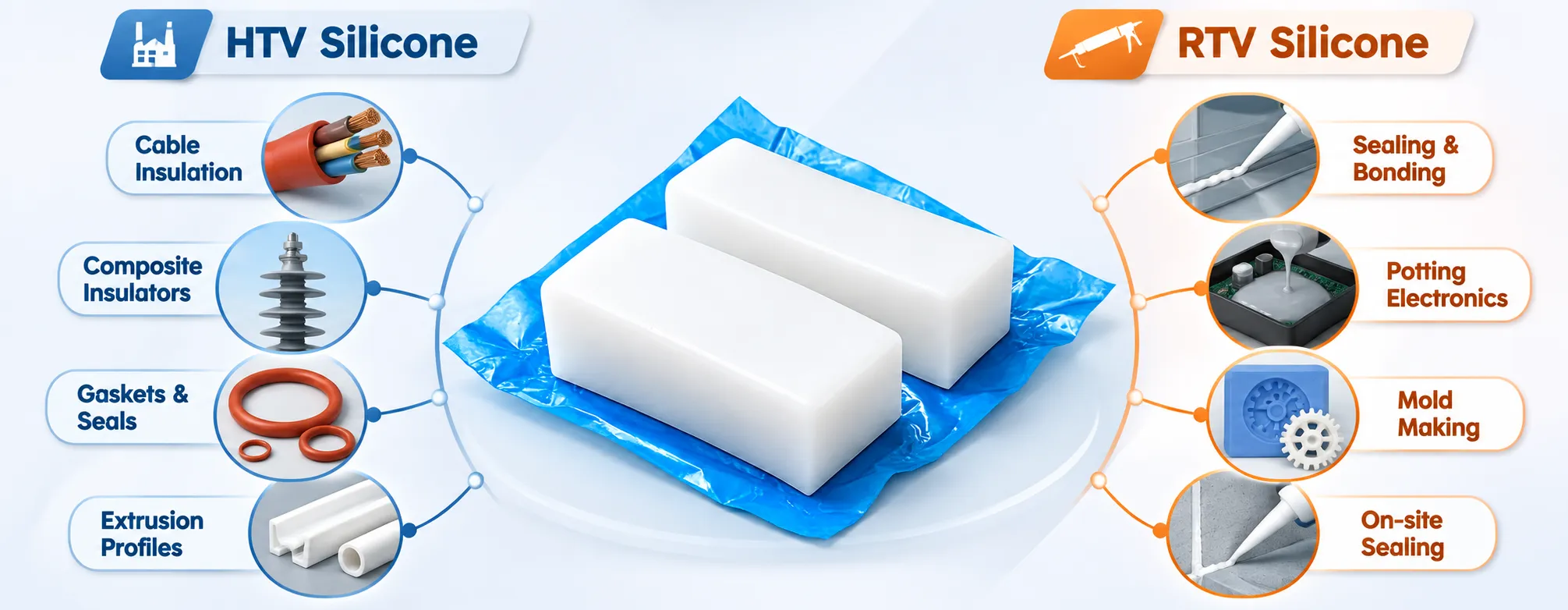
HTV and RTV silicone serve different manufacturing needs. HTV is commonly selected for solid molded or extruded components, while RTV is widely used for sealing, bonding, casting and encapsulation.
HTV Silicone Applications
Electrical insulation components: Electrical-grade HTV silicone is used in components requiring dielectric insulation, mechanical stability and environmental resistance.
Composite insulators: HTV silicone rubber is widely used as the external housing material in composite insulator manufacturing. It helps provide electrical insulation, hydrophobicity and resistance to outdoor weathering when properly formulated.
Industrial seals and gaskets: Compression-molded HTV silicone components are used in equipment that requires flexibility, sealing performance and temperature resistance.
Extruded silicone profiles: HTV silicone is used to produce continuous strips, tubes, sealing profiles and customized cross-sections.
Automotive and machinery components: Specialized compounds can be used in molded components, protective parts and industrial sealing systems.
RTV Silicone Applications
Industrial sealants: RTV-1 products are commonly used to seal joints, gaps, housings and connections where curing occurs after application.
Electrical potting: Certain RTV-2 silicone grades are used to encapsulate electronic assemblies, sensors and electrical components to provide protection against moisture, vibration and environmental exposure.
Protective coatings: RTV silicone coatings can be applied to surfaces and selected electrical insulation structures to provide protective properties.
Silicone molding: RTV-2 materials can be poured into molds to produce flexible molds, prototypes and customized cast components.
Maintenance and repair: RTV sealants are useful for on-site sealing and maintenance applications where conventional molding or extrusion is not practical.
| Industry | HTV Silicone Applications | RTV Silicone Applications |
|---|---|---|
| Power and Electrical | Composite insulator housings and molded insulating components. | Electrical potting, encapsulation and selected insulation coatings. |
| Ô tô | Molded seals, connectors and customized components. | Joint sealing, bonding and electronic encapsulation. |
| Thiết bị công nghiệp | Gaskets, tubing and extruded profiles. | Sealants, protective coatings and casting. |
| Electronics | Solid insulating components and molded parts. | Potting, encapsulation and protective coatings. |
| Sản phẩm tiêu dùng | Molded silicone accessories and components. | Flexible casting and selected sealing applications. |
7. HTV and RTV Silicone in Electrical Insulation Applications
Electrical insulation is an important area where both HTV and RTV silicone are used, but they often serve different functions within the insulation system.
HTV Silicone for Composite Insulators
High-voltage composite insulators commonly use silicone rubber as the external housing material around a structural core. The housing protects the core and provides the external insulating surface exposed to environmental conditions.
Electrical-grade HTV silicone compounds are selected according to several important performance requirements:
- Dielectric properties: Suitable electrical insulation performance.
- Hydrophobicity: Helps limit continuous water-film formation on the surface.
- Tracking resistance: Helps resist the formation of conductive surface paths.
- Erosion resistance: Helps reduce surface deterioration caused by electrical discharge.
- Mechanical strength: Supports molding, demolding and service requirements.
- Weather resistance: Supports outdoor exposure to UV radiation, ozone, moisture and temperature fluctuations.
For composite insulator manufacturers, the material must be evaluated as part of the complete product design. Dielectric strength alone cannot establish the voltage rating or long-term service performance of a finished insulator.
RTV Silicone for Electrical Protection
RTV silicone also plays an important role in electrical systems. Certain RTV products are used as insulating coatings, sealing materials and encapsulation compounds.
For example, RTV silicone coatings may be applied to existing insulator surfaces to improve their hydrophobic behavior and pollution performance. RTV-2 potting materials can also protect sensitive electronic components from moisture and vibration.
However, RTV coatings, RTV sealants and HTV composite insulator housings are different product categories. They should not be treated as interchangeable materials without considering the design and service requirements.
For manufacturing composite insulators, solid electrical-grade HTV silicone is generally the more relevant material category. RTV products are more commonly considered for coatings, sealing, encapsulation and maintenance-related applications.
8. How to Choose Between HTV and RTV Silicone
The best material depends on the product design, manufacturing method, performance requirements and production scale. The following selection factors can help industrial buyers identify the appropriate silicone rubber category.
1. Consider the Product Structure
If the product requires a solid molded component, a continuous extruded profile, a sheet or a dimensionally controlled rubber part, HTV silicone is generally the more suitable starting point.
If the material needs to fill a gap, coat a surface, seal a joint or encapsulate an existing component, RTV silicone may be more practical.
2. Evaluate Mechanical Requirements
For products exposed to repeated deformation, tensile loading, tearing or compression, compare the specific tensile strength, elongation, tear strength and compression set of the proposed grades.
HTV is frequently used for demanding solid rubber components, but the actual selection should be based on measured material properties rather than the HTV or RTV label alone.
3. Match the Production Method
HTV is suitable for manufacturers with molding or extrusion equipment and repeatable production requirements. RTV is more suitable when the application involves dispensing, casting, sealing or coating.
4. Consider Production Volume
For repeated production of identical components, HTV molding and extrusion can offer consistent manufacturing processes. For low-volume sealing, repair or customized casting, RTV may require less specialized production equipment.
5. Define Environmental and Electrical Requirements
For outdoor electrical applications, consider temperature, UV radiation, ozone, moisture, pollution, tracking and erosion resistance. For electrical encapsulation, evaluate dielectric properties, curing behavior, adhesion and compatibility with the components being protected.
6. Review Technical Documentation
Request grade-specific technical datasheets and relevant test reports. Confirm that the material meets the requirements of the finished product and its intended operating environment.
| Your Requirement | Recommended Starting Point | Reason |
|---|---|---|
| Compression-molded parts | HTV Silicone | Designed for solid compound molding. |
| Continuous extrusion profiles | HTV Silicone | Suitable for continuous solid rubber processing. |
| Composite insulator housing | Electrical-grade HTV Silicone | Designed for solid molded insulation housings. |
| Joint sealing | RTV-1 Silicone | Ready-to-use moisture-curing sealant systems. |
| Electronic encapsulation | RTV-2 Silicone | Liquid two-component systems can fill and encapsulate assemblies. |
| Protective coating | Application-specific RTV Silicone | Suitable formulations can be applied directly to surfaces. |
| Flexible cast molds | RTV-2 Silicone | Can be poured around a master pattern and cured. |
9. Production Cost and Manufacturing Efficiency
HTV and RTV silicone have different cost structures because they require different materials handling, production equipment and curing processes. The lower purchase price of one material does not necessarily mean a lower total manufacturing cost.
HTV Silicone Manufacturing Economics
HTV production may require compound preparation, mixing equipment, molds, presses or extrusion lines. These requirements can involve higher initial equipment and tooling investment.
However, for repeat production and consistent product geometries, a well-controlled HTV manufacturing process can support efficient batch production and continuous extrusion. Material utilization, cycle time, scrap rate and production volume all influence unit cost.
RTV Silicone Manufacturing Economics
RTV materials can often be applied using relatively simple dispensing, mixing or casting equipment. This can make them practical for maintenance, low-volume customized products and applications that do not justify dedicated molding tooling.
However, material mixing, application labor, curing time, pot life and production throughput can influence the total cost. For some applications, slower curing or manual application may limit manufacturing efficiency.
| Cost Factor | HTV Silicone | Silicone RTV |
|---|---|---|
| Equipment Investment | May require specialized mixing and molding or extrusion equipment. | Often requires dispensing, mixing or application equipment. |
| Tooling | Molds and extrusion dies may be required. | Depends on whether casting molds or application tools are needed. |
| Labor | Depends on automation and compound preparation. | Can involve mixing, dispensing and manual application. |
| Production Volume | Well suited to repeated production. | Useful for customized, lower-volume and application-based work. |
| Unit Cost | Can become competitive with efficient high-volume production. | Depends on material consumption, application labor and cure time. |
For industrial buyers, the most effective approach is to compare total manufacturing cost, including material consumption, tooling, equipment, labor, cycle time, inspection and rejection rates.
YAKOWS · HTV SILICONE RUBBER SUPPLIER
Need HTV Silicone Rubber for Your Manufacturing Project?
Yakows provides solid HTV/HCR silicone rubber compounds for industrial molding, extrusion, electrical insulation and customized manufacturing applications.
Whether you require general-purpose HTV silicone, high tear strength grades, high hardness compounds or electrical insulation materials, the appropriate formulation should be selected according to your product design and technical specifications.
When contacting our team, you can provide your target hardness, processing method, application, required performance and estimated purchasing quantity.
Request HTV Silicone Quotation →
Email: info@yakows.com
Frequently Asked Questions About HTV and RTV Silicone
What is the main difference between HTV and RTV silicone?
HTV silicone is a solid, high-consistency silicone rubber compound that is cured using heat. RTV silicone is designed to cure at or near room temperature through a chemical reaction. HTV is commonly used in molding and extrusion, while RTV is frequently used in sealing, coating, casting and encapsulation.
Is HTV silicone the same as HCR silicone?
HTV and HCR are closely related terms commonly used for solid, high-consistency silicone rubber compounds. HTV emphasizes the heat-vulcanizing process, while HCR describes the high-consistency material form. Commercial terminology can vary between suppliers.
Is HTV silicone stronger than RTV silicone?
Many industrial HTV compounds are formulated for demanding tensile, tear and mechanical requirements. However, RTV silicone also includes specialized high-performance elastomers. A fair comparison requires evaluating the technical data of the specific grades.
Does HTV silicone always have a higher temperature resistance than RTV?
No. HTV refers to the heat-vulcanizing process, not a guaranteed operating temperature rating. Both HTV and RTV silicone can be developed for different thermal requirements. Always check the continuous and intermittent operating temperature limits of the specific product.
What is the difference between RTV-1 and RTV-2 silicone?
RTV-1 is a one-component silicone that typically cures through exposure to atmospheric moisture. RTV-2 is a two-component system that requires mixing before curing and may use condensation or addition curing chemistry.
Can HTV silicone be used for extrusion?
Yes. HTV silicone is widely used for extrusion manufacturing of silicone tubing, sealing strips, profiles and customized continuous components. The compound should be selected according to extrusion stability, curing requirements and final product properties.
Can RTV silicone be used for electrical insulation?
Yes. Certain RTV silicone products are used for electrical potting, encapsulation, sealing and protective coatings. The required dielectric properties, adhesion, curing characteristics and environmental resistance must be verified for the intended application.
Which silicone rubber is used for composite insulators?
Solid electrical-grade HTV silicone rubber is commonly used for the external housing of composite insulators. It is selected for its electrical insulation properties, hydrophobicity and outdoor environmental resistance. Finished insulator performance must be validated through the relevant product tests.
Is HTV silicone suitable for mass production?
Yes. HTV silicone is suitable for repeated compression molding, transfer molding and extrusion production. It can support consistent dimensions and repeatable manufacturing when the compound, tooling and curing process are properly controlled.
How do I choose the right HTV silicone grade?
Consider hardness, tensile strength, tear strength, elongation, compression set, thermal conditions, electrical properties and manufacturing method. The final selection should be based on the actual product specifications and required application performance.
Can a silicone rubber manufacturer customize HTV compounds?
Yes. Specialized HTV silicone compounds can be developed according to hardness, mechanical performance, electrical insulation requirements, color, curing system and molding or extrusion conditions. Buyers should provide their target specifications and application details.