Silicone Materials Guide
HTV VS LSR Silicone Rubber
Silicone rubber is widely used in medical devices, automotive systems, electronics, consumer goods, industrial sealing, and food-contact applications. Among the many silicone material families, HTV silicone rubber and LSR silicone rubber are two of the most important choices for molded and extruded components. Although both are based on polysiloxane chemistry and share excellent heat resistance, flexibility, weatherability, and biocompatibility potential, they differ significantly in physical form, processing method, production efficiency, design flexibility, and cost structure.
1. What Is HTV Silicone Rubber?
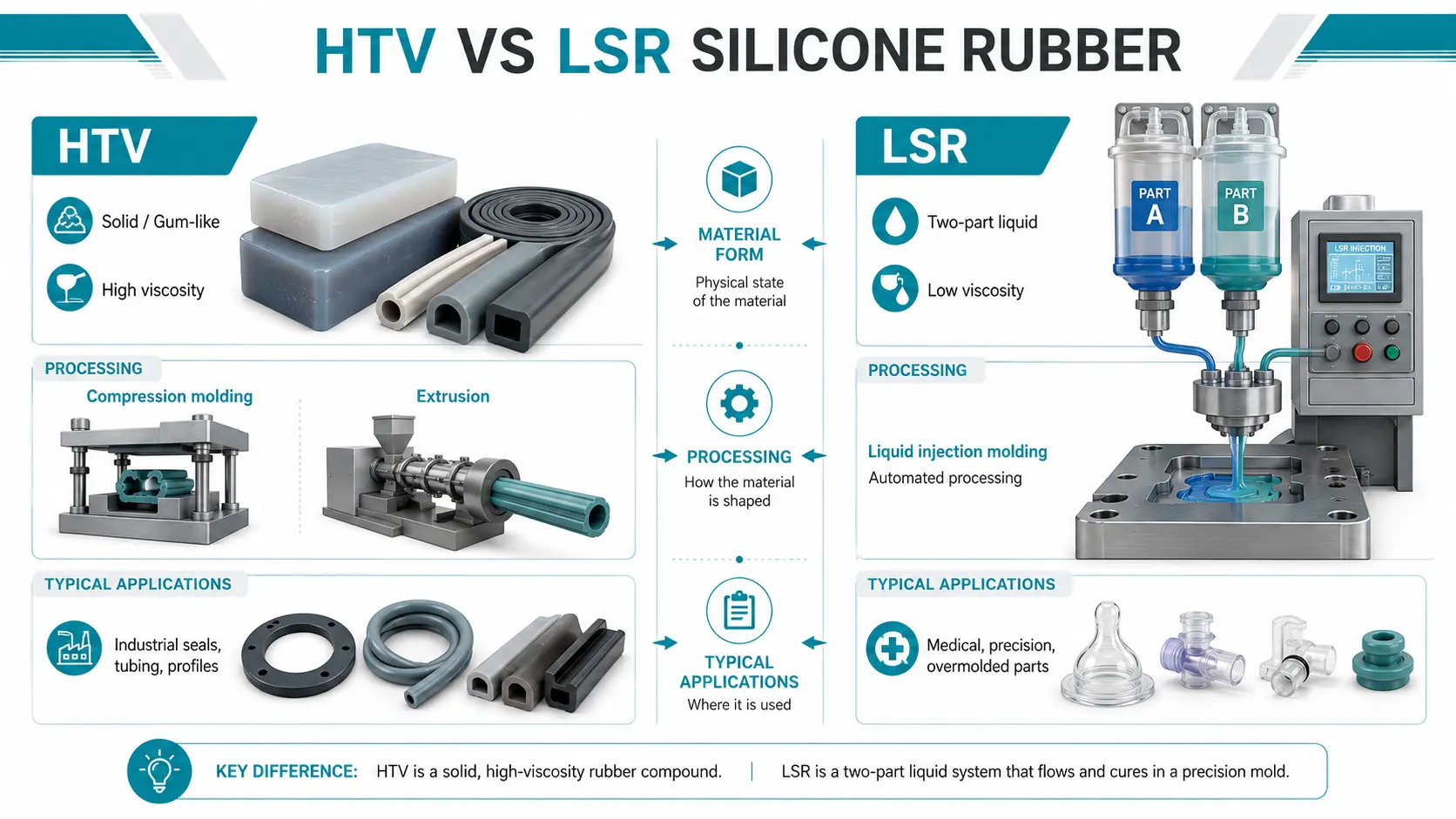
HTV stands for High Temperature Vulcanizing silicone rubber. It is commonly supplied as a solid or gum-like compound with relatively high viscosity. Before molding or extrusion, HTV silicone rubber is usually mixed with curing agents, pigments, fillers, and other additives. It is then shaped under heat and pressure through compression molding, transfer molding, calendering, or extrusion.
HTV silicone typically requires elevated temperature to complete crosslinking and form an elastic, stable rubber network. Depending on formulation, curing may be peroxide-based or platinum-based. Peroxide-cured HTV is common in general industrial products, while platinum-cured grades are often selected when cleaner curing, lower by-products, or stricter performance requirements are needed.
2. What Is LSR Silicone Rubber?
LSR stands for Liquid Silicone Rubber. Unlike HTV, LSR is supplied as a two-part liquid system, usually referred to as Part A and Part B. These two components are mixed in a precise ratio through automated metering equipment and then injected into a heated mold. LSR is commonly processed by liquid injection molding, also called LIM.
Most commercial LSR materials use platinum-catalyzed addition curing. This curing mechanism produces minimal by-products and allows high-purity, consistent, and automated processing. Because LSR flows easily before curing, it can fill complex cavities, thin walls, micro features, undercuts, and multi-cavity molds with excellent repeatability.
3. HTV vs LSR Silicone Rubber: Key Differences
| Yếu tố so sánh | Cao su silicone HTV | LSR Silicone Rubber |
|---|---|---|
| Hình thức vật liệu | Solid or gum-like rubber compound with high viscosity. | Two-part liquid silicone system with low viscosity. |
| Typical Processing Method | Compression molding, transfer molding, extrusion, calendering. | Liquid injection molding with automated metering and mixing. |
| Hệ thống đóng rắn | Usually peroxide-cured or platinum-cured depending on grade. | Commonly platinum-catalyzed addition curing. |
| Production Efficiency | Suitable for low to medium volumes; more manual handling may be required. | Highly efficient for large-volume production and multi-cavity molds. |
| Part Complexity | Best for simple to moderately complex shapes, profiles, tubes, and sheets. | Excellent for complex, thin-walled, micro, and precision components. |
| Tooling Cost | Generally lower initial tooling cost. | Higher mold and equipment investment. |
| Unit Cost at High Volume | Can become less competitive due to labor and cycle time. | Often lower due to automation, short cycle time, and repeatability. |
| Cleanliness | Depends strongly on compound, curing system, and workshop control. | Strong advantage in clean, closed, automated processing environments. |
| Các ứng dụng điển hình | Gaskets, hoses, profiles, seals, sheets, tubing, industrial parts. | Medical parts, baby products, precision seals, connectors, overmolded parts. |
4. Material Form and Handling Differences
One of the most obvious differences between HTV and LSR is material form. HTV is solid, tacky, and highly viscous. It must often be cut, weighed, preformed, or milled before processing. This gives manufacturers flexibility in adjusting compounds, but it also requires more manual handling and process control.
LSR, in contrast, is a pumpable liquid. Its two components are stored in containers or drums, delivered through pumps, mixed dynamically or statically, and injected into a mold by an automated system. This closed processing route improves cleanliness, reduces contamination risk, and enables stable repeatability.
5. Processing Technology Comparison
HTV silicone rubber is commonly processed through compression molding, transfer molding, extrusion, and calendering. Compression molding is suitable for seals, pads, gaskets, and relatively simple molded parts. Extrusion is ideal for tubes, hoses, cords, strips, and profiles. These methods are mature, flexible, and cost-effective for many applications.
LSR is mainly processed by injection molding. The process is highly automated: material metering, mixing, injection, curing, demolding, and even part removal can be integrated into a continuous production cell. Short cycle times, multi-cavity tooling, minimal flash, and automated demolding make LSR highly attractive for large-scale production.
6. Mechanical and Thermal Performance
Both HTV and LSR silicone rubber offer excellent thermal stability. Silicone rubber can remain flexible across a wide temperature range and can perform in environments where many organic elastomers become brittle, soften, or degrade.
HTV silicone often provides strong mechanical properties, particularly in tear strength, tensile strength, and abrasion resistance, depending on formulation and filler system. LSR also provides reliable elasticity, elongation, and compression set performance. Its greatest strength is consistency, especially for precision components and regulated production environments.
7. Design Flexibility and Part Complexity
HTV is suitable for many conventional shapes, including gaskets, rings, sheets, diaphragms, hoses, tubes, and simple molded parts. It is especially effective when the product has a relatively large cross-section or when extrusion is required.
LSR is superior when the part design is complex, small, thin, or highly detailed. It can reproduce fine surface textures, small holes, thin membranes, complex sealing lips, and intricate geometries. LSR also supports overmolding onto plastics, metals, glass, and other substrates, provided the substrate and bonding system are compatible.
8. Cleanliness, Biocompatibility, and Regulatory Considerations
Both HTV and LSR can be formulated for medical, food-contact, and high-purity applications, but LSR often has a stronger position in applications requiring very clean processing and high production consistency. Platinum-cured LSR generally produces fewer curing by-products than peroxide-cured systems, which helps reduce extractables and odor.
In medical and healthcare applications, material selection must consider more than the basic silicone family. Biocompatibility, sterilization compatibility, traceability, extractables and leachables, regulatory documentation, and manufacturing environment all matter.
9. Production Volume and Cost Structure
Cost comparison between HTV and LSR should include material cost, tooling cost, labor cost, cycle time, scrap rate, finishing cost, and quality control cost. HTV may have a lower initial tooling cost and can be economical for low- or medium-volume production.
LSR usually requires higher investment in injection molds, metering equipment, and process development. However, once production volume is high enough, LSR can reduce unit cost through automation, shorter cycles, lower labor input, and better part consistency.
10. How to Choose Between HTV and LSR
Choosing between HTV and LSR should begin with the part design and end-use requirements. If the product is a tube, hose, sheet, large gasket, or simple molded component, HTV may be the more practical option. If the part is small, complex, thin-walled, highly precise, or produced in very large quantities, LSR may offer better technical and economic performance.
Manufacturers should also evaluate curing system, hardness, color, transparency, tear strength, elongation, compression set, thermal aging, chemical exposure, regulatory requirements, and assembly method.
Kết luận
HTV and LSR silicone rubber are not competing materials in a simple sense; they are different solutions for different manufacturing and performance needs. HTV silicone rubber offers strong versatility, proven mechanical performance, and excellent suitability for extrusion, compression molding, and customized industrial products. LSR silicone rubber provides high precision, clean processing, automation potential, and outstanding consistency for complex and high-volume applications.
The best choice depends on part geometry, production volume, cleanliness requirements, regulatory expectations, tooling budget, and long-term cost targets. By understanding the fundamental differences between HTV and LSR, engineers and purchasing teams can select the most appropriate silicone rubber solution for reliable, efficient, and scalable product manufacturing.