
Is Rubber a Conductor or Insulator?
Rubber is generally an electrical insulator, not a conductor. Most conventional rubber materials resist the movement of electric charge because they contain relatively few mobile charge carriers. This is why rubber and rubber-like elastomers are widely used around electrical cables, connectors, protective equipment and insulating components.
However, the complete answer is more complicated. Rubber can become electrically conductive when conductive fillers are intentionally added, and even insulating rubber can experience leakage current, tracking or dielectric breakdown under wet, contaminated or very high-voltage conditions.
The electrical behavior also depends on the rubber type. Natural rubber, EPDM, silicone rubber, nitrile rubber and specially formulated conductive elastomers can have very different resistance, temperature stability and environmental performance.
This guide explains whether rubber is a conductor or insulator, why rubber usually resists electricity, when it can conduct, and why silicone rubber is widely used in high-voltage electrical insulation.
Quick Answer: Is Rubber a Conductor or Insulator?
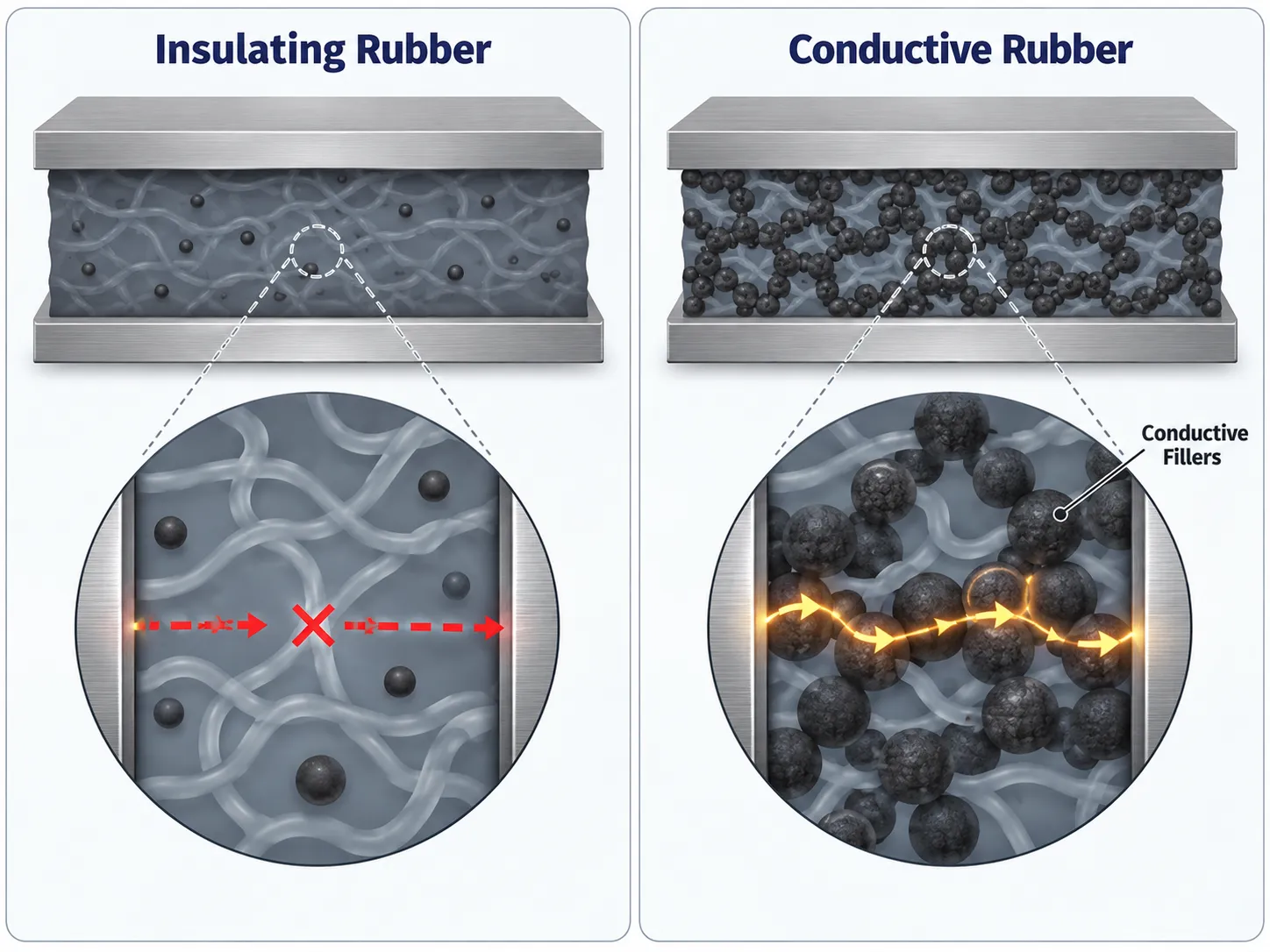
Tại sao cao su lại là chất cách điện?
Electrical conduction requires mobile charge carriers that can move through a material when an electric field is applied.
Metals such as copper and aluminum contain many mobile electrons, which is why electrical current flows through them easily.
In most rubber polymers, electrons are much more tightly associated with molecular bonds. The material therefore provides very few freely moving charge carriers.
As a result, the electrical resistance of ordinary rubber is much higher than that of metals.
Is Rubber a Perfect Insulator?
No electrical insulating material is perfect.
Even high-resistance rubber allows extremely small amounts of electrical leakage under some conditions. The important question is whether that leakage remains low enough for the intended application.
The performance of rubber insulation depends on factors such as formulation, thickness, temperature, moisture, voltage, contamination and aging.
Rubber vs Conductive Materials
| Chất liệu | Typical Electrical Behavior | Main Reason |
|---|---|---|
| Đồng | Excellent conductor | Large number of mobile electrons |
| Aluminum | Good conductor | Free movement of electrical charge |
| Cao su tiêu chuẩn | Electrical insulator | Very limited mobile charge carriers |
| Electrical Silicone Rubber | High-resistance insulator | Insulating polymer and controlled filler system |
| Cao su dẫn điện | Conductive or semi-conductive | Conductive fillers form electrical pathways |
Does Rubber Conduct Electricity?
Most ordinary rubber does not conduct electricity easily. This is why the material is commonly used in electrical insulation and protective applications.
However, saying that rubber “never conducts electricity” would be incorrect.
Electric current can appear in or around rubber through several mechanisms:
Can Rubber Be Made Conductive?
Yes. Rubber can be intentionally formulated to conduct electricity.
Conductive rubber compounds contain materials that form electrically connected pathways throughout the elastomer.
Common conductive filler systems may include carbon black, graphite, carbon-based nanomaterials or metallic particles.
As filler loading and distribution change, electrical resistance can drop by many orders of magnitude.
| Rubber Type | Electrical Function | Typical Application Direction |
|---|---|---|
| Cao su cách nhiệt | Restricts electrical current | Cable insulation, electrical seals, insulators |
| Cao su chống tĩnh điện | Allows controlled dissipation of static charge | Electronics manufacturing and industrial flooring |
| Cao su dẫn điện | Provides much lower electrical resistance | EMI shielding, grounding and conductive interfaces |
How Carbon Black Changes Rubber Conductivity
Carbon black is widely used in rubber formulations for several different reasons. Depending on the carbon black type and concentration, it may provide reinforcement, pigmentation or electrical conductivity.
At sufficiently effective loading, carbon particles begin to form connected networks inside the elastomer.
Once enough conductive pathways are established, the electrical resistance of the rubber drops significantly.
This explains why two black rubber compounds can have completely different electrical behavior even if they look almost identical.
Is Natural Rubber a Conductor or Insulator?
Natural rubber is generally an electrical insulator when properly formulated and dry.
Its polymer structure naturally provides high resistance to electrical current.
Natural rubber is also flexible and mechanically resilient, which historically made it useful in many insulating applications.
However, natural rubber has limitations in areas such as ozone resistance, weathering and prolonged high-temperature exposure.
For demanding electrical environments, synthetic elastomers may provide more stable long-term performance.
Are Synthetic Rubbers Electrical Insulators?
Many synthetic rubber materials provide useful electrical insulation, but their performance varies significantly by polymer and formulation.
| Rubber Type | Cách điện | Other Important Characteristics |
|---|---|---|
| Cao su silicone | Excellent in suitable electrical grades | Wide temperature range, UV and ozone resistance, hydrophobicity |
| EPDM | Good | Strong weather, ozone and water resistance |
| Cao su tự nhiên | Good when properly formulated | Strong elasticity and mechanical performance |
| NBR | Application dependent | Useful oil resistance |
| FKM | Application dependent | Strong chemical and high-temperature resistance |
The phrase “rubber is an insulator” is therefore correct in general, but engineers should always evaluate the exact compound rather than the polymer family alone.
Why Silicone Rubber Is an Important Electrical Insulator
Silicone rubber is one of the most important elastomers used in modern electrical insulation.
Suitable electrical-grade silicone compounds can provide high volume resistivity, useful dielectric strength and long-term resistance to temperature, UV radiation and ozone.
Silicone rubber also provides an important advantage in outdoor high-voltage systems: hydrophobicity.
What Is Volume Resistivity?
Volume resistivity describes how strongly a material resists electrical current flowing through its bulk.
A high volume resistivity indicates that only a very small electrical current can pass through the material under the specified test conditions.
This is one of the important properties used to characterize electrical insulating rubber.
Electrical-grade silicone rubber can achieve very high volume resistivity, but the actual value depends on formulation, temperature, moisture and test conditions.
What Is Dielectric Strength?
Dielectric strength describes how much electric field an insulating material can withstand before electrical breakdown occurs.
It is often expressed as voltage per unit thickness, such as kV/mm.
This property is especially relevant for cable insulation, molded electrical components and high-voltage silicone rubber.
Does Rubber Conduct Electricity When Wet?
Wet rubber can appear more conductive even when the bulk rubber material remains highly insulating.
The main reason is usually the water on its surface.
Real-world water contains dissolved minerals, salts and other ions. When this water spreads across an insulating surface, it can create a lower-resistance path for electrical current.
This distinction becomes particularly important in outdoor electrical equipment.
Why Salt Water Is More Dangerous
Salt water contains large numbers of dissolved ions that can move through the liquid and carry electrical charge.
In coastal environments, salt can accumulate on exposed electrical insulation.
When fog, dew or rain wets the surface, the salt dissolves and can dramatically reduce surface resistance.
This can increase leakage current even though the rubber material itself has not become a conductive polymer.
What Is Surface Leakage Current?
Leakage current is unwanted electrical current flowing through or across an insulating system.
On outdoor rubber insulation, moisture and contamination can create a conductive path along the surface.
→
→
→
Low leakage current does not always produce immediate failure, but sustained current can cause localized heating and contribute to further electrical degradation.
Does Rubber Conduct Electricity Under High Voltage?
At sufficiently high electrical stress, an insulating rubber can lose its ability to prevent current flow.
This is known as dielectric breakdown.
Before complete breakdown occurs, electrical insulation may also experience partial discharge, surface leakage, tracking or erosion.
The critical electric field depends on material formulation, thickness, defects, temperature and environmental conditions.
What Is Electrical Tracking?
Electrical tracking is progressive damage that creates a conductive path along the surface of an insulating material.
It can develop when moisture, contamination and electrical stress repeatedly produce localized discharges.
As the surface degrades, a carbonized or otherwise conductive path may form.
Tracking is especially important for outdoor high-voltage polymer insulation.
What Is Electrical Erosion?
Electrical erosion is the physical loss of insulating material caused by repeated electrical discharge and localized heating.
The surface can gradually become rough, pitted or damaged.
Severe erosion can reduce the protective thickness of the insulating housing.
Electrical-grade silicone rubber used in composite insulators is therefore often formulated for both tracking resistance and erosion resistance.
Tại sao tính kỵ nước lại quan trọng?
Hydrophobicity describes the ability of a surface to repel water.
On hydrophobic silicone rubber, water tends to form separated droplets rather than spreading immediately into one continuous film.
This helps interrupt possible surface conduction paths.
Hydrophobicity does not eliminate all leakage current, but it provides an important advantage in wet and polluted electrical environments.
Why Silicone Rubber Is Used in Composite Insulators
Composite insulators are one of the most demanding electrical applications for silicone rubber.
A typical composite insulator includes a fiberglass-reinforced core that carries mechanical load, metal end fittings and a silicone rubber housing with multiple sheds.
The silicone housing performs several important electrical and environmental functions.
| Silicone Rubber Function | Tại sao điều này lại quan trọng |
|---|---|
| Cách điện | Helps separate energized and grounded parts |
| Hydrophobic Surface | Reduces continuous wet conductive paths |
| Theo dõi mức kháng cự | Helps resist permanent surface conduction paths |
| Khả năng chống xói mòn | Helps withstand dry-band arcing and electrical heating |
| Weather Protection | Protects the FRP core from moisture and outdoor exposure |
| Khả năng chống tia UV | Supports long-term outdoor service |
Why Composite Insulators Use Sheds
The repeated shed profile of a composite insulator increases the creepage distance along the insulating surface.
A longer surface path helps reduce the risk of continuous leakage current and flashover under wet or contaminated conditions.
Shed geometry also influences water behavior and contamination accumulation.
Reliable insulation therefore depends on both the silicone rubber material and the physical design of the insulator.
Why ATH Is Used in Electrical Silicone Rubber
Electrical-grade silicone rubber for composite insulators often contains aluminum trihydrate, commonly called ATH.
ATH is used because it can improve resistance to electrical tracking and erosion.
Under severe localized heating, ATH can absorb thermal energy as chemically bound water is released.
This helps reduce thermal damage caused by repeated dry-band arcing.
However, ATH also changes the rheology and mechanical behavior of the silicone compound, so the complete formulation must remain balanced.
Cao su silicone dùng cho cách điện dây và cáp
Silicone rubber is widely used in wire and cable applications where electrical insulation must remain flexible across demanding temperatures.
Typical requirements include high electrical resistance, dielectric strength, heat-aging stability and reliable extrusion behavior.
Cable manufacturers must evaluate not only final electrical properties but also processing characteristics such as feed stability, extrusion pressure, surface quality and cure behavior.
Cao su silicone trong các hệ thống điện áp cao của xe điện
Electric vehicles use silicone elastomers in high-voltage cables, connector seals, battery components and protective electrical parts.
These materials may experience electrical stress together with heat, vibration and repeated temperature cycling.
Silicone rubber is useful because electrical insulation can be combined with thermal stability and flexibility.
The correct EV compound should still be selected for the exact voltage, temperature, flame, mechanical and processing requirements.
Rubber Insulation Applications
Rubber and silicone elastomers are used in many electrical applications because they combine insulation with flexibility.
Rubber vs Plastic as an Electrical Insulator
Both rubber and plastic can provide electrical insulation, but they behave differently mechanically.
Rubber's primary advantage is elasticity. It can bend, stretch and compress while maintaining contact with surrounding components.
Rigid plastics offer greater structural stiffness and can be better for housings and rigid electrical supports.
| Tài sản | Rubber | Rigid Plastic |
|---|---|---|
| Cách điện | Good to excellent depending on compound | Good to excellent depending on polymer |
| Tính linh hoạt | Tuyệt vời | Usually much lower |
| Elastic Recovery | High | Limited |
| Niêm phong | Excellent for suitable designs | Less conformable |
| Structural Rigidity | Lower | Cao hơn |
Does Higher Rubber Hardness Improve Electrical Insulation?
No. Shore hardness and electrical insulation are different properties.
A 70 Shore A rubber is not automatically a better electrical insulator than a 50 Shore A compound.
Hardness mainly describes resistance to indentation.
Electrical resistance depends on polymer chemistry, filler system, additives, moisture, contamination and temperature.
Does Temperature Affect Rubber Conductivity?
Temperature can affect the electrical resistance of rubber.
As temperature changes, molecular mobility and charge transport can change. Prolonged high-temperature exposure can also alter the polymer network and accelerate aging.
For electrical applications operating close to heat sources, insulation performance should be evaluated after relevant thermal aging rather than only at room temperature.
Does Aging Affect Rubber Electrical Insulation?
Yes. Electrical insulation can change throughout the service life of a rubber component.
This is particularly important for outdoor high-voltage equipment expected to operate for many years.
How to Choose Rubber for Electrical Insulation
Electrical rubber should be selected according to the complete application rather than one property.
What Should Electrical OEMs Include in a Rubber RFQ?
Cao su silicone điện của Yakows
Yakows supplies HTV/HCR silicone rubber and other silicone elastomer compounds for electrical insulation applications including composite insulators, surge arrester housings, wire and cable and EV high-voltage components.
Electrical-grade silicone materials can be evaluated around dielectric strength, volume resistivity, hydrophobicity, tracking and erosion resistance, tear strength, thermal aging and processing requirements.
For composite insulator manufacturers, material selection can also consider ATH filler systems, injection or compression molding behavior and batch-to-batch consistency.
Customers replacing an existing silicone compound can provide their current specification, application, processing method and observed production or field-performance issues for material comparison.
Các câu hỏi thường gặp
Is rubber a conductor or insulator?
Most conventional rubber is an electrical insulator because it strongly resists the movement of electrical charge.
Does rubber conduct electricity?
Ordinary insulating rubber conducts very little electricity, but conductive fillers, wet contamination or electrical breakdown can allow current to flow.
Why is rubber an insulator?
Rubber contains relatively few mobile charge carriers, so electric current cannot move through the material as easily as it can through metals.
Can rubber become conductive?
Yes. Rubber can be formulated with carbon black, graphite or other conductive fillers to create conductive or antistatic elastomers.
Cao su ướt có dẫn điện không?
The rubber may remain insulating internally, but water containing salts or contamination can create a conductive path across its surface.
Does rubber conduct electricity under high voltage?
Rubber remains insulating only within its electrical limits. Sufficiently high electrical stress can cause leakage, tracking or dielectric breakdown.
Is silicone rubber an electrical insulator?
Yes. Properly formulated silicone rubber is widely used as electrical insulation because of its high resistance, dielectric properties and environmental durability.
Why is silicone rubber used in composite insulators?
Silicone rubber combines electrical insulation with hydrophobicity, UV and ozone resistance and specialized tracking and erosion performance.
What is conductive rubber?
Conductive rubber is an elastomer formulated with conductive fillers that create electrical pathways through the material.
Does harder rubber insulate better?
Not necessarily. Shore hardness and electrical resistance are separate properties and should be evaluated independently.
What rubber is best for electrical insulation?
The best rubber depends on voltage, environment, temperature and mechanical requirements. Silicone rubber is especially useful for high-temperature and outdoor high-voltage insulation.
Can old rubber lose its insulating properties?
Yes. Heat, UV, electrical discharge, contamination and physical damage can gradually change insulation performance.