
Material Hardness Guide
Shore A vs Shore D Hardness
Shore hardness is widely used to compare elastomers, silicone rubber, thermoplastic elastomers and semi-rigid plastics. Shore A is mainly used for softer and flexible materials, while Shore D hardness is designed for harder elastomers and plastics. Understanding the difference helps engineers choose the correct material and interpret technical data more accurately.
What Is the Difference Between Shore A and Shore D Hardness?
The main difference between Shore A and Shore D hardness is the range of material stiffness each scale is designed to measure.
Shore A is commonly used for soft to moderately hard elastomers such as silicone rubber, EPDM, NBR, TPU and other flexible materials. Shore D is used for harder elastomers, rigid thermoplastic elastomers and many plastics.
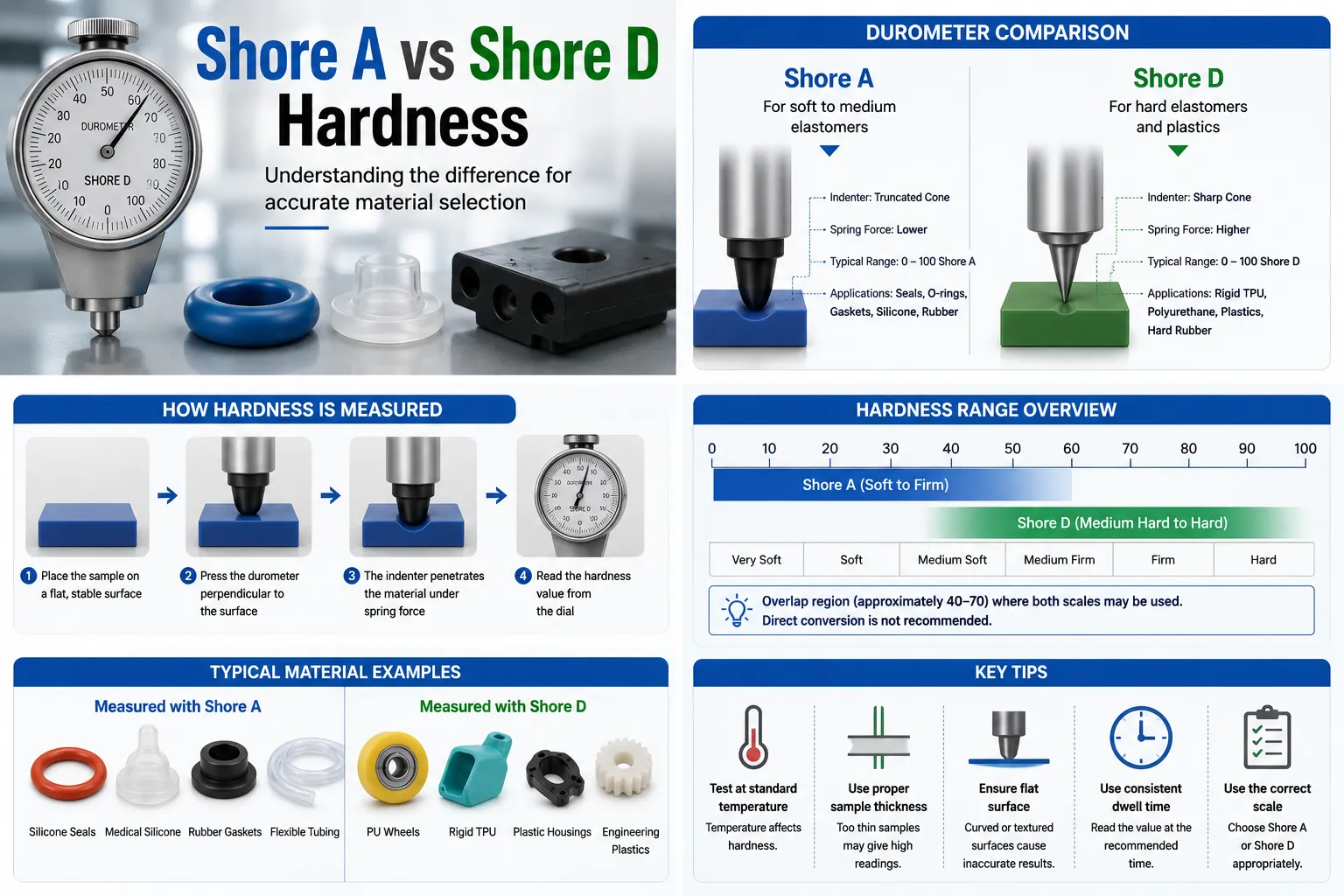
Both scales are measured using a durometer, but the indenter geometry and spring force are different. Shore D applies a substantially higher force and uses a sharper indenter, allowing it to measure materials that would be too hard for the Shore A scale.
Shore A is mainly for softer rubber-like materials, while Shore D hardness is mainly for harder rubber, semi-rigid elastomers and plastics.
What Is Shore Hardness?
Shore hardness is an indentation-hardness measurement. A spring-loaded indenter is pressed into the surface of a material, and the amount of penetration is converted into a value on a scale from 0 to 100.
A lower Shore number indicates that the indenter penetrates farther into the material. A higher number indicates less penetration and therefore a harder material.
Shore hardness is commonly measured according to standardized durometer methods such as ASTM D2240 and ISO 868.
The reading does not directly describe tensile strength, tear resistance, modulus or compression set. Two materials can have the same Shore hardness while behaving very differently under tension, compression or long-term load.
What Is Shore A Hardness?
Shore A is the most common hardness scale for flexible elastomers and rubber products.
Materials measured with Shore A may range from very soft silicone gels and elastomers to relatively firm rubber compounds.
Typical products measured using Shore A include:
- Silicone rubber seals
- O-rings
- EPDM gaskets
- NBR seals
- Flexible TPU
- Rubber rollers
- Phớt kín trong ngành ô tô
- Medical silicone components
- Composite insulator silicone housings
A very soft silicone may have a relatively low Shore A value, while a firm industrial silicone rubber compound may be specified around 60, 70 or even higher Shore A.
What Is Shore D Hardness?
Shore D hardness is a durometer scale intended for harder elastomers and plastics.
When a material becomes too hard for reliable Shore A measurement, the Shore D scale provides greater differentiation.
Shore D is commonly used for rigid TPU, hard polyurethane, engineering plastics, hard rubber compounds and other materials with significantly greater resistance to indentation.
Typical products measured with Shore D include:
- Hard polyurethane wheels
- Rigid TPU components
- Plastic housings
- Hard thermoplastic elastomers
- Industrial wear parts
- Plastic sheets and molded components
- Hard elastomer rollers
- Protective structural components
Shore D hardness is particularly useful when Shore A readings approach the upper end of the Shore A scale and no longer provide enough meaningful differentiation.
Shore A vs Shore D Hardness Comparison
| Tính năng | Bờ A | Shore D |
|---|---|---|
| Typical material type | Soft to firm elastomers | Hard elastomers and plastics |
| Common materials | Silicone, EPDM, NBR, soft TPU | Hard TPU, polyurethane, rigid TPE and plastics |
| Indenter force | Lower | Cao hơn |
| Indenter geometry | Designed for softer materials | Sharper profile for harder materials |
| Typical application | Seals, tubing, gaskets and flexible parts | Wear parts, wheels, housings and harder structural components |
| Best use | Flexible rubber-like behavior | Higher stiffness and indentation resistance |
How Is Shore D Hardness Measured?
Shore D hardness is measured using a Shore D durometer. The instrument contains a spring-loaded indenter that is pressed against a flat test surface.
The harder the material, the less deeply the indenter penetrates, resulting in a higher Shore D reading.
Several factors can influence the result, including sample thickness, surface condition, test temperature, measurement time and distance from edges.
Typical Test Procedure
- Prepare the sample. Use a flat, clean specimen with sufficient thickness for the selected test method.
- Condition the material. Allow the sample to reach the specified test temperature.
- Place the durometer perpendicular to the surface.
- Apply the instrument smoothly. Avoid impact or uneven pressure.
- Record the reading. Follow the specified dwell time where applicable.
- Repeat at multiple locations. Avoid edges and previous indentation points.
- Report the average or specified result.
Why Shore A and Shore D Use Different Indenters
A single durometer configuration cannot accurately differentiate every material from a very soft elastomer to a rigid plastic.
A soft silicone rubber requires a relatively gentle measurement system so the instrument can detect meaningful differences in indentation.
A hard polyurethane or plastic would barely deform under the same test conditions. Shore D therefore uses a different indenter and greater spring force.
This allows the Shore D scale to provide useful resolution for materials that would produce readings close to 100 Shore A.
Can Shore A Be Converted to Shore D?
Shore A and Shore D values should not be treated as directly interchangeable.
Approximate comparison charts exist, and certain materials fall within an overlapping region where both scales can produce usable readings. However, there is no universal exact mathematical conversion that applies to every elastomer.
The relationship depends on material viscoelasticity, formulation, thickness, temperature and test method.
Do not replace a specification such as 60 Shore D with a calculated Shore A value unless the conversion has been validated on the actual material.
Where Do Shore A and Shore D Overlap?
The upper portion of the Shore A scale overlaps with the lower portion of the Shore D scale.
A very hard elastomer might therefore be measurable using either scale, but the results will be expressed as different numbers.
In this transition region, Shore D can often provide better differentiation when materials are close to the practical upper limit of Shore A.
If a product specification is written in Shore D hardness, quality control should normally use Shore D rather than switching scales.
Typical Material Hardness Ranges
The following table gives general examples. Actual values depend on formulation and should not be used as universal specifications.
| Material / Product | Typical scale | General feel or behavior |
|---|---|---|
| Very soft silicone rubber | Bờ A | Very flexible and easy to compress |
| Medical silicone seal | Bờ A | Soft and conformable |
| General rubber gasket | Bờ A | Flexible with moderate resistance to compression |
| Firm silicone rubber | Bờ A | Flexible but relatively stiff |
| Hard TPU | Shore A or Shore D depending on grade | Firm to semi-rigid |
| Polyurethane wheel | Shore A or Shore D | Hard and wear resistant |
| Rigid thermoplastic elastomer | Shore D | Semi-rigid |
| Engineering plastic | Shore D | Hard with low indentation |
Shore D Hardness and Material Stiffness Are Not the Same
A higher Shore D hardness generally indicates greater resistance to indentation, but hardness should not be confused with elastic modulus.
Modulus describes the relationship between stress and strain, while Shore hardness measures surface indentation under defined conditions.
Two materials with similar Shore D readings can have different bending stiffness, tensile behavior or impact resistance.
Engineers designing structural parts should therefore review modulus, tensile strength and impact data in addition to hardness.
Shore D Hardness and Wear Resistance
Higher hardness can sometimes improve resistance to cutting, deformation or abrasion, but shore d hardness alone does not determine wear performance.
Abrasion resistance depends on polymer chemistry, filler system, friction, surface temperature, load and contact conditions.
A harder polyurethane may perform well in a wheel application, but another compound with the same Shore D hardness may have significantly different abrasion resistance.
Shore D Hardness in TPU
Thermoplastic polyurethane is available across a very broad hardness range.
Softer TPU grades are commonly specified using Shore A. As the material becomes harder and more rigid, manufacturers often switch to Shore D hardness.
High-Shore-D TPU may be used in rollers, wear components, protective housings, industrial wheels and structural flexible parts.
When comparing TPU grades, hardness should be considered together with tensile strength, elongation, abrasion resistance, flex fatigue and temperature behavior.
Shore Hardness of Silicone Rubber
Silicone rubber is normally specified using Shore A because most silicone elastomer formulations remain within a flexible rubber range.
Medical silicone, automotive silicone seals, high-voltage silicone and general industrial silicone compounds can be formulated in many different Shore A hardness levels.
Hardness affects flexibility, sealing force, demolding, tear behavior and component geometry.
Very hard silicone formulations exist, but Shore D is less commonly used for conventional flexible silicone rubber than for TPU or rigid plastics.
Shore Hardness in Composite Insulator Silicone Rubber
Composite insulator housings are normally manufactured from flexible high-voltage silicone rubber, so Shore A is generally more relevant than Shore D.
Housing hardness affects weather-shed flexibility, demolding and mechanical handling, but hardness alone does not determine whether the silicone is suitable for high-voltage insulation.
A composite-insulator silicone compound should also be evaluated for:
- Hydrophobicity
- Tracking resistance
- Erosion resistance
- Tear strength
- Độ bền kéo
- Elongation
- Khả năng chống chịu thời tiết
- UV and ozone resistance
- Electrical properties
- FRP core adhesion
Shore D Hardness in Plastic Components
Shore D is frequently used for materials that behave more like hard thermoplastics than conventional rubber.
It can be useful for comparing molded housings, rigid polyurethane systems and semi-rigid thermoplastic elastomers.
However, engineering plastics are also commonly characterized using Rockwell hardness, ball indentation hardness, tensile modulus and other test methods.
Shore D hardness should therefore be used when it is appropriate to the material specification rather than as the only measure of plastic performance.
How Temperature Affects Shore Hardness
Elastomer hardness changes with temperature.
At lower temperatures, many polymers become stiffer and may produce higher hardness readings. At higher temperatures, the same material may soften and produce lower readings.
Long-term thermal aging can also permanently change hardness. Some elastomers gradually become harder because of oxidation or continued crosslinking.
Material comparisons should therefore be performed under controlled and consistent test conditions.
How Sample Thickness Affects Shore D Hardness
Durometer measurement depends on the ability of the material beneath the indenter to deform.
If a sample is too thin, the rigid support surface beneath the sample can influence the reading and make the material appear harder than it actually is.
The test specimen should therefore meet the thickness requirements of the applicable test method or be made from stacked layers when permitted.
Production parts with thin walls may not be suitable for direct durometer testing without a defined fixture or alternative test specimen.
How Surface Condition Affects Hardness Testing
Shore hardness should ideally be measured on a smooth, flat surface.
Curved components, textured surfaces, mold lines and rough areas can produce inconsistent readings because the indenter does not contact the material uniformly.
When hardness is an important quality-control parameter, suppliers should agree on the test specimen geometry, test location and conditioning procedure.
Shore D Hardness Is Not a Strength Rating
A material with high Shore D hardness is not automatically stronger than a softer material.
Hardness describes indentation resistance. Strength may refer to tensile strength, tear resistance, flexural strength, compressive strength or impact resistance.
For example, a harder plastic may be brittle, while a slightly softer polyurethane can absorb significantly more impact energy.
The required performance must therefore be matched to the correct material property.
Shore D Hardness Is Not the Same as Shore A 100
A common misunderstanding is that 100 Shore A should equal 100 Shore D.
The two scales use different test configurations and are designed for different hardness ranges. Their numerical values cannot be directly compared simply because both scales run from 0 to 100.
A material that produces a high Shore A reading may produce a much lower numerical value when tested on Shore D.
When Should You Use Shore A?
Shore A is generally appropriate when the material is flexible and rubber-like.
Typical examples include:
- O-rings
- Soft and medium-hard gaskets
- Cao su silicone
- NBR rubber
- EPDM rubber
- Phớt kín trong ngành ô tô
- Flexible medical parts
- Soft TPU
- Vật liệu cách điện điện linh hoạt
When Should You Use Shore D?
Shore D hardness is generally more appropriate for materials that feel hard or semi-rigid and provide relatively little indentation under a Shore A durometer.
Typical examples include:
- Hard TPU
- Rigid polyurethane
- Hard industrial rollers
- Wear-resistant wheels
- Semi-rigid TPE
- Plastic housings
- Engineering plastic components
- Hard protective parts
How to Choose the Correct Shore Hardness Scale
- Identify the material family.
Determine whether the product is soft rubber, firm elastomer, hard TPU or rigid plastic. - Check the supplier specification.
Use the same Shore scale stated on the technical data sheet whenever possible. - Consider expected hardness.
Flexible elastomers normally use Shore A, while harder materials may require Shore D. - Avoid readings near the extreme end of a scale.
If the material is extremely hard on Shore A, consider whether Shore D is more appropriate. - Use standardized test conditions.
Control temperature, specimen thickness, surface and dwell time. - Do not rely on conversion charts for specifications.
Measure using the required scale directly. - Evaluate other properties.
Hardness should be considered together with tensile, tear, modulus and compression performance.
How to Specify Shore D Hardness on a Drawing
A good engineering specification should include more than a hardness number.
For example, specifying only “60 hardness” is ambiguous because it does not identify the hardness scale.
The drawing or material specification should clearly state Shore D hardness, the required tolerance and the relevant test method where necessary.
Additional requirements may include test temperature, specimen conditioning and approved test locations.
“Shore D hardness: 60 ± 5” is much clearer than simply writing “Hardness: 60.”
Common Shore Hardness Testing Mistakes
Using the Wrong Scale
Measuring a very hard material with Shore A can place the result near the top of the scale and reduce useful differentiation.
Testing a Sample That Is Too Thin
The support surface can increase the apparent hardness.
Testing Too Close to an Edge
Edge deformation can affect the reading.
Testing a Curved Surface
Poor contact between the durometer foot and part can create inconsistent measurements.
Changing Dwell Time
Viscoelastic materials can show different readings depending on how quickly the value is recorded.
Comparing Different Temperatures
A warm elastomer may appear softer than the same compound tested under colder conditions.
Using Approximate Conversion as an Acceptance Test
Shore A and Shore D conversion charts should not replace direct testing on the specified scale.
Các câu hỏi thường gặp
What is Shore D hardness?
Shore D hardness is a durometer measurement used primarily for harder elastomers, semi-rigid thermoplastic materials and plastics.
What is the difference between Shore A and Shore D?
Shore A is designed for softer rubber-like materials, while Shore D uses a higher-force measurement system for harder elastomers and plastics.
Is Shore D harder than Shore A?
Shore D is designed for harder materials, but the numerical values of the two scales cannot be compared directly.
Can Shore A be converted to Shore D?
Approximate comparison charts exist, but there is no universal exact conversion. Direct measurement using the required scale is preferred.
What materials are measured in Shore D?
Hard TPU, polyurethane, semi-rigid thermoplastic elastomers and many plastics are commonly measured using Shore D.
Is silicone rubber measured in Shore A or Shore D?
Most flexible silicone rubber is specified in Shore A. Shore D is more commonly used for significantly harder materials.
Is 70 Shore A the same as 70 Shore D?
No. The two scales use different indenters and forces, so identical numbers do not represent identical material hardness.
Does higher Shore D mean stronger material?
Not necessarily. Higher Shore D indicates greater indentation resistance, but tensile strength, impact strength and tear resistance are separate properties.
Does temperature change Shore D hardness?
Yes. Polymer stiffness changes with temperature, so hardness measurements should be performed under controlled conditions.
What Shore scale should I use for TPU?
Softer TPU is commonly specified in Shore A, while harder and more rigid TPU grades are often specified in Shore D.
Why is Shore D hardness important?
Shore D hardness provides a practical way to compare indentation resistance among harder elastomers, polyurethane materials and semi-rigid plastics.