
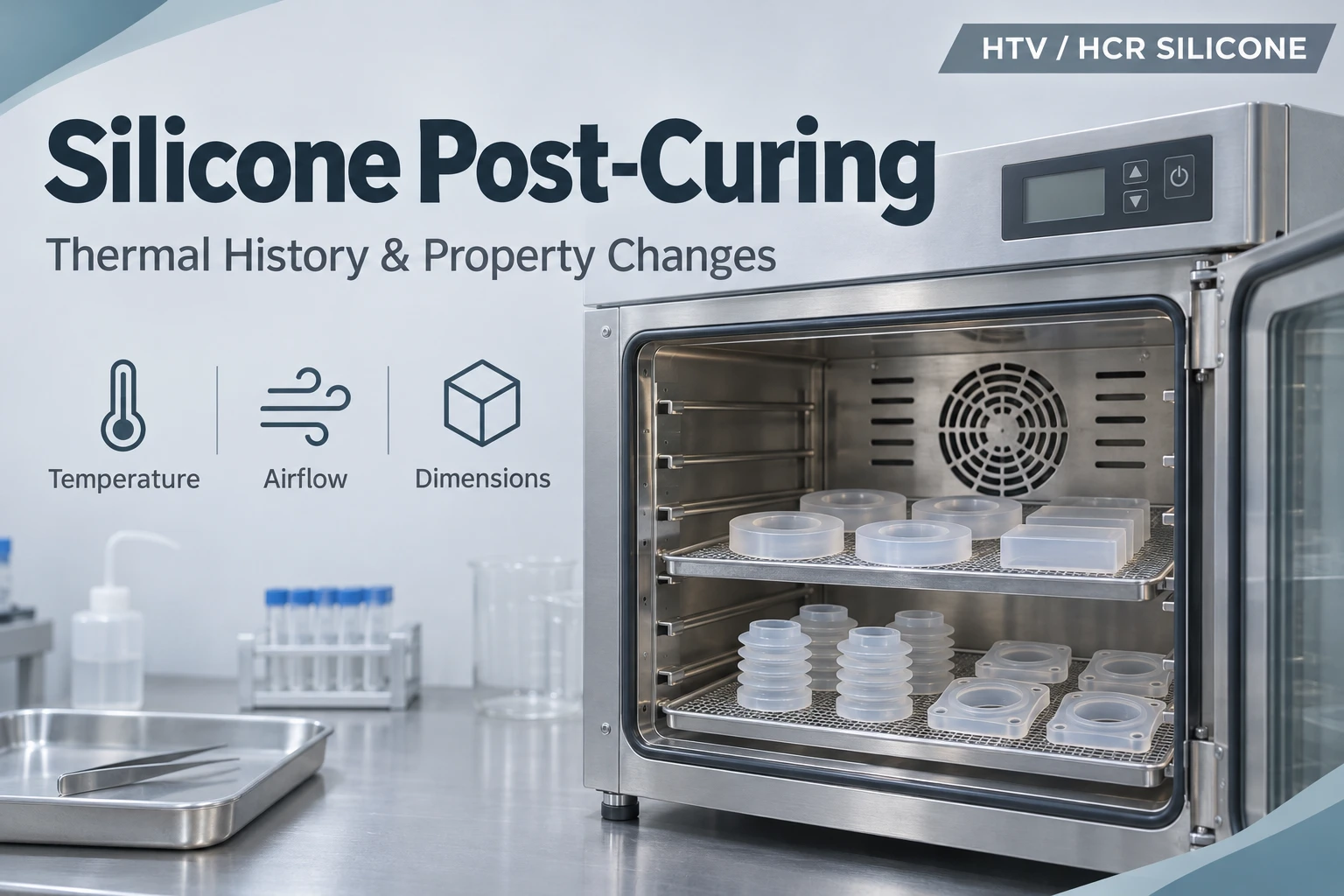
Define the Post-Cure Question Before Selecting an Oven Cycle
HTV silicone post-curing should be evaluated against a named material condition and a finished-part requirement. A complaint about odor, a dimensional change and a change in mechanical recovery are different investigations. Write down which response is unacceptable, how it was measured and whether the comparison sample received the same primary cure. An oven treatment cannot be specified responsibly from the word silicone alone.
Separate the supplier's required preparation from an experimental adjustment. If a property specification refers to a post-cured specimen, testing an as-molded specimen answers a different question. Conversely, applying an unnecessary oven cycle introduces another process variable. This discussion concerns solid HTV/HCR parts; it does not prescribe a cycle or establish food-contact, medical or electrical compliance.
Follow the Part Through the Oven, Not Only the Controller
An investigation record should identify the oven, load arrangement, tray position and time sequence. Preserve the distinction between the displayed setpoint and the temperature history established for the actual load. Record how the load was introduced, when timing began and how cooling was performed. A record containing only a temperature and a duration may conceal important differences between trials.
As an engineering comparison, mark equivalent parts at different tray positions and retain their individual measurements. Keep the grade, primary cure and measurement procedure unchanged. If differences follow position, investigate the equipment and loading pattern before attributing the result to the formulation. Use a qualified temperature-mapping procedure appropriate for the oven and avoid modifying ventilation outside the equipment's approved operating instructions.
What Happens After the Primary Cure?
Post-curing is a defined thermal treatment after the initial cure. Its purpose can include additional network development or reduction of residual volatile components, depending on the compound and application. The oven schedule must be connected to a specific material and intended result.
A part that can be removed from the tool has not necessarily reached the material state used for published test data. Conversely, not every silicone formulation requires the same additional treatment. Compare the processing documentation with the actual test preparation.
Volatile Removal and Part Geometry
Removal of residual components depends on the material, thermal history, geometry and oven conditions. A thin test plaque and a thick component do not automatically respond identically to the same nominal treatment.
Document the loading arrangement and relevant oven performance. Do not treat the setpoint alone as a complete description of the part's thermal exposure. If odor, mass change or extractables are the issue, choose measurements that address that issue instead of assuming hardness proves completion.
Mechanical Properties and Compression Recovery
Compare hardness, tensile behavior and compression response before and after the complete treatment using matched specimens. A change in one property does not show that every application requirement has improved.
When post-cure is part of the approved preparation, retain it in the process record. If a reduced schedule is proposed, evaluate the properties that motivated the treatment and the finished component's function. A satisfactory visual appearance is not a substitute for those measurements.
Dimensional Change After Oven Treatment
Measure parts under a defined conditioning state before attributing a dimension change to post-curing. Distinguish the initial molding shrinkage from additional change after the oven stage. Use the same datums and measurement method in both records.
Geometry and constraint can affect the observed shape. Track critical dimensions and flatness separately; one average shrinkage percentage may conceal local distortion. The required compensation belongs to the material–tool–process combination and should be established experimentally.
Troubleshooting an Unexpected Post-Cure Result
If a batch develops unexpected color, dimensions or mechanical behavior, compare raw-material identity, primary cure and oven history. Retain control samples from before the oven stage. Separating these steps prevents the last process operation from being blamed automatically.
Provide Yaksil with section thicknesses, loading, temperature records and the property that changed. Use the exact grade instructions as the starting point for a trial. Do not adopt another formulation's temperature and time as a universal correction.
Pair Before-and-After Measurements
Identify each part before treatment and measure the same features afterward. Record the conditioning time and measurement orientation. Thin flanges, thick sections and unsupported features may require separate observations. Measuring different groups without preserving their initial dimensions can make a small process effect difficult to distinguish from the variation already present after molding.
For a mass-change study, define specimen preparation, balance capability, cooling and handling. A measured mass change alone does not identify the chemical species lost or demonstrate compliance with a migration limit. If the application depends on extractables or a regulated substance, select a suitable analytical method and obtain the required product-specific evidence.
A Post-Cure Comparison Plan
Use three traceable groups where justified: the established production condition, an agreed reference preparation and one permitted process adjustment. State the purpose of each group before testing. Keep part geometry and the primary cure constant. Include an untreated reference only when it is safe and useful for investigation; do not release an experimental part merely because it looks acceptable.
Inspect the target property together with dimensions, surface condition and the component's functional response. A treatment that changes one laboratory result may introduce a different assembly problem. Retain the individual records rather than only a group average, and report any specimen excluded from the comparison with its reason.
Interpreting an Unexpected Result
If a post-cured part becomes dimensionally unacceptable, first compare the starting geometry and the measurement state. If odor remains, document how it was assessed and whether laboratory analysis is needed. If hardness changes, compare equivalent specimens under the same indentation conditions. None of these observations, in isolation, identifies an incorrect formulation.
The useful conclusion is specific: this material, this primary preparation and this oven sequence produced this measured response. A repeatable comparison can support a process decision. It should not be generalized into a universal temperature requirement or an unsupported claim that every HTV compound improves after longer heating.
Engineering Comparison Matrix
Choose the comparison that addresses the actual observation. These are proposed investigation routes, not Yaksil test results or universal acceptance criteria.
| Observation | Comparison | Keep documented |
|---|---|---|
| Dimension shifts after oven treatment | Pair the same feature before and after treatment | Primary cure and inspection state |
| Differences across trays | Compare marked equivalent parts by position | Material and load identification |
| Mass or odor changes | Select the relevant measurement or analytical method | Handling, cooling and observation criteria |
Technical Questions
Does a mass-loss result identify the volatile substance?
No. A mass difference is an aggregate observation under the stated preparation. Chemical identification and any application-specific limit require an appropriate analytical method and evidence.
Can the same oven recipe be used for every thickness?
Do not assume that it can. Establish the required condition using the actual grade, geometry and approved equipment procedure. Document how the load reaches the intended treatment state.
Does post-curing establish compliance?
No. Finished-article compliance depends on the applicable requirements and product-specific evidence. A process step is not a certification.
Discuss a Technical Issue
Share the material grade, component geometry, defect photographs, processing sequence and measured results with Yaksil. Include a baseline or unaffected sample where available and describe what changed before the problem appeared.
Review Cao su silicone HTV và HCR processing guidance in the context of the actual process. Technical discussion should lead to a testable explanation and a controlled evaluation of any proposed adjustment.
Technical References and Boundaries
Primary-source scope was checked on 23 November 2026. Public standards summaries do not replace licensed laboratory procedures. Diagnostic comparisons are engineering proposals; no grade-specific performance or certification is claimed.