
Silicone Rubber Types and Distinctions
Silicone rubber is not a single material. It is a broad family of elastomers that can differ significantly in viscosity, curing chemistry, processing method, mechanical properties and end-use performance. HTV, HCR, LSR and RTV are some of the most common terms, but they describe different ways silicone materials are formulated, supplied and processed.
Understanding these distinctions is important for buyers and engineers because two materials that are both called silicone rubber may behave very differently on the production line. A compound designed for extrusion may not be suitable for liquid injection molding, while a room-temperature-curing material may not provide the same performance as a high-consistency rubber used in cable insulation or composite insulators.
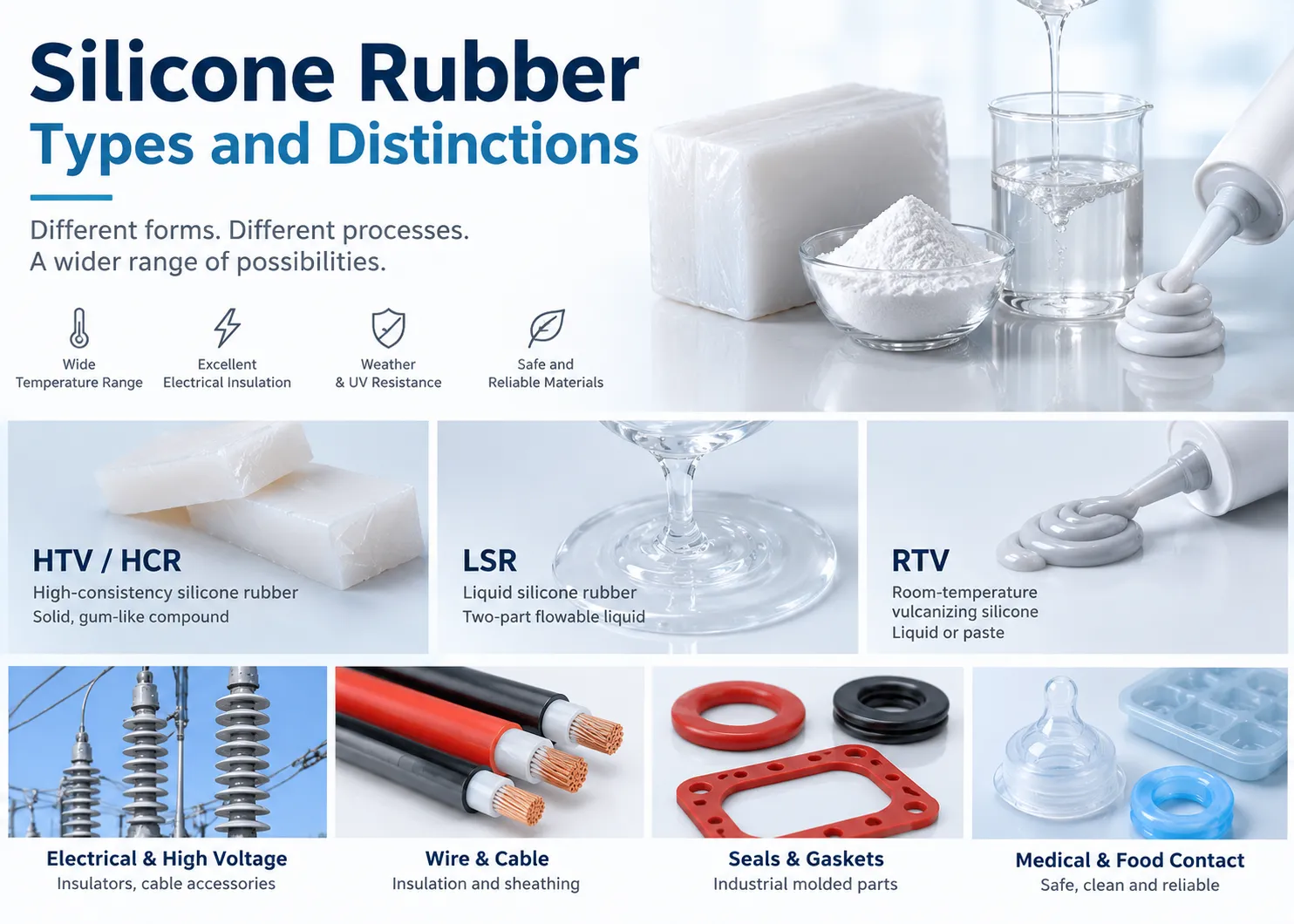
What Are the Main Types of Silicone Rubber?
The most practical way to classify silicone rubber is by its uncured physical form and curing method. From an industrial manufacturing perspective, the main categories are high-consistency silicone rubber, liquid silicone rubber and room-temperature-vulcanizing silicone.
| Type | Common Name | Uncured Form | Quy trình xử lý tiêu biểu | Các ứng dụng điển hình |
|---|---|---|---|---|
| HTV / HCR | High-temperature vulcanizing / high consistency rubber | Solid, gum-like compound | Compression molding, extrusion, transfer molding, calendering | Cables, insulators, seals, gaskets, industrial molded parts |
| LSR | Cao su silicone lỏng | Two-part flowable liquid | Đúc phun chất lỏng | Medical parts, connector seals, baby products, precision components |
| RTV | Room-temperature vulcanizing silicone | Liquid or paste | Dispensing, casting, sealing, potting | Sealants, electronics, mold making, adhesives and potting |
These categories are not simply different hardness grades. They represent different material systems with different processing equipment, curing behavior and manufacturing economics.
HTV and HCR Silicone Rubber
HTV and HCR are terms commonly used for high-consistency silicone compounds. HTV stands for high-temperature vulcanizing, while HCR stands for high consistency rubber. In many industrial contexts, the two terms refer to the same general family of gum-like silicone materials that require elevated temperature to cure.
Before vulcanization, HCR is dense and highly viscous. It is not pumpable like LSR. The compound is typically processed using compression molding, extrusion, transfer molding, calendering or suitable injection equipment designed for high-viscosity elastomers.
This category is especially important in industrial manufacturing because the formulation can be modified over a wide range. Hardness, tear strength, elongation, heat resistance, electrical performance, flame behavior, color and processing characteristics can all be adjusted according to the application.
Composite Insulators
Electrical grades can be formulated for hydrophobicity, tracking and erosion resistance, outdoor aging and mechanical durability.
Dây và cáp
Compounds can be designed for stable extrusion, electrical insulation, heat aging and flexibility.
Industrial Molding
Compression-molded seals, gaskets and technical components can use a wide range of hardness and mechanical-property combinations.
High-Temperature Parts
Special formulations can improve property retention during prolonged exposure to elevated temperatures.
Is HTV Silicone Rubber the Same as HCR?
They are often treated as equivalent terms, but they emphasize slightly different aspects of the material.
HCR describes the physical consistency of the uncured compound. It is a high-viscosity, gum-like rubber. HTV describes the curing condition because the material is vulcanized at elevated temperature.
In practice, many suppliers use HTV silicone rubber, HCR silicone rubber, solid silicone rubber and high-consistency silicone as overlapping commercial terms. When comparing materials, it is more useful to look at the actual formulation, cure system and processing method than to focus only on the acronym used by the supplier.
Cao su silicone lỏng
Liquid silicone rubber, commonly abbreviated as LSR, is very different from high-consistency silicone in its uncured state. It is normally supplied as two flowable components that are accurately metered, mixed and injected into a heated mold.
LSR is particularly well suited to automated manufacturing. Modern liquid injection molding systems can meter the two components continuously, inject the material rapidly and produce complex parts with short cycle times and limited manual handling.
Because the material flows easily before curing, LSR can fill thin sections and complex mold geometries that may be more difficult for high-consistency rubber. This makes it attractive for precision seals, medical products, electrical connectors and small molded components.
| Characteristic | HCR / HTV | LSR |
|---|---|---|
| Uncured Consistency | Solid and gum-like | Flowable liquid |
| Material Supply | Compound, sheets, blocks or strips | Typically two liquid components |
| Primary Molding Method | Compression, transfer or elastomer injection molding | Đúc phun chất lỏng |
| Đùn | Common | Not the normal processing route |
| Automation | Depends on process | Highly suitable for automated molding |
| Typical Part Geometry | Broad range of molded and extruded parts | Precision and complex molded components |
RTV Silicone Rubber
RTV stands for room-temperature vulcanizing. Unlike HTV and LSR systems that are normally cured rapidly in heated manufacturing equipment, RTV materials can crosslink at or near room temperature.
RTV silicone is widely used for sealing, bonding, potting, encapsulation and mold making. It is commonly supplied as either a one-component or two-component system.
The distinction is important because RTV usually serves a different manufacturing role from HCR or LSR. It is often dispensed directly into or onto an assembly rather than molded as a separate high-volume elastomeric part.
One-Component and Two-Component RTV Silicone
One-component RTV is supplied ready to use. It normally begins curing after exposure to moisture in the surrounding air. This makes it convenient for sealing joints, bonding components and applying silicone directly from cartridges or dispensing systems.
Two-component RTV requires the two parts to be mixed before use. Depending on the chemistry, it may use condensation curing or addition curing. Two-component systems are useful when curing needs to proceed through a larger volume rather than relying mainly on atmospheric moisture.
| RTV Type | How It Is Supplied | Cách sử dụng thông thường |
|---|---|---|
| RTV-1 | Single component | Sealants, bonding and maintenance applications |
| RTV-2 | Two components mixed before use | Potting, mold making, casting and encapsulation |
Peroxide-Cured and Platinum-Cured Silicone Rubber
Silicone materials can also be distinguished by the chemistry used to create the final crosslinked rubber network. Two important systems are peroxide curing and platinum-catalyzed addition curing.
Peroxide curing has long been used for high-consistency silicone. Different peroxide systems can be selected according to molding temperature, product geometry and required properties. Depending on the formulation and application, post-curing may be used after vulcanization.
Platinum-catalyzed addition curing is widely associated with LSR but can also be used with high-consistency silicone compounds. These systems can offer clean curing behavior and are frequently used where tightly controlled processing or specific finished-product requirements are important.
Peroxide Cure
Common in many traditional HTV/HCR compounds and suitable for a broad range of industrial molding and extrusion applications.
Platinum Addition Cure
Used extensively in LSR and also available in high-consistency compounds where clean curing and controlled processing are required.
Condensation-Cured and Addition-Cured Silicone
This distinction is especially common when discussing RTV systems.
Condensation curing creates crosslinks through a chemical reaction that produces small molecular by-products. The exact chemistry depends on the formulation. These systems are common in many room-temperature sealants and mold-making silicones.
Addition curing creates the network through an addition reaction, commonly using platinum catalysis. Because there is no equivalent condensation by-product from the crosslinking reaction, addition-cure systems can be advantageous for applications requiring dimensional stability or clean curing behavior.
The correct choice depends on processing conditions, substrate compatibility, required cure speed and final-product performance.
General-Purpose Silicone Rubber
General-purpose silicone compounds are designed to provide a practical balance of hardness, tensile strength, elongation, tear resistance, processability and cost. They are widely used for seals, molded components, profiles, tubing and other industrial products that do not require highly specialized electrical, flame-retardant or thermal performance.
These grades are often available across a broad Shore A hardness range and in different colors. For a straightforward molded component, a general-purpose grade can be more economical than specifying a specialized formulation with properties that the finished part does not actually need.
High-Temperature Silicone Rubber
High-temperature grades are formulated to retain useful mechanical properties during prolonged thermal exposure. This is different from simply measuring the highest temperature a material can survive for a few minutes.
Long-term heat can change hardness, elongation and tensile strength. A suitable heat-resistant formulation therefore needs to slow these changes so that the rubber remains functional for the required service life.
These materials are commonly used around industrial equipment, electrical systems, automotive components, ovens, heating equipment and other environments where conventional elastomers may age too quickly.
Electrical-Grade Silicone Rubber
Electrical silicone compounds are formulated for applications where dielectric behavior, surface performance and environmental aging are important. They may be used in composite insulators, surge arresters, cable accessories, high-voltage connectors and other electrical products.
In these applications, ordinary mechanical properties are not enough. The material may also need high volume resistivity, suitable dielectric strength, stable hydrophobic behavior and resistance to tracking and erosion.
Outdoor high-voltage insulation creates an especially demanding combination of stresses because moisture, pollution, ultraviolet radiation, corona, leakage current and temperature changes can occur together.
| Electrical Property | Tại sao điều này lại quan trọng |
|---|---|
| Độ bền điện môi | Helps evaluate resistance to electrical breakdown |
| Điện trở suất thể tích | Indicates resistance to electrical current through the material |
| Hydrophobicity | Helps limit continuous water films on outdoor insulating surfaces |
| Tracking Resistance | Important when contamination and moisture produce leakage current |
| Erosion Resistance | Helps the surface withstand repeated discharge and thermal damage |
Silicone Rubber for Wire and Cable
Cable compounds are another distinct category because they must perform reliably both during extrusion and after installation.
The uncured material needs stable rheology so that it can pass through extrusion equipment with consistent dimensions and surface quality. After curing, the insulation must maintain flexibility, electrical properties and mechanical integrity during thermal aging.
A cable material that has excellent tensile strength but unstable extrusion behavior can still create manufacturing problems. Likewise, a compound that extrudes smoothly but becomes brittle after prolonged heat exposure may not be appropriate for a demanding electrical system.
Cao su silicone chống cháy
Flame-retardant silicone uses specialized filler and additive systems to improve burning behavior. These formulations can be useful in electrical, transportation, cable and equipment applications where fire performance is part of the product specification.
Flame retardancy must be balanced against mechanical properties and processability. Adding functional fillers can change hardness, elongation, tear strength and viscosity, so the formulation should be evaluated as a complete system rather than by a flame rating alone.
Food-Contact Silicone Rubber
Food-contact silicone is formulated and manufactured with additional attention to raw-material selection, cleanliness and documentation for the intended market.
Depending on where the finished product is sold, buyers may request supporting information associated with FDA 21 CFR requirements, LFGB testing, BfR Recommendation XV or relevant European chemical requirements.
These terms should not automatically be treated as one universal certification. They represent different regulatory frameworks, recommendations, test approaches and compliance requirements.
Food-contact materials are commonly used for kitchenware, seals, tubing, processing components and other products that may contact food during use.
Medical Silicone Rubber
Medical silicone is another specialized category in which material purity, traceability, manufacturing control and supporting documentation may become more important than in ordinary industrial applications.
LSR is widely used for precision medical components because of its suitability for automated molding, but high-consistency silicone is also used in healthcare products. The appropriate material depends on the device, manufacturing process and type of contact with the patient.
A silicone material should never be considered suitable for a medical application based only on the words “medical grade.” The exact formulation, intended use and applicable testing or regulatory requirements need to be reviewed for the finished device.
Fluorosilicone Rubber
Fluorosilicone is a specialized silicone elastomer in which fluorinated organic groups are incorporated into the polymer structure. It retains many of the useful temperature and flexibility characteristics associated with silicone while improving resistance to certain fuels, oils and chemicals.
This makes fluorosilicone valuable in aerospace, automotive and fuel-system environments where standard silicone rubber may swell excessively in contact with hydrocarbons.
The trade-off is that fluorosilicone is generally more specialized and more expensive than standard silicone compounds. It should be selected because the application requires its chemical resistance rather than simply because it is considered a higher-performance material.
Conductive and Semiconductive Silicone Rubber
Standard silicone rubber is normally electrically insulating. However, silicone compounds can be made conductive or semiconductive by incorporating suitable conductive fillers.
These materials are used where controlled electrical conductivity, antistatic behavior, electromagnetic shielding or electrical-field management is required.
This illustrates an important point about silicone classification: the base polymer may remain similar, but changes to the filler system can transform the functional behavior of the finished compound.
Silicone Sponge and Silicone Foam
Silicone sponge and silicone foam contain a cellular structure rather than being fully dense elastomers. The cells reduce density and change compression behavior, making these materials useful for cushioning, thermal insulation and low-force sealing.
Closed-cell structures are often preferred where moisture resistance and sealing are important, while open-cell structures can be selected for applications where airflow or different compression characteristics are required.
These materials should not be confused with ordinary solid silicone rubber even when the chemical base is similar. Their mechanical response is strongly influenced by the cellular structure.
Solid Silicone Rubber vs Silicone Sponge
| Characteristic | Cao su silicone đặc | Silicone Sponge / Foam |
|---|---|---|
| Internal Structure | Dense elastomer | Cellular structure |
| Mật độ | Cao hơn | Lower |
| Compression | Requires greater force depending on hardness | Typically easier to compress |
| Cách sử dụng thông thường | Seals, molded parts, insulation, cables | Cushioning, thermal barriers, low-force seals |
| Độ bền cơ học | Generally higher | Depends strongly on cell structure |
How to Choose the Right Type of Silicone Rubber
The first question should be how the material will be processed. If the factory uses extrusion or compression molding, HCR or HTV is usually the starting point. If highly automated liquid injection molding is required, LSR may be more appropriate. For direct sealing, potting or casting, RTV can be the better choice.
The next step is to evaluate the service environment. Temperature, electrical stress, oils, outdoor weathering, compression, food contact and medical requirements can all push the formulation toward a more specialized material.
| Requirement | Silicone Type to Consider |
|---|---|
| Compression molding or extrusion | HTV / HCR |
| Automated precision liquid injection molding | LSR |
| Room-temperature sealing or potting | RTV |
| Composite insulator housing | Electrical-grade HTV / HCR |
| High-temperature cable | Heat-resistant cable-grade HCR |
| Fuel or hydrocarbon exposure | Fluorosilicone |
| Low-force compressible sealing | Silicone sponge or foam |
| Food-contact molded parts | Suitable food-contact HCR or LSR |
| Precision medical molding | Application-qualified medical LSR or HCR |
Why Shore Hardness Alone Does Not Define Silicone Rubber
Two silicone materials can both be 60 Shore A and still behave very differently. One may be optimized for extrusion, another for compression molding and another for high-voltage insulation.
Hardness measures resistance to indentation, but it does not directly describe tear strength, elongation, compression set, dielectric behavior, heat aging or processing viscosity.
For this reason, buyers should avoid selecting a silicone grade only by color and hardness. The material type, cure system, formulation and end-use environment should be reviewed together.
Why Formulation Creates So Many Silicone Rubber Distinctions
The siloxane polymer provides the foundation of silicone rubber, but the finished compound also contains reinforcing fillers, processing aids, pigments, functional additives and a curing system.
Changing these ingredients can significantly change material performance. Reinforcing silica affects mechanical strength and viscosity. Heat stabilizers influence long-term thermal aging. Electrical fillers can affect tracking and erosion performance. Conductive fillers can transform an insulating elastomer into a conductive material.
This means the distinction between silicone grades often comes from the complete formulation rather than from the silicone polymer alone.
Silicone Rubber Types Available from Yakows
Yakows supplies HTV/HCR silicone rubber, LSR and application-specific silicone compounds for industrial manufacturing.
A major focus is high-consistency silicone for electrical and high-voltage applications. Materials can be developed for composite insulators, cable systems, surge arresters and other electrical components where hydrophobicity, tracking resistance, erosion resistance, dielectric performance and mechanical durability are important.
Yakows also supplies compounds for EV and automotive components, high-temperature applications, industrial molding and food-contact products. Depending on the project, formulations can be adjusted around hardness, tensile strength, elongation, tear resistance, electrical behavior, color and processing characteristics.
The objective is not to label one type of silicone as universally better than another. The correct material is the one that matches the customer's production equipment and the actual conditions under which the finished part must operate.
Các câu hỏi thường gặp
What are the main types of silicone rubber?
The main industrial categories are HTV/HCR high-consistency silicone, LSR liquid silicone rubber and RTV room-temperature-vulcanizing silicone. Specialized grades include electrical, high-temperature, flame-retardant, food-contact, medical, fluorosilicone and conductive materials.
Cao su silicone HTV có giống với HCR không?
The terms are commonly used for the same broad family of high-consistency, heat-cured silicone materials, although individual manufacturers may use the terminology differently.
What is the difference between HCR and LSR?
HCR is a high-viscosity gum-like compound used in processes such as extrusion and compression molding. LSR is a flowable two-component material typically processed using liquid injection molding.
What is RTV silicone rubber?
RTV silicone is formulated to cure at or near room temperature and is commonly used for sealing, bonding, potting, casting and mold making.
What is the difference between RTV-1 and RTV-2?
RTV-1 is supplied as a single component and typically cures after exposure to atmospheric moisture. RTV-2 consists of two components that are mixed before use.
Which silicone rubber is used for composite insulators?
High-consistency electrical-grade silicone is widely used for composite insulator housings because it can combine dielectric insulation, hydrophobicity, weather resistance and tracking and erosion resistance.
Which silicone rubber is best for cable extrusion?
HTV/HCR compounds formulated for cable processing are commonly used because they combine high-temperature performance, electrical insulation and stable extrusion behavior.
Which type of silicone is used for liquid injection molding?
LSR is specifically designed for liquid injection molding and is widely used for automated production of precision silicone components.
Is all silicone rubber electrically insulating?
Most standard silicone compounds are highly insulating, but conductive and semiconductive formulations can be produced using specialized conductive fillers.
Is fluorosilicone better than standard silicone?
Not for every application. Fluorosilicone provides improved resistance to certain fuels and hydrocarbons, but standard silicone is often more economical and entirely suitable when that chemical resistance is not required.
Can silicone rubber hardness be customized?
Yes. Hardness can be adjusted within practical formulation limits, although changing hardness can also affect elongation, tear strength, viscosity and other properties.