
Tại sao cao su silicone lại được sử dụng trong các loại cách điện composite?
Tại sao cao su silicone lại được sử dụng trong các loại cách điện composite?
Silicone rubber is used in a composite insulator because it provides electrical insulation, surface hydrophobicity, weather resistance and flexibility in a lightweight housing. It protects the internal fiberglass core from moisture, contamination, ultraviolet exposure and mechanical damage while forming the weather sheds required for outdoor insulation.
Compared with rigid ceramic materials, silicone rubber can maintain a water-repellent surface and reduce the formation of continuous moisture films. This property helps control leakage current under rain, fog, salt and industrial pollution.
A properly formulated silicone rubber composite insulator can therefore provide reliable performance in transmission lines, distribution networks, substations, railway electrification and other outdoor high-voltage systems.
Key Reason
Silicone rubber combines hydrophobicity, dielectric insulation, weather resistance and flexible mechanical protection in one lightweight composite-insulator housing.
What Is a Composite Insulator?
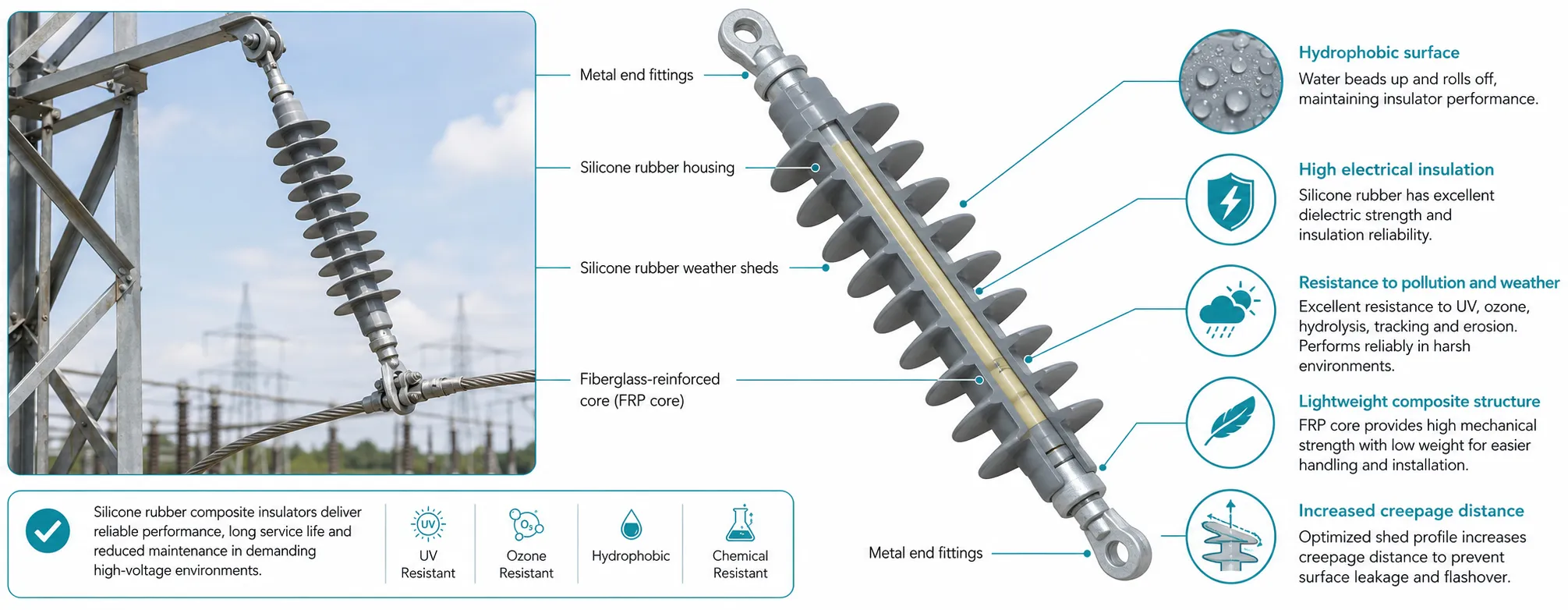
A composite insulator, also called a polymer insulator, is an electrical insulator made from several materials that perform different functions. A typical design includes a fiberglass-reinforced core, metal end fittings and an external polymer housing.
The core carries tensile, bending or compression loads. The metal fittings connect the insulator to conductors, towers, crossarms or electrical equipment. The outer housing provides electrical insulation and protects the core from the outdoor environment.
Silicone rubber is commonly used as the housing material because it can form flexible weather sheds while maintaining useful surface properties during outdoor service.
Fiberglass-Reinforced Core
The internal rod is commonly made from glass fibers combined with a resin system. It provides the main mechanical strength of suspension and tension insulators.
Metal End Fittings
End fittings transfer mechanical loads between the insulator and the supporting structure. Their attachment and sealing are critical because the core must remain protected from moisture.
Composite Insulator Housing
The composite insulator housing surrounds the core and creates the external insulation surface. The housing includes multiple sheds that increase creepage distance and direct water away from the central body.
Silicone Rubber Weather Sheds
Silicone rubber weather sheds increase the surface path between energized and grounded components. Their profile is designed according to voltage level, pollution conditions and installation orientation.
Main Advantages of Silicone Rubber in Composite Insulators
Strong Surface Hydrophobicity
Silicone rubber naturally repels water. Rain and condensation tend to form separate droplets rather than a continuous conductive film across the insulator surface.
Cách điện đáng tin cậy
Electrical insulation silicone rubber provides high resistance to current flow and helps isolate energized conductors from grounded structures.
Outdoor Weather Resistance
The material resists ultraviolet radiation, ozone, moisture and repeated temperature changes, making it suitable for long-term outdoor installation.
Flexible Protective Housing
The elastic housing absorbs minor impact and vibration without brittle fracture. It also protects the fiberglass core and core-housing interface.
Lightweight Construction
A polymer composite insulator is generally lighter than an equivalent porcelain assembly, simplifying transportation, tower handling and installation.
Complex Shape Molding
Silicone rubber can be molded into integrated sheds, sealing areas and detailed profiles suited to different voltage and pollution requirements.
Broad Temperature Performance
Suitable silicone formulations remain flexible during cold weather and retain useful properties under elevated outdoor temperatures.
Pollution Performance
Hydrophobicity and shed design help a silicone rubber insulator perform in coastal, desert, agricultural and industrial environments.
Why Is Hydrophobic Silicone Rubber Important?
Hydrophobic silicone rubber has a surface that resists wetting. When water reaches the housing, it tends to form droplets instead of spreading evenly across the sheds.
A continuous water film mixed with salt, dust or industrial contamination can become partially conductive. This may increase surface leakage current and create dry-band arcing. By limiting continuous wetting, silicone rubber helps reduce this risk.
Hydrophobicity Transfer
Silicone rubber can gradually transfer low-molecular-weight components to certain contamination layers on its surface. This can make deposited pollution more water repellent and partially restore surface performance after contamination.
The rate and effectiveness of this behavior depend on the silicone formulation, contamination type, aging condition and environmental exposure.
Hydrophobicity Recovery
Temporary electrical discharges or harsh cleaning may reduce surface hydrophobicity. A suitable silicone formulation may recover part of its water-repellent behavior after the electrical or environmental stress is removed.
Hydrophobicity Is Not the Only Requirement
A water-repellent surface cannot compensate for inadequate creepage distance, poor core sealing, weak end fittings, severe erosion or an unsuitable silicone formulation.
Electrical Performance of Silicone Rubber Insulators
Độ bền điện môi
Silicone rubber provides a high-resistance dielectric barrier around the load-bearing core. Dielectric performance depends on formulation, material thickness, voids, contamination and electric-field distribution.
Surface Leakage Current
Moisture and contamination can allow small currents to travel along the insulator surface. Hydrophobic silicone rubber and correctly designed sheds help interrupt continuous conductive paths.
Tracking Resistance
Electrical tracking is the development of a permanent conductive path across an insulating surface. A high-quality silicone rubber insulator formulation should resist tracking under electrical, moisture and contamination stress.
Erosion Resistance
Dry-band arcs can generate localized heat and gradually remove housing material. Mineral fillers and formulation design are used to improve resistance to erosion and maintain housing integrity.
Arc Resistance
The housing should tolerate temporary surface discharge without rapidly losing its insulating function. Arc resistance must be considered together with pollution severity and electric-field control.
Creepage Distance
Creepage distance is the shortest path along the insulating surface between conductive parts. Insulator shed number, diameter, spacing and profile are selected to provide a suitable creepage path.
Environmental Resistance of Silicone Rubber
Ultraviolet Radiation
Outdoor insulators receive continuous sunlight exposure. Silicone rubber offers strong resistance to UV-related cracking and embrittlement when an appropriate electrical-grade compound is used.
Khả năng chống ozone
Ozone can attack some organic rubber materials. Silicone rubber has good ozone resistance, supporting long-term outdoor electrical applications.
Temperature Cycling
Composite insulators may experience daily and seasonal temperature changes. The flexible silicone housing accommodates expansion and contraction while protecting the internal core.
Rain and Humidity
The water-repellent surface helps maintain insulation performance during rain, fog, condensation and high-humidity conditions.
Salt and Coastal Pollution
Coastal installations may accumulate salt deposits that become conductive when wet. Silicone rubber is often selected because of its hydrophobic surface and pollution performance.
Industrial Contamination
Factories, mines and transportation corridors can expose insulators to dust, smoke, chemicals and conductive particles. Material formulation and shed profile should match the expected contamination.
Desert Conditions
Desert installations combine dust, strong UV radiation, temperature variation and limited natural washing. Silicone rubber can be useful when the insulator is designed for the local pollution level.
Silicone Rubber Formulation for Composite Insulators
Electrical-grade silicone rubber is not the same as general-purpose silicone. A high voltage composite insulator requires a formulation designed for electrical stress, outdoor aging, tracking and erosion resistance.
Cao su silicone HTV
HTV silicone rubber means high-temperature-vulcanized silicone rubber. It is widely used for composite-insulator housings and is commonly processed through injection or compression molding.
Polyme silicone
The base polymer provides elasticity, hydrophobic behavior and environmental stability. Polymer quality and molecular structure influence processing and long-term performance.
Silica gia cường
Silica improves tensile strength, tear resistance and dimensional stability. The filler must be dispersed consistently throughout the compound.
Mineral Fillers
Special mineral fillers may be added to improve resistance to tracking, erosion and heat generated by surface discharges.
Pigments and Additives
Pigments provide color and identification, while processing aids support molding. Every additive must be compatible with the required electrical and environmental properties.
Hệ thống đóng rắn
The curing system creates permanent crosslinks in the silicone material. Cure conditions must be controlled to achieve consistent hardness, strength and surface performance.
Silicone Rubber Composite Insulator vs Other Insulators
Composite Insulator vs Porcelain Insulator
The choice between a composite insulator vs porcelain insulator depends on system voltage, mechanical load, pollution severity, inspection practices and utility experience.
Silicone composite insulators are often chosen for polluted environments, restricted structures and installations where low weight is valuable. Porcelain remains suitable for many systems because of its rigidity, established service history and familiar inspection methods.
How Silicone Rubber Housings Are Manufactured
Core and Fitting Preparation
The fiberglass core and metal end fittings are inspected, cleaned and assembled according to the required mechanical design.
Surface Preparation
The core surface is prepared to support reliable bonding between the core and silicone housing.
Silicone Material Preparation
The HTV silicone compound is mixed, checked and prepared under controlled conditions.
Housing Molding
The silicone rubber housing and sheds are molded around the assembled core or produced according to the selected housing process.
Quá trình làm cứng
Heat and time create the required crosslinked silicone structure and final mechanical properties.
Inspection and Testing
The finished insulator is checked for dimensions, housing defects, interfaces, sealing, marking and required electrical and mechanical performance.
Applications of Silicone Rubber Composite Insulators
Transmission Lines
Suspension and tension composite insulators support high-voltage conductors on transmission towers while maintaining the required electrical separation.
Distribution Networks
Line-post, pin and suspension polymer insulators are used on compact distribution structures and utility poles.
Electrical Substations
Silicone post insulators support busbars, disconnectors and other energized substation components.
Surge Arresters
Silicone rubber housings protect internal surge-arrester components from pollution, moisture and mechanical damage.
Hollow Composite Insulators
Hollow insulators are used around bushings, instrument transformers and other equipment that requires an external insulating enclosure.
Railway Electrification
Lightweight composite insulators support overhead contact systems and electrical equipment exposed to vibration and contamination.
Coastal and Industrial Areas
Hydrophobic silicone housings are frequently considered for installations with salt, dust, smoke and industrial deposits.
How to Select Silicone Rubber for Composite Insulators
1. Define the Voltage Level
Specify system voltage, lightning impulse, switching impulse and insulation-coordination requirements.
2. Determine Pollution Severity
Evaluate salt, dust, industrial emissions, humidity and local contamination before selecting the shed profile.
3. Calculate Creepage Distance
Set the required surface distance according to voltage, environment, altitude and project standards.
4. Review Tracking and Erosion Resistance
Confirm that the silicone formulation is intended for electrical outdoor insulation and surface-discharge exposure.
5. Confirm Mechanical Rating
Review tensile, bending, compression, torsion and long-term mechanical loads.
6. Inspect Core and End-Fitting Design
The sealing and mechanical connection must protect the core from moisture and transfer loads safely.
7. Review Housing Bonding
A reliable bond between silicone rubber and the internal assembly helps prevent water ingress and interface damage.
8. Confirm Weathering Performance
Evaluate UV, ozone, temperature cycling, rain and pollution resistance for the actual installation environment.
9. Verify Manufacturing Controls
Review material traceability, molding, curing, inspection and routine electrical and mechanical testing.
10. Plan Inspection and Maintenance
Establish inspection intervals and replacement criteria based on utility practice and local service conditions.
Factors That Can Affect Composite Insulator Performance
Surface Tracking and Erosion
Repeated dry-band arcing can damage the silicone housing when pollution, moisture and electric-field stress are severe.
Loss of Housing Integrity
Cuts, punctures, animal damage, poor handling or manufacturing defects can expose the internal structure.
Moisture Ingress
Water entering through an end-fitting or housing interface can damage the core and reduce mechanical reliability.
Poor Bonding
Voids or weak interfaces between the silicone housing and core can create moisture paths and concentrated electrical stress.
Core Damage
Mechanical overload, improper crimping, chemical attack or internal defects can reduce the strength of the fiberglass rod.
Incorrect Shed Profile
Insufficient creepage distance or poorly spaced sheds may reduce pollution performance even when the silicone compound is suitable.
Material Formulation Problems
General-purpose silicone or poorly dispersed fillers may not provide the tracking, erosion and weather resistance required for electrical service.
Các câu hỏi thường gặp
Why is silicone rubber used in composite insulators?
It provides hydrophobicity, electrical insulation, outdoor weather resistance and flexible protection for the internal core.
What is a silicone rubber composite insulator?
It is an electrical insulator made with a mechanical core, metal end fittings and a silicone rubber housing with weather sheds.
Why is hydrophobicity important for an insulator?
It limits continuous water films and can reduce surface leakage current in wet and contaminated conditions.
What is HTV silicone rubber?
HTV means high-temperature-vulcanized silicone rubber, a heat-cured elastomer commonly used for composite-insulator housings.
Is silicone rubber better than porcelain?
Silicone is lighter and more hydrophobic, while porcelain is rigid and has a long service history. The best option depends on the installation.
Can ordinary silicone be used for composite insulators?
No. The silicone should be specifically formulated and tested for outdoor electrical insulation, tracking and erosion resistance.
What causes a composite insulator to fail?
Possible causes include core damage, moisture ingress, poor bonding, housing erosion, mechanical overload and incorrect product selection.
Where are silicone composite insulators used?
They are used in transmission lines, distribution systems, substations, surge arresters, railway networks and high-voltage equipment.
Silicone Rubber Supports Reliable Outdoor Insulation
Silicone rubber is used in composite insulators because it combines water repellency, dielectric insulation, flexibility and resistance to outdoor aging. These properties help protect the load-bearing core and maintain surface insulation under rain, fog and pollution.
Long-term performance still depends on the complete design. The silicone formulation, shed profile, creepage distance, core material, end fittings, interfaces and manufacturing process must work together.
For reliable selection, engineers should evaluate the system voltage, pollution environment, mechanical load, material test data and manufacturing quality rather than choosing a composite insulator by housing material alone.