
Silicone Rubber Technical Guide
Mechanical Properties of Silicone Rubber: Key Parameters for Material Selection
Silicone rubber is widely used in electrical insulation, automotive components, industrial seals, cable accessories, composite insulators and other demanding applications. Its performance depends not only on its flexibility and temperature resistance, but also on a combination of mechanical properties that determine how the material behaves under tension, compression, tearing and repeated deformation.
For engineers, procurement teams and OEM manufacturers, understanding the mechanical property parameters of silicone rubber is essential when comparing compounds, specifying material requirements and evaluating product reliability. Hardness alone cannot determine whether a compound will provide sufficient tear resistance, maintain its shape under compression or withstand repeated mechanical loading.
This guide explains the key mechanical properties of silicone rubber, how they are measured, how the parameters interact and how to select a suitable silicone rubber compound for different industrial applications.
Yakows Material Solutions
Choose Silicone Rubber by Mechanical Performance
Different applications require different balances of strength, flexibility, hardness and deformation resistance. Explore the relevant silicone rubber product ranges before selecting a compound.
HTV-/HCR-Silikonkautschuk
Solid silicone compounds for molding, extrusion and industrial component manufacturing.
Flüssigsilikonkautschuk (LSR)
Liquid injection molding materials for precision components and repeatable production.
High Hardness Silicone Rubber
Formulations for applications requiring greater firmness and specific mechanical characteristics.
Silicone Rubber for Insulators and Cables
Material solutions for electrical insulation, outdoor exposure and demanding service conditions.
Need a specific combination of hardness, tensile strength, tear resistance or compression set?
What Are the Mechanical Properties of Silicone Rubber?
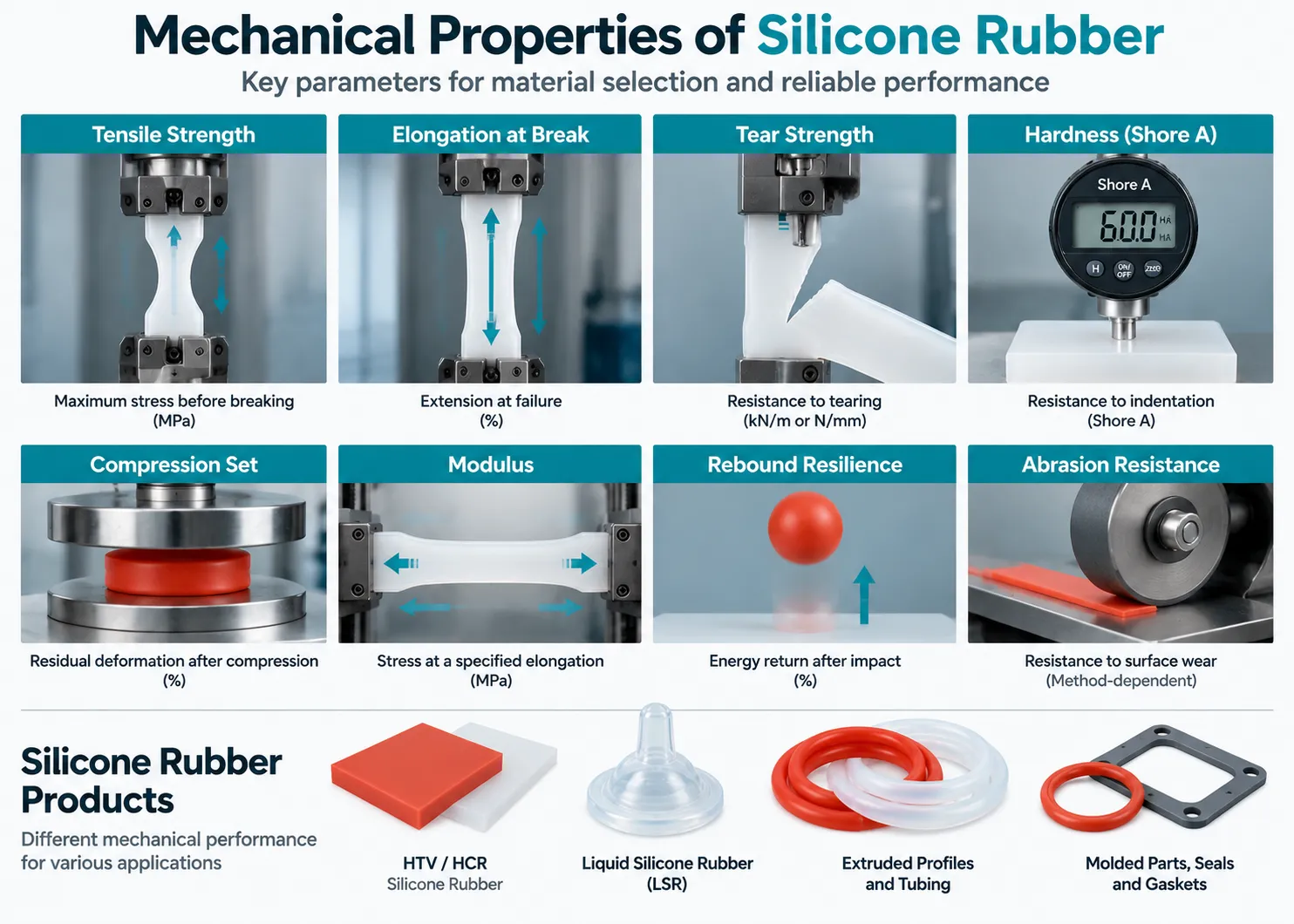
The mechanical properties of silicone rubber describe how the material responds to applied forces and deformation. They help engineers predict whether a compound can stretch without breaking, resist crack propagation, maintain a seal under compression or withstand repeated movement.
The most important parameters depend on the application, but a typical silicone rubber material specification may include the following:
| Parameter | What It Measures | Typical Unit | Warum das wichtig ist |
|---|---|---|---|
| Zugfestigkeit | Maximum tensile stress before the specimen breaks | MPa | Resistance to pulling forces |
| Bruchdehnung | Extension of the specimen at failure | % | Stretchability before rupture |
| Reißfestigkeit | Resistance to tearing under a specified test | kN/m or N/mm | Resistance to crack or notch propagation |
| Härte | Resistance to indentation | Shore A | Firmness and indentation response |
| Modulus | Stress required to reach a specified elongation | MPa | Resistance to stretching at a defined strain |
| Dauerverformung | Residual deformation after compression under specified conditions | % | Long-term sealing and recovery performance |
| Rebound Resilience | Energy returned after impact or deformation | % | Dynamic response and energy recovery |
| Abrasion Resistance | Resistance to surface wear under a defined test | Method-dependent | Wear performance during contact or movement |
These parameters are related, but they are not interchangeable. A silicone rubber compound with high tensile strength may not have the highest tear strength, and a harder compound does not automatically provide better compression set or abrasion resistance.
For meaningful material comparisons, test results should be evaluated using the same or demonstrably comparable test methods, specimen preparation and conditioning requirements.
1. Tensile Strength of Silicone Rubber
Tensile strength is the maximum tensile stress that a specimen withstands before breaking during a tensile test. It is commonly expressed in megapascals (MPa).
During testing, a standardized specimen is stretched at a controlled rate until it breaks. The measured force and specimen dimensions are used to determine the tensile properties of the material.
For silicone rubber manufacturers, tensile strength helps evaluate compound reinforcement and the ability of a finished component to withstand pulling loads during installation or use.
What Affects Silicone Rubber Tensile Strength?
- Polymer characteristics: Base polymer structure and molecular characteristics influence the compound's mechanical behavior.
- Reinforcing fillers: Filler type, loading and dispersion can significantly influence strength.
- Curing conditions: Cure chemistry, temperature and time affect the final network structure.
- Formulation balance: Different combinations of hardness, elongation and tear resistance may produce different tensile results.
- Test conditions: Specimen geometry, extension rate, temperature and conditioning can affect the reported value.
Tensile strength is particularly relevant to silicone tubing, flexible connectors, molded industrial components and cable accessories that may experience tension during assembly or service.
However, tensile strength alone cannot predict resistance to cuts, crack growth or repeated flexing. Those requirements should be evaluated using the corresponding mechanical tests.
2. Elongation at Break
Elongation at break measures how much a silicone rubber specimen stretches before it ruptures. It is expressed as a percentage of the specimen's original gauge length.
A higher elongation value indicates that the specimen can undergo greater extension before breaking under the specified test conditions. This can be important for flexible seals, tubing, sleeves and components that must accommodate movement.
Elongation should not be interpreted as a direct measure of tensile strength. Two silicone rubber compounds can have different combinations of tensile strength and elongation, even when their hardness values are similar.
For example, a flexible component may require substantial elongation to accommodate installation, while a dimensionally stable molded component may require a different balance of stiffness and extension.
When evaluating elongation, engineers should also consider tear strength, permanent deformation and the actual strain experienced by the component during service.
3. Tear Strength of Silicone Rubber
Tear strength measures a material's resistance to tearing under a specified test configuration. Unlike tensile testing, tear testing focuses on the behavior of a specimen designed to evaluate tearing, often involving a cut, notch or defined geometry.
This parameter is important when a silicone rubber component contains thin edges, sharp transitions, molded features or areas that may be damaged during handling and installation.
High tear strength silicone rubber is often considered for:
- Composite insulator sheds and other thin-section components.
- Silicone rubber profiles with narrow sealing lips.
- Flexible tubing and sleeves exposed to handling stress.
- Industrial gaskets and molded components with complex geometries.
- Parts that may experience localized cuts or repeated flexing.
Tear strength results depend on the test method and specimen geometry. Values from different tear-test configurations should not be compared directly without confirming their comparability.
For components with both pulling loads and cut-related failure risks, tensile strength and tear strength should be specified separately.
4. Silicone Rubber Hardness
Hardness measures a material's resistance to indentation. For conventional solid silicone rubber, hardness is commonly reported using the Shore A scale.
Hardness influences how a silicone rubber component feels and deforms under local contact pressure. It is therefore useful when selecting seals, gaskets, molded parts and other components with defined firmness requirements.
However, hardness does not directly measure tensile strength, tear strength or elastic recovery. A compound with a higher Shore A value is not automatically stronger or more durable in every application.
For material selection, the specified hardness range should be considered alongside the required tensile properties, tear resistance and compression set.
For more information, see our guide to Shore hardness testing for silicone rubber.
5. Modulus and Stress at a Specified Elongation
For elastomers, modulus is often reported as the stress required to reach a specified elongation, such as 100%, 200% or 300%. These values describe how much stress is needed to stretch the material to a defined extension.
A higher stress at a specified elongation generally indicates that more force is required to reach that extension under the same test conditions. It can help engineers understand the material's resistance to stretching during use.
For silicone rubber, this information can be useful when a component must retain its shape under load, resist excessive stretching or provide a predictable mechanical response.
When comparing modulus values, make sure the reported elongation point, test method and specimen conditions are the same. A 100% modulus value should not be compared directly with a 300% modulus value as if they described the same property.
6. Compression Set and Elastic Recovery
Compression set describes the residual deformation that remains after a rubber specimen has been compressed under specified conditions and then allowed to recover according to the test procedure.
It is especially important for silicone rubber seals, gaskets and other components that must maintain contact pressure over time.
In general, a lower compression set is desirable when the application requires better recovery after prolonged compression. However, the result depends on the test temperature, duration, compression level, specimen geometry and recovery conditions.
A silicone rubber compound should therefore be evaluated under conditions relevant to the intended application. A room-temperature result may not fully represent behavior after prolonged exposure to elevated temperatures.
Compression set is not the same as tensile strength or hardness. A compound can meet a target hardness requirement but still require additional evaluation for long-term sealing performance.
7. Rebound Resilience and Dynamic Performance
Rebound resilience describes the proportion of energy returned by a material after an impact or deformation in a specified test. It provides information about the material's dynamic response.
This property may be relevant to silicone rubber components exposed to repeated impact, vibration or cyclic deformation. The importance of rebound resilience depends on the component design and operating conditions.
For dynamic applications, engineers may also need to consider fatigue resistance, heat generation during repeated deformation and changes in mechanical properties after aging.
Rebound resilience alone does not predict fatigue life. Where repeated movement is a major design concern, application-specific testing should supplement basic mechanical property data.
8. Abrasion Resistance and Wear Performance
Abrasion resistance describes how well a silicone rubber surface withstands material loss caused by rubbing or contact under a defined test.
It may matter for components that slide against other surfaces, experience repeated handling or operate in environments where contact wear is unavoidable.
Silicone rubber offers useful flexibility and environmental resistance, but its abrasion performance varies by formulation and should not be assumed to exceed that of every other elastomer.
For applications with significant friction or wear, compare test data from suitable methods and evaluate the actual contact conditions, including surface roughness, applied load, movement and temperature.
9. How Silicone Rubber Formulation Affects Mechanical Properties
The mechanical performance of silicone rubber depends on the interaction between the base polymer, reinforcing fillers, additives and curing system. No single ingredient or formulation change improves every property simultaneously.
| Formulation Factor | Potential Influence | What Manufacturers Should Evaluate |
|---|---|---|
| Base Polymer | Influences elasticity, processing behavior and mechanical response. | Target application, process method and required property balance. |
| Verstärkungssilikat | Can improve tensile and tear properties when appropriately selected and dispersed. | Strength, elongation, hardness and processability together. |
| Aushärtungssystem | Affects crosslinking, final properties and processing requirements. | Cure conditions, post-curing and application-specific requirements. |
| Pigments and Additives | May influence appearance, processing and selected material properties. | Compatibility and performance of the complete formulation. |
| Mixing and Dispersion | Can affect batch consistency and the distribution of reinforcing ingredients. | Production consistency and repeatability of test results. |
For OEM manufacturers, the goal is to identify a compound that meets the complete specification rather than maximizing one mechanical parameter at the expense of other requirements.
10. How to Read a Silicone Rubber Mechanical Properties Datasheet
A technical datasheet allows engineers and buyers to screen potential materials before requesting samples. However, a datasheet should be interpreted as a set of test results obtained under defined conditions, not as a guarantee of identical performance in every finished product.
When reviewing a silicone rubber datasheet, check the following:
- Hardness: Confirm the Shore scale, target value and acceptable tolerance.
- Tensile strength: Check the reported value, unit and test method.
- Elongation at break: Determine whether the extension performance meets the component's requirements.
- Tear strength: Confirm the test method and specimen configuration before comparing suppliers.
- Modulus: Verify the specified elongation at which the stress was measured.
- Compression set: Review the temperature, duration, compression conditions and recovery procedure.
- Conditioning and curing: Confirm whether results refer to the material as cured, after post-curing or after aging.
- Application-specific tests: Check electrical, thermal, chemical or regulatory requirements where applicable.
Typical values from different manufacturers may not be directly comparable when testing conditions differ. For critical applications, the acceptance criteria should be agreed upon before qualification.
11. Common Test Standards for Silicone Rubber Mechanical Properties
Standardized testing helps manufacturers compare silicone rubber materials using defined procedures. The correct standard depends on the property being measured and the requirements of the product specification.
| Test Standard | Eigenschaft | Purpose |
|---|---|---|
| ASTM D412 | Tensile properties | Evaluates tensile behavior of vulcanized rubber and thermoplastic elastomers. |
| ISO 37 | Tensile stress-strain properties | Determines tensile strength, elongation and related tensile properties. |
| ASTM D624 | Tear strength | Measures resistance to tearing under a specified test configuration. |
| ASTM D2240 | Durometer hardness | Measures indentation hardness using the appropriate durometer scale. |
| ASTM D395 | Compression set | Evaluates residual deformation after specified compression conditions. |
For reference, consult the official standard information for ASTM D412, ASTM D624, ASTM D395 und ISO 37.
When a customer specifies a particular test standard, that requirement should take priority. Results obtained using different test methods or specimen geometries should not be treated as equivalent without technical justification.
12. Matching Mechanical Properties to Industrial Applications
The correct mechanical property combination depends on how the silicone rubber component is manufactured and used. The following examples illustrate which parameters typically deserve attention.
Composite Insulators and Electrical Insulation
Silicone rubber used in composite insulators must meet the requirements of the component design and electrical service environment. Tear resistance can be important for thin sheds and vulnerable edges, while tensile properties, aging resistance, hydrophobicity and electrical performance also need consideration.
Wire and Cable Components
For silicone rubber cable applications, tensile strength and elongation help evaluate handling and flexibility, while tear resistance may matter during installation. Electrical properties and thermal aging performance must be checked separately against the cable's specification.
Industrial Seals and Gaskets
Hardness, compression set and tear strength are often important for seals and gaskets. The appropriate balance depends on the sealing geometry, contact pressure, temperature and expected service life.
Extruded Tubing and Profiles
Extruded silicone products require suitable mechanical properties as well as stable processing behavior. Thin lips, hollow profiles and narrow sections may need particular attention to tear resistance and dimensional stability.
Automotive and Industrial Molded Parts
Molded components may require a balance of tensile strength, elongation, compression set and heat-aging performance. The final specification should reflect the loads, movement and environmental exposure experienced by the finished part.
13. How to Select the Right Silicone Rubber Compound
The most effective way to select silicone rubber is to start with the finished component and work backward to the required material properties.
- Define the application. Identify the component's function, geometry, manufacturing process and operating environment.
- Set the hardness range. Specify the appropriate Shore scale and tolerance rather than providing a hardness number without context.
- Identify the main mechanical risks. Determine whether the component is most vulnerable to stretching, tearing, compression, impact or wear.
- Specify the required tests. Select the relevant tensile, elongation, tear, modulus and compression set tests.
- Confirm other service requirements. Review temperature, electrical performance, chemical exposure and any applicable regulatory requirements.
- Validate the compound. Evaluate samples and, where necessary, finished components under representative manufacturing and service conditions.
A compound with the highest value in one test is not necessarily the best choice. Material selection should balance the properties that matter to the finished product while maintaining consistent manufacturing performance.
Frequently Asked Questions About Silicone Rubber Mechanical Properties
What are the most important mechanical properties of silicone rubber?
The main properties commonly evaluated include tensile strength, elongation at break, tear strength, hardness, modulus and compression set. Rebound resilience and abrasion resistance may also be important depending on the application.
Does higher hardness mean higher tensile strength?
No. Hardness measures resistance to indentation, while tensile strength measures the maximum tensile stress before failure. The relationship between the two depends on the formulation and material structure.
What is the difference between tensile strength and tear strength?
Tensile strength measures resistance to pulling until failure. Tear strength evaluates resistance to tearing under a defined test configuration. A silicone rubber compound can perform differently in these two tests.
Why is compression set important for silicone rubber?
Compression set helps assess the residual deformation remaining after a specimen has been compressed under specified conditions. It is particularly relevant to seals and gaskets that need to maintain contact pressure over time.
Can two silicone rubber compounds with the same hardness have different mechanical properties?
Yes. Different polymer characteristics, filler systems, curing conditions and formulation designs can produce different tensile strength, tear strength, elongation and compression set values at similar hardness levels.
How can I compare silicone rubber datasheets from different suppliers?
Compare the same properties using compatible test methods, specimen geometries, units and conditioning conditions. For critical applications, confirm the material through sample testing and agreed acceptance criteria.
Which silicone rubber is suitable for high mechanical strength applications?
The appropriate grade depends on the required combination of tensile strength, tear resistance, elongation, hardness and operating conditions. High-strength or high-tear formulations may be appropriate, but the finished component should be validated against its specific requirements.
Yakows Silicone Rubber Manufacturer
Looking for Silicone Rubber with Specific Mechanical Properties?
Yakows supplies silicone rubber compounds for OEM and industrial manufacturing applications. Material selection can be based on target hardness, tensile strength, tear resistance, elongation, compression set, electrical performance and processing requirements.
When requesting a recommendation, share your application, target property values, manufacturing method and operating conditions. This helps identify a suitable compound for sample evaluation before production approval.
E-Mail: info@yakows.com