
HTV Silicone Rubber vs Natural Rubber
When comparing Caoutchouc silicone HTV vs natural rubber, the most important differences are found in thermal stability, environmental resistance, electrical insulation, mechanical performance, processing technology, and long-term durability. HTV silicone rubber is designed for applications that require stable performance under high temperatures, UV exposure, ozone, moisture, and electrical stress, while natural rubber is mainly valued for its elasticity, tensile strength, and lower raw material cost. In practical engineering applications, natural rubber performs well in dynamic mechanical systems such as tires and vibration components, but HTV silicone rubber is more suitable for high-temperature sealing, electrical insulation, outdoor systems, medical devices, and industrial components exposed to harsh operating conditions. The reason comes from the polymer structure itself. HTV silicone rubber uses a silicon-oxygen backbone with stronger molecular bond energy, giving the material far better resistance to heat aging and environmental degradation than the carbon-based structure of natural rubber. As industries continue increasing requirements for reliability, lifespan, and temperature resistance, HTV silicone rubber has become one of the most widely used elastomers in electrical, automotive, energy, and industrial manufacturing sectors.
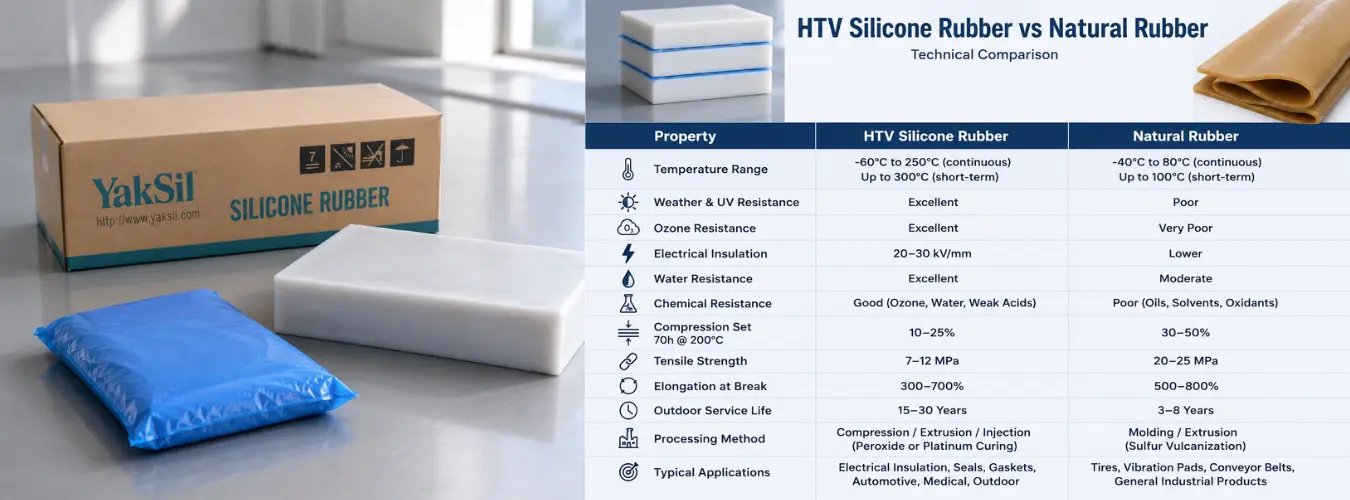
HTV Silicone Rubber vs Natural Rubber: Polymer Structure and Material Composition
The core difference between HTV silicone rubber and natural rubber begins with molecular structure.
HTV Silicone Rubber Molecular Backbone
−Si−O−Si−O−
HTV silicone rubber is based on polysiloxane polymers reinforced with silica fillers. The silicon-oxygen bond structure provides excellent thermal and chemical stability because the Si–O bond energy is significantly stronger than conventional carbon-carbon bonds.
Natural Rubber Molecular Backbone
(C5H8)n
Natural rubber is mainly composed of polyisoprene derived from latex. Because it is an organic hydrocarbon polymer, it is more vulnerable to oxidation, UV degradation, ozone cracking, and thermal aging.
This structural difference directly affects the performance characteristics of both materials.
| Propriété | Caoutchouc silicone HTV | Natural Rubber |
|---|---|---|
| Polymer Type | Polysiloxane | Polyisoprene |
| Backbone Structure | Silicon-Oxygen | Carbon-Carbon |
| Stabilité thermique | Excellent | Modéré |
| Résistance aux UV | Excellent | Pauvre |
| Ozone Resistance | Excellent | Very Poor |
| Oxidation Resistance | Excellent | Pauvre |
HTV Silicone Rubber vs Natural Rubber: Temperature Resistance
Temperature resistance is one of the largest performance differences between HTV silicone rubber and natural rubber.
HTV Silicone Rubber Temperature Range
−60∘C≤T≤250∘C
HTV silicone rubber can maintain flexibility and physical stability across a very wide temperature range. Even under long-term exposure above 200°C, the material can still preserve sealing and insulation performance.
Natural rubber cannot maintain the same stability under heat. As temperature increases, oxidation accelerates polymer degradation, leading to hardening, cracking, and permanent deformation.
| Temperature Property | Caoutchouc silicone HTV | Natural Rubber |
|---|---|---|
| Continuous Operating Temperature | -60°C to 250°C | -40°C to 80°C |
| Short-Term Heat Resistance | Up to 300°C | Around 100°C |
| Thermal Aging Resistance | Excellent | Pauvre |
| Low-Temperature Flexibility | Excellent | Modéré |
This is why HTV silicone rubber is commonly selected for engine sealing systems, battery insulation, industrial gaskets, and electrical cable accessories where thermal stability is critical.
HTV Silicone Rubber vs Natural Rubber: Mechanical Properties
Natural rubber has advantages in tensile strength and resilience, especially in applications involving continuous movement or dynamic loading. HTV silicone rubber, however, provides better long-term compression stability and heat-aging resistance.
| Mechanical Property | Caoutchouc silicone HTV | Natural Rubber |
|---|---|---|
| Résistance à la traction | 7–12 MPa | 20–25 MPa |
| Allongement à la rupture | 300–700% | 500–800% |
| Résistance à la déchirure | Modéré | Excellent |
| Compression Set Resistance | Excellent | Modéré |
| Heat Aging Stability | Excellent | Pauvre |
Natural rubber is widely used in products requiring repeated deformation, including tires, suspension systems, and vibration isolators. Its high rebound resilience allows it to absorb and release energy efficiently.
HTV silicone rubber is more suitable for static sealing systems where maintaining shape and sealing force over long periods is more important than dynamic rebound performance. In automotive connectors, waterproof enclosures, and industrial gaskets, low compression set becomes a major advantage.
HTV Silicone Rubber vs Natural Rubber: Compression Set Performance
Compression set is a critical factor in sealing applications because it determines whether a material can recover after long-term compression and maintain sealing pressure.
HTV silicone rubber performs significantly better than natural rubber under high-temperature compression conditions.
| Matériau | Compression Set After Heat Aging |
|---|---|
| Caoutchouc silicone HTV | 10–25% |
| Natural Rubber | 30–50% |
Lower compression set means the material can maintain sealing integrity for longer periods without leakage or deformation. This is especially important in:
- Automotive sealing systems
- Electrical connectors
- Waterproof housings
- Industrial pressure seals
- Outdoor enclosure gaskets
HTV Silicone Rubber vs Natural Rubber: Weather Resistance and UV Stability
Environmental aging is one of the biggest weaknesses of natural rubber. Prolonged exposure to sunlight, oxygen, ozone, and moisture causes rapid surface cracking and loss of elasticity.
HTV silicone rubber naturally resists environmental degradation without requiring heavy anti-aging additives.
| Environmental Property | Caoutchouc silicone HTV | Natural Rubber |
|---|---|---|
| Résistance aux UV | Excellent | Pauvre |
| Ozone Resistance | Excellent | Very Poor |
| Outdoor Durability | Excellent | Pauvre |
| Moisture Resistance | Excellent | Modéré |
This difference explains why HTV silicone rubber is widely used in outdoor electrical insulation systems, photovoltaic connectors, and weather-resistant industrial components.
In accelerated aging tests, HTV silicone rubber can maintain stable performance for decades, while natural rubber degrades much more rapidly under similar conditions.
HTV Silicone Rubber vs Natural Rubber: Electrical Insulation Properties
Electrical insulation is one of the strongest technical advantages of HTV silicone rubber.
HTV silicone rubber combines high dielectric strength, thermal stability, hydrophobicity, and arc resistance, making it highly suitable for high-voltage systems.
HTV Silicone Rubber Dielectric Strength
20 kV/mm≤E≤30 kV/mm
Natural rubber cannot maintain stable insulation properties under elevated temperatures or outdoor aging conditions.
HTV silicone rubber is commonly used in:
- Composite insulators
- High-voltage cable accessories
- Parafoudres
- EV battery insulation
- Outdoor transmission systems
The hydrophobic surface of HTV silicone rubber is particularly important because it reduces water film formation, helping maintain insulation performance in wet environments.
HTV Silicone Rubber vs Natural Rubber: Chemical Resistance
HTV silicone rubber has good resistance to:
- Ozone
- Oxygen
- Water
- UV exposure
- Weak acids
- Environmental oxidation
Natural rubber has weaker resistance to:
- Petroleum oils
- Solvents
- Oxidizing chemicals
- Exposition à l'ozone
However, HTV silicone rubber also has limitations in certain aggressive chemical environments, particularly with strong acids and some hydrocarbon solvents. Material selection should therefore be based on actual operating conditions.
HTV Silicone Rubber vs Natural Rubber: Processing Technology
HTV silicone rubber processing is more specialized than natural rubber processing because curing systems and molding temperatures are different.
HTV Silicone Rubber Processing Methods
Common processing methods include:
- Compression molding
- Extrusion
- Injection molding
- Transfer molding
HTV silicone rubber usually uses peroxide curing or platinum curing systems and requires higher processing temperatures.
Natural Rubber Processing Methods
Natural rubber commonly uses sulfur vulcanization and standard rubber processing equipment. Production cost is generally lower, and processing technology is more mature for high-volume manufacturing.
However, natural rubber compounds often require stabilizers and anti-aging additives to improve weather resistance and thermal performance.
HTV Silicone Rubber vs Natural Rubber: Automotive Applications
The automotive industry uses both materials, but for different operating environments.
HTV silicone rubber is commonly used in:
- Turbocharger hoses
- Ignition cable insulation
- EV battery seals
- Engine gaskets
- Sensor protection systems
Natural rubber is more commonly used in:
- Tires
- Suspension bushings
- Shock absorption systems
- Anti-vibration components
The selection depends on whether the application prioritizes dynamic elasticity or environmental resistance and heat stability.

HTV Silicone Rubber vs Natural Rubber: Electrical Industry Applications
HTV silicone rubber has become one of the primary materials used in modern electrical insulation systems because it maintains stable insulation performance under outdoor conditions.
Common applications include:
- Composite insulators
- Raccordements de câbles
- High-voltage connectors
- Outdoor insulation systems
Natural rubber is rarely used in advanced outdoor electrical systems because ozone cracking and environmental aging significantly reduce reliability.
HTV Silicone Rubber vs Natural Rubber: Medical and Food Applications
HTV silicone rubber is widely used in medical and food-contact applications because it is chemically stable, non-toxic, and biocompatible.
Typical applications include:
- Medical tubing
- Respiratory equipment
- Pharmaceutical seals
- Food-grade gaskets
- Baby care products
Many HTV silicone rubber compounds comply with FDA, LFGB, and USP Class VI standards.
Natural rubber is more limited in medical applications because latex proteins can trigger allergic reactions.
HTV Silicone Rubber vs Natural Rubber: Service Life and Cost Analysis
Although HTV silicone rubber has a higher initial material cost, its service life is significantly longer under harsh environmental conditions.
| Propriété | Caoutchouc silicone HTV | Natural Rubber |
|---|---|---|
| Outdoor Lifespan | 15–30 Years | 3–8 Years |
| Heat Aging Resistance | Excellent | Pauvre |
| Maintenance Frequency | Faible | Plus élevé |
Natural rubber is more economical for low-cost indoor applications where exposure to heat, UV, and ozone is limited.
HTV silicone rubber becomes more cost-effective in applications requiring long-term reliability, reduced maintenance, and stable performance under extreme conditions.
Conclusion
The comparison between HTV silicone rubber and natural rubber ultimately depends on operating environment and performance requirements rather than simple material cost. Natural rubber remains highly effective in applications requiring strong elasticity, dynamic fatigue resistance, and lower manufacturing cost, particularly in tires and vibration-control systems. However, HTV silicone rubber provides clear technical advantages in high-temperature resistance, electrical insulation, UV stability, ozone resistance, compression set performance, and long-term outdoor durability. These properties make HTV silicone rubber the preferred material for electrical insulation systems, automotive sealing, industrial gaskets, medical components, renewable energy equipment, and outdoor applications where environmental aging and thermal stability are critical factors.