
Are Silica Gel and Silicone Rubber the Same?
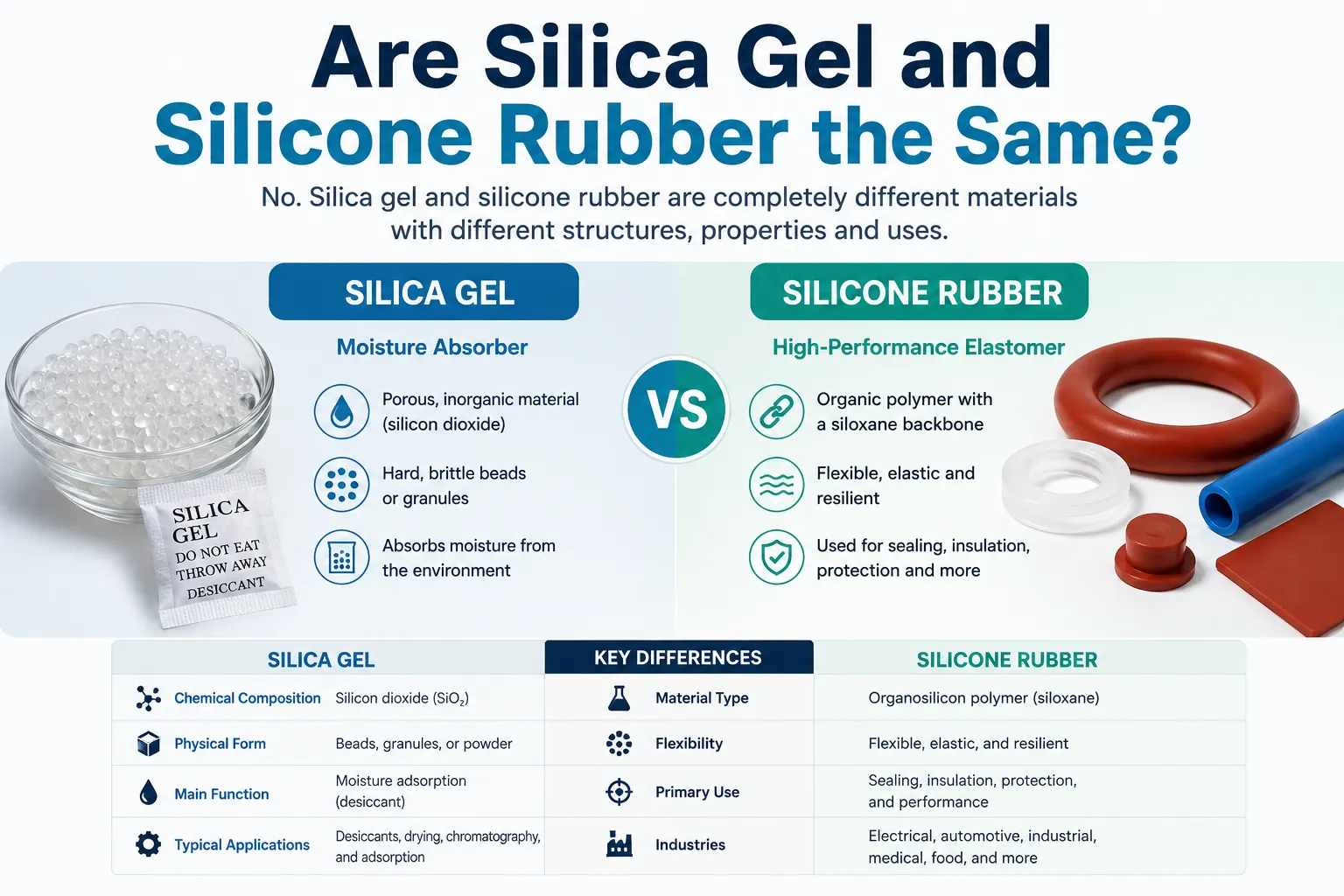
No. Silica gel and silicone rubber are not the same material. Silica gel is a porous, inorganic form of silicon dioxide mainly used to absorb moisture, while silicone rubber is a flexible, crosslinked elastomer based on organosilicon polymers. They both contain silicon and oxygen, which is why the names are often confused, but their chemical structure, physical form, manufacturing process and industrial uses are completely different.
Silica Gel vs Silicone Rubber: The Short Answer
The easiest way to understand the difference is to look at how the two materials behave. Silica gel is hard, porous and usually supplied as beads, granules or particles. It does not behave like rubber and cannot be stretched, compressed and recovered like an elastomer. Its most familiar use is inside small desiccant packets placed in packaging to control moisture.
Silicone rubber, by contrast, is an elastic material. After curing, it can bend, stretch, compress and return toward its original shape. Depending on the formulation, it can be used for electrical insulation, composite insulator housings, cable components, seals, gaskets, food-contact products, automotive components and many other industrial applications.
| Propriété | Silica Gel | Caoutchouc de silicone |
|---|---|---|
| Material Type | Porous inorganic material | Crosslinked elastomer |
| Main Chemistry | Silicon dioxide, SiO₂-based structure | Organosilicon polymer with a siloxane backbone |
| Typical Form | Beads, granules or powder | Rubber compound, molded parts, extrusions or sheets |
| Flexibility | Rigid and brittle | Flexible and elastic |
| Main Function | Moisture adsorption | Sealing, insulation, protection and flexible component manufacturing |
| Applications courantes | Desiccants, drying, chromatography and adsorption | Electrical, cable, automotive, industrial, food-contact and sealing applications |
What Is Silica Gel?
Silica gel is a highly porous form of silicon dioxide. Although the word “gel” appears in the name, the finished material commonly used in industry is usually dry and solid. Its internal pore structure gives it a very large surface area, allowing it to adsorb water vapor from the surrounding environment.
This is why silica gel is widely used as a desiccant. Small packets containing silica gel are commonly placed inside electronics packaging, pharmaceutical containers, machinery packaging, shoes and other products that need protection from humidity during storage or transportation.
Silica gel does not absorb water in the same way that a sponge holds liquid. Water molecules are primarily attracted to the extensive internal surface of the porous silica structure. This adsorption behavior is the property that makes the material useful for moisture control.
What Is Silicone Rubber?
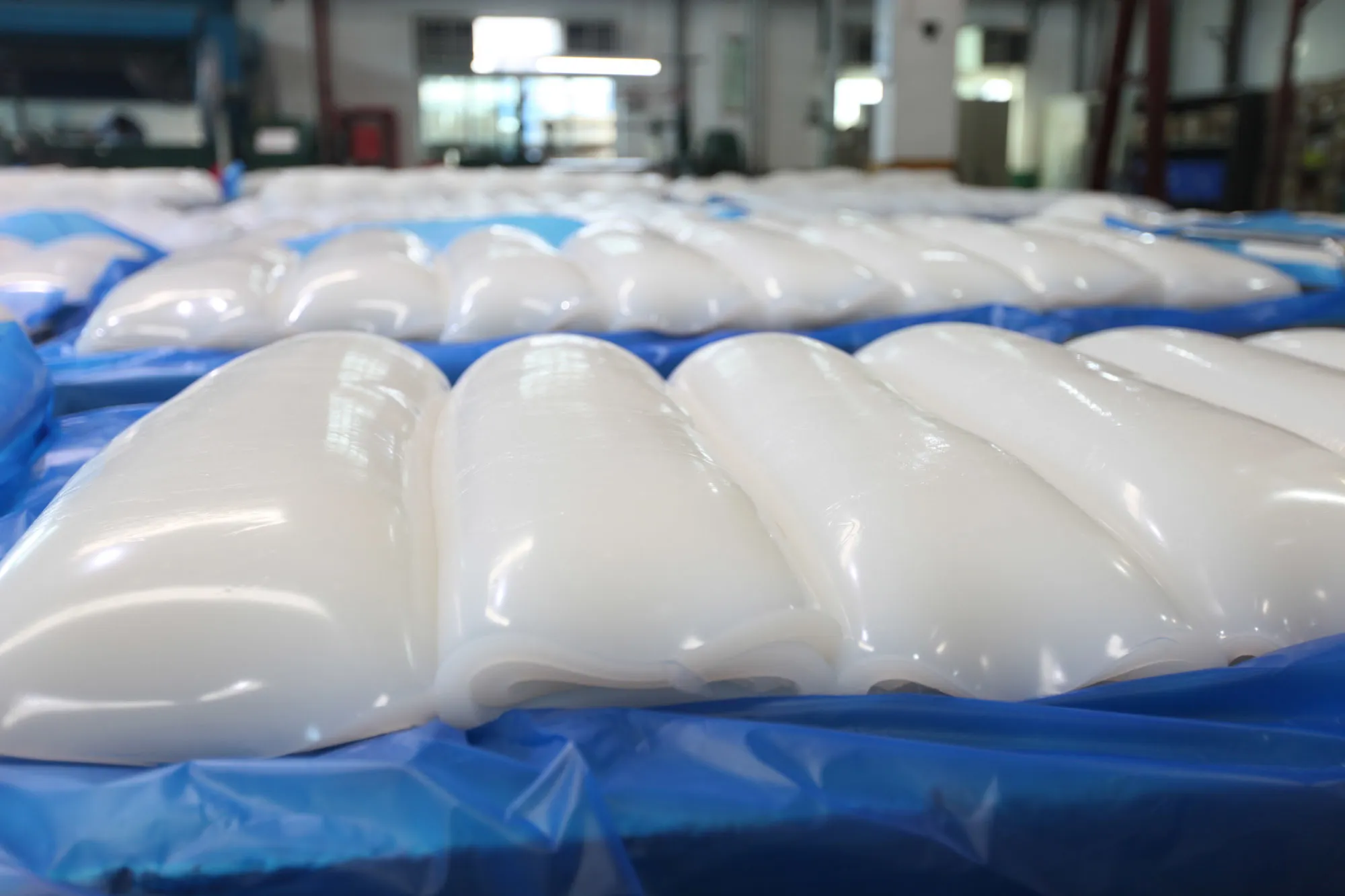
Silicone rubber is an elastomer based on silicone polymers. The main polymer chain contains repeating silicon–oxygen bonds, commonly described as a siloxane backbone. Organic groups are attached to the silicon atoms, and the polymer is compounded with reinforcing fillers, processing additives, curing agents and other ingredients before it becomes a useful industrial rubber.
After vulcanization, the polymer chains are connected into a three-dimensional elastic network. This crosslinked structure gives silicone rubber the ability to deform under mechanical load and recover after the load is removed.
Industrial silicone rubber is available in several processing forms. HTV and HCR silicone are high-consistency compounds widely used for molding and extrusion, while LSR is a lower-viscosity two-component system used for liquid injection molding. RTV materials cure at or near room temperature and are commonly used as sealants, adhesives and potting materials.
Why Are Silica Gel and Silicone Rubber So Often Confused?
The main reason is terminology. Both materials contain the word “silica” or “silicone,” and both ultimately involve silicon and oxygen chemistry. For someone unfamiliar with polymer materials, the names can sound as though they describe slightly different versions of the same substance.
They do not. The difference between them is much larger than the difference between two grades of rubber. Silica gel is fundamentally an inorganic porous material, while silicone rubber is a polymeric elastomer.
Confusion is also common in consumer markets because some languages and product listings use informal translations of “silica gel” to describe soft silicone products. A flexible phone case, baking mold or rubber gasket may therefore be incorrectly described as silica gel even though the actual material is silicone rubber.
Silica, Silica Gel and Silicone Rubber Are Three Different Things
Another source of confusion is that silica itself is also important in silicone rubber manufacturing. Silicone rubber frequently contains reinforcing silica, but that does not make the finished compound silica gel.
Silica is a broad term for silicon dioxide-based materials. Depending on how it is produced and processed, silica can exist in different forms with different surface areas, particle structures and industrial functions. Fumed silica and precipitated silica, for example, can be used as reinforcing fillers in elastomers.
Silica gel is one particular porous form of silica used largely for adsorption. Reinforcing silica used in silicone rubber serves a different purpose: it interacts with the silicone polymer and helps give the compound useful tensile strength, tear resistance, hardness and processing characteristics.
| Matériau | What It Is | Typical Role |
|---|---|---|
| Silice | General family of silicon dioxide materials | Fillers, reinforcement, adsorption and many industrial uses |
| Silica Gel | Porous silica with a high internal surface area | Moisture adsorption and drying |
| Caoutchouc de silicone | Crosslinked organosilicon elastomer | Flexible insulation, sealing and molded components |
Why Is Silica Added to Silicone Rubber?
Pure silicone polymer does not normally provide all the mechanical strength required for practical industrial products. Reinforcing silica is therefore one of the most important ingredients in many silicone rubber compounds.
The silica interacts with the polymer and strengthens the rubber network. Depending on the grade and loading, it can influence hardness, tensile strength, tear strength, elongation, viscosity and processing behavior. The surface chemistry of the filler also matters because untreated silica can interact strongly with silicone polymer and make a compound difficult to process.
Silicone compound manufacturers therefore control not only the amount of silica but also its structure, surface treatment and relationship with other formulation ingredients. A high-voltage silicone compound, for example, may require a different filler balance from a food-contact compound or a soft sealing material.
Do Silica Gel and Silicone Rubber Have the Same Chemical Structure?
No. Their structures are fundamentally different.
Silica gel is based on a three-dimensional silicon–oxygen network associated with silicon dioxide. Its porous structure contains an enormous internal surface area, which is responsible for its adsorption behavior.
Silicone polymers contain repeating siloxane units in the main chain. A simplified representation of a silicone backbone is:
However, silicone polymer is not simply a chain of silica. Organic groups are attached to the silicon atoms, and these groups strongly influence polymer behavior. After compounding and curing, the result is a flexible elastomeric network rather than a rigid porous mineral-like material.
Can Silica Gel Stretch Like Silicone Rubber?
No. Dry silica gel is rigid and brittle. If enough mechanical force is applied, the particles fracture rather than stretch elastically.
Silicone rubber behaves very differently because its long polymer chains can move and deform within a crosslinked network. When the rubber is stretched, the chains rearrange and extend. After the force is removed, the network drives the material back toward its original dimensions.
This elastic recovery is why silicone rubber can be used for gaskets, O-rings, cable seals, connector components, flexible electrical insulation and molded housings. Silica gel cannot perform these functions.
Which One Is Used for Electrical Insulation?
Silicone rubber is the material widely used for flexible electrical insulation. Properly formulated electrical grades can provide high volume resistivity, useful dielectric strength, weather resistance and long-term flexibility.
These characteristics are especially important in high-voltage applications. Composite insulators use silicone rubber housings because the material can combine electrical insulation with hydrophobic surface behavior and outdoor weather resistance. Cable systems use silicone compounds where electrical performance must be combined with flexibility and heat resistance.
Silica materials can also participate in electrical systems, particularly as fillers, but silica gel desiccant should not be confused with the silicone elastomer used as an insulating component.
| Electrical Application | Typical Role of Silicone Rubber |
|---|---|
| Composite Insulators | External insulating housing and weather-resistant sheds |
| Wire and Cable | Flexible electrical insulation and protective components |
| High-Voltage Connectors | Sealing and insulation around conductive interfaces |
| Cable Accessories | Flexible insulation, sealing and mechanical protection |
| EV Electrical Systems | Connector seals, cable components and insulating parts |
Which One Is More Heat Resistant?
This comparison needs context because silica gel and silicone rubber perform completely different jobs. Silica is an inorganic material and can tolerate temperatures at which organic polymer systems would already undergo significant degradation. However, that does not make silica gel a substitute for a high-temperature elastomer.
Silicone rubber is valued because it can remain flexible and useful while exposed to elevated temperatures. High-temperature grades can be engineered to retain elasticity and mechanical properties under thermal conditions where many conventional rubbers would harden or deteriorate more quickly.
For an industrial seal, cable component or electrical housing, the useful property is not simply resistance to temperature. The material must remain elastic, intact and functional after thermal aging. That is the role silicone rubber is designed to perform.
Can Silica Gel Be Used as a Silicone Rubber Filler?
Silicone formulations use carefully selected silica fillers, but industrial compound design does not normally mean taking ordinary desiccant beads from a silica gel packet and mixing them into silicone rubber.
Reinforcing fillers are selected according to particle size, surface area, structure, surface chemistry and interaction with the polymer. Fumed silica and precipitated silica used in elastomer formulation are engineered for controlled reinforcement and processing behavior.
The wrong filler can significantly change compound viscosity, curing, tensile strength, elongation and surface quality. For this reason, filler selection is a formulation decision rather than simply a matter of adding any material containing silicon dioxide.
Le caoutchouc silicone dans les isolateurs composites
One of the clearest examples of why silicone rubber is different from silica gel is a high-voltage composite insulator. The external housing must remain flexible, resist outdoor weather and provide a stable insulating surface for years.
Hydrophobicity is particularly important. A water-repellent surface can help prevent moisture from forming a continuous conductive film across contaminated insulation. The material must also withstand tracking, erosion, ultraviolet exposure, thermal cycling and mechanical stress.
These requirements depend on a carefully balanced rubber formulation. Reinforcing silica may be one component of that formulation, but the performance of the finished insulator comes from the complete silicone compound rather than from silica alone.
Silicone Rubber in Cable Applications
High-temperature and high-voltage cable systems require a material that can insulate conductors while remaining flexible during manufacturing and service. Silicone rubber is useful because it combines thermal stability, dielectric performance and elastic behavior.
The cable compound must also process consistently during extrusion. Poor filler dispersion or an unsuitable formulation can lead to rough surfaces, dimensional instability or mechanical weak points. These defects become more important as electrical stress increases.
Silica is important in many cable-grade silicone formulations because it contributes reinforcement, but the cable insulation itself is still a silicone rubber compound—not silica gel.
What About Food Grade Silicone?
Food grade silicone is another area where terminology can cause confusion. Flexible baking molds, food seals, kitchen components and similar products are typically made from specially formulated silicone elastomers, not from the silica gel found in desiccant packets.
For food-contact applications, the complete silicone formulation must be controlled according to the relevant market requirements. Depending on the target market and application, customers may require documentation associated with FDA 21 CFR, LFGB, BfR recommendations or European chemical compliance requirements.
Calling a flexible food-contact product “silica gel” can therefore create unnecessary confusion between an adsorbent material and an elastomer designed for direct mechanical use.
How to Tell Whether a Product Is Silica Gel or Silicone Rubber
In most cases, the physical behavior makes the distinction obvious. A product made from silicone rubber will generally feel flexible and elastic. It may be soft enough to bend, compress or stretch without breaking. Molded seals, flexible tubing and rubber housings are typical examples.
Silica gel is normally encountered as hard particles or beads. The material does not stretch, and individual particles can break or crush under sufficient force.
| If the Material... | It Is More Likely To Be... |
|---|---|
| Appears as small hard moisture-absorbing beads | Silica gel |
| Can stretch and recover | Caoutchouc de silicone |
| Is used inside a desiccant packet | Silica gel |
| Is molded into an O-ring or gasket | Caoutchouc de silicone |
| Forms a flexible cable-insulation layer | Caoutchouc de silicone |
| Is used as an external composite-insulator housing | Caoutchouc de silicone |
Silicone Rubber Is Also Different from Silica Sand
The naming confusion does not stop with silica gel. Silica sand, silicon, silicone and silicone rubber are also sometimes incorrectly treated as interchangeable terms.
Silica sand is largely composed of silicon dioxide minerals. Silicon is the chemical element Si. Silicone is a family of organosilicon polymers, while silicone rubber is the crosslinked elastomeric form used for flexible industrial products.
They are chemically related through silicon-containing chemistry, but they are not interchangeable materials. Choosing the correct terminology is particularly important in technical procurement because ordering the wrong material category can lead to completely different products.
When Should You Choose Silicone Rubber?
Silicone rubber should be considered when the component needs elastic deformation together with properties such as heat resistance, electrical insulation, weather resistance or long-term sealing performance.
The exact grade then depends on the application. Composite-insulator compounds emphasize outdoor electrical behavior and resistance to tracking and erosion. Cable compounds need electrical performance and consistent extrusion. Food-contact materials require carefully controlled formulations and the appropriate compliance documentation. Industrial seals may place greater emphasis on hardness, tear strength and compression behavior.
This is why selecting silicone rubber by color or Shore hardness alone is rarely enough for demanding applications. The formulation needs to match both the manufacturing process and the final service conditions.
Silicone Rubber Compounds from Yakows
Yakows provides HTV and HCR silicone rubber compounds for industrial manufacturing, including electrical insulation, composite insulators, cable systems, EV applications, high-temperature components, food-contact products and general molded rubber parts.
Our focus is on the finished performance of the silicone compound rather than simply the base polymer. Depending on the application, material development can involve hardness, tensile strength, elongation, tear resistance, electrical properties, heat aging, tracking resistance and processing behavior.
Silica is an important reinforcing ingredient in many silicone compounds, but it is only one part of the formulation. The performance of the finished rubber depends on how the polymer, filler system, additives and curing chemistry work together.
Foire aux questions
Are silica gel and silicone rubber the same?
No. Silica gel is a porous silicon dioxide material mainly used for adsorption, while silicone rubber is a flexible organosilicon elastomer.
Is silica gel a type of rubber?
No. Dry silica gel is a rigid porous inorganic material and does not behave as an elastomer.
Is silicone rubber made from silica gel?
No. Silicone rubber is based on silicone polymer chemistry. Reinforcing silica is commonly added to silicone compounds, but ordinary silica gel desiccant is not the same thing as silicone rubber.
Why is silica used in silicone rubber?
Suitable reinforcing silica improves mechanical strength, tear resistance, hardness and compound structure while influencing processing behavior.
Is silica the same as silicone?
No. Silica generally refers to silicon dioxide materials, while silicone refers to organosilicon polymers containing a siloxane backbone and organic groups.
Can silica gel stretch?
No. Silica gel particles are rigid and brittle. Flexible stretching and recovery require an elastomeric polymer network such as cured silicone rubber.
Which material is used for silicone seals and gaskets?
Flexible seals and gaskets are made from silicone rubber or another elastomer, not from silica gel desiccant.
Which material is used for composite insulators?
Electrical-grade silicone rubber is widely used as the external housing material on composite high-voltage insulators.
Is food grade silicone the same as silica gel?
No. Food grade silicone products are typically made from specially formulated silicone elastomers. Silica gel is primarily an adsorbent material.
Le caoutchouc de silicone est-il isolant électrique ?
Standard electrical-grade silicone rubber can provide high electrical resistivity and useful dielectric performance, making it suitable for many electrical and high-voltage applications.