
Does Rubber Conduct Electricity When Wet?
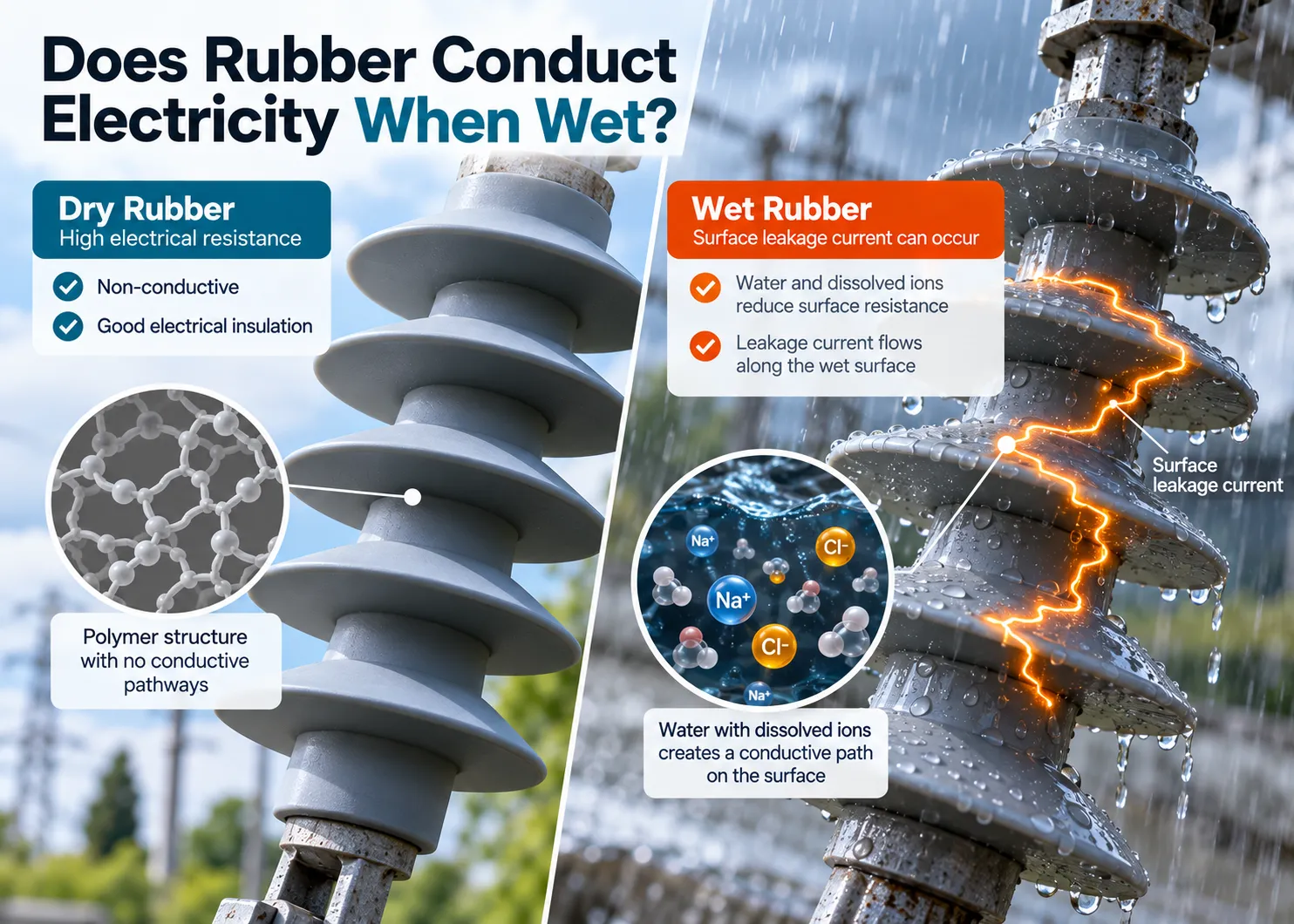
Does rubber conduct electricity when it becomes wet? In most cases, rubber itself remains an electrical insulator. However, water on the surface can dramatically change how electricity behaves around the material, especially when the water contains salts, dust, minerals or industrial contamination.
This distinction is important. A wet rubber surface can allow electrical leakage even when the bulk rubber material still has very high electrical resistance. In outdoor electrical equipment, the real problem is often not current passing directly through the rubber, but current traveling along a contaminated moisture layer on its surface.
This is one reason silicone rubber is widely used for composite insulators, surge arresters, cable systems and other outdoor electrical applications. Its hydrophobic surface helps water form droplets rather than a continuous conductive film.
This guide explains what happens when rubber gets wet, how water and contamination affect electrical resistance, why leakage current develops, and how silicone rubber helps improve insulation performance in wet environments.
Does Rubber Conduct Electricity?
Most conventional rubber materials are poor electrical conductors and are generally classified as electrical insulators.
The polymer structure contains relatively few mobile charge carriers, which means electrical current does not pass through the bulk material easily under normal conditions.
This is why rubber is widely used around electrical cables, connectors, gloves, protective covers and insulating components.
Does Wet Rubber Conduct Electricity?
Wet rubber does not automatically become electrically conductive throughout its entire structure.
The more important change usually occurs on the surface.
If water spreads across the rubber and contains dissolved ions, salts or contamination, electrical current can travel through this moisture layer.
This is known as surface leakage current.
The rubber underneath may still have high volume resistivity, while its wet surface has much lower resistance.
Why Water Changes Electrical Insulation
Water encountered in the real world is rarely chemically pure.
Rainwater, tap water, seawater and industrial moisture can contain dissolved minerals, salts, dust and other ionic contaminants.
These ions can move through the water when voltage is applied, allowing electrical current to flow.
| Water Condition | Typical Electrical Behavior |
|---|---|
| Highly Pure Water | Relatively low conductivity compared with contaminated water |
| Tap Water | Contains dissolved minerals that increase conductivity |
| Rainwater | Can contain dissolved atmospheric contaminants |
| Salt Water | Highly conductive because of dissolved ions |
| Industrial Runoff | Conductivity can be high depending on contamination |
This means the electrical behavior of wet rubber depends heavily on the type of water and the condition of the surface.
Does Rubber Conduct Electricity in Water?
If a rubber component is placed in water, current does not necessarily pass through the rubber itself.
Instead, the surrounding water can create an alternative conductive path.
If the water contains enough dissolved ions, electricity may travel around the rubber surface rather than through the insulating polymer.
This is especially important in electrical equipment where water can bridge the distance between energized and grounded regions.
Bulk Resistance vs Surface Resistance
Electrical insulation should be considered in two different directions.
For dry electrical-grade silicone rubber, both values can be very high.
But outdoor contamination and moisture can reduce surface resistance much more dramatically than bulk resistance.
This is why outdoor high-voltage insulation design pays close attention to the surface behavior of the material.
What Is Leakage Current on Wet Rubber?
Leakage current is a small unwanted current that flows through or across an insulating system.
On wet rubber, leakage current often develops along a conductive moisture layer.
The amount of current depends on factors including:
- Surface contamination
- Salt concentration
- Water coverage
- Applied voltage
- Insulator geometry
- Surface hydrophobicity
- Température
- Aging and surface damage
A small leakage current may not cause immediate failure, but prolonged current flow can create localized heating and accelerate electrical surface degradation.
Why Salt Makes Wet Rubber More Conductive
Salt dissolves into positively and negatively charged ions.
These ions can move through water when an electric field is applied, greatly increasing electrical conductivity.
This is why coastal electrical systems face more demanding insulation conditions than many dry inland environments.
Sea salt can accumulate on an insulator surface during dry weather. When fog, dew or rain adds moisture, the salt dissolves and forms a conductive layer.
→
→
→
Pollution Can Be More Important Than Water Alone
Water is only one part of outdoor insulation performance.
Dust, salt, industrial emissions, cement particles, metal contamination and other pollutants can accumulate on a rubber surface.
When dry, these deposits may not create severe electrical conduction.
When moisture arrives, however, soluble contaminants can dissolve and significantly reduce surface resistance.
This wet-pollution combination is one of the key reasons outdoor high-voltage insulation requires specialized materials and carefully designed creepage distances.
What Happens After Leakage Current Starts?
Once leakage current begins flowing across a contaminated wet surface, localized heating can occur.
Some areas may dry faster than others, producing dry zones with higher electrical resistance.
The applied voltage can then concentrate across these dry regions.
If the electric field becomes strong enough, small arcs can bridge the dry section.
These are known as dry-band arcs.
How Wet Conditions Lead to Electrical Tracking
Repeated electrical discharge can damage the rubber surface.
In some materials, thermal and electrical degradation can eventually create a carbonized or otherwise conductive path.
This progressive surface failure is known as electrical tracking.
Once tracking begins, current can follow the damaged path more easily and further accelerate degradation.
What Is Electrical Erosion?
Electrical erosion describes the physical loss of insulating material caused by repeated discharge, heat and electrical stress.
Dry-band arcs can produce very high localized temperatures.
Over time, these arcs may remove material from the surface, creating pits, rough areas or deeper damage.
Tracking and erosion resistance are therefore important performance requirements for silicone rubber used in outdoor high-voltage systems.
Why Silicone Rubber Performs Well When Wet
Silicone rubber has a major advantage over many other insulating materials: strong surface hydrophobicity.
A hydrophobic surface causes water to bead into droplets instead of spreading easily into a continuous film.
This can make it more difficult for a stable conductive path to form across the insulation surface.
Hydrophobicity Does Not Mean Zero Leakage Current
Silicone rubber hydrophobicity significantly improves wet-surface performance, but it does not make the insulation immune to electrical leakage.
Heavy contamination, prolonged wetting, severe electrical stress or surface aging can still increase leakage current.
Hydrophobicity should therefore be considered one part of the complete insulation system.
Material formulation, shed geometry, creepage distance, field distribution and environmental severity also matter.
Hydrophobicity Recovery of Silicone Rubber
One useful characteristic associated with silicone rubber is its ability to recover hydrophobic surface behavior after temporary loss under certain conditions.
Low-molecular-weight silicone species can migrate from the bulk material toward the surface.
These species may also migrate into contamination layers and help restore water-repellent behavior.
This phenomenon is particularly valuable in outdoor electrical insulation exposed to pollution and moisture.
However, recovery behavior depends on the formulation, contamination level and aging condition of the silicone rubber.
Le caoutchouc silicone dans les isolateurs composites
Composite insulators are one of the most important applications where wet-surface electrical performance matters.
The silicone rubber housing and sheds create the external insulating surface between the energized conductor and grounded structure.
During rain, fog or condensation, the housing can become wet while remaining under high electrical stress.
| Silicone Rubber Property | Importance in Wet Conditions |
|---|---|
| Hydrophobicité | Reduces formation of continuous surface water films |
| Suivi de la résistance | Helps resist permanent conductive path formation |
| Résistance à l'érosion | Helps withstand repeated dry-band arcing |
| Rigidité diélectrique | Supports insulation through the bulk material |
| Weather Resistance | Supports long outdoor exposure to rain, UV and ozone |
| Mechanical Strength | Maintains housing integrity during service |
Why Composite Insulators Have Sheds
The repeated shed structure on a composite insulator is not only a mechanical or visual feature.
Sheds increase the creepage distance along the insulation surface.
A longer creepage path makes it more difficult for surface current to travel continuously from the energized end toward ground.
Shed geometry also helps manage rainwater and contamination.
The final wet-performance capability therefore depends on both silicone rubber material properties and insulator design.
What Is Creepage Distance?
Creepage distance is the shortest distance along the surface of an insulating material between two conductive parts.
It is different from clearance distance, which is measured through air.
In polluted and wet environments, adequate creepage distance becomes particularly important because surface contamination can support leakage current.
How Coastal Environments Affect Rubber Insulation
Coastal environments can create severe electrical insulation conditions because airborne salt accumulates on exposed surfaces.
During dry weather, the salt layer may remain relatively non-conductive.
When fog or rain arrives, the salt dissolves and surface conductivity can increase rapidly.
This combination of salt contamination and moisture can significantly increase leakage current.
Hydrophobic silicone rubber is widely used in these environments because it helps control water-film formation on contaminated surfaces.
Industrial Pollution and Wet Rubber Insulation
Industrial environments can expose insulators to cement dust, chemical deposits, combustion particles and metallic contamination.
The electrical effect depends on whether the contaminants are soluble and how easily they retain moisture.
Some pollution layers can become strongly conductive when wet.
For electrical silicone rubber used near factories, mines, coastal facilities or heavy industry, tracking and erosion resistance can therefore be just as important as dielectric strength.
Does Rain Make Rubber Electrical Insulation Unsafe?
Not necessarily.
Electrical equipment designed for outdoor operation is expected to encounter rain, moisture and environmental contamination.
The insulation system should therefore be designed around wet operating conditions rather than assuming the surface will remain dry.
For polymeric insulators, this involves appropriate material selection, shed design, creepage distance and electric-field control.
Problems arise when environmental severity exceeds the insulation design capability or when the surface becomes damaged or heavily contaminated.
Does Distilled Water Make Rubber Conductive?
Highly purified water has much lower electrical conductivity than ordinary tap water or salt water because it contains fewer dissolved ions.
However, water exposed to air, containers or a rubber surface quickly picks up dissolved substances and contamination.
For practical electrical safety, water should never be assumed to remain perfectly pure.
This is why laboratory behavior in purified water can differ from real outdoor operating conditions.
Does Wet Silicone Rubber Conduct Electricity?
Wet silicone rubber generally remains highly resistive through its bulk material.
However, as with other insulating materials, surface current can occur if conductive water or contamination creates a suitable path.
Silicone rubber's advantage is that its hydrophobic surface tends to disrupt continuous water-film formation.
This helps explain why silicone rubber is particularly successful in outdoor high-voltage applications compared with materials whose surfaces become more easily wetted.
Why General-Purpose Rubber Is Not Always Suitable for Outdoor High Voltage
A rubber compound can have good basic electrical resistance without having sufficient outdoor high-voltage performance.
Composite insulators and similar products need materials that tolerate wet pollution, dry-band arcing, tracking, erosion, UV exposure and repeated thermal cycling.
General-purpose silicone rubber may not include the specialized filler system required for these conditions.
Electrical-grade HTV/HCR silicone is therefore formulated specifically for the intended high-voltage environment.
Why ATH Is Used in Electrical Silicone Rubber
Aluminum trihydrate, or ATH, is widely used in silicone rubber compounds for composite insulators and other demanding electrical applications.
ATH can improve resistance to electrical tracking and erosion.
When exposed to severe localized heat, ATH releases chemically bound water and absorbs thermal energy.
This can help reduce thermal degradation caused by electrical arcing.
However, adding mineral filler also changes material processing and mechanical behavior, so the complete formulation needs to remain balanced.
Reinforcing Silica vs ATH in Silicone Rubber
| Filler | Main Role |
|---|---|
| Reinforcing Silica | Improves tensile strength, tear strength and mechanical reinforcement |
| ATH | Supports tracking and erosion resistance in electrical-grade silicone |
High-voltage silicone compounds often use both mechanical reinforcement and electrical-performance fillers.
The ratio, surface treatment, dispersion and polymer system all influence the final balance of molding behavior, mechanical strength and electrical performance.
Can Aging Make Wet Rubber More Conductive?
Aging can reduce the ability of rubber insulation to resist wet electrical stress.
Surface cracking, erosion, contamination retention or loss of hydrophobicity can make water spread more easily and increase leakage current.
Why Surface Damage Matters
Cracks, cuts and erosion can create regions where water and contamination accumulate more easily.
Damaged geometry may also create localized electric-field concentration.
In severe cases, these defects can accelerate leakage current, discharge and further material degradation.
This is why long-term inspection of outdoor insulation considers surface condition as well as basic electrical testing.
Wet Rubber vs Conductive Rubber
Wet insulating rubber should not be confused with conductive rubber.
Conductive rubber is intentionally formulated with carbon black, graphite, metal particles or other conductive fillers.
These fillers form conductive networks inside the rubber material itself.
| Matériau | Why Current Can Flow |
|---|---|
| Dry Insulating Rubber | Very little current flows under normal conditions |
| Wet Insulating Rubber | Surface moisture or contamination can carry leakage current |
| Conductive Rubber | Conductive filler network allows current through the compound |
Silicone Rubber for Surge Arresters
Surge arresters also use silicone rubber housings in outdoor environments.
The silicone provides environmental protection and electrical insulation around the internal arrester components.
As with composite insulators, rain, humidity, contamination and UV exposure create long-term surface challenges.
Hydrophobicity and weather resistance therefore provide important advantages.
Silicone Rubber for Outdoor Cable Accessories
Cable terminations and accessories can also experience moisture and contamination.
Silicone rubber may be used in stress-control and insulating components where flexibility, electrical insulation and environmental resistance are required.
The design needs to prevent moisture penetration while controlling electric-field distribution around the cable interface.
What Properties Matter for Wet Electrical Environments?
How to Select Silicone Rubber for Composite Insulators
Composite insulator silicone should not be selected only by Shore A hardness or dielectric strength.
The material must work as part of a complete outdoor insulation system.
Manufacturers should evaluate:
- Hydrophobicity and hydrophobicity recovery
- Tracking and erosion resistance
- Dielectric properties
- Tear strength and elongation
- ATH filler system
- Heat and weather aging
- Injection or compression molding behavior
- Batch-to-batch processing consistency
Actual production trials are also important because electrical-grade silicone compounds with similar datasheet values can behave differently during molding.
What Should Electrical OEMs Include in an RFQ?
Electrical Silicone Rubber for Wet Environments from Yakows
Yakows supplies HTV/HCR silicone rubber compounds for composite insulators, surge arrester housings, wire and cable and other electrical insulation applications.
For outdoor high-voltage use, materials can be evaluated around hydrophobicity, dielectric strength, volume resistivity, tracking and erosion resistance, mechanical strength, thermal aging and processing behavior.
Composite insulator manufacturers can also evaluate compound mold flow, ATH filler systems, tear strength and batch-to-batch consistency for injection or compression molding.
Customers replacing an existing material can provide their current specification, voltage application, environmental conditions and known production or field-performance issues for comparison.
Foire aux questions
Does rubber conduct electricity when wet?
The rubber itself may remain electrically insulating, but water containing salts or contamination can create a conductive surface path and allow leakage current to flow.
Does rubber conduct electricity in water?
Rubber normally remains highly resistive internally, but conductive water can allow current to travel around or across the rubber surface.
Does rain make rubber conductive?
Rain does not necessarily make the rubber material conductive, but it can wet contamination on the surface and reduce surface electrical resistance.
Does salt water make rubber conduct electricity?
Salt water is highly conductive and can create a strong surface leakage path around insulating rubber.
Why does wet rubber sometimes allow electricity to pass?
The current usually travels through conductive moisture or contamination on the surface rather than through the rubber polymer itself.
Is silicone rubber waterproof?
Silicone rubber generally has good resistance to water and moisture, but the finished component and interfaces must also be designed to prevent water ingress.
Why is silicone rubber used for outdoor insulators?
Silicone rubber combines electrical insulation, hydrophobicity, weather resistance and tracking and erosion resistance.
What is leakage current on an insulator?
Leakage current is unwanted electrical current flowing along or through the insulation, often increased by wet contamination on the surface.
What is hydrophobicity in silicone rubber?
Hydrophobicity describes the tendency of water to form droplets rather than spread into a continuous film across the silicone surface.
Can old rubber become more conductive when wet?
Aging, cracking, erosion and contamination can reduce surface insulation performance and increase wet leakage current.