
Silicone Rubber Electrical Material Guide
Does Rubber Conduct Electricity?
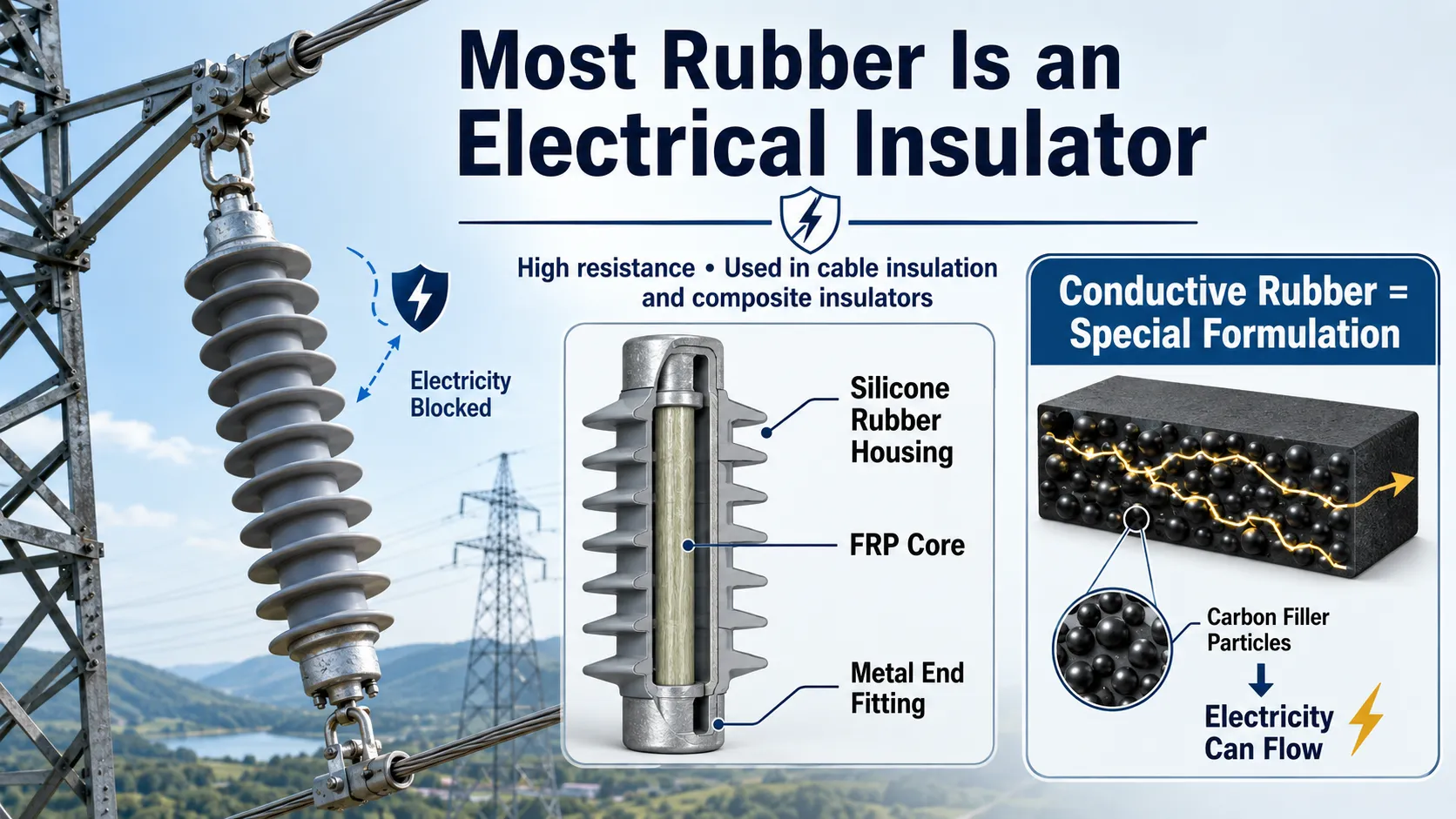
Does rubber conduct electricity? In most everyday and industrial applications, standard rubber is considered a poor electrical conductor and is commonly used as an insulating material. However, not all rubber behaves the same way. Silicone rubber, EPDM, natural rubber and other elastomers can provide high electrical resistance in their normal insulating formulations, while specially compounded rubber can be made semiconductive or electrically conductive by adding carbon black, conductive particles or other functional fillers. For silicone rubber applications, electrical behavior therefore depends on the complete compound rather than the word “rubber” alone.
Does Rubber Conduct Electricity?
Under normal conditions, most conventional rubber materials do not conduct electricity easily.
This is why rubber is widely associated with electrical insulation. A typical insulating rubber has very high resistance to the movement of electrical charge compared with metals such as copper or aluminum.
However, saying that “rubber does not conduct electricity” is too simple.
Rubber is a large family of materials. Its electrical behavior depends on the base polymer, fillers, additives, moisture, temperature, contamination and the way the compound is formulated.
For example, a standard silicone rubber cable-insulation compound can have very high electrical resistance, while a carbon-filled silicone rubber may intentionally conduct electricity.
ordinary insulating rubber conducts electricity very poorly, but specially formulated conductive rubber can carry electrical current.
Why Does Rubber Usually Not Conduct Electricity?
Electrical conduction requires charge carriers that can move through a material.
Metals conduct electricity easily because they contain electrons that can move relatively freely through the metallic structure.
Most unmodified rubber polymers do not have the same type of freely moving charge carriers.
Their molecular structures restrict electrical charge movement, giving the material relatively high electrical resistance.
This is why many elastomers behave as electrical insulators when properly formulated and kept clean and dry.
Silicone rubber is a particularly important example because it combines electrical insulation with flexibility, temperature resistance and environmental durability.
Is Rubber a Conductor or an Insulator?
Rubber can be either an insulator or a conductor depending on its formulation.
In most general applications, rubber is formulated as an insulating elastomer.
In other applications, manufacturers intentionally add conductive fillers so that the rubber can carry charge or control electrical resistance.
| Type de caoutchouc | Comportement électrique | Typical Application |
|---|---|---|
| Standard insulating rubber | Résistance électrique très élevée | Cable insulation, seals and electrical protection |
| Antistatic rubber | Allows controlled charge dissipation | Electronics handling and static-sensitive environments |
| Semiconductive rubber | Controlled intermediate resistance | High-voltage cable layers and electric-field control |
| Caoutchouc conducteur | Designed to conduct electrical current | EMI shielding, conductive contacts and grounding components |
The important point is that electrical conductivity is a designed material property.
Le caoutchouc de silicone est-il conducteur d'électricité ?
Standard silicone rubber is generally an excellent electrical insulator.
Properly formulated insulating silicone rubber provides high electrical resistance while remaining flexible over a broad temperature range.
This combination makes silicone rubber useful for wire and cable insulation, connector seals, high-voltage components, electrical housings and outdoor insulation.
However, silicone rubber can also be intentionally formulated to conduct electricity.
Carbon black, metal particles, nickel-coated fillers, silver-coated particles or other electrically conductive materials can be incorporated into the silicone compound.
These fillers create conductive pathways through the elastomer.
Why Is Silicone Rubber Used for Electrical Insulation?
Electrical insulation is one of the major industrial uses of silicone rubber.
The material can combine high electrical resistance with mechanical flexibility and good temperature stability.
This is particularly useful because many electrical components must remain flexible while operating close to conductors, terminals, motors, batteries or power electronics.
Silicone rubber can also maintain useful properties after repeated heating and cooling cycles.
For outdoor electrical equipment, silicone formulations can additionally provide resistance to UV radiation, ozone, moisture and weather exposure.
These properties explain why electrical-grade silicone rubber is widely used in both low-voltage and high-voltage applications.
What Is Volume Resistivity?
Volume resistivity is one of the most important properties used to describe whether rubber conducts electricity.
It represents the resistance of the material to electrical current passing through its bulk.
Higher volume resistivity means the material resists current flow more strongly.
Lower volume resistivity means electricity can move through the material more easily.
| Material Behavior | Relative Volume Resistivity | General Interpretation |
|---|---|---|
| Electrical insulating silicone | Very high | Current flow through the rubber is strongly restricted |
| Antistatic silicone | Reduced in a controlled way | Allows accumulated static charge to dissipate |
| Semiconductive silicone | Intermediate | Used where controlled electrical resistance is required |
| Conductive silicone | Low compared with insulating rubber | Designed to carry electrical charge |
Exact resistance values should always be taken from the technical data of the actual silicone grade because formulations vary significantly.
Volume Resistivity vs Electrical Conductivity
Electrical resistivity and conductivity describe opposite aspects of the same behavior.
A material with very high resistivity has very low electrical conductivity.
A material with low resistivity has higher electrical conductivity.
For insulating silicone rubber, engineers normally want very high resistance.
For conductive silicone, they intentionally reduce resistance by adding a network of conductive particles.
Low resistivity = better electrical conductor.
What Is Surface Resistivity?
Volume resistivity measures current through the bulk of the rubber, while surface resistivity describes electrical resistance along the surface.
This distinction is important in real electrical environments.
A silicone rubber component may have excellent bulk insulation but develop lower surface resistance if the surface becomes contaminated with moisture, salts, dust or conductive deposits.
Outdoor high-voltage components are particularly sensitive to surface condition.
Rain, industrial pollution and salt contamination can create conductive paths across the surface even when the underlying silicone rubber remains highly insulating.
What Is Dielectric Strength?
Dielectric strength is different from electrical resistance.
It describes how much electric field a material can withstand before electrical breakdown occurs under specified test conditions.
A material can have very high electrical resistivity but still fail if the applied voltage becomes high enough.
Electrical insulation design therefore needs to consider both resistance and dielectric strength.
| Electrical Property | What It Describes |
|---|---|
| Volume resistivity | Resistance to electrical current through the rubber |
| Surface resistivity | Resistance to current moving along the surface |
| Dielectric strength | Ability to withstand electric field before breakdown |
| Dielectric constant | How the material responds to an electric field |
| Dissipation factor | Electrical energy loss under an alternating field |
Does Rubber Become Conductive at High Voltage?
An insulating rubber does not automatically become a normal conductor simply because voltage increases.
However, every insulation system has limits.
If the electric field becomes sufficiently high, electrical breakdown can occur.
Breakdown may create a conductive path through the insulation, resulting in permanent damage.
In high-voltage applications, the rubber material must therefore be selected according to voltage level, insulation thickness, electric-field distribution and environmental conditions.
Simply knowing that rubber is “nonconductive” is not enough for high-voltage design.
What Makes Rubber Conductive?
Standard elastomer polymers usually have high electrical resistance, so conductive rubber is created by modifying the formulation.
Conductive particles are distributed through the rubber compound.
When enough particles are present and sufficiently close together, they form an interconnected electrical network.
Electrical charge can then move through this network.
The amount, type and distribution of conductive filler strongly influence the final conductivity.
Carbon Black and Conductive Rubber
Carbon black is one of the most widely used fillers for creating conductive or semiconductive rubber.
Not all carbon black has the same electrical effect.
Particle size, structure, loading and dispersion influence whether the final compound remains insulating, becomes antistatic or develops significant conductivity.
As conductive filler loading increases, electrical resistance can decrease dramatically once enough particles begin to form a connected network.
However, increasing carbon black also changes mechanical properties, hardness, viscosity, processing behavior and color.
Conductive silicone therefore requires a balanced formulation rather than simply adding as much carbon as possible.
Metal-Filled Conductive Silicone Rubber
Silicone rubber can also be compounded with electrically conductive metal-based fillers.
These materials are commonly considered when higher conductivity or electromagnetic shielding performance is required.
Conductive filler systems may include silver, nickel, aluminum or metal-coated particles depending on the target performance.
The resulting elastomer can combine flexibility and sealing behavior with electrical conductivity.
This is useful for conductive gaskets installed between electronic housings where both environmental sealing and EMI shielding are required.
What Is Conductive Silicone Rubber?
Conductive silicone rubber is a silicone elastomer specifically formulated to allow electrical current or electrical charge to move through the material.
The base silicone polymer itself remains an elastomeric matrix, while conductive fillers create electrical pathways.
Conductive silicone can be molded into gaskets, contacts, keypads, grounding components and shielding parts.
The required conductivity depends heavily on the application.
A material intended only to dissipate static electricity may have much higher resistance than a material designed to provide a low-resistance conductive connection.
What Is Semiconductive Silicone Rubber?
Semiconductive silicone rubber has controlled electrical resistance between a highly insulating material and a strongly conductive material.
Semiconductive behavior is useful when engineers do not want a perfect insulator but also do not want a highly conductive metallic path.
In high-voltage systems, semiconductive elastomers can be used for electric-field control and interface management.
The resistance range must be carefully controlled because these applications depend on predictable electrical behavior.
Insulating vs Semiconductive vs Conductive Silicone Rubber
| Silicone Type | Electrical Function | Utilisation type |
|---|---|---|
| Insulating silicone | Restricts electrical current | Wire insulation, connectors, seals and high-voltage housings |
| Antistatic silicone | Allows controlled static-charge dissipation | Electronics and static-sensitive equipment |
| Semiconductive silicone | Provides controlled intermediate resistance | High-voltage field-control applications |
| Conductive silicone | Provides electrical conduction | EMI shielding, conductive seals and electrical contacts |
Does Black Rubber Conduct Electricity?
Black color alone does not tell you whether rubber conducts electricity.
Many black rubber compounds contain carbon black, but carbon black can be used for several reasons, including reinforcement, UV protection, pigmentation and electrical conductivity.
A black rubber compound can therefore still be electrically insulating.
Another black compound may be specifically engineered as semiconductive or conductive.
Electrical resistance must be measured or specified rather than assumed from color.
Does Clear Silicone Rubber Conduct Electricity?
Clear or translucent silicone rubber is generally associated with insulating formulations because it does not contain large quantities of dark conductive fillers.
However, transparency alone is not an electrical specification.
A clear silicone product should still be evaluated according to its volume resistivity, dielectric strength and intended electrical application.
Appearance can provide clues about formulation, but it cannot replace technical data.
Does Wet Rubber Conduct Electricity?
Moisture can change electrical behavior, particularly at the surface.
Pure rubber may remain highly insulating, but water containing dissolved salts or contaminants can create a more conductive path across the surface.
This is especially relevant outdoors.
A wet and polluted insulator surface can carry leakage current even though the silicone rubber bulk remains electrically insulating.
For this reason, high-voltage insulation design considers surface hydrophobicity, creepage distance, contamination and tracking resistance in addition to bulk resistivity.
Does Temperature Affect Rubber Conductivity?
Yes. Electrical properties can change with temperature.
As temperature changes, molecular movement and charge transport behavior inside the material can also change.
Long-term heat aging may additionally change the rubber structure, fillers and interfaces.
Electrical-grade silicone should therefore be evaluated at temperatures relevant to the final application rather than only at room temperature.
This is particularly important for EV power systems, high-temperature wiring and electrical equipment close to motors or heaters.
Does Rubber Thickness Affect Electrical Insulation?
Yes. Insulation thickness is important, particularly when dielectric strength and voltage withstand are considered.
A thicker insulation layer generally provides a longer path through the material between conductive parts.
However, insulation design is not simply a matter of making rubber thicker.
Defects, air voids, interfaces, sharp electrodes, electric-field concentration and material quality can all influence breakdown behavior.
High-voltage design therefore requires both suitable material properties and controlled geometry.
Does Shore Hardness Affect Electrical Conductivity?
Shore hardness does not directly determine whether rubber conducts electricity.
Shore hardness measures resistance to indentation, while electrical resistance measures how easily charge moves through the material.
Two silicone rubber compounds can both be Shore A 60 while having completely different electrical behavior.
One may be a high-resistivity electrical insulation compound.
Another may contain conductive carbon and be designed as semiconductive rubber.
Does Vulcanization Affect Electrical Properties?
Vulcanization converts an uncured rubber compound into a crosslinked elastomer.
For HTV silicone rubber, proper curing is important because the finished electrical properties should represent the actual crosslinked material used in service.
Under-cured silicone may have different mechanical, surface and electrical behavior from a fully cured compound.
Curing conditions, post-curing and contamination therefore need to be controlled when producing electrical silicone rubber.
Electrical Insulating HTV Silicone Rubber
HTV silicone rubber is widely used where flexible electrical insulation must be manufactured by extrusion or molding.
HCR, or High Consistency Rubber, begins as a high-viscosity silicone compound.
The compound can be extruded around conductors or molded into electrical components and then heat cured.
Electrical-grade HTV compounds may be designed to provide high resistivity, dielectric strength, temperature stability and mechanical flexibility.
Depending on the application, additional properties such as flame retardancy, tracking resistance or high tear strength may also be required.
Why Silicone Rubber Is Used for Cable Insulation
Wire and cable insulation must prevent current from escaping the conductor while also surviving bending, heat and installation stress.
Silicone rubber is useful because suitable grades combine electrical insulation with flexibility.
In production, an HTV silicone compound is extruded around the conductor and subsequently vulcanized.
The finished crosslinked insulation layer protects the conductor while remaining flexible.
Cable compounds may also need to meet requirements for heat aging, tensile strength, elongation and flame performance.
Rubber Cable Grommets and Electrical Insulation
Rubber cable grommets are another example of how insulating silicone rubber can support electrical safety.
The grommet is installed around a panel opening where a cable passes through metal or rigid plastic.
Its main function is mechanical protection rather than replacing the cable's own insulation.
By preventing the cable jacket from rubbing against a sharp conductive panel edge, the grommet helps protect the primary insulation system.
Silicone rubber grommets can be particularly useful where elevated temperature, electrical insulation and flexible edge protection are required together.
Does Rubber Protect You From Electricity?
Rubber is widely used in electrical protective products, but it should never be assumed that any rubber object provides safe protection from electric shock.
Electrical protective equipment must be specifically designed, manufactured and tested for its voltage class and intended use.
A general silicone gasket, rubber glove, shoe sole or cable grommet should not be treated as certified electrical protective equipment simply because rubber is normally insulating.
never rely on an unspecified rubber product for personal protection against live electrical systems. Use equipment designed and rated for the applicable electrical hazard.
Silicone Rubber in EV and NEV Electrical Systems
Electric vehicles and new energy vehicles create demanding environments for electrically insulating elastomers.
High-voltage battery systems combine electrical stress with heat, vibration, moisture and repeated temperature cycling.
Silicone rubber can be used for connector seals, cable insulation, battery gaskets and protective electrical components.
| EV / NEV Component | Role of Silicone Rubber | Important Electrical Consideration |
|---|---|---|
| High-voltage cable | Flexible insulation | Dielectric strength and resistivity |
| HV connector seal | Environmental sealing | Electrical insulation and contamination control |
| Battery enclosure gasket | Étanchéité | Insulating or conductive behavior must match design |
| Power electronics | Sealing and flexible protection | Temperature and electrical stability |
Conductive Silicone for EMI Shielding
Not every electrical application needs an insulator.
Electronic enclosures often require electromagnetic interference shielding.
A conductive silicone gasket can provide environmental sealing while maintaining electrical contact between two conductive housing surfaces.
The conductive path helps reduce electromagnetic leakage through the enclosure joint.
This is a fundamentally different function from insulating silicone.
For EMI applications, conductivity, shielding performance, compression behavior and corrosion compatibility must all be considered.
Silicone Rubber in High-Voltage Composite Insulators
Silicone rubber is widely used for the housing and weather sheds of high-voltage composite insulators.
In this application, the silicone compound must provide electrical insulation while operating outdoors for long periods.
Bulk electrical resistance is important, but surface behavior becomes equally critical.
Pollution and moisture can create leakage current across the surface.
High-voltage silicone compounds are therefore designed with properties such as hydrophobicity, tracking resistance, erosion resistance, UV resistance and weather stability.
The silicone housing is typically molded around an FRP core and vulcanized to form the finished external insulation.
Hydrophobicity and Electrical Insulation
Hydrophobicity is one reason silicone rubber performs well in outdoor high-voltage insulation.
On a hydrophobic surface, water tends to form separate droplets rather than spreading into a continuous film.
This can help reduce the formation of continuous conductive water paths over contaminated surfaces.
However, hydrophobicity does not eliminate all electrical leakage.
Insulator design must still consider creepage distance, electric-field distribution, pollution level and weather conditions.
What Is Electrical Tracking in Rubber?
Electrical tracking is progressive surface degradation that can occur when leakage current repeatedly travels across an insulating surface.
Moisture and contamination can create local conductive paths.
When parts of these paths dry, localized electrical discharges may occur.
Repeated electrical stress can damage the polymer surface and eventually create a more permanent conductive track.
High-voltage silicone rubber formulations therefore need specific tracking and erosion resistance.
Can Contamination Make Rubber Conduct Electricity?
Yes, especially at the surface.
Dust, salt, conductive particles, metal residue, carbon contamination and ionic liquids can reduce surface resistance.
This is important during both manufacturing and service.
An insulating silicone part can have excellent bulk properties but still experience leakage current if its surface becomes heavily contaminated.
Electrical components should therefore be handled, cleaned and packaged in a way that protects critical insulation surfaces.
Can Aging Change the Electrical Conductivity of Rubber?
Long-term aging can change electrical properties.
Heat, UV radiation, ozone, chemicals and mechanical stress can modify the rubber surface or bulk structure.
In outdoor electrical insulation, surface erosion and contamination can be particularly important.
In high-temperature applications, thermal aging may change hardness, elongation and interfaces as well as electrical properties.
Critical electrical silicone materials should therefore be evaluated after relevant environmental aging rather than only in their original condition.
How Is the Electrical Resistance of Rubber Tested?
Electrical rubber testing depends on the intended application.
Insulating materials may be evaluated using volume resistivity, surface resistivity and dielectric strength tests.
Conductive silicone may instead be evaluated using resistance or resistivity measurements appropriate to its conductivity range.
| Test | What It Measures | Pourquoi est-ce important ? |
|---|---|---|
| Volume resistivity | Resistance through the material | Determines bulk insulating or conductive behavior |
| Surface resistivity | Resistance along the surface | Important for contaminated or outdoor surfaces |
| Dielectric strength | Breakdown resistance under electric field | Important for insulation thickness design |
| Leakage current | Current flowing through or across insulation | Useful in actual electrical assemblies |
| Traces et érosion | Surface resistance to electrical degradation | Important for high-voltage outdoor insulation |
ASTM D257 is commonly associated with DC resistance and resistivity measurements for insulating materials, while dielectric strength can be evaluated using methods such as ASTM D149 or relevant IEC procedures.
How to Choose Silicone Rubber for an Electrical Application
Electrical silicone rubber should be selected according to the function of the finished component rather than simply asking whether rubber conducts electricity.
The first question is whether the component should be insulating, antistatic, semiconductive or conductive.
For insulation, volume resistivity and dielectric strength should be reviewed.
For high-voltage outdoor applications, tracking resistance, erosion resistance and hydrophobicity become important.
Mechanical requirements should then be considered. Shore hardness, tensile strength, elongation and tear resistance must match the component geometry.
Temperature is another major factor. Cable insulation close to a motor may require different silicone from an electrical seal operating at room temperature.
If the component contacts oil, coolant or another fluid, chemical compatibility must also be evaluated.
Finally, the selected silicone should be validated after the actual molding or extrusion and curing process because finished-product properties depend on both formulation and processing.
Questions to Ask an Electrical Silicone Rubber Supplier
When selecting silicone rubber for an electrical component, a supplier should be able to define more than just color and Shore hardness.
Important information includes whether the compound is insulating, antistatic, semiconductive or conductive, together with its volume resistivity and dielectric properties.
For HTV and HCR materials, the recommended curing system and processing conditions should also be confirmed.
Depending on the application, heat-aging data, flame performance, compression set, tracking resistance and chemical compatibility may also be required.
For high-voltage applications, ask specifically whether the compound was developed and tested for high-voltage insulation rather than assuming that every electrically insulating silicone rubber is suitable.
Foire aux questions
Does rubber conduct electricity?
Standard rubber usually conducts electricity very poorly and is generally considered an electrical insulator. However, rubber can be made conductive by adding suitable conductive fillers.
Is rubber a conductor or an insulator?
Most normal rubber compounds are electrical insulators, but specialized antistatic, semiconductive and conductive rubber compounds are also available.
Does silicone rubber conduct electricity?
Standard silicone rubber is generally highly electrically resistive, but conductive silicone can be produced using carbon black, metal particles or other conductive fillers.
Why does rubber not conduct electricity?
Most rubber polymers do not contain the freely moving electrical charge carriers that allow metals to conduct current easily.
Can black rubber conduct electricity?
Sometimes, but color alone is not enough to determine conductivity. Black rubber may be insulating, semiconductive or conductive depending on its carbon-black type and formulation.
Does wet rubber conduct electricity?
Moisture and ionic contamination can reduce surface resistance and create leakage-current paths, even when the rubber itself remains highly insulating.
Can rubber become conductive at high voltage?
Insulating rubber does not simply become a normal conductor, but sufficiently high electric fields can cause dielectric breakdown and permanent electrical damage.
What is conductive silicone rubber?
Conductive silicone rubber is a silicone elastomer containing conductive fillers that create electrical pathways through the rubber.
What is semiconductive rubber?
Semiconductive rubber has controlled electrical resistance between highly insulating and strongly conductive materials and is useful for applications such as high-voltage electric-field control.
Does Shore hardness affect electrical conductivity?
Not directly. Shore hardness measures indentation resistance, while conductivity depends on polymer chemistry, conductive fillers and the complete compound formulation.
Does silicone rubber protect electrical cables?
Yes. Electrical-grade silicone rubber can be used as cable insulation, while silicone cable grommets can protect the cable jacket from abrasion at panel openings.
Is silicone rubber used in electric vehicles?
Yes. Silicone rubber can be used in high-voltage cable insulation, connector seals, battery gaskets and power-electronics components.
Is silicone rubber used for high-voltage insulation?
Yes. Specialized HTV silicone rubber is widely used in composite insulator housings and other high-voltage applications where electrical insulation, hydrophobicity and tracking resistance are required.
Can conductive silicone still be flexible?
Yes. Conductive fillers can be incorporated into silicone while retaining elastomeric flexibility, although filler loading can affect hardness, elongation and mechanical properties.
Can rubber protect a person from electric shock?
Only properly designed and rated electrical protective equipment should be relied upon for shock protection. An ordinary rubber or silicone product should never be assumed to provide safe personal electrical protection.