
Industrial Manufacturing of Liquid Silicone Rubber (LSR)
Caoutchouc de silicone liquide (LSR) is one of the most important high-performance elastomer materials used in modern industrial manufacturing. Due to its excellent thermal stability, chemical resistance, flexibility, electrical insulation properties, and biocompatibility, LSR has become widely used in industries such as automotive engineering, medical devices, consumer electronics, aerospace systems, and precision industrial equipment. Compared with traditional organic rubber materials, LSR offers superior durability under extreme environmental conditions and is highly suitable for automated manufacturing processes.
In industrial applications, the demand for LSR has increased rapidly over the past two decades. The growth of electric vehicles, wearable electronics, minimally invasive medical devices, and high-precision sealing systems has further accelerated the development of silicone material technology. Modern manufacturers require materials that can maintain stable mechanical performance under heat, pressure, ultraviolet radiation, and chemical exposure. Liquid Silicone Rubber satisfies these requirements while also supporting high-speed injection molding and large-scale automated production.
From an industrial perspective, the production of LSR is not a simple mixing process. Instead, it is a highly sophisticated chemical engineering operation involving silicone monomer synthesis, polymerization technology, filler surface treatment, catalyst chemistry, rheological engineering, precision compounding, automated molding systems, and strict quality control procedures. Each production stage must be carefully controlled because even small variations in viscosity, moisture, catalyst concentration, or filler dispersion can significantly affect the final material properties.
Liquid Silicone Rubber Chemical Structure and Fundamental Properties
The basic molecular structure of Liquid Silicone Rubber is based on polysiloxane chemistry, particularly polydimethylsiloxane (PDMS). Unlike traditional carbon-based elastomers, silicone polymers contain alternating silicon and oxygen atoms within the main molecular backbone. This unique structure provides exceptional thermal and environmental stability.
The silicon-oxygen bond possesses higher bond energy than typical carbon-carbon bonds found in organic polymers. As a result, LSR exhibits excellent resistance to oxidation, ozone degradation, ultraviolet radiation, and high temperatures. Even under severe industrial conditions, silicone rubber can maintain flexibility and elasticity over a very wide temperature range, typically from -50°C to over 250°C.
The most important characteristics of LSR include:
- Excellent heat resistance
- High flexibility and elasticity
- Outstanding weather resistance
- Electrical insulation performance
- Chemical inertness
- Biocompatibility
- Low compression set
- Good transparency
These properties make LSR highly suitable for precision industrial applications where long-term reliability is essential.
Industrial LSR systems are usually supplied as two separate liquid components. Part A typically contains vinyl-functional silicone polymers and platinum catalyst, while Part B contains hydride-functional crosslinkers and inhibitor systems. Once the two components are mixed, a platinum-catalyzed hydrosilylation reaction occurs, forming a three-dimensional elastomeric network.
Compared with peroxide-cured silicone systems, addition-cure LSR provides several important industrial advantages. The curing reaction produces no volatile by-products, resulting in lower shrinkage, reduced contamination, and improved dimensional stability. This is particularly important in medical and electronic applications where material purity is critical.
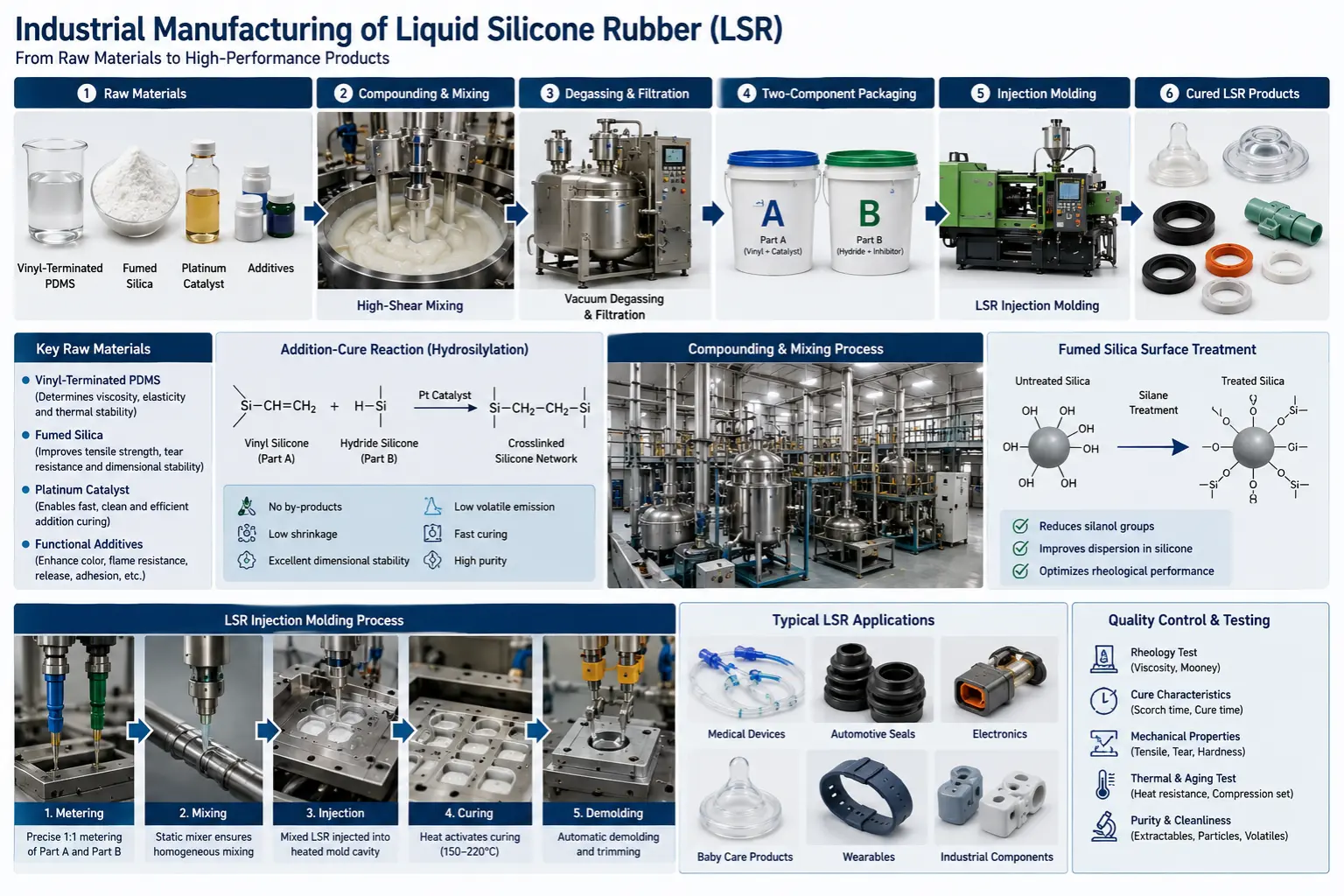
Raw Materials Used in Liquid Silicone Rubber Manufacturing
The quality of Liquid Silicone Rubber depends heavily on the purity and consistency of its raw materials. Industrial manufacturers therefore implement strict supplier qualification procedures and raw material inspection systems to ensure stable product performance.
Silicone Base Polymer
The primary component of LSR is vinyl-terminated polydimethylsiloxane. This polymer acts as the elastomer matrix and determines many key material properties such as viscosity, elasticity, flexibility, and thermal resistance.
Industrial silicone polymers are commonly produced through ring-opening polymerization of cyclic siloxanes such as:
- Octamethylcyclotetrasiloxane (D4)
- Decamethylcyclopentasiloxane (D5)
During polymer synthesis, manufacturers carefully control reaction temperature, catalyst concentration, pressure, and polymer chain length. Precise molecular weight control is essential because viscosity consistency directly influences injection molding performance.
Reinforcing Fillers
Pure silicone rubber possesses relatively low mechanical strength. To improve tensile strength and tear resistance, reinforcing fillers are added to the formulation. The most important reinforcing filler in LSR manufacturing is fumed silica.
Fumed silica provides several advantages:
- Improved tensile strength
- Enhanced tear resistance
- Better dimensional stability
- Improved mechanical durability
However, untreated silica particles contain silanol groups that create strong hydrogen bonding, significantly increasing viscosity. To solve this issue, manufacturers use surface treatment technologies involving silazanes and siloxanes to chemically modify the filler surface. Proper surface treatment improves filler dispersion and stabilizes rheological behavior during processing.
Platinum Catalyst and Crosslinkers
Platinum catalysts play a critical role in addition-curing LSR systems. The platinum catalyst promotes hydrosilylation reactions between vinyl-functional silicone polymers and hydride-functional crosslinkers.
Industrial platinum catalysts offer several benefits:
- Fast curing speed
- High curing efficiency
- Excellente stabilité thermique
- Low volatile emissions
- Improved product purity
However, platinum catalysts are highly sensitive to contamination. Sulfur compounds, phosphorus-containing substances, amines, and organotin residues can poison the catalyst and inhibit curing reactions. Therefore, contamination control is extremely important during industrial production.
Functional Additives
Depending on the final application, manufacturers may also incorporate functional additives into the formulation. These additives can include pigments, flame retardants, heat stabilizers, adhesion promoters, and low-friction modifiers.
For example:
- Medical-grade LSR requires ultra-high purity additives
- Automotive-grade LSR may require heat stabilizers
- Electronic-grade LSR often requires flame retardants
- Optical-grade LSR requires excellent transparency
The formulation design therefore depends heavily on the target industrial application.
Industrial Production of Silicone Polymer
The industrial production of silicone materials begins with organochlorosilane chemistry. One of the most important intermediate materials is dimethyldichlorosilane, which undergoes hydrolysis to produce cyclic siloxanes and linear silicone oligomers.
This reaction also generates hydrogen chloride as a by-product, creating significant engineering challenges related to corrosion resistance and environmental protection. Large industrial silicone plants therefore require advanced reactor systems, acid recovery units, gas treatment systems, and corrosion-resistant equipment.
After hydrolysis, cyclic siloxanes are purified and transferred into polymerization reactors. Ring-opening polymerization is then performed using catalysts such as potassium hydroxide or quaternary ammonium compounds. During this stage, precise control of temperature and reaction time is essential because polymer chain length strongly influences the viscosity and processing behavior of the final material.
Modern silicone manufacturing plants rely heavily on automated process control systems. Sensors continuously monitor:
- Température
- Pressure
- Viscosité
- Catalyst concentration
- Moisture content
These automated systems improve production consistency, reduce batch variation, and increase manufacturing efficiency.
Compounding and Mixing Technology
Compounding is one of the most technically demanding stages in LSR manufacturing. During this process, silicone polymers, fillers, catalysts, pigments, additives, and crosslinkers are combined to create the final elastomer formulation.
Industrial compounding equipment commonly includes:
- Planetary mixers
- Sigma-blade kneaders
- Double planetary vacuum mixers
- Continuous high-shear mixing systems
The primary objective of compounding is to achieve uniform dispersion of silica particles throughout the polymer matrix. Poor dispersion can result in weak mechanical properties, inconsistent curing behavior, and surface defects in molded products.
Vacuum mixing systems are especially important because they remove trapped air and volatile contaminants during processing. Air bubbles may create defects during injection molding, while moisture contamination can interfere with catalyst performance.
Temperature control is another critical factor during compounding. Excessive heat generation may trigger premature curing reactions or alter rheological properties. Industrial mixing systems therefore include advanced cooling systems and computerized monitoring technology.
Once compounding is completed, the formulation is divided into the two-component system used for commercial storage and transportation. Separating the platinum catalyst from the hydride-functional crosslinker prevents premature curing and ensures long shelf life.
Injection Molding and Automated Production
Injection molding is the dominant processing technology used for Liquid Silicone Rubber. Compared with traditional rubber molding methods, LSR injection molding offers higher efficiency, shorter cycle times, lower material waste, and greater dimensional precision.
Industrial LSR injection molding systems use precision metering pumps to continuously deliver Part A and Part B in an exact ratio, typically 1:1. The two components are mixed immediately before entering the mold cavity.
Several important process parameters must be carefully controlled during molding:
- Injection pressure
- Mold temperature
- Mixing ratio
- Cure time
- Flow rate
Unlike thermoplastic molding, LSR molding uses heated molds to activate the curing reaction. Typical mold temperatures range from 150°C to 220°C. Once the material enters the heated cavity, rapid crosslinking occurs and the elastomer solidifies.
Modern LSR molding systems frequently use cold-runner technology. In this system, the runner remains cool while only the mold cavity is heated. This minimizes material waste and improves production efficiency.
Automation is another major advantage of LSR manufacturing. Many factories employ:
- Robotic demolding systems
- Automated trimming equipment
- Machine vision inspection systems
- Real-time process monitoring platforms
Fully automated production lines reduce labor costs, improve consistency, and minimize contamination risk.
Quality Control and Industrial Standards
Quality assurance is extremely important in industrial LSR manufacturing because many applications involve critical operating environments. Automotive sealing systems, implantable medical devices, infant care products, and electrical insulation systems all require highly reliable material performance.
Industrial manufacturers therefore perform comprehensive testing throughout the entire production process. Raw materials are carefully analyzed before use, while finished products undergo extensive physical and mechanical evaluation.
Typical testing procedures include:
- Essais de résistance à la traction
- Elongation measurement
- Hardness testing
- Analyse de la déformation rémanente après compression
- Évaluation du vieillissement thermique
- Dielectric performance testing
- Rheological analysis
Medical-grade LSR production often takes place in ISO Class 7 or ISO Class 8 cleanroom environments. Strict contamination control is essential because microscopic particles or volatile residues may affect product safety.
Manufacturers supplying medical and automotive industries must also comply with international standards such as ASTM, ISO, FDA, and USP regulations. Compliance with these standards is essential for entering high-end industrial markets.
Future Development of the LSR Industry
The future of the Liquid Silicone Rubber industry is strongly connected to technological developments in electric vehicles, medical technology, renewable energy systems, semiconductor manufacturing, and wearable electronics.
One important trend is the integration of smart manufacturing technologies into silicone production facilities. Artificial intelligence, predictive maintenance systems, digital twins, and real-time process monitoring are increasingly being used to improve production efficiency and consistency.
Environmental sustainability is also becoming increasingly important. Manufacturers are investing heavily in:
- Energy-efficient production systems
- Lower-emission manufacturing technologies
- Recyclable silicone materials
- Sustainable raw material development
Medical applications are expected to remain one of the fastest-growing sectors for LSR. Demand for minimally invasive medical devices, wearable healthcare systems, and implantable technologies continues to increase globally.
At the same time, the electronics industry is creating new opportunities for high-performance silicone materials. Electric vehicle battery systems, flexible electronics, semiconductor packaging, and next-generation communication equipment all require advanced elastomer materials capable of operating under demanding conditions.
Conclusion
Liquid Silicone Rubber manufacturing represents a highly advanced combination of polymer chemistry, materials science, industrial engineering, automation technology, and precision manufacturing. From silicone monomer synthesis and polymerization to compounding, injection molding, and quality assurance, every stage of production requires sophisticated technical expertise and strict process control.
The unique molecular structure of silicone materials provides exceptional thermal stability, flexibility, chemical resistance, and environmental durability, allowing LSR to outperform many conventional elastomer systems in demanding industrial applications.
As industries continue moving toward automation, miniaturization, sustainability, and high-performance engineering, the global importance of Liquid Silicone Rubber will continue to grow. Future developments in smart manufacturing, medical technology, renewable energy, and advanced electronics are expected to further expand the industrial applications of LSR and drive continued innovation throughout the silicone industry.