
Comment fabriquer des élastiques en caoutchouc silicone ?
Silicone rubber bands are flexible, reusable rings used in consumer products, packaging, electronics, medical devices, food equipment and industrial assemblies. Making a reliable silicone band requires more than pouring silicone into a circular mold. Material grade, hardness, mold design, curing conditions, dimensional tolerances and quality inspection all affect the finished product.
How Are Silicone Rubber Bands Made?
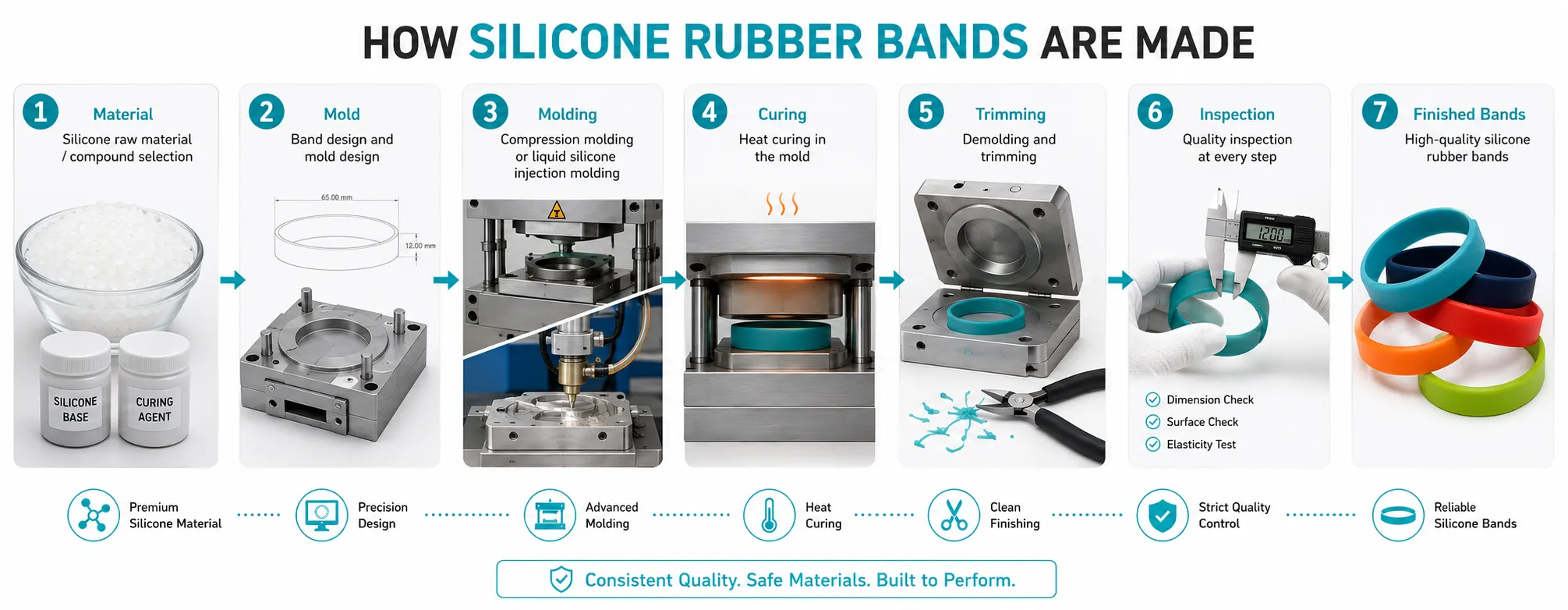
Silicone rubber bands are generally produced by placing or injecting uncured silicone material into a precision mold and then applying heat to cure the material into an elastic ring. After curing, the bands are removed from the mold, trimmed, inspected and sometimes post-cured, printed or surface-treated.
The most common industrial production methods are compression molding and liquid silicone rubber injection molding. Some simple rings can also be produced by extruding silicone tubing or sleeves and cutting the extruded material into individual bands.
The correct method depends on production volume, band dimensions, hardness, color, surface details, regulatory requirements and budget. Compression molding is practical for prototypes and moderate volumes, while liquid silicone rubber injection molding is more suitable for high-volume automated production.
Basic Manufacturing Sequence
Select the silicone compound, design the band and mold, prepare the material, fill the mold, cure the silicone, demold the bands, remove flash, inspect the dimensions and complete any required printing, post-curing or packaging.
Selecting Material for Silicone Rubber Bands
The performance of a silicone band begins with the compound. Silicone rubber is available in different curing systems, hardness levels, colors and regulatory grades. A material used for a promotional wristband may not be suitable for food equipment, medical contact or a high-temperature industrial assembly.
High-Consistency Silicone Rubber
High-consistency rubber, often abbreviated as HCR, has a gum-like consistency before curing. It is widely used for compression molding, transfer molding, extrusion and some injection-molding processes.
HCR is a common choice for compression-molded silicone rubber bands because it is easy to portion into preforms and can provide strong mechanical properties. The compound may use a peroxide or platinum curing system, depending on the required application and processing conditions.
Caoutchouc de silicone liquide
Liquid silicone rubber, or LSR, is typically supplied as two components that are accurately metered and mixed before entering an injection mold. Heat inside the mold rapidly cures the material into the final shape.
LSR is especially useful for high-volume custom silicone rubber bands because the process can produce consistent dimensions, fine surface details and repeatable colors. It is also suitable for thin sections and complex molded features.
Platinum-Cured Silicone
Platinum-cured silicone is frequently selected for consumer, medical and food-contact products when the selected grade is appropriate for the application. It can provide controlled curing, low odor and consistent mechanical performance.
Platinum curing does not automatically make a silicone band food grade or medical grade. The complete formulation, manufacturing process, post-curing requirements and applicable product documentation must still be reviewed.
Peroxide-Cured Silicone
Peroxide-cured silicone is commonly used for general industrial bands, seals and extruded products. It can provide efficient processing and dependable physical properties.
Some peroxide-cured products require post-curing to reduce volatile curing residues and stabilize the final material. The compound supplier's processing instructions should determine the actual post-cure conditions.
Choosing Silicone Hardness
Silicone hardness is commonly measured on the Shore A scale. Softer bands stretch easily and conform to irregular surfaces, while harder bands provide greater shape retention and resistance to indentation.
Designing a Silicone Rubber Band
A successful silicone band design must account for how the product stretches, how frequently it will be used and what surfaces it will contact. The inside diameter, outside diameter, width and thickness should be selected according to the installed size and required holding force.
Inside Diameter
The inside diameter controls how the band fits around a product, wrist, container or mechanical component. A band designed to stretch during installation is normally smaller than the object around which it will be placed.
Excessive stretch can create high stress, permanent deformation or tearing. Insufficient stretch may result in poor retention. Prototype testing is therefore important before the production mold is finalized.
Band Width and Thickness
Increasing band width distributes force over a larger area and creates more space for logos or text. Increasing thickness generally increases stiffness and tensile load, but it also increases material consumption and curing time.
Sharp transitions between thick and thin sections should be avoided. Smooth radii help material flow through the mold and reduce stress concentration during stretching.
Parting Line and Flash
The mold parting line should be positioned where minor flash or a visible seam will have the least effect on appearance and performance. Precision molds can reduce flash, but trimming or deflashing may still be necessary.
Logo and Text Design
Custom silicone wristbands and identification bands can include debossed, embossed, printed or color-filled text. Very small lettering may be difficult to mold or print clearly, especially on soft or narrow bands.
Artwork should be converted into clean vector graphics, and minimum line thickness should be confirmed with the mold maker before tooling begins.
Silicone Rubber Band Manufacturing Methods
Moulage par compression
Compression-molded silicone bands are made by placing a measured HCR preform into a heated mold cavity. The mold closes under pressure, forcing the silicone to fill the ring-shaped cavity. Heat then cures the compound.
Compression molding has relatively straightforward tooling and is practical for prototypes, custom sizes and low- to medium-volume production. It can also accommodate different hardnesses, colors and molded logos.
The main limitations are greater manual material handling, longer cycle times and potentially more flash than a highly automated injection-molding process.
Liquid Silicone Rubber Injection Molding
During liquid silicone rubber injection molding, the two LSR components are pumped from their containers, accurately metered, mixed and injected into a closed heated mold. The silicone cures inside the cavity before the finished bands are removed.
This process supports automation, repeatable material mixing and efficient high-volume production. Multi-cavity molds can produce many silicone bands during each cycle.
LSR tooling and production equipment require a greater initial investment, so the method is generally most economical when production volume justifies the tooling cost.
Moulage par transfert
Transfer molding uses high-consistency silicone placed in a separate chamber. Pressure pushes the material through runners and gates into a closed mold cavity.
This method can provide better cavity filling than basic compression molding and may be useful for silicone bands containing inserts or more complex features.
Extrusion and Cutting
Some simple silicone rings can be made by extruding a continuous silicone tube or sleeve. After curing, the extruded material is cut across its length to create individual bands.
The process is economical for bands with a constant rectangular profile and no molded logo. However, the cut surfaces, dimensional tolerances and circular shape may differ from a directly molded band.
RTV Silicone Casting for Prototypes
Small prototype quantities may be cast using a two-component room-temperature-vulcanizing silicone and a suitable ring mold. This approach can be useful for checking shape, fit or appearance before investing in production tooling.
Cast prototype materials may not provide the same mechanical properties, regulatory documentation or production consistency as an industrial HCR or LSR compound. A prototype material should therefore not be treated as an automatic substitute for the final production grade.
Step-by-Step Silicone Rubber Band Production Process
Define Product Requirements
Determine the band dimensions, stretch ratio, hardness, color, surface finish, operating temperature, chemical exposure and applicable regulatory requirements.
Select the Silicone Compound
Choose HCR or LSR and confirm that the grade provides the required tensile strength, elongation, tear resistance and compression performance.
Create a Band Drawing
Prepare a technical drawing showing inside diameter, width, thickness, tolerances, lettering and surface requirements.
Design and Manufacture the Mold
Create the mold cavities, runners, vents and parting surfaces according to the selected silicone and production process.
Prepare the Material
For HCR, weigh and form consistent preforms. For LSR, meter and mix the two components with any approved color concentrate.
Fill the Mold
Place the HCR preform in the cavity or inject the mixed LSR into the closed mold. Proper venting helps displaced air escape.
Cure the Silicone
Apply the temperature and curing time specified for the compound, mold design and part thickness. Do not estimate curing conditions without validated process data.
Demold the Bands
Open the mold and remove the cured products without overstretching or damaging the hot silicone.
Trim and Post-Cure
Remove flash manually, mechanically or through a suitable deflashing process. Complete post-curing when required by the material specification.
Inspect and Package
Check appearance, dimensions, hardness and mechanical performance before cleaning and packaging the accepted bands.
Processing Safety
Silicone compounds, pigments, catalysts and cleaning materials should be handled according to their technical data sheets and safety data sheets. Industrial molds and curing equipment can operate at high temperature and pressure and should only be used by trained personnel.
Quality Control for Silicone Rubber Bands
Dimensional Inspection
Measure the band diameter, width and thickness using suitable inspection tools. Silicone parts can deform during measurement, so the inspection method and applied force should be consistent.
Hardness Testing
Hardness testing confirms whether the cured compound is within the specified Shore A range. Samples must be thick enough and conditioned according to the chosen test procedure.
Tensile and Elongation Testing
Tensile testing evaluates the force required to break the material, while elongation measures how far it stretches before failure. These properties help determine whether the silicone rubber bands will withstand repeated installation and use.
Tear Resistance
Tear resistance is especially important when a band includes lettering, holes, thin sections or sharp transitions. Small cuts can grow quickly when the band is stretched.
Stretch-Recovery Testing
A finished band can be stretched to a defined diameter or extension and held for a specified period. After release, the band is measured again to assess permanent deformation.
Visual Inspection
Inspect each batch for bubbles, incomplete filling, contamination, color variation, surface marks, excess flash and damaged lettering.
Application Testing
The most useful test often involves installing the band on the actual product. This confirms fit, holding force, appearance and removal performance under realistic conditions.
Custom Silicone Rubber Band Options
Custom Colors
Pigments can match branding, product identification or functional color-coding requirements.
Embossed Logos
Raised logos are formed directly in the mold and remain visible without a separate printing process.
Debossed Text
Recessed lettering provides a durable marking that is protected from direct surface wear.
Printed Graphics
Screen printing, pad printing and other methods can add contrasting text or multicolor artwork.
Color Filling
Recessed text can be filled with a contrasting color to improve readability and visual impact.
Special Properties
Formulations may provide conductivity, fluorescence, flame resistance, high tear strength or regulatory compliance.
Silicone Wristbands
Silicone wristbands are commonly used for events, fundraising, awareness campaigns and membership identification. Comfort, skin-contact suitability, correct inside diameter and smooth edges are important design considerations.
Wristbands may include continuous printing, segmented colors, debossed messages or individual numbering. Samples should be reviewed before mass production because colors and fine lettering may appear different on cured silicone than on a digital screen.
Industrial Silicone Bands
Industrial silicone bands can retain cables, identify equipment, seal covers or hold components during assembly. These bands may require higher hardness, greater tear resistance or compatibility with heat, oils and cleaning chemicals.
Common Silicone Band Defects and Solutions
How to Choose a Silicone Rubber Band Manufacturer
A reliable manufacturer should understand both silicone materials and precision tooling. Ask whether the supplier supports compression molding, LSR injection molding, extrusion, printing and secondary finishing.
Review the manufacturer's experience with similar band dimensions, hardness levels and production quantities. Very thin bands, tight tolerances and multi-color designs may require specialized mold and process capabilities.
For food, medical or sensitive consumer applications, request material documentation, lot traceability, change-control procedures and relevant test reports. A general claim such as high-quality silicone is not enough to confirm suitability.
The quotation should clearly identify tooling cost, material grade, color, tolerance, sample approval process, production lead time, inspection requirements and packaging.
Foire aux questions
What material is used to make silicone rubber bands?
Manufacturers commonly use high-consistency silicone rubber or two-component liquid silicone rubber selected according to the product design and production method.
Are silicone rubber bands injection molded?
Many high-volume bands are made through liquid silicone rubber injection molding. Compression molding is also widely used for custom and medium-volume production.
Can silicone bands be made by extrusion?
Yes. A continuous tube or sleeve can be extruded, cured and cut into rings, although this method is best suited to simple profiles without molded lettering.
How are logos added to silicone wristbands?
Logos can be embossed, debossed, printed or color-filled. Molded markings generally provide better resistance to wear than surface printing.
Why do silicone rubber bands break?
Common causes include excessive stretching, sharp mold features, low tear strength, surface cuts, chemical exposure and incomplete curing.
Can silicone bands withstand high temperatures?
Many silicone compounds provide good heat resistance, but the actual operating limit depends on the formulation, exposure duration and mechanical load.
Are silicone rubber bands food safe?
Only bands made from an appropriate food-contact formulation and manufactured under suitable controls should be considered for food applications.
What hardness is best for a silicone band?
The best hardness depends on the required stretch, holding force, comfort, thickness and application. Prototype testing is recommended before production.
Make Silicone Bands for the Actual Application
Producing dependable silicone rubber bands requires coordinated material selection, product design, mold engineering, curing and quality control. Compression molding provides flexibility for custom and moderate-volume projects, while liquid silicone rubber injection molding supports efficient high-volume manufacturing.
Before production begins, define the band dimensions, hardness, stretch ratio, environment, markings and regulatory requirements. Prototype testing and a controlled manufacturing process help prevent tearing, poor recovery, dimensional variation and premature failure.