
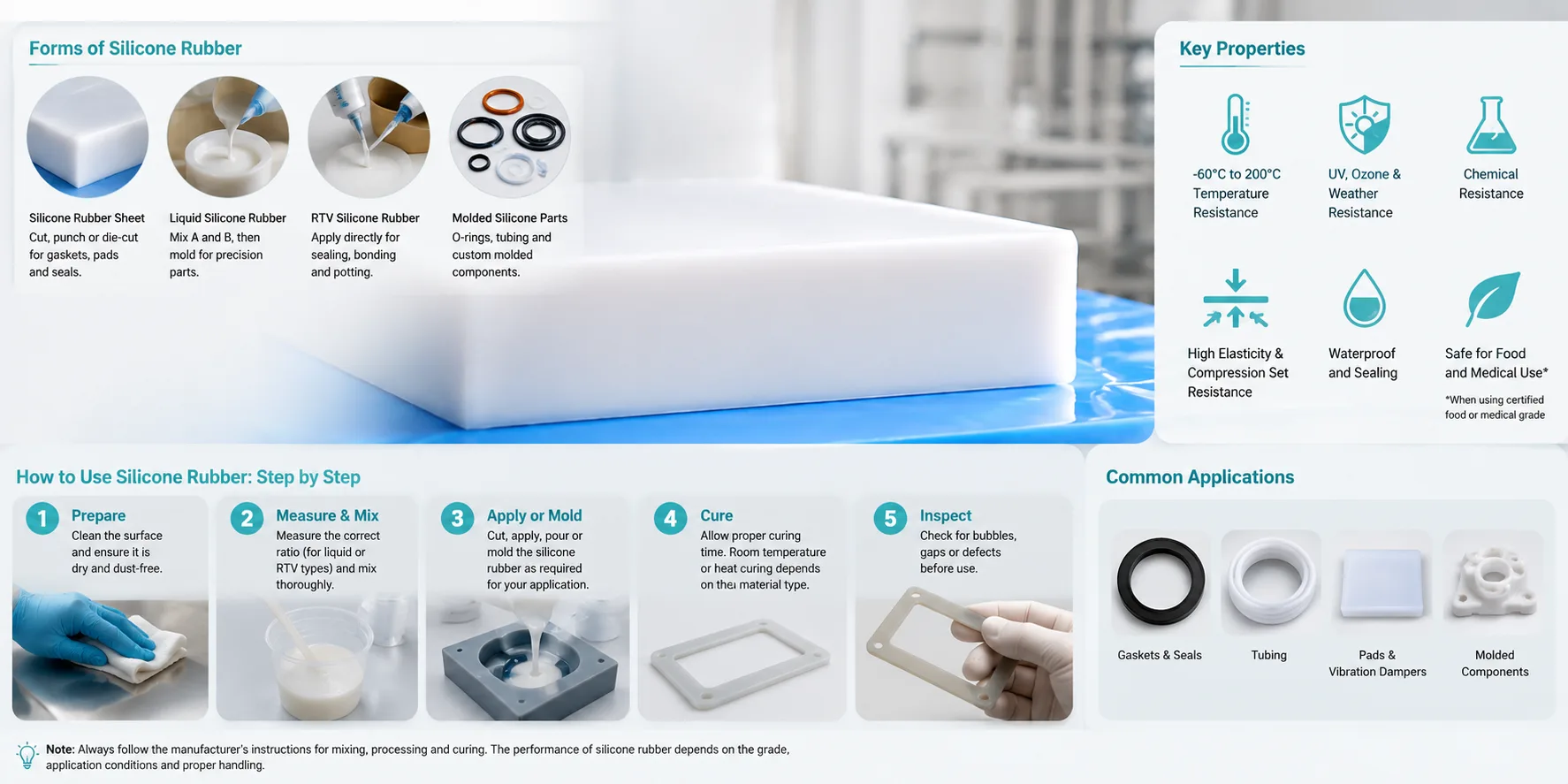
How to Use Silicone Rubber
Caoutchouc de silicone is a flexible, durable, and heat-resistant elastomer used in sealing, molding, insulation, cushioning, medical products, food-contact parts, automotive components, electronics, and industrial equipment. It is valued for its excellent temperature resistance, weather stability, elasticity, chemical resistance, and long service life. Whether you are working with a silicone rubber sheet, liquid silicone rubber, RTV silicone rubber, silicone rubber gasket, or silicone rubber seal, the key to successful use is choosing the right material type and applying it correctly.
Unlike ordinary rubber materials, silicone rubber can remain flexible in both high and low temperatures. It also performs well in outdoor environments because it resists UV light, ozone, moisture, and aging. This makes it suitable for applications such as waterproof seals, electrical insulation parts, food grade silicone rubber tubing, custom silicone rubber molds, and high temperature silicone rubber components. However, different silicone rubber products are designed for different uses, so understanding the material, preparation steps, curing method, and maintenance requirements is essential.
What Is Silicone Rubber?
Caoutchouc de silicone is a synthetic elastomer made from silicone polymers combined with fillers, curing agents, pigments, and performance additives. Its molecular structure gives it excellent thermal stability and flexibility. Compared with natural rubber, nitrile rubber, or EPDM rubber, silicone rubber is especially known for its ability to withstand extreme temperatures while maintaining softness and elasticity.
In practical use, silicone rubber is not just one single product. It can be manufactured as solid rubber, sponge rubber, foam rubber, liquid silicone rubber, extruded tubing, molded parts, O-rings, gaskets, seals, sheets, strips, profiles, and custom parts. For example, a silicone rubber sheet may be cut into pads or gaskets, while liquid silicone rubber can be injection molded into precise components. RTV silicone rubber can cure at room temperature and is often used for sealing, potting, mold making, and repair work.
The reason silicone rubber is widely used is that it combines flexibility with resistance. It can seal gaps, absorb vibration, protect surfaces, insulate electrical parts, resist weathering, and form accurate shapes. This combination makes silicone rubber useful in household repairs, industrial production, laboratory work, food processing, automotive manufacturing, electronics assembly, and medical device production.
Main Types of Silicone Rubber
Before learning how to use silicone rubber, it is important to understand the main types. Each type has a different curing method, hardness range, processing requirement, and application area. Choosing the wrong type can lead to weak bonding, poor sealing, incomplete curing, deformation, or reduced service life.
| Type of Silicone Rubber | Typical Form | Best Used For | Key Advantage |
|---|---|---|---|
| RTV silicone rubber | Paste, liquid, or two-part compound | Sealing, mold making, repair, potting, small-batch production | Cures at room temperature |
| Caoutchouc de silicone liquide | Two-part liquid material | Injection molding, precision parts, medical and food grade products | High accuracy and fast production |
| Solid silicone rubber | Sheet, roll, strip, profile, or molded part | Gaskets, seals, pads, tubing, insulation, vibration control | Durable and versatile |
| High temperature silicone rubber | Sheet, gasket, seal, hose, or molded component | Engines, ovens, heaters, industrial equipment | Excellent heat resistance |
| Food grade silicone rubber | Tubing, seals, mats, molds, kitchen and processing parts | Food-contact and beverage applications | Clean, flexible, and suitable for food-related use when properly certified |
How to Use Silicone Rubber Step by Step
The correct way to use silicone rubber depends on the product form. A silicone rubber sheet is handled differently from liquid silicone rubber or RTV silicone rubber. However, most silicone rubber projects follow a similar process: identify the application, prepare the surface or mold, apply or shape the material, allow proper curing or installation, and inspect the final result.
Step 1: Identify the Application
Start by defining what the silicone rubber needs to do. Is it used as a waterproof silicone rubber seal, a heat resistant silicone rubber gasket, an electrical insulation pad, a soft protective cover, a custom silicone rubber mold, or a flexible vibration-damping part? The application determines the required hardness, thickness, curing method, temperature range, and chemical resistance.
Step 2: Choose the Correct Grade
For food-contact parts, choose food grade silicone rubber that meets the required standards for the target market. For healthcare products, medical grade silicone rubber may be required. For industrial heat exposure, high temperature silicone rubber is usually more suitable. For outdoor use, select silicone rubber with strong UV, ozone, and weather resistance.
Step 3: Prepare the Surface
Surface preparation is important when silicone rubber is used for sealing, bonding, coating, or potting. Remove dust, oil, moisture, rust, and loose particles. A clean, dry surface helps the silicone rubber adhesive or RTV silicone rubber sealant perform better. If bonding to metal, glass, plastic, or painted surfaces, a compatible primer may be needed.
Step 4: Apply, Cut, Pour, or Mold the Material
For silicone rubber sheet applications, measure the required size and cut the sheet with a sharp knife, die cutter, or CNC cutting tool. For RTV silicone rubber, apply the material evenly with a caulking gun, spatula, or dispensing tool. For liquid silicone rubber molding, mix the two components according to the specified ratio and inject or pour the material into the mold.
Step 5: Allow Proper Curing or Installation
Some silicone rubber materials cure at room temperature, while others require heat, pressure, or specialized molding equipment. RTV silicone rubber may need several hours or more to fully cure depending on thickness, humidity, and product formulation. Liquid silicone rubber used in injection molding cures quickly under controlled heat. Always allow enough curing time before applying stress, pressure, or fluid exposure.
Step 6: Inspect the Final Result
After curing or installation, inspect the silicone rubber part for bubbles, gaps, weak adhesion, uneven thickness, surface defects, or incomplete sealing. A silicone rubber gasket should sit flat and compress evenly. A silicone rubber seal should have continuous contact with the sealing surface. A molded silicone rubber part should match the required dimensions and flexibility.
Common Applications of Silicone Rubber
Silicone rubber is used across many industries because it can solve different performance problems. It can seal, protect, cushion, insulate, and mold. In industrial environments, silicone rubber components are commonly used in pumps, valves, heat exchangers, lighting equipment, control cabinets, and production machinery. In consumer products, it appears in kitchenware, wearable devices, phone cases, seals, mats, and household repair materials.
In automotive applications, silicone rubber is used for hoses, grommets, seals, ignition cable insulation, vibration pads, and high temperature engine-area components. In electronics, silicone rubber protects circuits from moisture, dust, vibration, and thermal stress. Silicone rubber potting compounds and encapsulants are especially useful when components need long-term environmental protection.
In food and beverage processing, food grade silicone rubber tubing, gaskets, and seals are used because they are flexible, easy to clean, and resistant to temperature changes. In medical and laboratory settings, medical grade silicone rubber is selected for tubing, seals, diaphragms, and molded components where purity, flexibility, and biocompatibility may be required.
How to Choose the Right Silicone Rubber
Choosing the right silicone rubber requires more than selecting a color or thickness. The most important factors include hardness, temperature range, tensile strength, elongation, compression set, tear resistance, chemical compatibility, and certification requirements. For gaskets and seals, compression set is especially important because the material must recover after being compressed. Poor recovery can cause leaks over time.
Hardness is usually measured by Shore A. Soft silicone rubber is useful for flexible seals and cushioning, while harder silicone rubber is better for structural support, wear resistance, and precision parts. A silicone rubber sheet used as a sealing pad may need a different hardness from a silicone rubber O-ring or molded keyboard component.
Temperature is another key factor. Standard silicone rubber already offers good temperature performance, but high temperature silicone rubber is better for ovens, engines, heaters, and industrial hot-air systems. For low-temperature applications, silicone rubber remains flexible where many other elastomers become stiff or brittle.
Using Silicone Rubber for Molding and Sealing
Silicone rubber is widely used for mold making because it can reproduce fine details and release easily from many casting materials. RTV silicone rubber is popular for creating custom molds for resin, wax, gypsum, concrete, soap, and prototype parts. To use silicone rubber for mold making, the master pattern should be clean, stable, and properly positioned. A mold box is then prepared, and the silicone rubber is mixed and poured around the model.
Air bubbles are a common issue in silicone rubber mold making. To reduce bubbles, pour slowly from one corner and allow the silicone to flow naturally around the object. For professional results, vacuum degassing may be used before pouring. After curing, the mold can be removed and inspected for trapped air, weak areas, or surface defects.
For sealing applications, silicone rubber can be used as preformed gaskets, O-rings, strips, profiles, or liquid sealant. A silicone rubber gasket is often placed between two surfaces and compressed to prevent leaks. RTV silicone rubber sealant can fill irregular gaps and form a flexible waterproof seal after curing. In both cases, the sealing surface should be clean, dry, and properly aligned.
How to Bond Silicone Rubber
Bonding silicone rubber can be challenging because silicone has low surface energy, which makes many common adhesives ineffective. For reliable bonding, use a silicone rubber adhesive, silicone-based sealant, or an adhesive system specifically designed for silicone materials. In some cases, a primer is required to improve adhesion to metal, plastic, glass, or another silicone surface.
The bonding process should begin with cleaning. Remove grease, release agents, dust, and moisture. Apply primer if required, then apply the adhesive in a controlled layer. Press the parts together with even pressure and allow full curing before loading the bond. For high-stress applications, mechanical fastening, overmolding, or custom part design may provide better reliability than adhesive alone.
When bonding silicone rubber to other materials, always check compatibility. Some plastics may be sensitive to solvents, while some metals may require surface treatment. A small test sample is recommended before full production, especially when the application involves heat, water, chemicals, or repeated movement.
Maintenance and Storage Tips
Silicone rubber is low-maintenance, but proper care can extend its service life. For installed silicone rubber seals and gaskets, inspect them regularly for cracks, cuts, permanent deformation, swelling, contamination, or loss of elasticity. Replace parts that show visible damage or no longer seal properly.
Cleaning should be done with compatible mild cleaners. Avoid aggressive solvents unless the specific silicone rubber grade is known to resist them. In food and medical applications, cleaning procedures should follow the required hygiene and regulatory standards. For silicone rubber tubing, check for discoloration, hardening, blockage, or wall thinning.
Store silicone rubber products in a clean, cool, dry place away from sharp objects, heavy compression, and incompatible chemicals. Although silicone rubber resists UV and ozone better than many other elastomers, controlled storage still helps preserve appearance and performance. Sheets should be stored flat or rolled without excessive tension.
Common Mistakes to Avoid
One common mistake is using general-purpose silicone rubber in an application that requires food grade silicone rubber, medical grade silicone rubber, or high temperature silicone rubber. Another mistake is applying RTV silicone rubber too thickly and expecting it to cure quickly. Thick sections may require more time, and some curing systems need moisture from the air to cure properly.
Poor surface preparation is another frequent problem. Oil, dust, and moisture can reduce adhesion and cause seal failure. In molding applications, incorrect mixing ratios can lead to soft, sticky, or incomplete curing. In gasket applications, over-compression can damage the silicone rubber gasket and reduce its ability to recover.
It is also important not to assume that all silicone rubber materials resist all chemicals. While silicone rubber performs well against many environmental factors, some oils, fuels, solvents, acids, or concentrated chemicals may affect certain grades. Always check chemical compatibility before using silicone rubber in demanding environments.
Conclusion
So, how do you use silicone rubber correctly? The answer depends on the form and application. A silicone rubber sheet may be cut into gaskets or pads. RTV silicone rubber may be applied as a sealant or mold-making compound. Liquid silicone rubber may be molded into precision components. Food grade silicone rubber, medical grade silicone rubber, and high temperature silicone rubber should be selected when the application requires specific safety, purity, or temperature performance.
Caoutchouc de silicone is a highly versatile material, but it works best when it is chosen, prepared, applied, cured, and maintained properly. By understanding the differences between silicone rubber types and following correct handling methods, users can create reliable seals, durable molded parts, flexible insulation, and long-lasting components for industrial, commercial, and household applications.