
Silicone Rubber Testing Guide
How Shore Hardness Testing Works for Silicone Rubber
Shore hardness is one of the most widely used measurements for evaluating the indentation resistance of silicone rubber and other elastomeric materials. It helps manufacturers verify material consistency, specify hardness requirements and determine whether a silicone rubber compound is suitable for a particular component.
However, obtaining a reliable Shore hardness value requires more than pressing a hardness tester against a rubber surface. The testing scale, specimen thickness, surface condition, applied force, measurement time and material curing conditions can all influence the result.
This guide explains how the Shore hardness test works, the differences between Shore A and Shore D, the correct measurement procedure, common testing errors and how silicone rubber manufacturers can use hardness data for material selection and quality control.
What Is Shore Hardness?
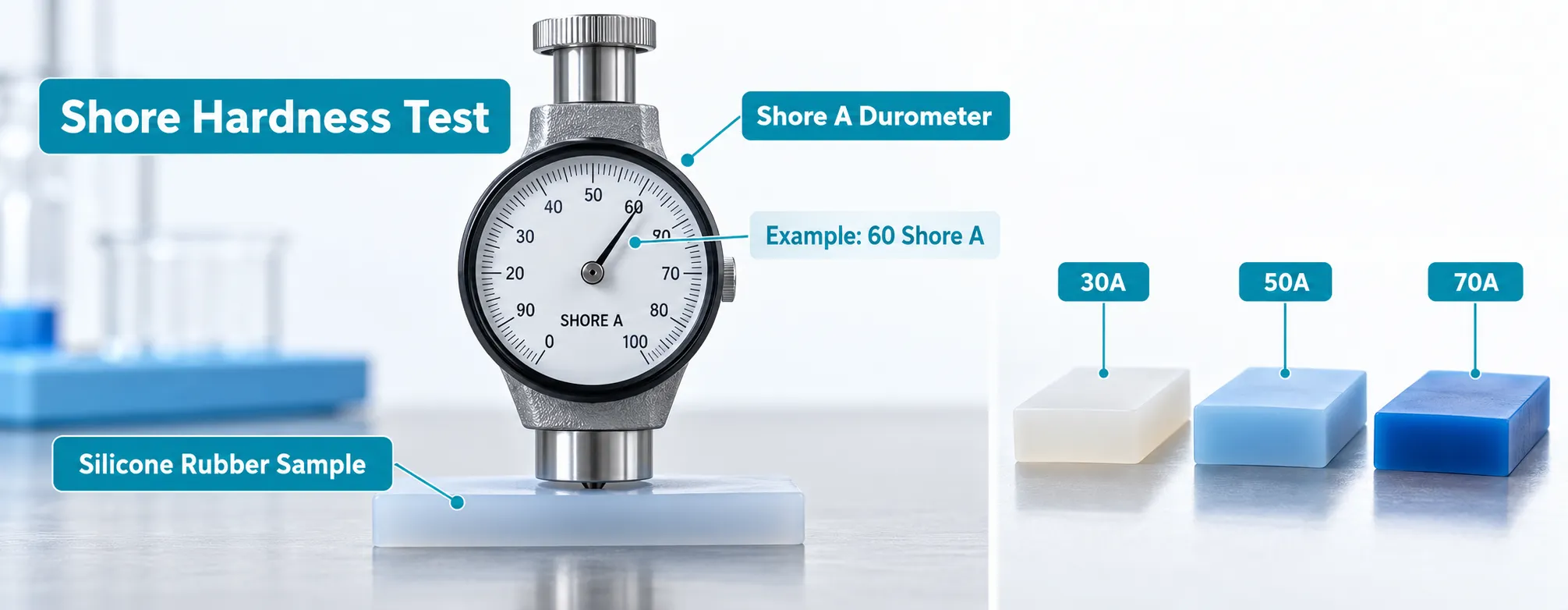
Shore hardness is a measure of a material's resistance to indentation. It is determined using an instrument called a durometer, which presses a standardized indenter into the material under specified conditions.
The resulting reading is reported on a Shore scale, such as Shore A or Shore D. The appropriate scale depends on the material's hardness range and the applicable test method.
For silicone rubber manufacturers, Shore hardness is commonly used to specify incoming raw materials, compare compound grades, inspect molded components and monitor consistency between production batches.
For example, an OEM customer may specify a silicone rubber compound with a target hardness of 60 Shore A. The supplier and customer should also agree on the permitted tolerance, test method and specimen conditions so that both parties evaluate the material consistently.
Although hardness is an important specification, it does not independently determine whether a silicone rubber compound is suitable for an application. A soft sealing component and a high-voltage insulating component may require very different combinations of mechanical, thermal and electrical properties.
How Does the Shore Hardness Test Work?
The Shore hardness test measures how far a standardized indenter penetrates the surface of a material under a specified spring force. The instrument converts the indentation response into a numerical hardness reading.
The test principle is based on indentation depth rather than a direct measurement of tensile strength or elastic modulus. A material that resists deeper indentation generally produces a higher Shore hardness reading on the same scale under comparable test conditions.
Shore hardness is commonly expressed on a scale from 0 to 100. However, the scale is not a linear measure of material strength, and a difference of 10 Shore points does not represent the same change in mechanical performance across every part of the scale.
Different Shore scales also use different indenter geometries and spring forces. Consequently, a reading obtained using one scale cannot automatically be treated as equivalent to a reading obtained using another.
What Are the Common Shore Hardness Scales?
Several Shore scales are defined for different material hardness ranges and testing requirements. Shore A and Shore D are particularly common in rubber and plastics testing, while other scales serve more specialized purposes.
| Scale | Typical Material Range | Applications courantes |
|---|---|---|
| Rive A | Soft to relatively firm elastomers | Silicone rubber, rubber seals, gaskets and flexible molded components |
| Shore D | Harder elastomers and many rigid plastics | Hard rubber products, rigid polymers and materials outside the suitable Shore A range |
| Shore 00 | Very soft materials | Selected soft gels, foams and compliant materials |
| Shore AM / M | Applications requiring specialized indentation methods | Selected thin specimens or specialized material testing, depending on the method |
This table is a general guide rather than a substitute for the relevant standard. The correct scale must be selected according to the specimen, expected hardness and test requirements.
For most conventional solid silicone rubber compounds, Shore A is a common starting point. If a compound is very soft or unusually hard, the testing method should be confirmed with the material supplier or testing laboratory.
Shore A vs Shore D: What Is the Difference?
Shore A and Shore D are both indentation hardness scales, but they use different indenter geometries and spring characteristics. Shore A is commonly used for elastomers, while Shore D is generally used for harder elastomers and rigid plastics.
Shore A Hardness
Suitable for many flexible silicone rubber compounds, seals, gaskets and molded elastomer components.
Shore D Hardness
Suitable for harder materials where the Shore D indenter and applied force are appropriate for the specimen.
For example, a silicone rubber specification of 50 Shore A and a specification of 50 Shore D are not interchangeable. The same numerical value on different scales does not mean the materials have the same hardness.
There is also no universally reliable conversion formula between Shore A and Shore D. Conversion charts may provide approximate estimates in limited ranges, but these should not replace testing with the correct instrument and method.
How to Perform a Shore Hardness Test
A reliable Shore hardness result depends on consistent specimen preparation, correct instrument handling and appropriate measurement conditions. The exact procedure should follow the selected standard and customer specification.
Step 1: Select the Correct Durometer
Choose the appropriate Shore scale according to the expected hardness of the silicone rubber. Shore A is commonly used for conventional solid silicone elastomers, while Shore D may be appropriate for harder materials.
Step 2: Prepare the Specimen
The specimen should have a suitable flat, smooth surface and meet the thickness and dimensional requirements of the test method. It should be properly cured and conditioned as required by the applicable specification.
For many conventional Shore A and Shore D tests, a specimen thickness of approximately 6 mm is commonly used. However, the exact requirements depend on the selected standard and test configuration. Stacking thinner specimens may introduce interface effects and should only be done when permitted by the applicable method.
Step 3: Check the Instrument
Verify that the durometer is in suitable working condition and that calibration or verification requirements have been met. An instrument with a damaged indenter or unreliable calibration can produce misleading readings.
Step 4: Position the Specimen
Place the specimen on a firm, flat support. Ensure that the tested surface is clean and that the indenter can contact it without interference from curvature, edges or underlying gaps.
Step 5: Apply the Durometer Correctly
Hold the instrument perpendicular to the specimen surface and bring the presser foot into contact smoothly. Avoid impact, tilting or excessive lateral movement, as these can affect the reading.
Step 6: Record the Reading
Read the instrument at the time specified by the test method or agreed specification. The result may change with dwell time because silicone rubber is viscoelastic and can continue deforming under load.
Step 7: Take Multiple Measurements
Measure at appropriate locations away from specimen edges, previous indentations and other locations that could interfere with the result. Follow the required number of measurements and reporting procedure.
Step 8: Report the Result Clearly
Record the numerical value together with the Shore scale and applicable test method. Include the specimen condition and measurement time where required, especially when results are being compared between suppliers or laboratories.
What Factors Affect Shore Hardness Results?
Even when testing the same silicone rubber grade, results may vary if measurement conditions are inconsistent. The following factors should be considered when evaluating hardness data.
| Factor | Potential Effect | Recommended Control |
|---|---|---|
| Specimen Thickness | An unsuitable thickness or backing condition can affect indentation. | Follow the selected method's thickness requirements. |
| Surface Condition | Roughness, curvature or defects can affect contact. | Use a suitable, clean and flat test surface. |
| Test Temperature | Temperature changes can alter elastomer stiffness and indentation response. | Condition and test specimens under agreed conditions. |
| Dwell Time | Viscoelastic deformation can change the reading over time. | Use the specified reading time consistently. |
| Instrument Alignment | Tilted contact can create inconsistent measurements. | Keep the instrument perpendicular to the surface. |
| Instrument Condition | Calibration drift or indenter damage can affect accuracy. | Maintain and verify the instrument as required. |
| Curing Conditions | Different curing or post-curing conditions can change the material's properties. | Control cure conditions and specimen preparation. |
| Measurement Location | Edges and previous indentations can influence the result. | Follow the required spacing and location rules. |
These factors are particularly important when a customer and supplier obtain different hardness values for what is believed to be the same silicone rubber compound. Before concluding that the material is out of specification, both parties should confirm that they used comparable methods and conditions.
What Does Shore Hardness Tell You About Silicone Rubber?
Shore hardness is useful for describing indentation resistance, but it is not a complete measure of silicone rubber performance.
What Shore Hardness Can Tell You
- Whether a material falls within a specified hardness range.
- Whether batches are reasonably consistent under the same test conditions.
- Whether a compound is relatively softer or harder on the same Shore scale.
- Whether a material may be suitable for an application with a defined hardness requirement.
What Shore Hardness Cannot Tell You on Its Own
- Tensile strength: The force required to stretch the material until failure.
- Tear strength: Resistance to crack propagation after a cut or notch develops.
- Elongation at break: The amount the material can stretch before breaking.
- Compression set: The amount of permanent deformation remaining after compression under specified conditions.
- Electrical performance: Properties such as dielectric strength and volume resistivity.
- Long-term durability: Resistance to thermal aging, weathering and application-specific exposure.
Two silicone rubber compounds can have the same Shore A hardness but different tensile strength, tear resistance, compression set and electrical properties. This is why hardness should be treated as one part of a complete material specification.
How to Choose the Right Shore Hardness for Silicone Rubber
The correct hardness depends on the component's function, geometry, assembly requirements and operating environment. A higher hardness is not automatically better, and the softest compound is not always the most flexible or durable choice for a particular design.
| Candidature | Hardness Considerations | Other Properties to Evaluate |
|---|---|---|
| Seals and Gaskets | Balance compliance with resistance to deformation. | Compression set, tear strength and fluid compatibility. |
| Extruded Tubing | Match flexibility with dimensional stability and handling needs. | Tensile strength, elongation and tear resistance. |
| Isolateurs composites | Meet the design's mechanical and molding requirements. | Tear strength, electrical performance, weathering and hydrophobicity. |
| Cable Insulation | Balance flexibility with processing and product design requirements. | Dielectric properties, thermal aging and extrusion stability. |
| Molded Industrial Parts | Match indentation resistance to contact and structural needs. | Wear, tensile strength, tear strength and service temperature. |
| Food-Contact Components | Meet the component's sealing or handling requirements. | Formulation suitability, cleanliness and applicable compliance documentation. |
When selecting a silicone rubber compound, start by defining the target Shore hardness and acceptable tolerance. Then identify the other properties required for the actual application.
For demanding applications, sample testing and evaluation of the finished component are recommended. The appropriate hardness range should be confirmed against the product design rather than selected from a generic chart alone.
Using Shore Hardness for Silicone Rubber Quality Control
Shore hardness is widely used in production quality control because it is relatively quick to measure and can help identify differences between batches. However, the value is most useful when the test procedure is consistent and the acceptance criteria are clearly defined.
Incoming Material Inspection
Manufacturers can check the hardness of incoming silicone rubber materials against the agreed specification. This helps identify possible deviations before the compound enters production.
In-Process and Finished-Part Inspection
Depending on the quality plan, hardness can be measured on properly prepared specimens or finished components where the geometry permits a valid test. Results from different specimen configurations should not automatically be treated as directly equivalent.
Batch-to-Batch Consistency
Recording hardness results over time helps identify trends and unusual variation. A change in hardness may indicate a material or processing difference, but further investigation may be needed to identify the cause.
Clear Acceptance Criteria
A useful silicone rubber quality specification should identify the Shore scale, target hardness, acceptable tolerance, test method and relevant specimen conditions. The supplier and customer should agree on these details before routine inspection begins.
ASTM D2240 vs ISO 48-4: Which Test Standard Should You Use?
ASTM D2240 and ISO 48-4 are widely referenced standards for durometer-based Shore hardness testing. Both describe standardized indentation hardness methods, but their requirements and terminology should not be assumed to be identical in every detail.
| Standard | General Scope | When to Reference It |
|---|---|---|
| ASTM D2240 | Durometer hardness testing for specified rubber, elastomeric and plastic materials. | When a customer drawing, material specification or quality plan requires an ASTM durometer method. |
| ISO 48-4 | Determination of indentation hardness by the durometer method for vulcanized or thermoplastic rubber. | When the relevant product specification or customer requires the ISO method. |
The correct choice is the method specified by the product drawing, customer requirement or agreed quality plan. If a specification simply states “Shore A” without naming the method or measurement conditions, clarify the requirement before comparing results between laboratories.
For reference, consult the official ASTM D2240 standard and the technical guidance on Shore hardness testing.
Frequently Asked Questions About Shore Hardness
What is Shore hardness in silicone rubber?
Shore hardness measures the resistance of silicone rubber to indentation under specified test conditions. Shore A is commonly used for conventional solid silicone rubber compounds.
What is the difference between Shore A and Shore D?
Shore A is commonly used for softer elastomers, while Shore D is generally used for harder elastomers and rigid plastics. They use different indenter geometries and spring characteristics, so their readings are not directly interchangeable.
Is Shore hardness measured in degrees?
Shore hardness is normally reported as a numerical value with its scale, such as 60 Shore A or 70 Shore D. The scale should always be stated explicitly.
Does higher Shore hardness mean stronger silicone rubber?
No. Hardness measures indentation resistance. It does not directly determine tensile strength, tear strength, elongation or compression set.
Can Shore A be converted accurately to Shore D?
There is no universal exact conversion between the two scales. Approximate conversion charts may be useful in limited ranges, but the correct scale should be measured directly whenever a specification requires it.
Why do two silicone rubber samples show different hardness values?
Differences may result from the compound formulation, curing conditions, specimen thickness, temperature, dwell time, surface condition, instrument alignment or calibration. Test conditions should be checked before concluding that the material is inconsistent.
How thick should a Shore hardness test specimen be?
The required thickness depends on the selected standard and test configuration. Approximately 6 mm is commonly used for conventional Shore A and Shore D specimens, but the applicable method and customer specification should determine the final requirement.
How often should Shore hardness be tested during production?
The inspection frequency should follow the agreed quality plan, material risk and production requirements. Incoming inspection, batch verification and periodic finished-product checks may be appropriate depending on the application.
What Shore hardness is best for silicone rubber seals?
There is no universal best value. The appropriate hardness depends on sealing geometry, contact pressure, required flexibility, compression set, temperature and the mating components. Prototype or application testing may be necessary.
Can Shore hardness predict the service life of silicone rubber?
No. Shore hardness alone cannot predict service life. Temperature, mechanical stress, environmental exposure, formulation and other material properties must also be considered.
Need the Right Silicone Rubber Hardness for Your Application?
Yakows supplies silicone rubber compounds for industrial and OEM applications, including HTV/HCR materials and specialized formulations. Material selection can be evaluated according to target Shore hardness, mechanical requirements, processing method and operating environment.
When requesting a recommendation, share your target hardness and tolerance, component application, processing method and any required tensile, tear, temperature or electrical specifications. This information helps narrow down suitable compound options.