
Silicone Rubber For Silicone Molds
In modern mold-making applications, silicone molds are widely used for resin casting, concrete casting, candle making, soap production, food-grade baking molds, chocolate molds, jewelry molds, prototype replication, and industrial component forming. Behind every reliable silicone mold, however, there is one critical material factor: the quality and performance of caoutchouc de silicone.
Silicone rubber is the base material that gives silicone molds their flexibility, durability, heat resistance, chemical stability, and excellent release performance. For manufacturers, choosing the right silicone rubber is not simply about selecting a soft or hard material. It requires a professional understanding of physical properties, curing systems, processing behavior, application conditions, and final mold performance.
Whether a silicone mold is used for food contact, resin casting, industrial replication, or high-temperature applications, the properties of silicone rubber directly influence mold accuracy, service life, tearing resistance, demolding performance, and production efficiency. A poorly selected silicone rubber may lead to deformation, tearing, shrinkage, surface defects, poor detail reproduction, or premature mold failure.
What Are Silicone Molds?
Silicone molds are flexible molds made from silicone rubber materials. They are designed to reproduce shapes, textures, and fine details from a master model or tooling surface. Because silicone rubber has excellent elasticity and release characteristics, silicone molds can capture complex geometries and allow easy demolding without damaging the finished part.
Compared with rigid molds made from metal, plastic, or plaster, silicone molds are more flexible and easier to use for products with undercuts, fine patterns, irregular surfaces, or delicate features. This is why silicone molds are commonly used in handicrafts, industrial design, rapid prototyping, artistic casting, food production, and small-batch manufacturing.
However, different applications require different types of silicone rubber. For example, food-grade silicone molds require safe, clean, and compliant materials, while industrial casting molds may require higher tear strength, better chemical resistance, or stronger dimensional stability.
Why Silicone Rubber Matters in Silicone Molds Manufacturing
Silicone rubber is the foundation of silicone mold performance. Its mechanical properties determine how the mold stretches, bends, releases, and returns to its original shape. Its thermal and chemical properties determine whether the mold can withstand heat, casting resins, waxes, concrete, soap bases, or other production materials.
In professional silicone molds manufacturing, manufacturers usually evaluate silicone rubber based on several important indicators, including Shore hardness, tear strength, tensile strength, elongation, viscosity, curing system, shrinkage rate, and temperature resistance. These values are not just technical data on a product sheet. They directly affect production quality and long-term mold reliability.
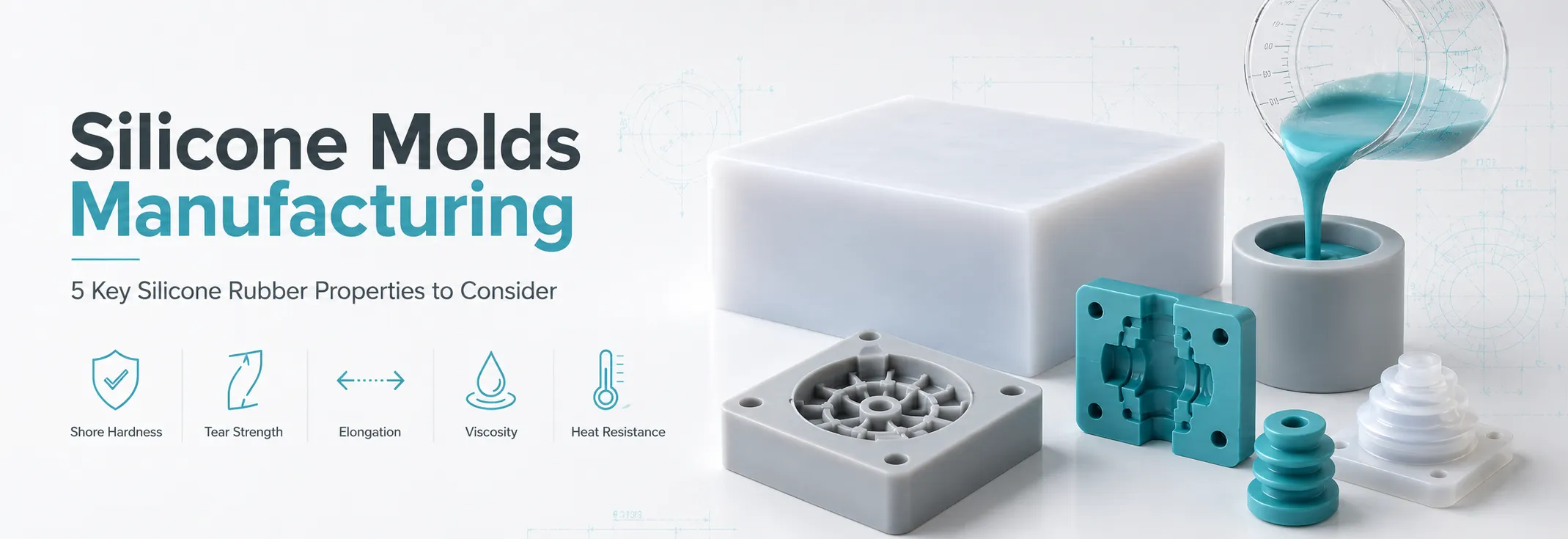
Below are five key silicone rubber properties that should be carefully considered when manufacturing high-quality silicone molds.
Comparison Table: 5 Key Silicone Rubber Properties for Silicone Molds
| Propriété | Pourquoi est-ce important ? | Impact on Silicone Molds | Typical Consideration |
|---|---|---|---|
| Shore Hardness | Determines softness, flexibility, and support | Affects demolding, shape stability, and handling | Soft for complex details; harder for dimensional support |
| Résistance à la déchirure | Measures resistance to tearing under stress | Improves mold life, especially with undercuts or repeated use | High tear strength is important for detailed or flexible molds |
| Elongation | Shows how far silicone rubber can stretch before breaking | Supports easy demolding and flexibility | Higher elongation is useful for complex shapes |
| Viscosity | Affects flowability during mold making | Influences bubble release, detail reproduction, and processing | Lower viscosity helps fill fine details and reduce trapped air |
| Heat Resistance | Determines performance under elevated temperatures | Essential for baking molds, wax casting, and industrial processes | Choose temperature rating based on actual working conditions |
1. Shore Hardness
Shore hardness is one of the first properties manufacturers consider when selecting silicone rubber for silicone molds. It measures the softness or firmness of the cured silicone material. In mold-making applications, Shore A hardness is commonly used to describe the hardness level of silicone rubber.
A softer silicone rubber provides greater flexibility, which is useful for molds with deep undercuts, delicate patterns, complex shapes, or fragile castings. Soft silicone molds can be stretched and peeled away from the finished product more easily, reducing the risk of damage during demolding.
However, silicone rubber that is too soft may not provide enough support. The mold may deform under the weight of casting material, especially in large molds or applications requiring dimensional accuracy. This can lead to uneven wall thickness, distorted shapes, or inaccurate finished parts.
A harder silicone rubber provides better shape retention and structural stability. It is suitable for flat molds, simple geometries, larger parts, or applications where the mold must maintain precise dimensions. The trade-off is that harder silicone molds may be less flexible and more difficult to remove from products with undercuts.
How to Choose the Right Hardness
For highly detailed silicone molds, a softer material may be preferred because it allows better flexibility during demolding. For industrial silicone molds that require repeated use and dimensional control, a medium or higher hardness silicone rubber may be more suitable.
The ideal hardness depends on the mold size, part geometry, casting material, demolding method, and expected service life. In professional silicone molds manufacturing, hardness should be balanced with tear strength and elongation instead of being evaluated alone.
2. Tear Strength
Tear strength is a critical property for silicone molds, especially when the mold includes thin walls, sharp corners, deep grooves, undercuts, or complex three-dimensional details. It measures how well silicone rubber resists tearing when subjected to mechanical stress.
During demolding, silicone molds are often stretched, bent, twisted, or pulled away from the cast object. If the silicone rubber has poor tear strength, small cracks may start around edges, corners, or detailed areas. Over time, these cracks can expand and shorten the service life of the mold.
High tear strength silicone rubber is especially important for resin casting molds, concrete molds, figurine molds, jewelry molds, prototype molds, and industrial part molds. These applications often involve detailed shapes or repeated production cycles, making durability a major requirement.
Why Tear Strength Affects Mold Life
A silicone mold does not usually fail all at once. In many cases, failure begins with small tears at stress concentration points. These may appear near sharp edges, narrow sections, or areas that are repeatedly stretched during demolding. Once tearing begins, the mold may lose accuracy, produce surface defects, or become unusable.
Selecting silicone rubber with strong tear resistance helps extend mold life, reduce replacement frequency, and improve production consistency. For manufacturers, this can lower total production cost even if the higher-performance silicone rubber has a higher initial price.
3. Elongation and Flexibility
Elongation refers to the ability of silicone rubber to stretch before breaking. It is usually expressed as a percentage. A higher elongation value means the material can stretch more without failure. In silicone molds manufacturing, elongation is closely related to flexibility, demolding performance, and resistance to mechanical damage.
Flexible silicone molds are useful when the finished product has complex shapes, negative angles, fine details, or fragile surfaces. A mold with good elongation can be pulled, opened, or peeled back without cracking or permanently deforming.
For applications such as resin art, candle molds, soap molds, plaster molds, and decorative product casting, good elongation helps improve user experience and product yield. It allows operators to remove finished parts smoothly and reduces the chance of breaking either the mold or the product.
Balancing Flexibility and Stability
Although high elongation is valuable, flexibility must be balanced with mold stability. A silicone rubber that stretches too easily may deform during filling, curing, or handling. For large silicone molds or molds that need tight tolerances, excessive flexibility can become a problem.
This is why silicone molds manufacturers often evaluate elongation together with hardness and tensile strength. The goal is to select a silicone rubber that is flexible enough for demolding but stable enough to maintain accurate shape.
4. Viscosity and Processing Performance
Viscosity describes how easily uncured silicone rubber flows before curing. It is one of the most important processing properties in silicone molds manufacturing. A low-viscosity silicone rubber flows more easily into fine details, narrow gaps, and textured surfaces. A high-viscosity material may be thicker and harder to pour, but it may provide better control in certain mold-making processes.
For silicone molds that require precise detail reproduction, viscosity has a direct impact on surface quality. If the silicone rubber does not flow well into small details, the final mold may lose texture, sharpness, or dimensional accuracy. This is especially important for artistic molds, figurine molds, jewelry molds, decorative panels, and prototype molds.
Viscosity also affects bubble release. Air bubbles trapped in silicone rubber can create voids, weak points, or surface defects in the finished mold. Lower-viscosity silicone rubber can help bubbles rise and escape more easily, especially when used with proper mixing, degassing, and pouring techniques.
Processing Factors to Consider
In addition to viscosity, manufacturers should consider working time, curing time, mixing ratio, and curing conditions. A silicone rubber with a very short working time may be difficult to process for large molds, while a very long curing time may reduce production efficiency.
For manual mold-making operations, easy mixing and good flowability are important. For automated or large-scale silicone molds manufacturing, consistent viscosity and stable processing behavior are essential for repeatable quality.
5. Heat Resistance and Chemical Stability
Heat resistance is another key reason silicone rubber is widely used for silicone molds. Many silicone molds are exposed to elevated temperatures during baking, wax casting, resin curing, soap production, or industrial part manufacturing. A suitable silicone rubber must maintain its flexibility, shape, and mechanical properties under actual service temperatures.
For baking molds, chocolate molds, and other food-related applications, heat resistance must be combined with food-grade safety requirements. For industrial silicone molds, the material may need to withstand hot resins, waxes, gypsum, concrete reactions, or thermal cycling during repeated production.
Chemical stability is equally important. Some casting materials, pigments, solvents, additives, or curing agents may interact with silicone rubber. If the silicone rubber is not compatible with the casting material, the mold may swell, soften, discolor, lose strength, or experience surface inhibition.
Choosing Silicone Rubber for Demanding Applications
For high-temperature or chemically demanding silicone molds, manufacturers should choose silicone rubber grades designed for the specific application. Platinum-cured silicone rubber may be preferred for cleaner, food-grade, or high-purity applications, while tin-cured silicone rubber may be used in many general mold-making applications.
Before mass production, it is recommended to test silicone rubber with the actual casting material and processing conditions. This helps confirm release performance, surface finish, curing compatibility, and long-term mold durability.
Additional Factors in Silicone Rubber Selection
Although the five properties above are essential, they are not the only factors to consider. Professional silicone molds manufacturing may also require evaluation of curing system, shrinkage rate, tensile strength, color, transparency, food-contact compliance, flame resistance, and environmental conditions.
For example, low shrinkage is important when dimensional accuracy is required. Food-grade compliance is necessary for silicone molds used in baking, chocolate, candy, or kitchenware applications. High tensile strength is helpful when molds are frequently stretched or handled. The curing system affects safety, processing, cost, and compatibility with different casting materials.
| Candidature | Recommended Silicone Rubber Focus | Key Requirement |
|---|---|---|
| Food and baking silicone molds | Food-grade silicone rubber, heat resistance, clean curing system | Safety, temperature performance, easy release |
| Resin casting molds | High tear strength, good release, chemical compatibility | Detail reproduction and repeated demolding |
| Candle and soap molds | Flexible silicone rubber, moderate hardness, smooth surface | Easy demolding and attractive finish |
| Concrete or gypsum molds | Durable silicone rubber, tear resistance, dimensional stability | Strength and mold service life |
| Industrial prototype molds | Low shrinkage, high accuracy, stable mechanical properties | Precision and repeatability |
How to Choose Silicone Rubber for Silicone Molds
The best silicone rubber for silicone molds depends on the final application. A manufacturer should first understand what material will be cast into the mold, how often the mold will be used, what temperature it will experience, and how complex the product geometry is.
For simple molds with low production frequency, a general-purpose silicone rubber may be sufficient. For molds with high detail, deep undercuts, or frequent demolding, higher tear strength and elongation are more important. For food-grade silicone molds, safety and compliance must be prioritized. For industrial molds, durability, accuracy, and chemical stability may be the main concerns.
A practical selection process should include:
- Identifying the mold application and casting material
- Defining hardness and flexibility requirements
- Checking tear strength and elongation values
- Evaluating viscosity, working time, and curing time
- Confirming heat resistance and chemical compatibility
- Testing the silicone rubber before mass production
- Reviewing compliance requirements for food, medical, or industrial use
Final Thoughts
Silicone molds are valued for their flexibility, detail reproduction, heat resistance, and ease of release. But these advantages come from the performance of silicone rubber itself. In silicone molds manufacturing, choosing the right silicone rubber is essential for producing molds that are durable, accurate, safe, and efficient in use.
The five key properties — Shore hardness, tear strength, elongation, viscosity, and heat resistance — provide a strong foundation for material selection. By understanding how each property affects mold performance, manufacturers can reduce production problems, improve product consistency, and extend mold service life.
For companies producing or sourcing silicone molds, working with a reliable silicone rubber supplier can make a significant difference. A professional supplier can help recommend suitable silicone rubber grades based on application, processing method, performance requirements, and industry standards.