
Silicone Rubber Elongation at Break: A Buyer’s Guide
Silicone Rubber Mechanical Selection Guide
Understanding Elongation Data Before Material Approval
Silicone rubber elongation at break measures extension at rupture in a specified tensile test. Review it with strength, hardness and the actual deformation requirements of the component.
What Is Elongation at Break in Silicone Rubber?
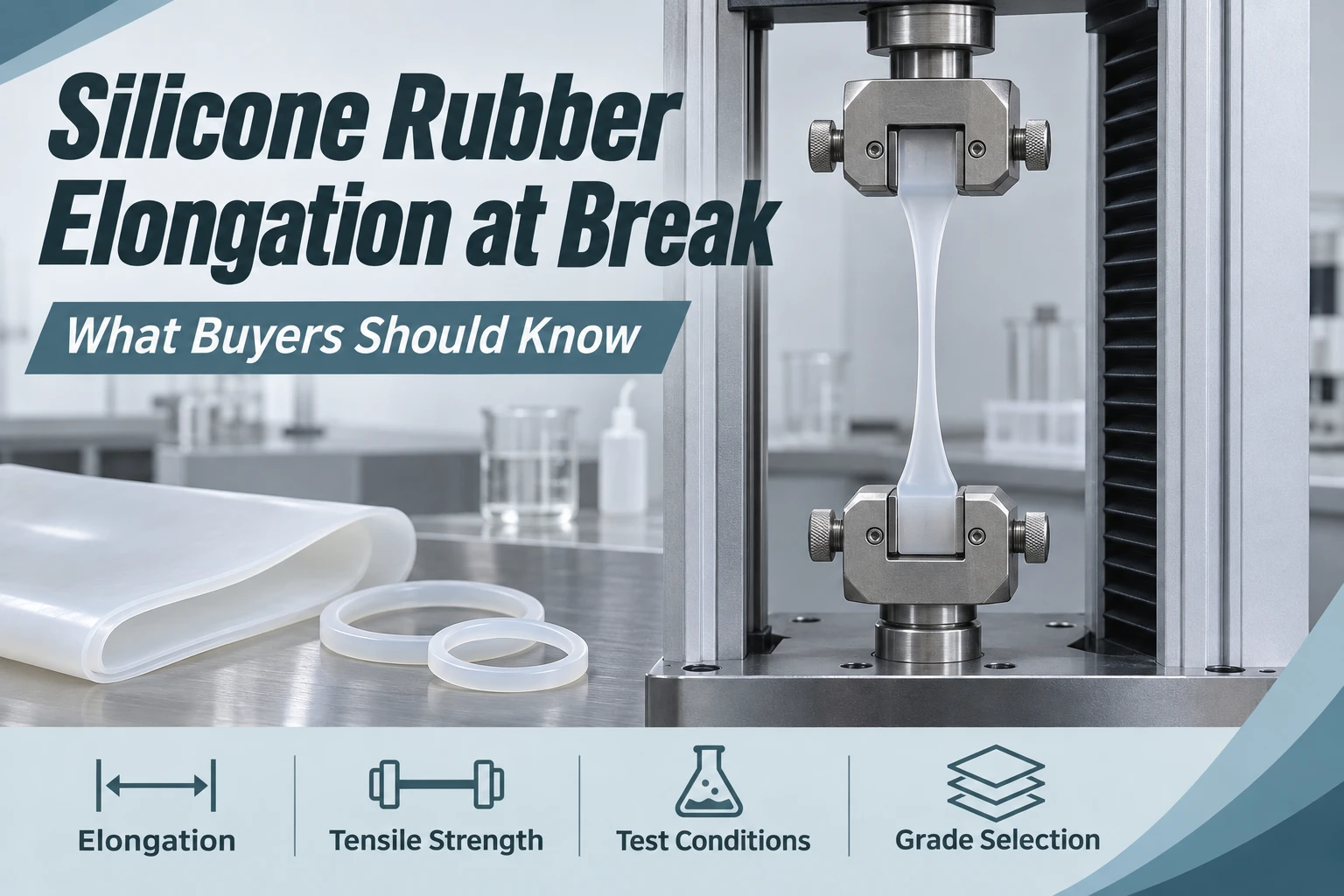
Silicone rubber elongation at break is the increase in a specimen’s gauge length at rupture, expressed as a percentage of its original gauge length. It describes extension in a defined tensile test. It is not a recommended working strain for a finished component and does not state how completely the rubber recovers after stretching.
For buyers, the useful question is whether the proposed compound can meet the component’s deformation requirements alongside strength, recovery and processing needs. A large percentage on a data sheet should start a technical discussion rather than end material selection.
This guide focuses on interpreting elongation data for purchasing and qualification. For the broader strength comparison, see silicone tensile strength vs tear strength.
How Is Elongation at Break Calculated?
The calculation compares extension at break with the initial gauge length: elongation at break (%) = (length at break − initial gauge length) ÷ initial gauge length × 100.
For illustration only, if an initial 20 mm gauge length reaches 100 mm at rupture, the extension is 80 mm and the calculated elongation is 400%. These are hypothetical numbers to explain the calculation, not test results for any Yaksil grade.
Use the defined gauge length and appropriate strain measurement. Do not substitute the total length of a molded component or assume that all movement of the testing-machine crosshead represents extension within the specimen’s gauge section.
Elongation, Tensile Strength and Hardness: What Is Different?
| Propriété | What it describes | What it cannot establish alone |
|---|---|---|
| Elongation at break | Extension at rupture relative to initial gauge length | Safe repeated operating strain |
| Tensile strength | Maximum tensile stress in the specified test | Resistance to every notch or tear mechanism |
| Résistance à la déchirure | Resistance evaluated using a specified tear specimen and procedure | Overall tensile extension behavior |
| Shore A hardness | Resistance to indentation under the stated method | A complete mechanical specification |
A softer compound is not automatically the best option for a demanding flexible part. Compare the combination of properties required by the design. Do not use one result as a substitute for another simply because both appear under mechanical properties.
Which Test Details Should Accompany the Percentage?
ASTM D412 and ISO 37 are commonly used for rubber tensile-property testing. Identify the actual standard and procedure rather than treating the names as proof that every result is directly comparable. Instron notes that specimen and strain measurement choices matter when testing highly extensible elastomers. [1]
Request the specimen geometry, gauge length, test speed, conditioning and test temperature. Include the initial cure and any post-cure applied before testing. Ask how elongation was measured and whether reported results came from valid breaks.
Compare materials under matched conditions wherever practical. Where methods differ, mark the comparison as unresolved and ask the supplier or laboratory which additional test would make the evidence useful for the project.
Why Can Elongation Results Differ Between Laboratories?
Rubber specimens can thin substantially as they stretch. Gripping, slippage and measurement outside the intended gauge region can affect interpretation. Instron’s rubber tensile guidance explains why crosshead travel may differ from strain measured over the gauge length and discusses suitable extensometry. [1]
When two reports disagree, first compare test details and sample preparation. Record where the specimen failed and ask whether the laboratory considered the result valid under its procedure. Do not immediately conclude that a batch is defective solely because two differently prepared reports show different percentages.
A controlled retest should use agreed specimen preparation, conditioning and measurement. Preserve both the original and repeat records so the technical explanation remains traceable.
Does High Elongation Mean a Part Can Stretch That Far in Service?
No. Breaking a test specimen once and operating a component repeatedly are different requirements. A product may need to recover its shape, maintain a seal or withstand repeated movement long before rupture becomes the relevant limit.
Describe the actual deformation, number or pattern of movements, temperature and contact environment when discussing a flexible component. If recovery matters, define how it will be evaluated. If repeated movement matters, agree a representative durability test rather than using elongation at break as a lifetime prediction.
For a seal, also review compression behavior and assembly. For a thin membrane, discuss the local geometry and movement. Material data should support the application-specific acceptance plan.
How Should Buyers Select an HTV or LSR Grade?
Start with the production route. Review Caoutchouc silicone HTV for the intended solid-rubber process, or caoutchouc de silicone liquide for a suitable metering and liquid injection-molding system. Ask for the exact candidate grade rather than comparing family labels.
Specify hardness, strength, tear behavior and extension requirements together. Include appearance, thermal exposure and the documents required for the intended market. A laboratory elongation result does not establish food-contact, medical or electrical suitability.
Run a representative trial before production approval. Check processing stability, finished dimensions, demolding and the functional requirements of the part. Keep the approved formulation and processing basis linked to the trial record.
What Should an Elongation-Focused Material RFQ Include?
- Component: application, drawing, thin sections and critical interfaces.
- Production: molding or extrusion route, equipment and existing grade reference.
- Mechanical requirements: hardness, tensile strength, tear strength and elongation, with agreed test methods.
- Operating conditions: deformation, movement, temperature, contact media and recovery expectations.
- Qualification: sample quantity, required reports and representative part tests.
- Supply: expected demand, packaging, destination and traceability requirements.
Ask which targets are supported by current data and which require testing. Distinguish typical data from guaranteed acceptance limits. A requirement that must be verified for deliveries should be written into the agreed purchase specification.
Silicone Rubber Elongation at Break FAQ
Is higher elongation always better?
No. Select the balance required by the component and process. A high rupture extension cannot compensate for inadequate strength, recovery or application suitability.
Can two grades with the same hardness have different elongation?
Yes. Hardness is only one property of a formulated compound. Compare the exact grades and their complete data.
Is elongation at break the same as elastic recovery?
No. Extension at rupture does not quantify how well a specimen returns to its original shape after unloading.
Can ASTM D412 and ISO 37 results be mixed in one ranking?
First review methods, specimens and conditions. Request matched evidence where necessary rather than assuming equivalence from the test names.
Use Elongation Data to Support a Complete Material Decision
Silicone rubber elongation at break is useful when the result stays attached to its grade and test conditions. Compare it alongside strength, hardness and recovery requirements, then confirm finished-part behavior with an agreed trial.
Send Yaksil your application, production method and mechanical targets. Request a proposed silicone grade, technical documents and samples for qualification.
Technical Sources
References checked on 17 November 2026. Third-party products illustrate technical principles; they are not Yaksil specifications.