
How to Improve the Adhesion of Silicone
Improving silicone adhesion is one of the most common challenges in silicone rubber manufacturing. Silicone elastomers offer excellent heat resistance, flexibility, weatherability and electrical insulation, but their naturally low surface energy can make reliable bonding difficult. Strong adhesion normally depends on more than choosing a powerful adhesive. The silicone formulation, substrate condition, surface preparation, primer chemistry, curing system and production environment all need to work together.
Why Is Silicone Difficult to Bond?
Silicone rubber has a highly flexible siloxane backbone and a surface that tends to exhibit relatively low surface energy. This characteristic contributes to several useful properties, including water repellency, release behavior and resistance to environmental contamination. At the same time, it means that many conventional adhesives do not naturally spread or wet the silicone surface effectively.
When an adhesive cannot wet the surface, intimate molecular contact is limited. Even if the adhesive cures correctly, the joint may separate from the silicone rather than fail within the adhesive itself. This type of interface failure is a common indication that surface preparation or chemical compatibility needs to be improved.
Because of these factors, successful silicone adhesion should be treated as an interface-engineering problem. A reliable bond is created by controlling both the silicone surface and the material that must adhere to it.
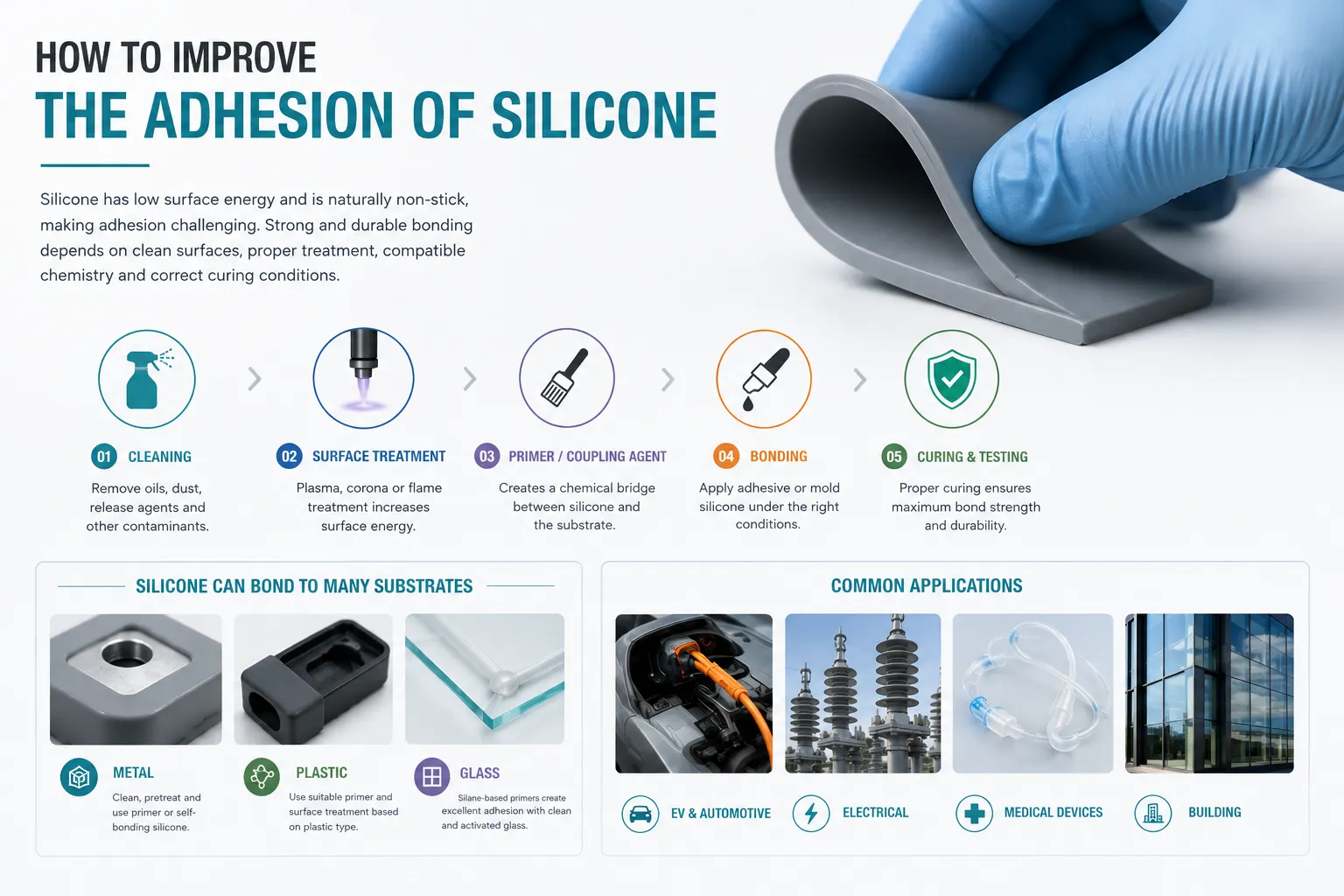
Start with the Silicone Formulation
Before modifying the surface, it is important to understand the silicone compound itself. Two silicone rubbers that look almost identical can produce very different adhesion results because their formulations may contain different polymers, fillers, processing aids, pigments, release additives or curing systems.
HTV and HCR silicone rubber compounds are frequently designed for compression molding, extrusion, injection molding or high-voltage electrical applications. Some grades are intentionally optimized for easy release from tooling, while others can be formulated specifically for improved bonding to metals, plastics or other elastomers.
If a finished component will later be bonded, coated, printed or overmolded, this requirement should ideally be considered during formulation development. Trying to create strong adhesion after selecting a highly release-oriented silicone compound may require significantly more surface treatment and process control.
| Silicone Factor | Possible Influence on Adhesion | What to Evaluate |
|---|---|---|
| Processing additives | May migrate toward the surface and reduce bonding | Surface cleanliness and compatibility |
| Silicone oils | Excess free oil can weaken interfacial bonding | Oil content and migration after curing |
| Curing system | Can affect primer or adhesive chemistry | Peroxide or platinum cure compatibility |
| Filler system | Can influence surface characteristics | Compound formulation and surface condition |
| Release agents | Can strongly interfere with adhesion | Molding process and cleaning requirements |
Clean the Silicone Surface Before Bonding
Surface cleaning is one of the simplest steps in improving silicone adhesion, but it is also one of the most frequently underestimated. A surface can appear visually clean while still carrying microscopic residues from molding, handling, storage or packaging.
Dust, grease, fingerprints, mold release agents and low-molecular-weight silicone residues can create a weak boundary layer between the silicone and adhesive. In this situation, even an otherwise suitable adhesive may bond mainly to the contamination rather than to the silicone rubber itself.
The cleaning method must be selected according to the silicone formulation and substrate. A cleaning agent that works well for one material may cause swelling, surface changes or residue on another. For industrial production, the cleaning process should therefore be standardized instead of relying on informal wiping immediately before assembly.
Increase Surface Energy with Surface Treatment
When cleaning alone does not provide sufficient adhesion, surface activation is often the next step. Plasma treatment, corona treatment and other controlled surface-treatment methods can modify the outermost molecular layer of silicone rubber and increase its surface energy.
This improves wetting, allowing primers, inks, coatings or adhesives to spread more effectively and interact more strongly with the silicone surface. Unlike mechanical roughening, these methods primarily change surface chemistry rather than simply increasing surface texture.
Plasma Treatment
Plasma treatment can introduce more polar functional groups at the silicone surface. It is widely used when controlled and repeatable activation is required before bonding, printing or coating.
Corona Treatment
Corona treatment can be practical for continuous materials, films and selected molded products. Its effectiveness depends on geometry, treatment intensity and process consistency.
Flame Treatment
Controlled flame treatment is used for some polymer surfaces, although process control is critical because excessive heat can damage silicone parts or alter their dimensions.
Surface activation is often temporary. After treatment, the silicone surface can gradually recover toward its original lower-energy state as molecular groups rearrange. For this reason, bonding should usually take place within a validated time window after treatment.
Use a Silicone Adhesion Primer
A primer acts as a chemical bridge between silicone rubber and another material. Instead of expecting the adhesive to form a strong bond directly with both surfaces, a properly selected primer creates an intermediate layer designed to interact with the silicone on one side and the adhesive or substrate on the other.
Primers can be especially useful when bonding silicone to metals, glass, engineered plastics or other difficult substrates. They are also commonly used in silicone overmolding processes where uncured silicone needs to chemically bond to a rigid insert during vulcanization.
However, applying more primer does not necessarily create a stronger bond. Excessive primer thickness can form a weak layer and may reduce consistency. The coating normally needs to be thin and uniform, followed by the drying or activation conditions recommended for the specific system.
Primer Performance Depends on the Complete System
The silicone grade, primer chemistry, substrate, adhesive, curing temperature and time between application and bonding should be evaluated together. A primer that works well with one silicone compound may perform poorly with another.
Silane Coupling Agents and Silicone Adhesion
Silane coupling chemistry is widely used to improve adhesion between organic and inorganic materials. Suitable silanes can contain reactive groups that interact with surfaces such as glass, silica or metal oxides while another part of the molecule participates in reactions with the polymer, adhesive or primer system.
In silicone technology, coupling agents may be incorporated into formulations or used as part of a surface-treatment system. Their effectiveness depends strongly on substrate chemistry and the curing mechanism involved.
It is therefore more useful to select coupling chemistry according to the materials being joined than to search for a single universal silicone adhesion promoter. Metal, glass, polyamide, polyester and other substrates present different surface chemistries and often require different adhesion strategies.
How to Improve Silicone-to-Metal Adhesion
Silicone-to-metal bonding is common in electrical components, automotive parts, industrial seals, dampers and molded assemblies. Metals can provide good bonding surfaces, but their actual condition can vary considerably.
Oil, oxide layers, machining fluids, fingerprints and corrosion products can reduce adhesion. A controlled cleaning and surface-preparation process is therefore essential before primer application or silicone overmolding.
| Metal Condition | Potential Problem | Typical Adhesion Strategy |
|---|---|---|
| Oily surface | Prevents proper wetting | Controlled degreasing and cleaning |
| Heavy oxide or corrosion | Creates a weak or unstable interface | Appropriate pretreatment before priming |
| Smooth untreated metal | May provide insufficient chemical interaction | Primer or suitable surface activation |
| Prepared metal insert | Can support strong chemical bonding | Validated primer and silicone molding process |
For overmolding, metal inserts also need to remain clean after preparation. Prepared inserts stored for long periods in uncontrolled environments may accumulate contamination that reduces final bond strength.
How to Improve Silicone-to-Plastic Adhesion
Bonding silicone to plastic can be more complicated because plastics cover an enormous range of surface energies, chemical structures and temperature limits. Materials such as polycarbonate, polyamide and some engineering thermoplastics can sometimes be bonded successfully with the correct primer or self-bonding silicone system, while low-surface-energy plastics may require much more intensive treatment.
Another challenge is molding temperature. HTV or liquid silicone molding processes can expose plastic inserts to elevated temperatures. The insert therefore needs enough dimensional and thermal stability to survive the silicone curing cycle.
Surface treatment can also affect different plastics in different ways. Plasma activation may be highly effective for one polymer but provide limited improvement for another. For this reason, the exact plastic grade—not only the general polymer family—should be included during adhesion testing.
How to Improve Silicone-to-Glass Adhesion
Glass surfaces contain chemical groups that can interact effectively with suitable silane-based adhesion systems. As a result, strong silicone-to-glass adhesion can often be achieved when the surface is properly cleaned and the primer chemistry is compatible.
Contamination remains a major concern. Fingerprints, cleaning residues and dust can dramatically reduce uniformity. In production, glass bonding should therefore use controlled cleaning and handling procedures instead of relying only on visual inspection.
Moisture conditions can also influence some primer systems. The surface and primer should be prepared according to the recommended process window to obtain a stable interface rather than simply a strong initial bond.
Self-Bonding Silicone Rubber
For high-volume manufacturing, one of the most effective solutions can be to use a silicone compound designed specifically for direct bonding. Self-bonding silicone formulations contain chemistry intended to create adhesion to selected substrates during curing.
This can reduce or eliminate separate primer application, improving production efficiency and lowering the risk of inconsistent primer coating. Self-bonding systems are particularly attractive for automated injection molding and overmolding processes.
However, the term “self-bonding” does not mean that the silicone will bond equally well to every material. The substrate type, surface cleanliness, molding temperature and curing conditions still determine whether the interface develops correctly.
→
→
→
→
Does Increasing Surface Roughness Improve Silicone Adhesion?
Mechanical roughening can sometimes improve adhesion by increasing effective contact area and creating additional mechanical interlocking. Sandblasting, abrasion or other controlled treatments are therefore used in selected metal and industrial bonding processes.
However, roughness should not be confused with chemical adhesion. A heavily roughened but contaminated surface may still perform poorly, while a clean chemically activated surface can produce excellent bonding without extreme texture.
Excessive roughening may also create sharp features, residual particles or inconsistent geometry. Surface texture should therefore be engineered for the application rather than treated as a simple rule that rougher always means stronger.
How Curing Conditions Affect Silicone Adhesion
Adhesion often develops at the same time that the silicone itself is curing. If the silicone is under-cured, the polymer network and interface may not reach their intended strength. If the temperature or curing cycle is unsuitable for the primer system, chemical bonding at the interface can also remain incomplete.
In molded HTV and HCR silicone, temperature, curing time, part thickness and mold design can all influence the interface. The substrate must reach conditions that allow the silicone and adhesion-promoting chemistry to react effectively.
Post-curing may improve the stability of some bonded assemblies, but its influence depends on the silicone and substrate. A post-cure process that benefits the silicone rubber must also be compatible with the metal, plastic, coating or adhesive present in the assembly.
Peroxide-Cured vs Platinum-Cured Silicone Adhesion
The curing system can influence both silicone processing and adhesion strategy. Peroxide-cured HTV silicone and platinum-cured silicone use different crosslinking mechanisms, so primers and bonding agents must be compatible with the chemistry being used.
Platinum-cured silicone is particularly sensitive to certain contaminants that can inhibit the catalyst and prevent complete vulcanization. Compounds containing sulfur, some amines, certain organotin materials and other catalyst-inhibiting substances can interfere with cure when they contact the silicone.
A poor result may therefore appear to be an adhesion failure when the actual problem is incomplete cure near the interface. When developing a platinum-cured overmolding system, both adhesion performance and cure compatibility should be evaluated.
| System | Main Consideration | Development Focus |
|---|---|---|
| Peroxide-cured HTV / HCR | Primer and cure-cycle compatibility | Interface strength and post-cure behavior |
| Platinum-cured HCR | Catalyst inhibition | Clean substrates and compatible primers |
| LSR overmolding | Fast cure and insert compatibility | Automation, mold temperature and self-bonding grade |
| RTV bonding | Moisture or addition-cure chemistry | Adhesive thickness and curing environment |
Why Release Agents Can Cause Adhesion Failure
Release agents are useful during molding because they help silicone parts separate from tooling. Unfortunately, the same release function can interfere with later bonding. Residual release chemistry may remain on the molded surface and create an intentionally non-stick boundary layer.
If secondary bonding is required, mold-release practices should therefore be reviewed early in process development. A compound with good inherent mold release may allow reduced external release-agent use, or dedicated mold coatings may be considered where appropriate.
Cleaning molded parts after release-agent exposure can sometimes restore bonding performance, but the cleaning method must actually remove the residue rather than simply redistribute it across the surface.
Bonding Fresh Silicone vs Aged Silicone
The age and storage history of silicone parts can influence adhesion. Freshly molded silicone may have a different surface condition from parts stored for several weeks. Low-molecular-weight materials can migrate, environmental contamination can accumulate and the surface can undergo chemical rearrangement.
For surface-treated silicone, aging becomes even more important because plasma or corona activation can gradually decrease after treatment. A process that produces excellent adhesion when bonding occurs immediately may become unreliable if treated parts remain in storage for several days.
Production specifications should therefore define not only the treatment method but also the maximum allowable time between surface preparation and bonding.
Silicone Adhesion in Electrical Applications
Silicone rubber is widely used in high-voltage insulation because of its electrical performance, weather resistance and hydrophobic surface behavior. In these applications, adhesion can become important when silicone needs to bond to fiberglass cores, metal fittings, cable components or other insulating materials.
For composite insulators, the interface between the silicone housing and internal structure must remain stable during temperature cycling, moisture exposure and long-term outdoor service. Weak bonding can allow gaps or pathways to develop where moisture and contamination may accumulate.
Electrical applications therefore require more than high initial peel strength. The interface should be evaluated after thermal aging, humidity exposure and other conditions representative of actual service.
Silicone Adhesion in EV and Automotive Components
Electric vehicles increasingly use silicone elastomers for high-voltage connectors, battery components, cable seals, thermal management systems and electronic assemblies. Many of these components combine silicone with metal or engineering plastics.
Reliable adhesion helps maintain sealing and positioning under vibration, repeated temperature cycling and exposure to automotive fluids. The large difference in thermal expansion between silicone and rigid substrates also places stress on bonded interfaces.
A strong EV bonding system should therefore balance adhesion with flexibility. An extremely rigid adhesive layer can create local stress concentrations even if its initial bond strength is high. Silicone-based bonding systems are often valuable because they can maintain elasticity while accommodating movement between different materials.
How to Evaluate Silicone Adhesion
Adhesion should not be evaluated only by pulling a sample manually and deciding whether it feels strong. Quantitative testing provides much more useful information, particularly when comparing primers, treatments or silicone formulations.
Depending on component geometry, peel, lap-shear, pull-off or custom tensile tests may be used. The failure mode should be recorded together with the force required to break the sample.
| Failure Mode | What Happens | What It Usually Suggests |
|---|---|---|
| Adhesive failure | Silicone separates cleanly from the substrate | Interface or surface preparation needs improvement |
| Cohesive silicone failure | Silicone tears while material remains bonded | Interface may be stronger than the silicone itself |
| Cohesive adhesive failure | Adhesive splits internally | Adhesive strength may be limiting performance |
| Mixed failure | Several failure modes occur together | Interface consistency should be examined |
Cohesive failure in silicone is often a useful indication of strong interfacial bonding because the silicone itself breaks before complete separation from the substrate. However, the required test method and acceptance criteria should always be determined by the actual application.
Why Initial Adhesion Is Not Enough
A bond that performs well immediately after production may not remain reliable over years of service. Silicone assemblies can experience heat, cold, humidity, UV exposure, chemicals, mechanical vibration and repeated deformation.
These conditions can gradually change the interface. Water may migrate into weakly bonded regions, different materials may expand and contract at different rates, and chemical exposure may attack the primer or adhesive layer.
For this reason, meaningful silicone adhesion testing should include aging conditions appropriate to the final product. Electrical equipment may require humidity and thermal aging, while automotive components may need temperature cycling and fluid exposure.
A Practical Process for Improving Silicone Adhesion
The most effective approach is to determine where the adhesion failure originates before changing several variables simultaneously. First identify the silicone compound, curing system and substrate. Then examine whether the failure is caused by contamination, insufficient surface energy, incompatible chemistry or an inadequate curing process.
Surface cleaning should normally be established first. If adhesion remains insufficient, surface activation or a suitable primer can be evaluated. For new molded products, self-bonding silicone may provide a more efficient long-term solution than adding a separate manual priming process.
Identify Materials
Confirm silicone grade, curing chemistry and exact substrate.
Control Surface
Remove contamination and standardize preparation.
Improve Wetting
Evaluate plasma, corona or suitable activation.
Add Chemistry
Select primer, coupling agent or self-bonding silicone.
Validate
Test bond strength and durability after aging.
Changing one factor at a time makes it much easier to understand which process actually improves performance. Once an effective system is found, cleaning conditions, treatment parameters, primer thickness, drying time and bonding interval should be converted into controlled production specifications.
Frequently Asked Questions About Silicone Adhesion
Why does silicone have poor adhesion?
Silicone rubber generally has relatively low surface energy, which can make it difficult for conventional adhesives to wet and interact strongly with the surface. Oils, release agents and other contaminants can further reduce adhesion.
How can I make silicone stick better?
Improvement normally begins with proper cleaning. Plasma or corona treatment can increase surface energy, while a compatible silicone primer or self-bonding silicone formulation can provide additional chemical adhesion.
Does sanding silicone improve adhesion?
Mechanical abrasion can sometimes improve mechanical interlocking, but it is usually not sufficient by itself. Surface cleanliness and chemical compatibility remain essential.
Does plasma treatment improve silicone adhesion?
Yes. Properly controlled plasma treatment can temporarily increase silicone surface energy and improve wetting by adhesives, primers, coatings and inks.
How long after plasma treatment should silicone be bonded?
The effective time window depends on the silicone formulation and treatment process. Because activated silicone surfaces can gradually recover toward lower surface energy, bonding should be carried out within a validated production interval.
Can silicone bond directly to metal?
Some specially formulated self-bonding silicone grades can bond directly to selected metals during curing. Other systems require cleaning, surface preparation and a compatible primer.
Can silicone bond to plastic?
Yes, but performance depends strongly on the plastic type. Some engineering plastics are relatively easy to bond with suitable primers or self-bonding silicone, while low-surface-energy polymers can be considerably more difficult.
What is a silicone primer?
A silicone primer is an adhesion-promoting coating designed to create better chemical interaction between silicone rubber and another material such as metal, glass, plastic or an adhesive.
Does heat improve silicone adhesion?
Heat can help when the bonding system requires elevated temperature for curing or interfacial reaction. However, excessive heat cannot compensate for contamination or incompatible materials.
Why does silicone peel away from metal after molding?
Possible causes include oil or oxide contamination, insufficient primer coverage, incompatible primer chemistry, improper curing conditions or movement of the insert during molding.
Can mold release affect silicone adhesion?
Yes. Release-agent residues can form a weak non-stick layer on molded silicone and significantly reduce secondary bonding, printing or coating performance.
What is self-bonding silicone?
Self-bonding silicone is formulated with adhesion-promoting chemistry that allows the silicone to bond to selected substrates during curing, sometimes eliminating the need for separate primer application.