
How Fire Resistant Is Silicone Rubber?
Silicone rubber is known for excellent heat resistance, but heat resistance and fire resistance are not the same thing. Standard silicone rubber can tolerate elevated temperatures better than many conventional elastomers, yet it can still decompose, ignite or burn when exposed to sufficiently severe flame or heat.
The actual fire behavior of silicone rubber depends on its formulation, thickness, curing system, fillers, flame-retardant additives and the test method used. For electrical, wire and cable, EV and industrial applications, engineers therefore need to evaluate the specific silicone compound rather than assuming that every silicone rubber grade is automatically flame retardant.
This article explains how silicone rubber behaves under flame, the difference between heat resistance and flame resistance, how flame-retardant silicone compounds are formulated and what buyers should check when selecting material for fire-sensitive applications.
Is Silicone Rubber Fire Resistant?
Silicone rubber can offer better resistance to heat and flame exposure than many conventional organic rubbers, but it should not automatically be described as fireproof.
Under moderate heat, silicone can maintain flexibility and mechanical performance for relatively long periods. Under direct flame or sufficiently high temperature, however, the polymer structure eventually begins to decompose. Depending on the formulation and test conditions, the material may burn, self-extinguish after the ignition source is removed, form a silica-rich residue or continue degrading under heat.
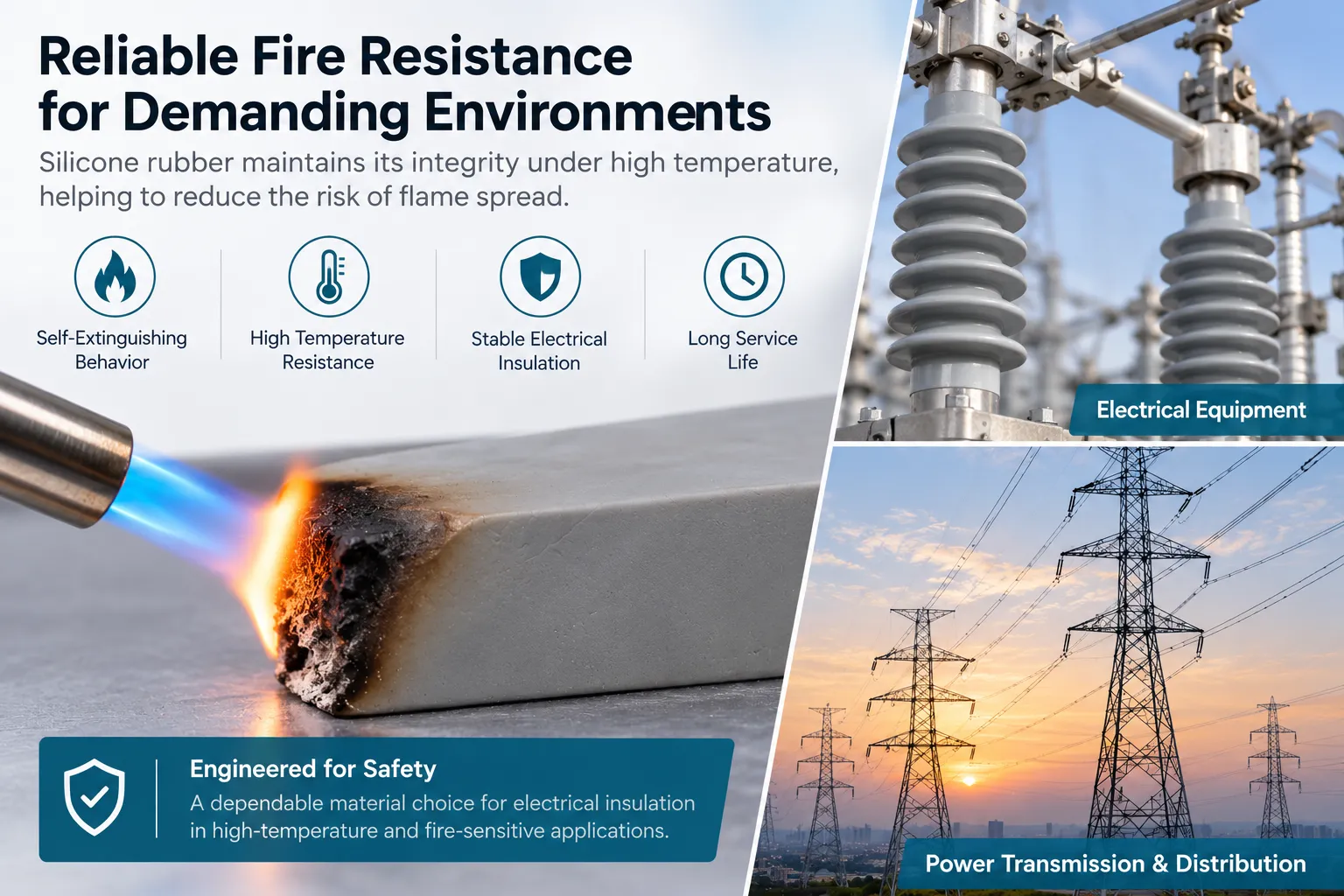
Heat Resistance and Fire Resistance Are Different
This distinction is one of the most important points when specifying silicone rubber.
Heat resistance describes how well a material maintains useful properties during prolonged exposure to elevated temperature. Fire resistance or flame resistance describes how the material behaves when exposed to ignition, direct flame or severe thermal energy.
| Propriedade | What It Describes | Typical Question |
|---|---|---|
| Heat Resistance | Long-term performance at elevated operating temperature | Will the rubber remain flexible after thousands of hours at high temperature? |
| Flame Resistance | Behavior during and after exposure to an ignition source | Will the material continue burning after the flame is removed? |
| Fire Performance | Broader behavior including ignition, flame spread, smoke and heat release | How will the finished product behave during a fire event? |
| Thermal Aging | Change in mechanical properties after prolonged heat exposure | How much hardness, tensile strength or elongation is retained? |
A silicone rubber that performs well at elevated operating temperatures does not automatically meet UL 94, cable flame tests or another fire-performance requirement.
Does Silicone Rubber Burn?
Yes, silicone rubber can burn under sufficiently severe conditions. Its behavior, however, is different from many conventional hydrocarbon-based elastomers.
When silicone is exposed to intense heat, the siloxane polymer network begins to break down. Volatile decomposition products can be released while the remaining inorganic portion can form a silica-rich residue.
The amount of flame spread, after-flame time, dripping, residue formation and self-extinguishing behavior depends strongly on the formulation. A general-purpose silicone compound and a dedicated flame-retardant silicone can therefore behave very differently in the same flame test.
What Happens to Silicone Rubber in a Fire?
Fire exposure creates several processes at the same time. The material heats rapidly, polymer chains begin to decompose, volatile products may be generated and the remaining mineral portion of the formulation can form a solid residue.
Why Silicone Rubber Can Perform Well Under Heat
Silicone rubber has a siloxane backbone based on alternating silicon and oxygen atoms. This structure gives silicone a different thermal behavior from many conventional organic elastomers whose main polymer backbone is carbon based.
This chemistry helps silicone retain flexibility and useful mechanical properties at temperatures that can accelerate aging in materials such as natural rubber, many general-purpose synthetic rubbers and some thermoplastics.
However, the final performance of a commercial compound also depends on reinforcing silica, pigments, curing system, heat stabilizers and other additives. The base polymer alone does not determine the complete fire performance.
Standard Silicone Rubber vs Flame-Retardant Silicone Rubber
Standard industrial silicone rubber is usually formulated around properties such as hardness, tensile strength, elongation, tear strength, compression set, heat resistance and processing behavior.
A flame-retardant silicone rubber is formulated specifically to improve performance when exposed to flame or severe heat. This usually requires additional functional ingredients and tighter control of the compound formulation.
| Characteristic | Standard Silicone Rubber | Borracha de silicone retardante de chamas |
|---|---|---|
| Primary Design Goal | General mechanical, thermal or electrical performance | Improved flame behavior while maintaining required material properties |
| Flame Rating | Not necessarily specified | May be formulated and tested to a defined flame requirement |
| Functional Fillers | Depends on application | May include flame-retardant or ceramic-forming filler systems |
| Propriedades mecânicas | Optimized for the general application | Must be balanced against flame-retardant loading |
| Typical Uses | Seals, tubing, molded parts, cable and general industrial applications | Electrical components, transportation, cable systems and fire-sensitive equipment |
How Flame-Retardant Silicone Rubber Is Formulated
Flame performance is normally improved through the complete formulation rather than through one universal additive.
Mineral fillers, reinforcing silica, heat-stabilizing ingredients and specialized flame-retardant systems can all influence how silicone behaves during ignition and thermal decomposition.
In some electrical silicone compounds, mineral fillers such as aluminum hydroxide may also contribute to thermal and electrical performance. Other formulations may use different combinations of fillers, synergists or ceramic-forming ingredients depending on the target standard and application.
Why More Flame Retardant Does Not Automatically Mean Better Silicone
Increasing flame-retardant filler loading can improve certain fire-related properties, but it can also change other characteristics of the silicone compound.
High filler loading can increase hardness and density, reduce elongation, change tear behavior and make extrusion or molding more difficult. The result may pass a flame test but perform poorly during production or mechanical service.
The formulation therefore needs to balance fire performance with the requirements of the finished component.
What Is UL 94?
UL 94 is one of the most widely referenced flammability classifications for polymeric materials used in electrical and electronic products. It evaluates how a material specimen behaves under defined flame-test conditions.
Common classifications include horizontal and vertical burning classifications such as HB, V-2, V-1 and V-0. A V-0 classification generally represents more demanding vertical-burning performance than V-1 or V-2 under the relevant test conditions.
When a project requires UL 94 performance, buyers should confirm the exact compound, specimen thickness, color where relevant and supporting documentation.
Does UL 94 V-0 Mean the Silicone Is Fireproof?
No. A UL 94 V-0 classification does not mean that a silicone material cannot burn or be damaged by fire.
It means the material satisfied defined criteria during a particular vertical flammability test. Real fire conditions can involve longer exposure, different heat flux, larger components, fuel sources, airflow and surrounding materials.
UL 94 is therefore useful for material comparison and qualification, but it should not be interpreted as a guarantee that the complete product is fireproof.
Fire Resistance in Electrical Silicone Rubber
Electrical applications frequently combine several material requirements. The silicone may need to provide electrical insulation, thermal stability, mechanical strength and flame performance at the same time.
| Requirement | Por que isso é importante |
|---|---|
| Rigidez dielétrica | Provides resistance to electrical breakdown under defined conditions. |
| Resistividade volumétrica | Helps limit electrical current through the insulating material. |
| Flame Resistance | Reduces the risk of sustained burning in fire-sensitive equipment. |
| Heat Aging | Helps maintain useful properties after prolonged elevated-temperature exposure. |
| Resistência ao rasgo | Helps molded insulation survive assembly and mechanical loading. |
A flame-retardant electrical silicone therefore needs to be evaluated as a complete electrical insulation material rather than only as a fire-resistant rubber.
Silicone Rubber Fire Resistance in Wire and Cable
Wire and cable applications often require insulation materials that can tolerate high operating temperatures while limiting flame propagation.
Silicone rubber is attractive for cable insulation because it can remain flexible at elevated temperature and can be extruded into continuous insulation layers. Dedicated cable formulations can also be developed for improved flame performance.
However, cable fire performance is usually evaluated on the finished cable system, not only on a small raw-material specimen. Conductor size, insulation thickness, jacket construction and other materials all influence the result.
| Cable Consideration | Por que isso é importante |
|---|---|
| Insulation Thickness | Can influence both electrical and flame behavior. |
| Extrusion Quality | Uniform insulation reduces weak areas and processing defects. |
| Flame Propagation | May be controlled by application-specific cable test requirements. |
| Heat Aging | Ensures flexibility and mechanical strength remain useful after prolonged heat. |
| Finished Cable Test | Confirms how the complete cable construction behaves rather than only the compound. |
Why Fire Resistance Matters in EV High-Voltage Systems
EV high-voltage systems contain batteries, power electronics, connectors and high-current cables that can generate significant heat during operation or abnormal conditions.
Silicone rubber may be used in high-voltage cables, connector seals, boots, grommets and insulating parts because it combines electrical insulation with flexibility and thermal resistance.
Where flame performance is required, the compound must also meet the applicable automotive or component-level fire requirement. An orange color or an “EV grade” marketing label does not prove flame resistance.
For more information on this application, see Silicone Rubber in EV High-Voltage Systems.
Heat Resistance Does Not Replace Flame Testing
A silicone material may survive continuous elevated temperatures for long periods while still failing a specific flame test.
This happens because heat aging and flame testing expose the material to very different conditions. Heat aging typically involves controlled temperature over hours or days. Flame testing exposes the material to a concentrated ignition source and evaluates burning behavior over a much shorter period.
Both may be required for electrical, cable, EV or industrial applications.
What About Smoke and Decomposition Products?
Fire performance should not be evaluated only by whether the rubber continues burning. Smoke, gases, residue and heat release can also matter in enclosed electrical, transportation and building environments.
Silicone rubber contains no halogen as part of its basic siloxane polymer backbone, but this does not mean every silicone compound automatically meets low-smoke, low-toxicity or halogen-free finished-product requirements.
Fillers, pigments, additives and surrounding materials also influence the behavior of the finished system. If smoke density, toxicity or halogen content is critical to the project, those properties should be evaluated through the applicable test methods rather than assumed from the word “silicone.”
What Is Ceramifying Silicone Rubber?
Some specialized silicone compounds are designed to form a mechanically stable or ceramic-like residue after severe fire exposure. These materials are often described as ceramifying silicone rubber or ceramic-forming silicone.
Instead of relying only on self-extinguishing behavior, these formulations are designed so that selected fillers and additives react during high-temperature exposure and help create a protective residue.
This can be useful in applications where maintaining some degree of physical separation or circuit protection during fire is important, particularly in specialized cable systems.
Ceramifying behavior is a specialized material function and should not be assumed for standard silicone rubber.
Does Silicone Rubber Melt in a Fire?
Cured silicone rubber is a crosslinked elastomer, so it does not behave like a conventional thermoplastic that simply softens and melts into a liquid when heated.
Under severe thermal exposure, the crosslinked silicone network instead degrades chemically. The material may lose strength, crack, burn and form inorganic residue as decomposition progresses.
This difference can be useful in some electrical and cable applications, but it does not eliminate the need for flame testing.
Can Silicone Rubber Self-Extinguish?
Some silicone rubber compounds can show self-extinguishing behavior after the ignition source is removed, particularly when specifically formulated for flame resistance.
Whether this happens depends on the exact compound, specimen geometry, thickness and flame test.
It is therefore better to say that a specific silicone grade meets a defined flame classification than to make a general claim that all silicone rubber is self-extinguishing.
Does Color Affect Flame Resistance?
Color pigments are part of the compound formulation and can influence material properties. In many cases the effect may be small, but a material qualified in one color should not automatically be assumed to have identical flame performance in every custom color.
This is particularly important when flame-retardant grades require formal testing or customer approval. If color customization is needed, buyers should confirm whether the flame data or certification applies to the requested color.
Processing Can Affect Final Fire Performance
Even a properly formulated flame-retardant silicone needs to be processed correctly. Mixing errors, contamination, incorrect catalyst addition and incomplete curing can change the finished material.
| Processing Issue | Possible Effect |
|---|---|
| Incorrect Cure | Mechanical and thermal properties may not reach the intended level. |
| Contamination | Foreign materials can alter electrical, mechanical or flame behavior. |
| Poor Dispersion | Functional fillers may not perform consistently throughout the compound. |
| Incorrect Thickness | Can change both flame-test and finished-component performance. |
| Unauthorized Additives | Can invalidate previously tested formulation performance. |
How to Choose Fire-Resistant Silicone Rubber
The correct compound should be selected from the finished-product requirement rather than from a generic request for “fireproof silicone.”
What Should Be Included in a Flame-Retardant Silicone RFQ?
A detailed RFQ allows the supplier to determine whether an existing flame-retardant grade is suitable or whether a different compound is required.
What Buyers Should Ask the Supplier
Fire-resistant material sourcing should be based on test evidence and the exact formulation rather than marketing language.
| Question | Por que isso é importante |
|---|---|
| Which flame test does the grade meet? | Different standards evaluate different aspects of fire behavior. |
| At what thickness was it tested? | Flammability performance can vary with specimen thickness. |
| Which color was tested? | Color and formulation changes may affect previously established performance. |
| Is the result for raw material or finished product? | Component construction may change final fire behavior. |
| Can supporting documentation be supplied? | Helps verify that the claim relates to the exact grade being purchased. |
| Are electrical and mechanical properties also controlled? | A flame-retardant material still needs to perform during normal service. |
Flame-Resistant Silicone Rubber from Yakows
Yakows supplies HTV/HCR silicone rubber compounds for electrical insulation, wire and cable, EV systems, high-temperature components and other industrial applications.
Where flame resistance is required, material selection needs to balance fire behavior with electrical insulation, mechanical strength, heat aging and processing characteristics. A cable compound may require stable extrusion together with flame performance, while a molded electrical component may require a different combination of hardness, tear strength and dielectric properties.
Customers can provide the required flame standard, application, processing method, hardness, electrical requirements, temperature conditions, color and production volume so that an appropriate silicone rubber compound can be evaluated.
Perguntas frequentes
Is silicone rubber fire resistant?
Silicone rubber generally has good heat resistance and can offer useful flame performance, but not every silicone compound is flame retardant. Fire resistance depends on the formulation and the specific test requirement.
Does silicone rubber burn?
Yes. Silicone rubber can burn or thermally decompose when exposed to sufficiently severe heat or flame. Flame-retardant formulations can reduce sustained burning and improve self-extinguishing behavior.
Is silicone rubber fireproof?
No material should be described as universally fireproof based only on being silicone. A specific compound should be evaluated according to the applicable flame or fire test.
Does silicone rubber melt?
Cured silicone rubber is a crosslinked elastomer and does not normally melt like a conventional thermoplastic. Under severe heat it instead degrades chemically, loses mechanical strength and can form an inorganic residue.
Can silicone rubber achieve UL 94 V-0?
Specially formulated silicone compounds can be designed to meet UL 94 V-0 at specified test thicknesses and conditions. Buyers should verify the exact grade and supporting test documentation.
Is high-temperature silicone automatically flame retardant?
No. High-temperature resistance describes long-term thermal performance, while flame retardancy describes behavior during direct flame exposure. These are different properties.
Is silicone rubber suitable for fire-resistant cable?
Silicone rubber can be used in cable systems requiring heat and flame performance, but the complete cable construction must meet the applicable cable fire test.
What is flame-retardant silicone rubber?
Flame-retardant silicone is a compound formulated with selected fillers and functional additives to improve ignition, burning or self-extinguishing behavior while maintaining required mechanical and electrical properties.
What is ceramifying silicone rubber?
Ceramifying silicone is a specialized formulation designed to form a mechanically stable or ceramic-like residue during severe fire exposure. It is commonly associated with specialized fire-resistant cable applications.
Does orange silicone mean it is flame resistant?
No. Color does not determine flame performance. Orange silicone is commonly used in high-voltage applications, but the compound still needs to meet the required fire standard independently.