
Why Two HTV Silicone Grades with the Same Hardness Process Differently
Two HTV silicone grades can both be specified at 60 Shore A and still behave very differently on a two-roll mill, extruder or compression-molding press. One compound may release cleanly from the rolls and feed smoothly into an extruder, while another may feel tackier, show greater die swell, trap more air or require different molding conditions.
The reason is simple: Shore A hardness describes the cured rubber, not the complete processing behavior of the uncured compound. HTV silicone processing is controlled by polymer molecular weight, filler system, filler-polymer interaction, process aids, curing chemistry, mixing history and many other formulation variables that hardness alone cannot show.
For engineers and buyers, this distinction matters because selecting HTV silicone by hardness alone can lead to extrusion instability, difficult milling, poor mold filling or inconsistent production even when the finished hardness matches the specification.
Same Shore A Does Not Mean the Same HTV Silicone
Shore A hardness is one of the most widely used specifications for silicone rubber because it provides a convenient indication of how soft or firm the cured material feels. But it represents only one property of the finished elastomer.
Two compounds can reach the same cured hardness through different formulation routes. One may use a higher-molecular-weight silicone gum with a particular reinforcing silica system, while another may use a different gum structure, filler loading or processing additive package.
After curing, both may measure 60 Shore A. Before curing, however, they may have very different viscosity, plasticity, tack, roll behavior, extrusion pressure and mold flow.
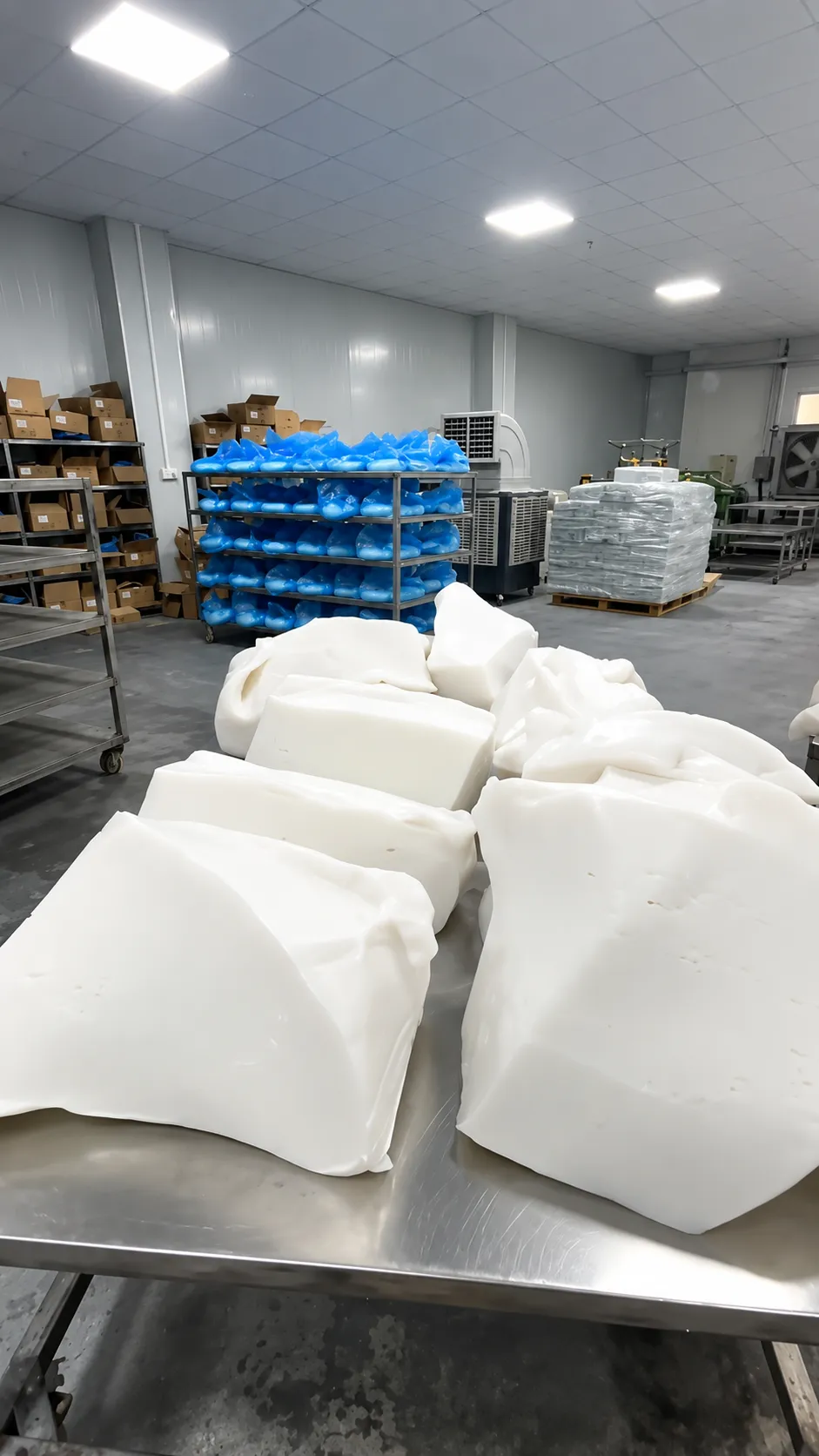
What Does HTV Silicone Processing Behavior Include?
When processors say one HTV silicone “runs better” than another, they may be referring to several different characteristics.
Polymer Molecular Weight Changes the Processing Feel
The silicone gum used in HTV silicone is normally a high-molecular-weight polymer. Its molecular weight has a major influence on uncured rheology.
A higher-molecular-weight gum can increase melt strength and elastic response. This may help an extruded profile maintain its shape, but it can also increase processing resistance and affect milling behavior.
A lower effective molecular weight or different molecular-weight distribution may make the compound feel easier to deform, but it can also alter die swell, extrusion stability and mechanical properties.
Therefore, two compounds can be adjusted to the same final Shore A hardness while still using polymer systems that respond differently under shear.
Vinyl Content Can Affect More Than Curing
Vinyl functionality in silicone gum is important in many HTV silicone formulations because it participates in crosslinking and can influence the way the polymer interacts with the curing system.
Different polymer architectures and vinyl levels can affect cure response, crosslink density and mechanical behavior after vulcanization.
They can also influence how the compound responds during mixing and processing when combined with different filler systems and cure packages.
This means two compounds with the same hardness may not have the same polymer architecture even if they appear similar on a basic technical datasheet.
Reinforcing Silica Has a Major Effect on Processing
Reinforcing silica is one of the most important ingredients in HTV silicone. It provides much of the tensile strength and tear resistance required for industrial applications, but it also strongly influences uncured processing behavior.
Different grades of silica can vary in surface area, particle structure, surface treatment and interaction with the silicone polymer.
| Silica Variable | Possible Processing Effect |
|---|---|
| Surface Area | Can change reinforcement, viscosity and polymer-filler interaction. |
| Surface Treatment | Can influence filler dispersion, structuring and processing stability. |
| Loading Level | Can increase hardness and reinforcement while also increasing processing resistance. |
| Dispersion Quality | Poor dispersion can create rough extrusion, inconsistent flow and local weak points. |
One HTV silicone may achieve 60 Shore A with one filler system, while another reaches the same hardness using a different balance of filler and polymer. Their processing behavior can therefore be very different.
Filler-Polymer Interaction Can Make a Compound Feel “Structured”
Silica does not behave like an inert powder inside silicone rubber. Its surface can interact strongly with the silicone polymer and with other formulation ingredients.
Over time, these interactions can create a more structured compound. Processors may experience this as increased stiffness, reduced ease of milling or a change in extrusion behavior after storage.
Processing aids and filler surface treatments are often used to control this interaction, but different formulations manage it differently.
As a result, two HTV silicone grades with identical hardness can still show different storage behavior, mill softening and extrusion pressure.
Processing Aids Can Change Milling and Extrusion Dramatically
Processing aids are added to HTV silicone to help control polymer-filler interaction and improve manufacturability.
They can influence roll release, tack, viscosity, extrusion surface and how easily the compound incorporates additional ingredients during final processing.
A compound with a carefully balanced processing-aid package may feel smoother and easier to handle even if its cured hardness is identical to another grade.
Heat Treatment During Compounding Matters
HTV silicone base compounds are often heat treated during manufacturing to help stabilize filler-polymer interactions and remove moisture or low-molecular-weight volatile materials.
The exact temperature, time and vacuum conditions depend on the formulation and production process.
If two compounds are manufactured using different heat-treatment strategies, their processing stability can differ even if their final hardness is the same.
Good heat-treatment control can help improve storage consistency, reduce unwanted structuring and create more repeatable extrusion or molding behavior.
Uncured Plasticity Is More Relevant to Processing Than Shore A
For many HTV/HCR compounds, uncured plasticity or viscosity provides more direct information about processing behavior than cured hardness.
Measurements such as Williams plasticity, Mooney viscosity or other rheological evaluations may be used depending on the compound and supplier.
These measurements help describe how the uncured material resists deformation before vulcanization.
| Propriedade | What It Tells You |
|---|---|
| Shore A Hardness | Firmness of the cured silicone rubber |
| Plasticity | Resistance of the uncured compound to deformation |
| Viscosity | Resistance to flow under defined conditions |
| Cure Curve | How crosslinking develops with time and temperature |
Two compounds can therefore have the same Shore A hardness but very different uncured plasticity.
Why Two HTV Silicone Grades Behave Differently on a Two-Roll Mill
Two-roll milling is one of the first places where processors notice differences between HTV silicone grades.
One material may band quickly and release cleanly, while another sticks more strongly, breaks unevenly or requires more time before it reaches a consistent processing condition.
These differences can come from polymer molecular weight, silica surface chemistry, processing aids, temperature, storage history and the amount of additional catalyst, pigment or additive introduced on the mill.
| Observed Behavior | Possible Contributing Factors |
|---|---|
| Strong Roll Tack | Polymer-filler interaction, processing-aid balance, roll temperature or formulation chemistry |
| Poor Banding | Plasticity, gum structure, temperature or compound history |
| Easy Release | Balanced rheology and controlled surface interaction |
| Slow Ingredient Incorporation | High viscosity, strong structuring or inadequate mill conditions |
Why the Same Hardness Can Extrude Differently
Extrusion places the silicone compound under continuous shear and pressure. Under these conditions, rheology becomes much more important than cured hardness.
One HTV silicone may feed smoothly, maintain stable pressure and produce a clean surface. Another may show unstable feeding, higher pressure, rougher surface or excessive die swell.
These differences are often caused by polymer elasticity, filler interaction and compound viscosity rather than by Shore A hardness.
Die Swell Is Not Predicted by Hardness
Die swell occurs when an elastomer expands after leaving an extrusion die. The polymer chains are deformed inside the die and then partially recover when the pressure is released.
Higher elastic recovery can produce more swell, which changes the final profile dimensions.
Two 60 Shore A HTV silicone compounds may therefore require different die dimensions or extrusion settings to produce the same finished profile.
This is particularly important for tubing, cable insulation and precision extruded profiles where dimensional control is critical.
Compression Molding Can Also Be Very Different
Equal-hardness HTV silicone grades can behave differently during compression molding because the uncured material must first deform and fill the mold cavity before vulcanization progresses.
A compound with lower flow under the molding conditions may require different preform size, pressure or temperature. Another compound may fill thin sections more easily but also show more flash.
The Curing System Changes Processing Behavior
HTV silicone can use different peroxide curing systems, and some high-consistency materials can also use platinum-catalyzed addition curing.
The cure package affects how quickly crosslinking begins as temperature increases. This influences scorch safety, mold flow, extrusion vulcanization and production cycle time.
Two materials with the same final hardness may use different curing chemistry or catalyst concentration, which can make their processing windows very different.
Functional Additives Can Change Processing
Many HTV silicone grades contain functional additives designed for specific applications.
Electrical compounds may contain fillers for tracking and erosion resistance. Flame-retardant silicone may use additional mineral or functional additives. Heat-resistant grades may contain thermal stabilizers. Food-contact grades may use a different formulation strategy altogether.
These additives can alter viscosity, density, filler interaction and cure behavior.
This means an electrical HTV silicone and a general-purpose HTV silicone can have the same hardness while processing very differently because the electrical grade carries a much more complex filler system.
Pigments Can Also Influence the Compound
Color is sometimes treated as purely cosmetic, but pigment masterbatches or color additives become part of the compound formulation.
Different pigment systems can influence viscosity, curing and mechanical properties, especially when used at higher concentrations or when the carrier material differs from the base compound.
For critical production, a grade approved in natural color should be validated again after significant pigment changes rather than assuming processing will remain exactly the same.
Storage History Can Change How HTV Silicone Feels
HTV silicone does not always behave identically from the first day after production to the end of its storage period.
Filler-polymer interactions can continue developing during storage. Temperature during storage can also influence how quickly these changes occur.
Some compounds may require milling or conditioning before processing to reach a stable state.
This is why processors comparing two materials should also consider production date, storage time and storage conditions rather than comparing only the grade names and hardness.
Batch History and Mixing Quality Matter
The way an HTV silicone compound is mixed can influence its final processing behavior.
Filler dispersion, mixing temperature, mixing energy, heat treatment and homogenization all affect how uniform the material becomes.
Poor dispersion may result in inconsistent viscosity, rough extrusion or unstable mechanical properties. Good batch control helps ensure that the material behaves similarly from lot to lot.
For industrial buyers, this is one reason supplier consistency can matter just as much as the nominal technical datasheet.
Same Hardness Does Not Mean the Same Mechanical Properties
Hardness also does not predict tensile strength, elongation or tear strength.
Two HTV silicone grades can both measure 60 Shore A but have very different mechanical-property profiles.
| Propriedade | Grade A | Grade B |
|---|---|---|
| Shore A Hardness | 60 | 60 |
| Resistência à tração | Can be optimized for general molding | Can be optimized for higher mechanical performance |
| Alongamento | May be moderate | May be significantly higher |
| Resistência ao rasgo | Standard | High-tear formulation possible |
| Processing Rheology | Optimized for molding | Optimized for extrusion |
This example illustrates why hardness alone cannot define the real performance of an HTV silicone compound.
Extrusion Grade and Molding Grade Can Share the Same Hardness
A very common example is the difference between an extrusion-grade HTV silicone and a compression-molding grade.
Both may be supplied at 50, 60 or 70 Shore A. But the extrusion grade may be designed for stable feed, smooth die flow and controlled swell, while the molding grade may be designed for cavity filling, release and short cycle time.
| Requirement | Extrusion Grade | Molding Grade |
|---|---|---|
| Feed Stability | Very important | Less important |
| Die Swell Control | Critical | Not a primary concern |
| Mold Flow | Secondary | Critical |
| Demolding | Not applicable to continuous extrusion | Important |
| Qualidade da superfície | Critical for profiles and cable | Depends on molded-part requirements |
Electrical HTV Silicone Is a Good Example
Electrical-grade HTV silicone often demonstrates why equal hardness does not equal equal processing.
A composite-insulator compound may contain a specialized filler system designed for tracking and erosion resistance. This can significantly change viscosity and molding behavior compared with a general-purpose silicone of the same hardness.
A cable grade may instead be optimized for continuous extrusion, dielectric properties and heat aging.
Both materials could be 60 Shore A, but they are designed around different processing and service requirements.
How to Compare Two HTV Silicone Grades Properly
If two materials have the same Shore A hardness but process differently, the comparison should move beyond hardness and look at the full compound profile.
Do Not Copy Processing Parameters from One Grade to Another
When changing HTV silicone suppliers or grades, processors often try to use exactly the same mill settings, extrusion speed, die design, curing temperature or molding cycle.
This can create unnecessary problems.
Even if the new material has the same hardness and similar mechanical properties, its rheology and curing behavior may require adjustments.
Extruder temperature, screw speed, die dimensions, mill gap, molding pressure or cure time may all need optimization for the new compound.
What Should Buyers Ask an HTV Silicone Supplier?
If processing consistency matters, the RFQ should include more than Shore A hardness.
HTV Silicone Compound Selection from Yakows
Yakows supplies HTV/HCR silicone rubber compounds for extrusion, compression molding, electrical insulation, composite insulators, wire and cable, EV systems, food-contact applications and industrial components.
When recommending an HTV silicone grade, hardness is only one part of the selection process. The processing method, uncured behavior, cure system, mechanical properties and end-use requirements all need to be considered together.
For customers replacing an existing material, it is particularly useful to provide both the target technical properties and information about current processing behavior. This helps distinguish whether the project needs only the same Shore A hardness or a truly comparable processing profile.
Perguntas frequentes
Why can two HTV silicone grades with the same hardness process differently?
Because Shore A hardness measures the cured rubber, while processing behavior depends on uncured rheology, polymer molecular weight, filler system, processing aids, curing chemistry and manufacturing history.
Does Shore A hardness tell me silicone viscosity?
No. Two compounds with the same Shore A hardness can have very different uncured viscosity or plasticity.
Why does one HTV silicone stick more to the rolls?
Roll tack can be influenced by polymer structure, filler interaction, processing aids, roll temperature, compound history and formulation chemistry.
Why does one silicone grade have more die swell?
Die swell is strongly influenced by polymer elasticity, molecular structure and compound rheology rather than cured hardness alone.
Can extrusion and molding grades have the same Shore A?
Yes. They can have the same cured hardness while being formulated for very different uncured flow and processing behavior.
Does filler type affect HTV silicone processing?
Yes. Silica type, surface treatment, loading and dispersion strongly influence viscosity, structuring, extrusion and milling behavior.
Can storage change HTV silicone processing?
Yes. Filler-polymer interaction can continue during storage, and storage temperature or age can affect how the compound feels during processing.
Should I use the same processing settings when changing HTV silicone grades?
Not automatically. A new grade may require changes to milling, extrusion, molding or curing parameters even if the Shore A hardness is the same.
What should I compare besides hardness?
Compare uncured plasticity, rheology, cure behavior, tensile strength, elongation, tear strength, filler system and actual performance on your production equipment.