
HTV SILICONE · MATERIAL SELECTION GUIDE
Choosing the Right HTV Silicone Rubber Grade for Your Application
HTV silicone is available in different material grades designed to meet specific mechanical, chemical and appearance requirements. While general-purpose HTV silicone rubber is suitable for many industrial applications, specialized components may require higher tear strength, increased hardness, improved oil resistance or better resistance to yellowing.
Selecting the correct HTV silicone rubber grade is important for manufacturers producing molded seals, gaskets, industrial components, extruded profiles and electrical insulation products. A material that performs well in one application may not provide the required durability or processing behavior in another.
This guide compares four specialized HTV silicone rubber grades, explains their performance characteristics and applications, and provides practical guidance for choosing the right silicone compound according to product design, operating conditions and manufacturing requirements.
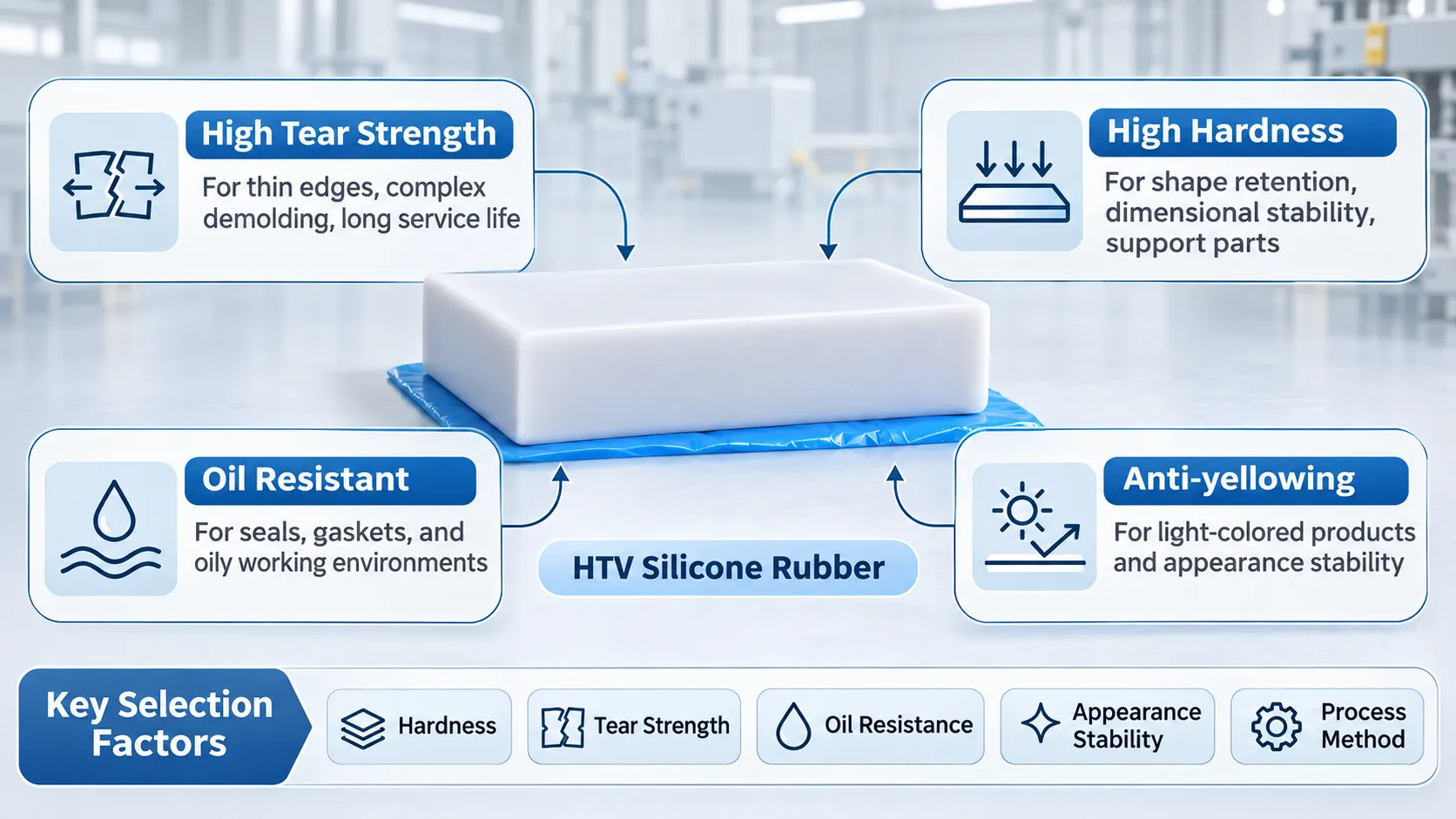
YAKOWS · HTV / HCR SILICONE RUBBER
Specialized HTV Silicone Rubber Grades for Industrial Manufacturing
Yakows supplies solid HTV/HCR silicone rubber compounds for different industrial manufacturing requirements. Material selection can be tailored around mechanical strength, hardness, environmental exposure, appearance and processing conditions.
High Tear Strength HTV Silicone
Designed for components requiring improved resistance to tearing during molding, demolding, handling and repeated mechanical stress.
High Hardness HTV Silicone
For molded and extruded components requiring a firmer material structure, dimensional stability and controlled deformation.
Oil Resistant HTV Silicone
Specialized formulations for applications involving oil exposure, where fluid compatibility and mechanical property retention must be evaluated.
High Anti-Yellowing HTV Silicone
Formulated for improved color stability in white, transparent, light-colored and appearance-sensitive silicone products.
Not sure which HTV silicone grade matches your product requirements?
1. Why Does HTV Silicone Grade Selection Matter?
HTV silicone rubber, also known as High Consistency Rubber (HCR), is a solid silicone compound that can be processed through compression molding, transfer molding, injection molding and extrusion.
Although different HTV compounds may share the same basic silicone polymer family, their final properties can vary significantly according to polymer characteristics, reinforcing silica, curing systems and functional additives.
For example, a manufacturer producing a thin-walled molded component may prioritize tear strength, while a manufacturer producing rigid rubber parts may require higher hardness. Components exposed to industrial oils need a different compatibility assessment from products designed to maintain a white or transparent appearance.
Four Important Performance Requirements
| HTV Silicone Grade | Main Performance Focus | Typical Application Requirements |
|---|---|---|
| High Tear Strength | Resistance to tear propagation. | Thin sections, complex shapes and demanding demolding conditions. |
| High Hardness | Greater resistance to indentation and deformation. | Firmer molded components and dimensionally stable profiles. |
| Oil Resistant | Compatibility with specified oils and fluid exposure. | Oil-exposed industrial components and sealing applications. |
| High Anti-Yellowing | Improved color stability and reduced yellowing. | White, light-colored and appearance-sensitive products. |
These grades should not be viewed as mutually exclusive categories. Depending on the formulation, multiple performance requirements may be combined into one customized HTV silicone compound.
2. High Tear Strength HTV Silicone: For Demanding Mechanical Applications
High tear strength HTV silicone is developed for silicone rubber components that require greater resistance to crack initiation and tear propagation. This is particularly important when products have thin sections, sharp corners, complex geometries or repeated mechanical loading.
Why Is Tear Strength Important?
During manufacturing, silicone rubber components are exposed to forces during mold filling, curing, demolding and handling. Thin edges and narrow sections can be particularly vulnerable to tearing if the compound does not provide sufficient resistance.
In service, repeated bending, stretching, compression and mechanical contact can also contribute to crack development. A suitable high tear strength compound can help improve the durability of components under these conditions.
How Is High Tear Strength Achieved?
The tear resistance of HTV silicone rubber is influenced by polymer molecular characteristics, reinforcing silica, filler dispersion, crosslink density and curing conditions.
Reinforcing silica plays an important role in improving mechanical properties. Its type, loading and dispersion affect the interaction between the filler and silicone polymer matrix.
Formulation optimization is necessary because increasing one mechanical property does not automatically improve every other property. Tear strength should be evaluated alongside tensile strength, elongation, hardness and processing behavior.
Aplicações típicas
- Thin-walled molded silicone rubber components.
- Complex molded seals and gaskets.
- Industrial rubber profiles with narrow sections.
- Flexible components subject to repeated bending.
- Silicone components requiring reliable demolding.
- Electrical insulation components with complex molded geometries.
What Should Buyers Check?
When purchasing high tear strength HTV silicone, do not evaluate the material using tensile strength alone. Request tear strength data using a defined test specimen and method, and compare elongation, hardness and curing characteristics as well.
ASTM D624 is commonly used to evaluate tear strength of conventional vulcanized rubber and thermoplastic elastomers, while ASTM D412 covers tensile properties.
3. High Hardness HTV Silicone: For Greater Firmness and Dimensional Stability
High hardness HTV silicone is selected when a finished component needs a firmer structure and greater resistance to indentation or deformation under a specified load.
Hardness is commonly measured using the Shore A scale. For silicone rubber, the appropriate hardness depends on the component geometry, compression requirements, installation conditions and mechanical loading.
What Does Higher Shore A Hardness Mean?
A higher Shore A value generally indicates a firmer material that offers greater resistance to indentation under the specified test conditions.
For industrial components, this can be useful when the design requires a stable shape, controlled compression or reduced surface deformation.
However, high hardness does not automatically mean higher tensile strength, tear strength or longer service life. These properties must be evaluated independently.
How Is High Hardness HTV Formulated?
Hardness can be adjusted through polymer selection, reinforcing filler loading, formulation balance and curing conditions.
The objective is to achieve the required hardness without compromising important properties such as elongation, tear resistance, processability and compression performance.
Aplicações típicas
- Firm molded industrial rubber components.
- Structural rubber parts requiring controlled deformation.
- Protective rubber components and housings.
- Selected high-hardness sealing applications.
- Custom extruded profiles requiring a specific material firmness.
How to Choose the Correct Hardness
Start with the finished component's function rather than selecting the highest available Shore A value.
For sealing products, excessively high hardness may reduce the ability of a component to conform to mating surfaces. For molded parts, an unsuitable hardness may also affect demolding, flexibility and installation.
Request Shore A hardness data, tensile strength, elongation, compression set and actual sample evaluation before confirming a grade.
4. Oil Resistant HTV Silicone: For Oil-Exposed Industrial Components
Oil resistant HTV silicone is intended for applications where silicone rubber components may come into contact with lubricating oils, industrial fluids or other specified oil-based media.
Oil resistance is a formulation-specific property. Standard silicone rubber should not automatically be considered suitable for every petroleum-based oil, fuel or solvent.
Why Does Oil Compatibility Matter?
When rubber is exposed to an incompatible fluid, it may absorb liquid and experience swelling, dimensional changes, softening or deterioration in mechanical performance.
For sealing components, these changes can affect contact pressure, dimensional accuracy and sealing reliability.
Oil compatibility should therefore be evaluated according to the actual fluid, concentration, operating temperature and duration of exposure.
What Makes an Oil Resistant Silicone Grade Different?
Specialized oil-resistant silicone formulations are developed to improve performance in defined fluid environments. Polymer selection, formulation design and curing characteristics all influence the final compatibility.
However, there is no single oil-resistant formulation that is suitable for every type of oil. Mineral oils, synthetic lubricants, hydraulic fluids, fuels and specialty industrial oils can behave differently when in contact with an elastomer.
Aplicações típicas
- Industrial seals exposed to specified lubricating oils.
- Selected equipment gaskets and molded components.
- Industrial rubber parts requiring controlled fluid compatibility.
- Oil-exposed components operating under elevated temperatures.
- Specialized equipment accessories and protective parts.
Important: Verify the Actual Oil Type
For applications involving petroleum oils or fuels, standard VMQ silicone may not provide sufficient resistance. Depending on the exposure, specialized fluorosilicone (FVMQ), NBR or FKM may be more appropriate alternatives.
When comparing an oil-resistant HTV silicone grade, request immersion test results using the actual oil or a representative test fluid. Evaluate volume change, mass change, hardness variation, tensile strength and elongation retention after exposure.
ASTM D471 and ISO 1817 provide commonly used methods for evaluating the effect of liquids on rubber. The selected test fluid and conditions should match the intended application as closely as possible.
5. High Anti-Yellowing HTV Silicone: For Better Color Stability
High anti-yellowing HTV silicone is developed for applications where maintaining the original color and appearance of silicone rubber is important.
White, transparent and light-colored silicone products can be particularly sensitive to visible color changes during processing, heat exposure, UV exposure and long-term use.
Why Does Silicone Rubber Turn Yellow?
Yellowing can be associated with several factors, including thermal exposure, UV radiation, formulation chemistry, impurities, curing conditions and interactions between additives.
In some cases, discoloration may become more visible in white and transparent silicone products, even when their basic mechanical performance remains acceptable.
How Does Anti-Yellowing HTV Silicone Improve Color Stability?
Anti-yellowing formulations are designed to improve resistance to unwanted color changes through appropriate polymer selection, additive control and curing-system optimization.
Material cleanliness, filler quality, pigment compatibility and processing conditions also contribute to final appearance.
For products exposed to sunlight or outdoor environments, UV stability should be evaluated separately from heat-related yellowing resistance. A material that maintains its color under thermal aging is not automatically resistant to every outdoor weathering condition.
Aplicações típicas
- White silicone rubber molded components.
- Transparent and translucent silicone products.
- Light-colored industrial seals and gaskets.
- Consumer and household silicone components.
- Appearance-sensitive silicone parts requiring stable color.
What Should Manufacturers Evaluate?
Color stability should be assessed before and after the relevant aging conditions. Depending on the application, this may include heat aging, UV exposure and actual production trials.
Color measurements using the CIELAB color system can help quantify changes rather than relying only on visual inspection.
For white or transparent products, manufacturers should also evaluate pigment compatibility, curing residues, surface appearance and batch-to-batch color consistency.
6. Comparison of Four Specialized HTV Silicone Rubber Grades
The following comparison summarizes the main performance differences and helps manufacturers identify which material direction should be evaluated first.
| Performance Grade | Primary Advantage | Important Parameters | Suitable Applications |
|---|---|---|---|
| High Tear Strength | Improved resistance to tear propagation. | Tear strength, tensile strength, elongation and hardness. | Complex molded components, thin sections and flexible profiles. |
| High Hardness | Greater firmness and indentation resistance. | Shore A hardness, tensile strength, elongation and compression set. | Firm molded parts, housings and dimensionally controlled components. |
| Oil Resistant | Improved compatibility with specified oils. | Volume change, mass change, hardness variation and tensile retention. | Oil-exposed seals and industrial components. |
| High Anti-Yellowing | Improved color stability. | Color change, heat aging, UV aging and appearance consistency. | White, transparent and light-colored silicone products. |
Can These Properties Be Combined?
Yes. HTV silicone formulations can be developed to balance multiple performance requirements.
For example, an industrial molded component may require high tear strength and high hardness. A white silicone component may need anti-yellowing performance together with specific mechanical properties.
However, improving one property can influence others. High hardness may affect flexibility, while specialized additives can change processing behavior or mechanical performance. Oil resistance and color stability also require separate validation.
The most suitable grade is therefore the formulation that meets the complete set of application requirements rather than simply achieving the highest value in one test.
7. How to Choose the Right HTV Silicone Grade
Before selecting an HTV silicone rubber compound, manufacturers should evaluate the finished product, operating environment and manufacturing process together.
Step 1: Identify the Main Performance Requirement
Determine which property is most critical. Is the component likely to tear during demolding? Does it require a firm structure? Will it contact oil? Does it need to maintain a white or transparent appearance?
Step 2: Define the Required Technical Parameters
Translate the application requirements into measurable specifications.
- Hardness: target Shore A value and tolerance.
- Tear resistance: minimum tear strength and test method.
- Mechanical performance: tensile strength and elongation.
- Oil resistance: specified oil type, temperature and exposure duration.
- Color stability: acceptable color variation after aging.
- Service conditions: temperature, UV, ozone and humidity exposure.
Step 3: Consider the Manufacturing Process
HTV silicone compounds may be used in compression molding, transfer molding, injection molding and extrusion. Each process has different requirements for material plasticity, flow, curing behavior and dimensional control.
For example, a high tear strength grade may be particularly useful for complex mold geometries, while an extruded profile may require a balance between material firmness, surface quality and dimensional stability.
Step 4: Evaluate Actual Operating Conditions
Laboratory properties are important, but the actual operating environment can change material performance.
Evaluate continuous temperature, peak temperature, mechanical stress, oil exposure, weathering and product lifespan. For specialized compounds, test the material under representative service conditions.
Step 5: Request Samples and Conduct Production Trials
A technical datasheet is useful for initial screening, but sample testing is necessary to verify whether the material works with the manufacturer's equipment and product design.
Check mold filling, curing, demolding, finished dimensions, surface quality and the required mechanical or environmental properties.
8. HTV Silicone Processing and Manufacturing Considerations
The performance of an HTV silicone rubber grade depends not only on its formulation but also on processing conditions. Incorrect curing, poor dispersion or unsuitable production parameters may affect the finished component.
Moldagem por compressão
Compression molding is widely used for seals, gaskets, molded industrial components and silicone insulation parts. Preform weight, mold temperature, pressure, venting and curing time should be controlled.
Injection and Transfer Molding
These processes can be used for more complex components and production environments requiring controlled material distribution. Compound plasticity, mold filling and curing behavior should be matched to the equipment.
Extrusão
HTV silicone rubber extrusion is used to manufacture continuous profiles, tubing, cords and insulating sleeves. Material consistency, die design, extrusion speed and curing conditions influence dimensional accuracy and surface quality.
Why Grade-Specific Processing Trials Matter
Different HTV grades may behave differently during production, even when they have similar hardness values. High filler loading, specialized additives and different curing systems can influence processing behavior.
Manufacturers should therefore confirm the processing window of each grade rather than applying the same production settings to every compound.
9. What to Check Before Buying HTV Silicone Rubber
When sourcing HTV silicone rubber for OEM manufacturing, buyers should evaluate both material performance and supplier capability.
| Evaluation Item | What to Request | Por que isso é importante |
|---|---|---|
| Technical Datasheet | Hardness, tensile strength, elongation and tear strength. | Confirms the basic material specification. |
| Special Performance Data | Oil immersion results, aging tests and color stability data. | Verifies application-specific performance. |
| Processing Information | Curing recommendations, processing method and handling guidance. | Helps match the material to production equipment. |
| Quality Documentation | TDS, SDS, COA and batch identification. | Supports material traceability and quality control. |
| Sample Support | Trial samples and technical assistance. | Allows real production validation before bulk orders. |
| Supply Capability | Production capacity, packaging and delivery arrangements. | Supports stable OEM and repeat-order supply. |
Information to Include in Your HTV Silicone RFQ
- Finished product name and application.
- Required HTV silicone grade or special performance.
- Target hardness and tolerance.
- Required tensile and tear strength.
- Oil type and exposure conditions, if applicable.
- Color and anti-yellowing requirements, if applicable.
- Compression molding, injection molding or extrusion process.
- Estimated monthly or annual consumption.
- Sample quantity and delivery destination.
YAKOWS · HTV / HCR SILICONE RUBBER MANUFACTURER
Need a Customized HTV Silicone Rubber Grade?
Yakows provides HTV/HCR silicone rubber compounds for industrial molding, extrusion, sealing and specialized applications.
Whether your project requires high tear strength, high hardness, oil resistance or improved anti-yellowing performance, our team can help evaluate the material requirements and suitable formulation direction.
Send us your target specifications, product application and manufacturing process to discuss material selection, technical documentation and sample evaluation.
Request a Quote & Technical Support →
E-mail: info@yakows.com
Frequently Asked Questions About HTV Silicone
What is HTV silicone rubber?
HTV silicone rubber, also called High Consistency Rubber (HCR), is a solid silicone compound that is heat-cured to form an elastic material. It is commonly used in compression molding, transfer molding, injection molding and extrusion.
What are the main grades of HTV silicone rubber?
HTV silicone rubber is available in general-purpose and specialized grades, including high tear strength, high hardness, oil-resistant and anti-yellowing formulations. The correct grade depends on the mechanical, chemical, appearance and processing requirements of the finished product.
What is high tear strength HTV silicone used for?
High tear strength HTV silicone is used for components requiring improved resistance to tearing during demolding, handling or service. Typical applications include complex molded parts, thin-walled components and flexible industrial profiles.
What hardness is available for HTV silicone rubber?
HTV silicone rubber can be formulated across a wide Shore A hardness range, depending on the polymer, filler system and formulation. The correct hardness should be selected according to the component's flexibility, deformation and mechanical requirements.
Is HTV silicone rubber resistant to oil?
Oil resistance depends on the specific silicone formulation and the type of oil. Standard silicone rubber should not be assumed to resist all petroleum oils or fuels. Oil-resistant grades must be evaluated using the actual fluid and operating conditions.
What is anti-yellowing silicone rubber?
Anti-yellowing silicone rubber is formulated to improve color stability and reduce unwanted discoloration under defined conditions such as heat exposure and aging. UV resistance should be evaluated separately for outdoor applications.
Can different HTV silicone properties be combined?
Yes. Specialized formulations can be designed to balance multiple properties, such as high tear strength and high hardness or mechanical performance and color stability. The final formulation must be validated against the full set of application requirements.
How do I choose the right HTV silicone rubber grade?
Start with the finished product's application, required hardness, mechanical performance, temperature and environmental exposure. For oil-resistant products, specify the oil type. For anti-yellowing products, define the acceptable color change and aging conditions. Sample testing is recommended before bulk production.
Can HTV silicone rubber be customized for OEM manufacturing?
Yes. HTV silicone compounds can be developed around specified hardness, mechanical properties, color, curing behavior and processing requirements. Manufacturers should provide the product design, target specifications and production method when requesting a customized grade.