
Material Safety Guide
O silicone é mais seguro do que o plástico?
Silicone and plastic are used in food containers, baby products, kitchen tools, medical components, seals and everyday household products. Silicone is often promoted as a safer alternative to plastic, but the answer depends on material quality, formulation, temperature, product design and intended use. This guide explains the differences between silicone and plastic so buyers can make a more informed decision.
Is Silicone Safer Than Plastic? The Quick Answer
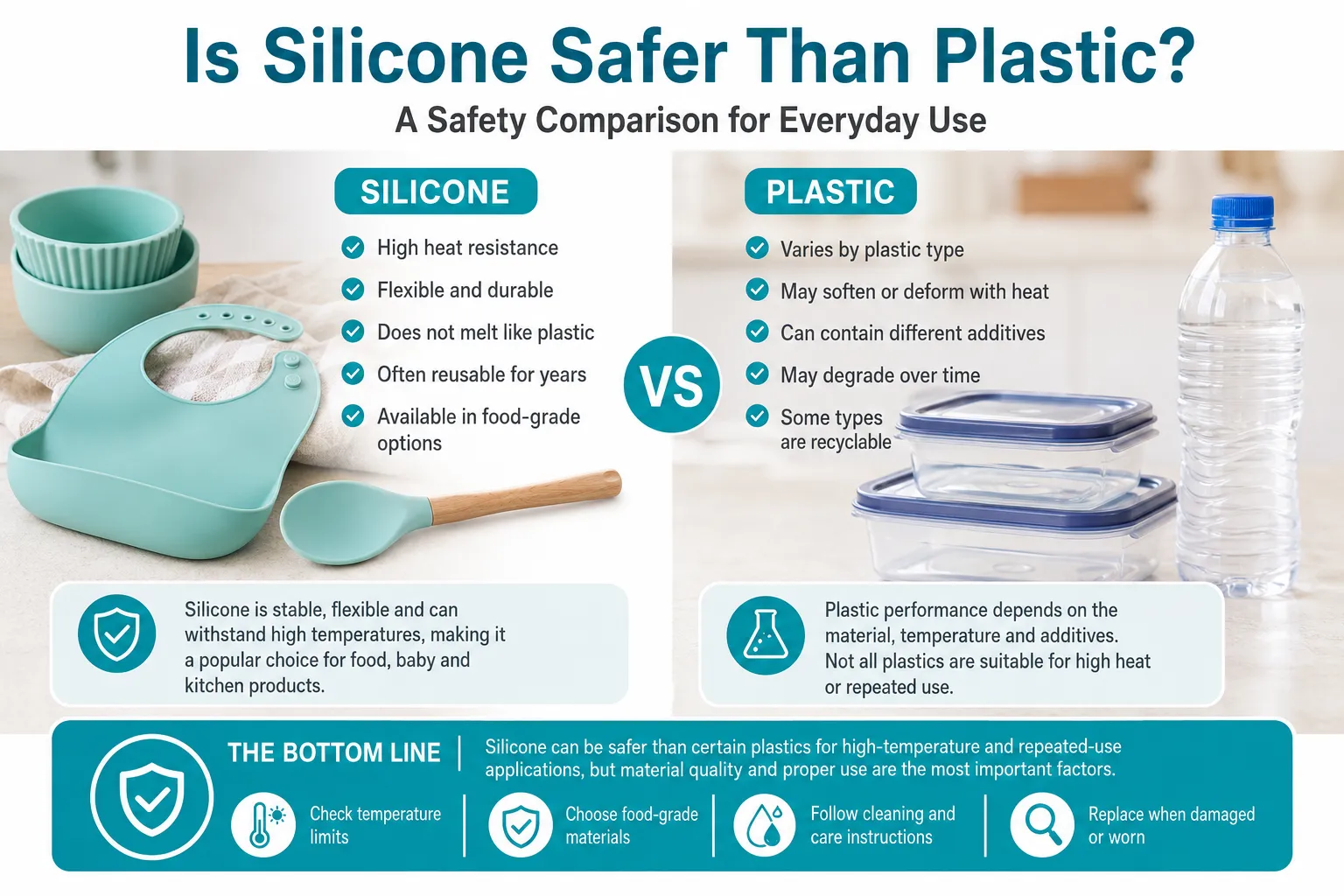
High-quality silicone can be a safer and more durable choice than some plastics in applications involving heat, repeated use and flexibility. However, silicone is not automatically safer simply because a product is labeled as silicone.
The safety of any material depends on its formulation, manufacturing quality, additives, operating temperature and whether it is suitable for the intended application. A properly specified food-contact plastic may be safer than an unknown or poorly manufactured silicone product.
Silicone rubber is often preferred for baking tools, seals, flexible containers and reusable kitchen products because it can tolerate higher temperatures and does not soften in the same way as many thermoplastics. Plastic may still be the better choice where rigidity, transparency, low weight, recycling access or lower cost is important.
Simple Conclusion
Silicone can be safer than certain plastics for high-temperature and repeated-use applications, but material grade and product quality matter more than the word silicone or plastic on the package.
What Is Silicone?
To understand the comparison, it is important to first answer what is silicone. Silicone is a family of synthetic polymers built around a silicon-oxygen backbone. Organic groups are attached to this backbone to create fluids, gels, resins, sealants and flexible elastomers.
Silicone rubber is the cured, elastic form of silicone. It is commonly used for gaskets, tubing, kitchen tools, medical parts, electrical insulation, baby products and industrial components.
When silicone rubber is cured, polymer chains become crosslinked. This creates a flexible three-dimensional structure that does not melt and reshape like a conventional thermoplastic. At extreme temperatures, cured silicone may eventually lose strength or degrade, but it does not normally flow like softened plastic.
Is Silicone a Plastic?
A common question is is silicone a plastic. Silicone is a polymer, but flexible cured silicone is generally classified as an elastomer rather than a conventional plastic.
Most everyday plastics are thermoplastics. They soften when heated and can often be remolded. A silicone elastomer behaves more like rubber because it stretches, compresses and returns toward its original shape.
Although silicone and plastic are both manufactured polymer materials, their molecular structure, temperature response and physical behavior are different.
What Is a Silicone Elastomer?
A silicone elastomer is a crosslinked silicone material with rubber-like properties. It may be soft and flexible or relatively firm, depending on the formulation and hardness.
Silicone elastomers can be supplied as sheets, tubes, seals, molded components, foam products and liquid-molded parts. Specialty formulations may provide flame resistance, thermal conductivity, electrical conductivity or improved tear strength.
What Is Plastic?
Plastic is a broad term covering many synthetic and semi-synthetic polymer materials. Common examples include polyethylene, polypropylene, polycarbonate, PVC, PET, nylon and ABS.
Different plastics have very different properties. Some are designed for disposable packaging, while others are engineered for high-temperature mechanical components. It is therefore inaccurate to treat all plastics as one material with the same safety profile.
Plastic products may contain pigments, stabilizers, plasticizers, processing aids or other additives. The type and quantity of these ingredients depend on the polymer, manufacturing process and intended use.
Why Plastic Is So Common
Plastic is widely used because it is lightweight, economical and easy to form into complex shapes. It can be rigid, flexible, transparent, impact-resistant or chemically resistant.
For packaging and mass-produced consumer goods, plastic often provides a lower-cost solution than silicone. However, some plastics may deform, become brittle or lose performance when exposed to high heat, sunlight or repeated cleaning.
Silicone vs Plastic Safety Comparison
The question of whether silicone is safer than plastic should be evaluated through several factors rather than a single label. These factors include temperature resistance, chemical stability, additives, durability and product certification.
Estabilidade química
Silicone is known for good environmental and chemical stability. It performs well against moisture, ozone, sunlight and many common household conditions.
However, silicone is not resistant to every oil, fuel, solvent or chemical. Swelling and property loss may occur if the wrong silicone formulation is used.
Plastic performance also varies. Polypropylene may perform well in one application, while PVC, polycarbonate or another polymer may be selected for completely different conditions.
Material Additives
Neither silicone nor plastic should be evaluated only by its base polymer. Fillers, colorants, curing agents and manufacturing residues can affect final product quality.
A high-quality silicone product should be made from a controlled formulation appropriate for its use. Low-quality products may contain excessive filler or unknown additives that reduce strength, flexibility and long-term stability.
Similarly, plastic safety depends on the resin grade, additives, manufacturing process and whether the finished product is designed for food, medical, industrial or general consumer use.
Odor and Residues
New silicone products may sometimes have a noticeable odor. This can result from processing residues, packaging or the curing system. A strong or persistent odor may indicate that the product has not been fully processed or is not appropriate for sensitive applications.
Plastic products may also release odor, particularly when heated or newly manufactured. Consumers should follow cleaning and use instructions and avoid products that develop unusual odors, surface changes or deformation.
Is Silicone Safer Than Plastic for Food Use?
Food containers, baking molds, spatulas, storage bags and bottle components are common areas where silicone and plastic are compared.
High-quality food-contact silicone is often selected because it remains flexible, resists heat and can be reused many times. It is especially useful for baking accessories, seals, lids and products that require repeated bending.
Food-contact plastics can also be suitable when they are used within their intended temperature and service conditions. Polypropylene, for example, is commonly used in reusable containers because it is lightweight and relatively heat resistant compared with some other plastics.
Silicone de qualidade alimentar
The term food-grade silicone generally describes silicone material manufactured for food-contact applications. However, the phrase alone does not provide complete information about the formulation, testing or manufacturing quality.
Buyers should look for clear product specifications, a known manufacturer and instructions covering temperature, cleaning and intended use. Products intended for food contact should not be replaced with general-purpose construction silicone or unknown industrial compounds.
Silicone Baking Products
Silicone baking molds and mats are popular because they are flexible and easy to release. They should be placed on a stable tray when necessary and used within the manufacturer's temperature recommendations.
Do not place silicone products directly against heating elements or open flames unless they are specifically designed for that purpose. High temperature resistance does not mean unlimited heat resistance.
Plastic Food Containers
Plastic food containers should be matched to their intended use. A container designed for cold storage may not be appropriate for microwave heating, boiling liquids or oven use.
Containers that become scratched, warped, cracked or discolored should be inspected and replaced when necessary. Damage can make cleaning more difficult and may reduce product performance.
Silicone and Plastic Temperature Resistance
Temperature resistance is one of the most important differences between silicone and plastic. Silicone rubber generally retains flexibility across a wider temperature range than many common consumer plastics.
Does Silicone Melt?
Cured silicone rubber does not normally have a conventional melting point. Because it is crosslinked, it does not melt and flow like a thermoplastic.
At excessive temperatures, silicone may soften, lose mechanical strength, discolor or eventually decompose. The safe operating range depends on formulation, thickness, exposure time and environment.
Plastic Softening and Deformation
Thermoplastic materials can soften or deform when heated. The temperature at which this occurs varies widely among different plastics.
Some engineering plastics can handle elevated temperatures, while lightweight packaging plastics may deform under hot water or direct heating. Products should only be used within their specified temperature range.
Cold-Temperature Performance
Silicone rubber often remains flexible in cold environments where some plastics and traditional rubbers become hard or brittle. This makes silicone useful in freezer seals, outdoor products and cold-climate equipment.
Rubber vs Silicone vs Plastic
The comparison of rubber vs silicone is different from silicone versus plastic. Silicone rubber is an elastomer, but it is not the same as natural rubber, nitrile rubber, EPDM or neoprene.
Traditional rubbers may offer better abrasion resistance, oil resistance or lower cost. Silicone usually provides better heat resistance, weather stability and low-temperature flexibility.
Plastic is generally less elastic than rubber or silicone, although flexible plastics can be produced with different formulations and additives.
Borracha de silicone
Best suited for temperature resistance, flexibility, weather exposure and repeated sealing applications.
Traditional Rubber
Often selected for abrasion, oil resistance, mechanical strength or economical industrial sealing.
Plastic
Useful for rigid containers, structural components, packaging, transparency and high-volume production.
Performance Silicones
Specialized grades can provide thermal conductivity, flame resistance, electrical conductivity or medical-use characteristics.
Is Silicone More Durable Than Plastic?
Silicone can be more durable than plastic in applications involving bending, heat, sunlight and temperature cycling. Its elastic structure allows it to recover after compression and deformation.
However, silicone is softer than many rigid plastics. It can be cut, punctured or torn by sharp objects. Its surface may also attract dust or become damaged by aggressive cleaning tools.
Rigid plastic may be more appropriate for products that require structural strength, hard surfaces or precise shape retention. Durability should therefore be evaluated according to how the product will actually be used.
Hard Silicone
Hard silicone has a higher hardness and provides better shape retention than soft silicone. It may be used for firm seals, plugs, industrial components and molded parts.
Higher hardness does not automatically mean greater tear resistance or longer service life. A balanced formulation must also consider elongation, tensile strength and compression set.
Is Silicone Better Than Plastic for the Environment?
Silicone is often promoted as an environmentally friendly alternative because reusable silicone products may last longer than disposable plastic items. A long service life can reduce the frequency of replacement.
However, silicone is still an industrially manufactured material. It does not naturally disappear after disposal, and recycling options may be limited in many locations.
Plastic recycling availability depends on the polymer type, product design, contamination and local waste systems. Some plastic materials have established collection streams, while mixed-material products may be difficult to recycle.
The most environmentally responsible choice is often a durable product that is used correctly for a long time. Replacing a functional plastic product with a new silicone product does not automatically reduce environmental impact.
Reusable vs Disposable Products
A reusable silicone bag may reduce the use of disposable bags when it is cleaned and reused many times. A durable plastic container may offer a similar benefit if it remains safe and functional for long-term use.
Product lifespan, manufacturing quality and actual user behavior are important when comparing environmental performance.
How to Choose Between Silicone and Plastic
1. Check the Intended Use
Determine whether the product will be used for food, medical contact, industrial sealing, storage, heating or general household use.
2. Review Temperature Limits
Choose silicone for repeated high- or low-temperature exposure when its specified operating range matches the application.
3. Evaluate Flexibility
Silicone is useful for seals, collapsible containers and flexible components. Plastic is often better for rigid shapes and structural parts.
4. Confirm Material Grade
Look for clear information about the formulation, intended use, manufacturer and applicable product requirements.
5. Inspect Product Quality
Avoid products with strong unexplained odors, sticky surfaces, cracks, poor molding or incomplete labeling.
6. Consider Cleaning
Select a material that can tolerate the required washing, sterilization or cleaning process without damage.
7. Think About Service Life
A more durable reusable product may provide better value and generate less waste than a frequently replaced item.
8. Follow Use Instructions
Do not assume every silicone or plastic product is suitable for ovens, microwaves, boiling water, freezers or food contact.
Perguntas frequentes
Is silicone always safer than plastic?
No. Safety depends on the material grade, additives, manufacturing quality, temperature and intended application.
Is silicone a type of plastic?
Silicone is a polymer, but cured flexible silicone is usually classified as an elastomer rather than a conventional thermoplastic.
Is silicone safer for hot food?
Properly specified food-contact silicone can be suitable for hot-food applications because of its temperature resistance. Always follow the product's temperature and use instructions.
Can silicone release chemicals when heated?
Material behavior depends on formulation and temperature. Use products from reliable manufacturers and do not exceed the stated operating limits.
Does silicone contain plasticizers?
Silicone rubber does not normally rely on the same plasticizer systems used in some flexible plastics, but it may contain fillers, pigments and other formulation additives.
Which is better for reusable food containers?
Silicone offers flexibility and heat resistance, while plastic offers rigidity and lower weight. The better choice depends on product quality and intended use.
When should silicone products be replaced?
Replace them when they become torn, sticky, permanently discolored, difficult to clean or visibly degraded.
Choose the Material, Not Just the Label
Silicone can be safer than certain plastics in applications involving heat, repeated use, flexibility and outdoor exposure. However, silicone is not automatically safe, and plastic is not automatically harmful.
The best choice depends on formulation, product quality, temperature, cleaning requirements and intended use. By checking material specifications and following manufacturer instructions, consumers and industrial buyers can select products that provide better safety, performance and service life.