
8 Steps in the HTV Silicone Rubber Manufacturing Process
HTV silicone rubber is not made by simply mixing silicone gum with a curing agent. A finished high-consistency silicone compound is the result of controlled polymer selection, filler reinforcement, intensive mixing, heat treatment, additive adjustment, filtration and quality testing. Each stage affects how the material behaves during extrusion, compression molding or injection molding—and how the finished rubber part performs after curing.
This article follows the manufacturing process from raw silicone gum to a finished HTV compound and explains why each stage matters for properties such as hardness, tensile strength, tear resistance, heat aging, electrical insulation and processing consistency.
Что такое силиконовый каучук HTV?
HTV stands for high-temperature vulcanizing. In industrial use, the term generally refers to high-consistency silicone rubber supplied as a solid, gum-like compound and cured at elevated temperature.
HTV is closely related to the term HCR, or high consistency rubber. In many commercial and technical contexts, HTV silicone rubber and HCR silicone rubber refer to the same broad material family, although terminology can vary between manufacturers.
Unlike liquid silicone rubber, which is pumpable and normally processed using liquid injection molding equipment, HTV has a much higher viscosity. Before curing, it resembles a dense rubber compound and can be processed by compression molding, transfer molding, extrusion, calendering and suitable injection-molding processes.
| Материал | Typical Uncured Form | Common Processing |
|---|---|---|
| HTV / HCR Silicone | High-viscosity gum-like compound | Compression molding, extrusion, transfer molding, calendering |
| LSR | Two-part flowable liquid | Liquid injection molding |
| RTV | Liquid or paste | Dispensing, casting, sealing or potting |
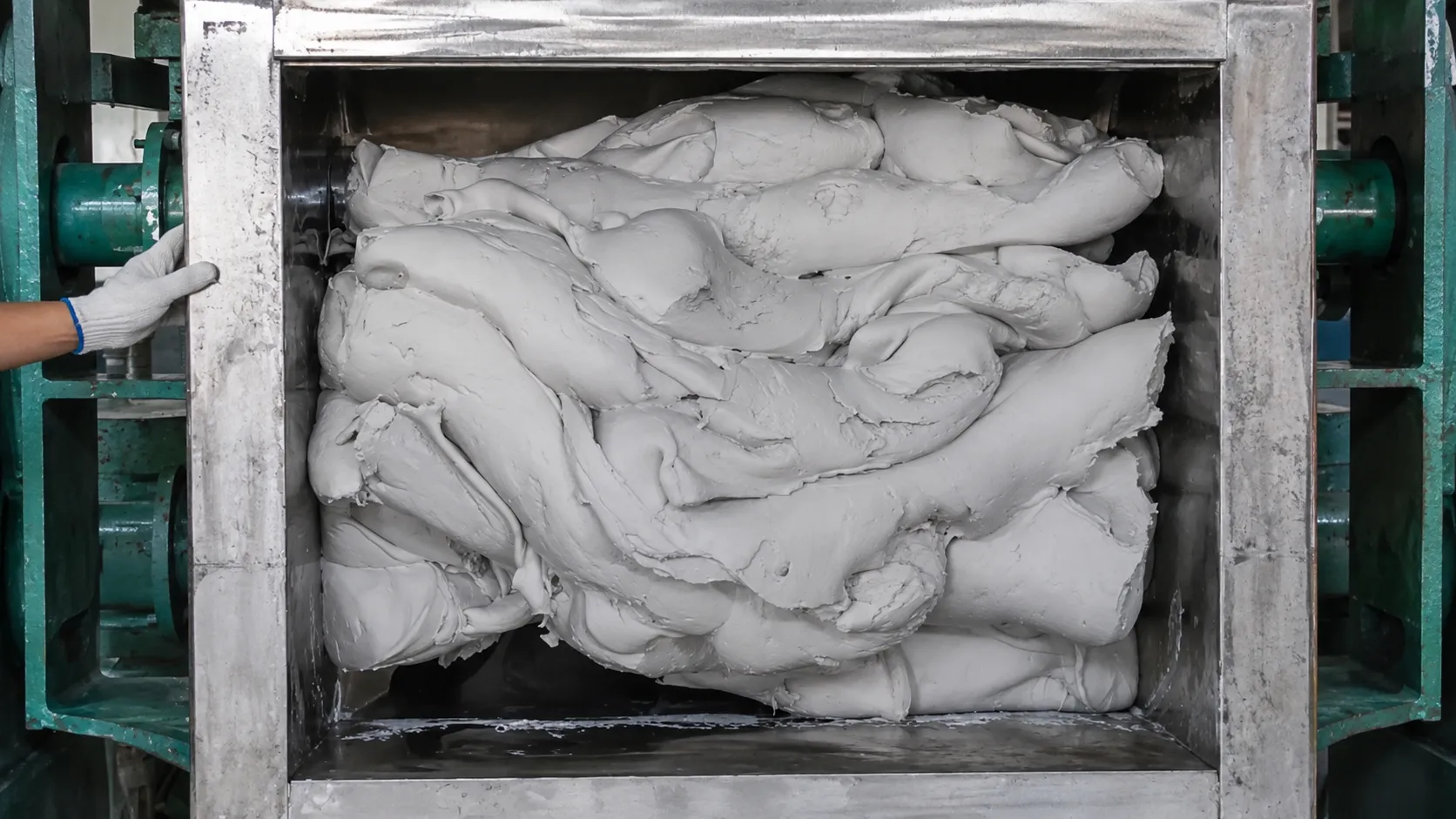
From Silicone Gum to Finished Compound
There is no single universal recipe for every HTV compound. Electrical insulation, cable extrusion, automotive seals, food-contact products and high-temperature industrial parts all require different formulation balances. However, most high-consistency silicone manufacturing processes follow a similar technical logic.
The exact equipment, temperature, sequence and mixing time are adjusted according to the formulation. Manufacturers also protect many detailed processing parameters as proprietary know-how because small changes can have a significant effect on finished compound performance.
Select the Silicone Gum
The manufacturing process begins with the silicone polymer itself. For most general-purpose HTV compounds, the base polymer is a high-molecular-weight polydimethylsiloxane or a related silicone gum with a siloxane backbone.
The molecular weight and vinyl content of the gum influence processing, curing behavior and final mechanical properties. A manufacturer may use one polymer or a blend of several gums to create the desired balance between viscosity, strength, elasticity and processability.
This first decision is more important than it may appear. A compound designed for high-speed cable extrusion may need a different rheological balance from a compound designed for compression-molded composite insulator housings. Likewise, a soft sealing grade may require a different polymer structure from a high-tear-strength industrial grade.
Add Reinforcing Silica and Processing Ingredients
Reinforcing silica is one of the most important ingredients in HTV silicone rubber. Silicone gum by itself is too weak for most demanding applications, so finely divided silica is incorporated to increase mechanical strength and create a useful elastomeric compound.
Depending on the formulation, manufacturers may use fumed silica, precipitated silica or specially treated silica. Surface area, structure and surface chemistry all influence how strongly the filler interacts with the polymer.
Silica can significantly affect tensile strength, tear strength, hardness, elongation, viscosity and extrusion behavior. However, reinforcement has to be controlled carefully. Too much filler or poor filler treatment can make the material excessively stiff or difficult to process.
Processing aids and structure-control agents may also be introduced at this stage. These help manage the interaction between silica and the silicone polymer and can improve compound processing and storage behavior.
| Raw Material | Main Role in the Compound |
|---|---|
| Silicone Gum | Provides the primary elastomeric polymer structure |
| Армирующий кремнезем | Improves tensile strength, tear strength and compound structure |
| Processing Aids | Help control viscosity, filler interaction and processing behavior |
| Functional Fillers | Adjust electrical, thermal, flame or other application-specific properties |
| Pigments / Masterbatch | Provide controlled color when required |
Mix and Disperse the Compound
Once the main raw materials have been selected and weighed, they must be mixed with enough shear to disperse the silica throughout the high-viscosity silicone gum.
This is one of the most important parts of the HTV silicone rubber manufacturing process. Filler dispersion affects surface quality, mechanical strength, extrusion behavior and the consistency of cured test results. Poorly dispersed silica can produce weak areas, uneven hardness and unstable processing.
Industrial manufacturers may use kneaders, internal mixers, two-roll mills or combinations of different mixing equipment depending on batch size, formulation and production scale.
Unlike low-viscosity liquids, silicone gum does not allow powders to disperse easily. The mixer must apply sufficient mechanical energy while controlling temperature so that the compound becomes homogeneous without damaging the polymer or introducing unnecessary contamination.
Heat-Treat and Devolatilize the Base Compound
After intensive mixing, many HTV base compounds undergo a controlled heat-treatment stage. This helps stabilize the interaction between the silicone polymer, reinforcing silica and processing ingredients.
Heat treatment can also help remove moisture and low-molecular-weight volatile substances from the compound. Depending on the formulation and equipment, vacuum may be used to improve devolatilization.
This stage is important because silica has a very high surface area and can interact strongly with both moisture and silicone chains. Without suitable treatment, the compound may show changing viscosity, poor storage stability or inconsistent processing.
The temperature and treatment time must be controlled carefully. The objective is to condition and stabilize the base compound rather than prematurely initiate final vulcanization.
Add Functional Ingredients for the Final Application
Once the reinforced silicone base has been properly mixed and conditioned, the formulation can be adjusted for the intended end use. This is where one HTV silicone grade begins to differ significantly from another.
A general-purpose molding compound may require a balanced combination of mechanical properties and processing stability. A high-temperature grade may use additives designed to improve thermal aging. An electrical compound may require a filler system optimized for dielectric performance, tracking resistance or long-term outdoor durability.
Flame-retardant grades, low-compression-set materials, colored compounds and specialized cable materials all require different formulation strategies.
Electrical & High Voltage
Formulation may focus on dielectric strength, volume resistivity, hydrophobicity, tracking resistance and erosion resistance.
Wire & Cable
Extrusion stability, electrical insulation, heat aging and mechanical flexibility become important.
Automotive & EV
Temperature cycling, sealing behavior, tear strength, compression performance and electrical insulation may need to be balanced.
Food Contact
Raw-material control, processing cleanliness and appropriate compliance documentation become important considerations.
Industrial Sealing
Hardness, tensile strength, elongation, tear strength and compression behavior may dominate the formulation.
High-Temperature Parts
The material must retain useful mechanical properties after prolonged exposure to elevated temperatures.
Homogenize, Strain and Filter the Silicone Compound
After functional ingredients have been incorporated, the compound needs to be made as uniform and clean as practical before it becomes a finished commercial material.
Additional milling or mixing can improve homogenization and ensure that pigments, fillers and additives are evenly distributed. The material may then pass through a straining or filtration system to reduce the risk of foreign particles, agglomerates or other contaminants remaining in the compound.
This is particularly important for electrical insulation, cable extrusion and precision molded components. A small contaminant that would be irrelevant in a thick general-purpose rubber part can become much more significant in a thin insulation layer or high-voltage component.
Filtration also contributes to better surface quality. Extruded tubing, profiles and cable insulation are especially sensitive to hard particles or poorly dispersed material because defects can appear directly on the finished surface.
| Возможная проблема | Possible Effect on Processing |
|---|---|
| Filler Agglomerates | Rough surface, weak points or inconsistent mechanical properties |
| Foreign Contamination | Visible defects or possible electrical weak zones |
| Poor Pigment Dispersion | Uneven color and inconsistent appearance |
| Incomplete Homogenization | Variation in hardness, cure behavior or processing stability |
Prepare the Curing System
HTV silicone rubber becomes an elastomer only after the polymer chains are crosslinked. This requires an appropriate curing system.
Peroxide curing has traditionally been widely used for high-consistency silicone rubber. Different peroxide systems can be selected according to processing temperature, product geometry and required properties. Some cured products may also undergo post-curing to reduce residual volatile substances and stabilize certain properties.
Addition-cure systems based on platinum chemistry are also used in high-consistency silicone applications when specific processing, cleanliness or performance characteristics are required.
The way the curing system is supplied depends on the commercial product. Some compounds are delivered ready for processing, while other silicone bases are supplied separately from the catalyst or curing additive so that the processor adds the crosslinking system before production.
Test, Release and Package the Finished HTV Silicone Rubber
The final stage is quality control. Before a production batch is released, representative samples are tested against the specifications established for the grade.
Shore A hardness is one of the most familiar values, but it is only part of the picture. Tensile strength, elongation and tear strength are commonly used to evaluate mechanical performance. Density can help reveal formulation consistency, while compression or permanent-deformation tests may be important for sealing materials.
Electrical grades may also be evaluated using properties such as dielectric strength, volume resistivity, dielectric constant and tracking or erosion performance. High-temperature grades may require heat-aging tests to determine how well mechanical properties are retained after prolonged thermal exposure.
| Тест | Что это помогает оценить |
|---|---|
| Твердость по шкале Шор А | Resistance to indentation and general compound hardness |
| Прочность на разрыв | Maximum tensile stress before failure |
| Относительное удлинение при разрыве | Ability of the cured rubber to stretch before breaking |
| Прочность на разрыв | Resistance to propagation of cuts and tears |
| Плотность | Formulation and batch consistency |
| Термическое старение | Retention of properties after prolonged thermal exposure |
| Диэлектрическая прочность | Electrical breakdown resistance under defined test conditions |
| Объёмное удельное сопротивление | Resistance to current flowing through the bulk material |
| Tracking / Erosion | Surface durability in demanding electrical environments |
Only after the material meets the required internal or customer specification should the batch be identified, packaged and released for shipment.
Why Batch Consistency Matters So Much
For a silicone rubber processor, a technically impressive datasheet is not enough if the material behaves differently from one batch to the next.
A variation in viscosity can change extrusion pressure. A small difference in cure behavior can affect molding cycle time. Variation in filler dispersion can change tear strength or surface appearance. In automated manufacturing, even small material changes can increase scrap rates or force operators to repeatedly adjust machine settings.
That is why an HTV silicone rubber manufacturer needs to control raw materials, weighing, mixing conditions, heat treatment, contamination, curing preparation and final testing as one connected production system.
How the Process Changes for Electrical-Grade HTV Silicone Rubber
The same general manufacturing logic applies to electrical silicone compounds, but the formulation priorities become different.
For composite insulator housings, the finished material must provide more than basic dielectric insulation. Outdoor performance can depend on hydrophobic surface behavior, resistance to tracking and erosion, weather resistance, mechanical strength and stable molding behavior.
Fillers therefore become particularly important. The compound designer needs to balance electrical surface performance against hardness, elongation, tear strength, viscosity and processability. Excessive emphasis on one property can make the overall compound less suitable for production.
Cable compounds create another challenge. They need reliable electrical insulation, but they also need consistent extrusion, smooth surface quality and sufficient flexibility after long-term heat aging.
This is why electrical-grade HTV silicone should be evaluated as a complete formulation rather than by dielectric strength alone.
How the Process Changes for High-Temperature Silicone
High-temperature silicone rubber is formulated to retain useful properties during prolonged thermal exposure. The goal is not simply to survive a short peak temperature.
Heat can gradually change hardness, tensile strength and elongation. For this reason, high-temperature formulations may use polymer systems, stabilizers and filler combinations selected to slow thermal degradation and maintain flexibility for a longer period.
The manufacturing process must also protect the consistency of these additives. Poor dispersion can produce regions that age differently from the rest of the rubber, while contamination can influence both processing and final performance.
How the Process Changes for Food-Contact Silicone
Food-contact compounds place greater emphasis on raw-material control, cleanliness and documentation. The formulation must be designed around the intended market and finished application.
Customers may require supporting information related to FDA 21 CFR, LFGB testing, BfR Recommendation XV or European chemical requirements. These should be evaluated individually rather than treated as one universal food-grade certification.
Post-curing may also be important for certain food-contact products depending on the curing system, regulatory requirement and finished-part specification.
What Can Go Wrong During HTV Silicone Manufacturing?
Many problems seen during molding or extrusion can begin earlier in the compound manufacturing process. The final defect may appear in the customer's factory, but the underlying cause can involve raw-material variation, poor filler dispersion, contamination, excessive heat history or an unsuitable curing system.
| Problem | Possible Compound-Related Cause | Effect During Processing |
|---|---|---|
| Compound Too Hard to Process | Filler balance or structure control is unsuitable | High extrusion pressure or poor mold filling |
| Poor Tear Strength | Insufficient reinforcement or poor dispersion | Parts tear during demolding or assembly |
| Дефекты поверхности | Contamination, agglomerates or poor filtration | Rough extrusion or visible molded defects |
| Unstable Cure | Curing-system variation or contamination | Variable cycle time and inconsistent properties |
| Batch-to-Batch Variation | Raw-material or process inconsistency | Frequent machine adjustment and higher scrap |
| Poor Heat Aging | Formulation not matched to service temperature | Hardening, cracking or loss of elongation |
How Yakows Approaches HTV Silicone Rubber Compounding
Yakows supplies HTV/HCR silicone rubber compounds for electrical insulation, composite insulators, cable systems, EV components, food-contact applications, high-temperature parts and general industrial molding.
These applications do not need exactly the same formulation. A composite-insulator manufacturer may focus on tracking resistance, erosion resistance, hydrophobicity and tear strength. A cable customer may care more about extrusion stability, dielectric performance and heat aging. A molded industrial component may require a specific balance of hardness, elongation and demolding strength.
For that reason, material selection starts with the finished application and manufacturing process. The polymer system, reinforcement, functional additives and curing method can then be evaluated around the performance that the customer actually needs.
This application-oriented approach is particularly important when a standard silicone grade meets the basic datasheet specification but does not process well on the customer's equipment or fails to deliver the expected performance in the finished part.
What Should Buyers Ask an HTV Silicone Rubber Manufacturer?
When evaluating a supplier, buyers should ask more than which hardness grades are available. A capable manufacturer should understand the interaction between formulation, processing and finished-product performance.
For extrusion projects, discuss extrusion speed, surface quality, die swell and operating temperature. For molding projects, explain mold geometry, cycle time, demolding problems and tear-sensitive areas. For electrical products, provide the relevant dielectric, tracking, erosion and aging requirements.
It is also worth asking how the supplier controls batch consistency, which properties are tested before release, whether application-specific formulations can be developed and how technical problems are handled after production trials begin.
Часто задаваемые вопросы
How is HTV silicone rubber made?
HTV silicone rubber is generally made by combining high-molecular-weight silicone gum with reinforcing silica, processing aids and functional additives, followed by intensive mixing, heat treatment, homogenization, filtration, curing-system preparation and final quality testing.
What is the main raw material in HTV silicone rubber?
The main polymer is a high-molecular-weight silicone gum based on a siloxane backbone. Reinforcing silica is then added to provide the mechanical strength required for practical rubber products.
Why is silica added to HTV silicone?
Reinforcing silica improves tensile strength, tear strength, hardness and overall compound structure. It also has a major influence on viscosity and processing behavior.
Why does HTV silicone need heat treatment?
Controlled heat treatment helps stabilize the polymer-filler system and can remove moisture and low-molecular-weight volatile materials, improving processing and storage consistency.
Is HTV silicone the same as HCR silicone?
The terms are often used for the same general family of high-consistency, heat-cured silicone rubber, although terminology can vary between manufacturers.
What curing agents are used for HTV silicone?
Peroxide curing is widely used, while platinum addition-cure systems are also available for applications that require different processing or finished-product characteristics.
Is the curing agent always added by the silicone manufacturer?
No. Some commercial compounds are supplied ready to process, while others are supplied as a base material with the curing system added separately by the processor.
What equipment is used to manufacture HTV silicone rubber?
Industrial production can use kneaders, internal mixers, two-roll mills, strainers and other mixing or finishing equipment depending on formulation, batch size and factory process.
How is electrical-grade HTV silicone different?
Electrical grades may use specially designed filler and additive systems to balance dielectric properties, tracking and erosion resistance, hydrophobicity, mechanical strength and processing performance.
Can HTV silicone rubber be customized?
Yes. Hardness, color, tear strength, thermal performance, electrical behavior, flame resistance and processing characteristics can be adjusted within practical formulation limits.