
Silicone Material Guide
Is Silicone a Solid or Liquid?
Silicone can be manufactured as a fluid, gel, paste, rubber or solid resin. Its physical state depends on molecular structure, crosslinking level, formulation and curing stage.
Is Silicone a Solid or Liquid?
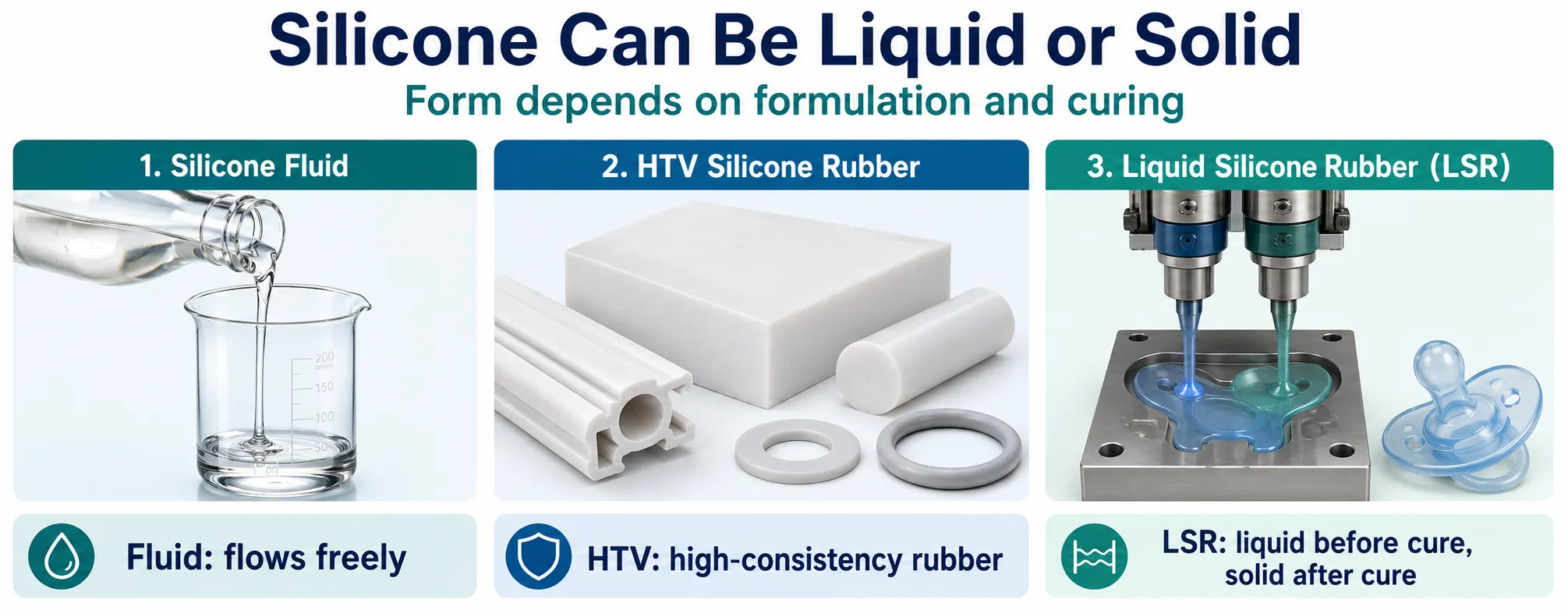
Silicone can be either a solid or a liquid. The word silicone describes a broad family of synthetic materials rather than one product with a single physical state. Different silicone formulations can be supplied as oils, fluids, gels, pastes, uncured rubber compounds or cured elastic solids.
The state of silicone mainly depends on the length of its polymer chains and the number of chemical crosslinks between those chains. Shorter and less-connected molecules can flow like liquids. Longer polymer chains with permanent crosslinks form flexible solids such as silicone rubber.
Processing stage also matters. A silicone material may begin as a pumpable liquid or moldable gum and then become a solid elastomer after curing. Therefore, the same product can be described as liquid before curing and solid after curing.
Silicone is a material family that includes both liquids and solids. Silicone oil remains liquid, while cured silicone rubber is a flexible solid.
Why Silicone Exists in Different Physical States
Most silicone materials are based on polymer chains containing alternating silicon and oxygen atoms. Organic groups attached to the silicon atoms influence flexibility, chemical behavior and compatibility with fillers or curing agents.
When the polymer chains are relatively short and are not permanently connected, they can move past one another. The material behaves as a liquid or viscous fluid. Increasing molecular weight makes the silicone thicker and less able to flow.
When curing creates chemical bridges between the polymer chains, the material develops a three-dimensional network. The chains can still flex, but they can no longer flow independently. The cured silicone therefore behaves as an elastic solid.
The amount of crosslinking also changes the final consistency. A lightly crosslinked silicone may form a soft gel, while a more highly crosslinked formulation becomes a firm rubber or rigid resin.
Common Forms of Silicone
| Silicone form | Physical state | Typical characteristics | Common applications |
|---|---|---|---|
| Silicone oil | Liquid | Flows freely and is available in different viscosities | Lubrication, damping, heat transfer and release agents |
| Silicone fluid | Liquid | Low- to high-viscosity fluid with good temperature stability | Coatings, cosmetics, electrical fluids and industrial processing |
| Silicone gel | Soft semisolid | Lightly crosslinked, soft and able to deform easily | Electronic protection, cushioning and encapsulation |
| Silicone sealant | Paste before cure; solid after cure | Can be applied from a cartridge and cures in place | Sealing, glazing, construction and electrical assembly |
| Жидкий силиконовый каучук | Liquid before cure; solid rubber after cure | Pumpable two-component molding material | Precision seals, medical parts, connectors and consumer products |
| Силиконовая резина HTV | Gum-like solid before cure; elastic solid after cure | High-consistency compound that requires heat curing | Extruded profiles, cable insulation, seals and composite insulators |
| Silicone resin | Solid after cure | More highly crosslinked and generally more rigid than silicone rubber | Coatings, electrical insulation, binders and heat-resistant finishes |
Is Silicone Rubber a Solid?
Yes. Fully cured silicone rubber is classified as a solid elastomer. It maintains its general shape and does not flow under its own weight in the way a liquid does.
However, silicone rubber is not a rigid solid like glass or metal. It can stretch, compress, bend and recover because the crosslinked polymer network remains highly flexible.
This combination of solid form and elastic movement makes silicone rubber useful for seals, gaskets, tubing, membranes, cable insulation and molded components. The material can conform to surfaces while still maintaining its structure.
Silicone rubber is also generally amorphous rather than crystalline. Its polymer chains do not form the highly ordered structure found in many rigid solids. This contributes to its flexibility over a broad temperature range.
Cured silicone rubber is an elastic solid, even though it may feel soft and deform easily when pressed.
Что такое силиконовый каучук HTV?
HTV silicone rubber is a high-consistency silicone compound that requires heat to complete vulcanization. HTV means high-temperature vulcanizing, and the material is also commonly called HCR, high-consistency rubber or heat-cured silicone rubber.
Before curing, HTV silicone rubber normally has a firm, gum-like form. It does not pour like a liquid. The compound can be cut into strips, formed into preforms, fed into an extruder or placed into a heated mold.
During curing, heat activates the peroxide or addition-curing system. Chemical crosslinks form between the polymer chains, converting the moldable compound into a stable elastic solid.
HTV silicone rubber is commonly used for extrusion, compression molding, transfer molding, injection molding and calendering. Typical products include tubing, profiles, sheets, wire insulation, gaskets, electrical components and composite-insulator housings.
Physical State of HTV Silicone Rubber
| Production stage | Physical form | Material behavior |
|---|---|---|
| Before curing | High-consistency gum | Firm, moldable and non-pourable |
| During heating | Softening and crosslinking compound | Fills the die or mold while the curing reaction develops |
| After curing | Elastic solid | Maintains its shape while remaining flexible |
Что такое жидкий силиконовый каучук?
Liquid silicone rubber, commonly abbreviated as LSR, is a two-component silicone material designed for liquid injection molding. Its components are pumpable before mixing and curing.
Although it is called liquid silicone rubber, the finished molded product is not a liquid. The name describes the material during processing. After the two components are mixed and heated, the silicone crosslinks and becomes a flexible solid.
LSR can flow into detailed mold cavities, thin sections and complex geometries. This makes it suitable for high-volume automated manufacturing of precision components.
Common applications include connector seals, medical components, baby-care products, kitchenware, membranes, valve components and electrical insulation parts.
Physical State of Liquid Silicone Rubber
| Production stage | Physical form | Material behavior |
|---|---|---|
| Component A | Viscous liquid | Stored and pumped separately |
| Component B | Viscous liquid | Contains the complementary curing ingredients |
| After mixing | Reactive liquid mixture | Can be injected into a heated mold |
| After curing | Elastic solid | Retains the molded shape and flexible rubber properties |
HTV Silicone Rubber vs Liquid Silicone Rubber
HTV silicone rubber and liquid silicone rubber both become solid elastomers after curing, but their uncured form and processing requirements are different.
| Особенность | Силиконовая резина HTV | Жидкий силиконовый каучук |
|---|---|---|
| Uncured state | Firm, gum-like compound | Pumpable viscous liquid |
| Material components | One compound with added or pre-mixed curing system | Usually supplied as two separate components |
| Material handling | Cut, rolled, extruded or mechanically fed | Pumped, metered and mixed |
| Common processing | Extrusion, compression molding, transfer molding and HCR injection molding | Liquid injection molding |
| Mold-filling behavior | Requires pressure to move the high-consistency compound | Flows easily into detailed mold cavities |
| Automation level | Depends on the selected processing equipment | Well suited to automated production |
| Final state | Flexible solid rubber | Flexible solid rubber |
The better material depends on the product geometry, manufacturing volume, tooling, equipment and required mechanical properties. Neither material should be selected only because one begins as a solid and the other begins as a liquid.
Is Uncured Silicone a Liquid?
Some uncured silicone products are liquids, but others are pastes or gum-like compounds. The term uncured only means that permanent crosslinking has not yet been completed.
One-part RTV silicone sealant is normally supplied as a thick paste. It can be pushed through a cartridge nozzle but does not flow like silicone oil. Moisture in the air then causes it to cure into a flexible solid.
Two-part casting silicone may be supplied as pourable liquids. After mixing, the material can be poured around a model or component before curing into rubber.
HTV silicone rubber is also uncured when supplied, but it has such a high consistency that it behaves more like soft gum than a liquid.
Is Silicone Gel a Solid or Liquid?
Silicone gel is commonly described as a semisolid. It contains a lightly crosslinked polymer network that holds its shape weakly while allowing substantial deformation.
A silicone gel may appear to flow very slowly under long-term pressure, but it does not behave like an ordinary free-flowing silicone liquid. It remains connected as a soft three-dimensional network.
This soft behavior makes silicone gel useful for protecting sensitive electronics. The gel can surround components, absorb vibration and accommodate thermal expansion without placing high mechanical stress on delicate connections.
Силикон плавится?
Cured silicone rubber does not normally melt and flow in the same way as a thermoplastic. Its polymer chains are permanently connected by crosslinks, preventing the material from becoming a processable liquid again.
At high temperatures, silicone rubber may soften, lose mechanical properties or eventually degrade. The exact behavior depends on the formulation, temperature, exposure time and surrounding atmosphere.
Because cured silicone is a thermoset elastomer, it cannot generally be remelted and remolded. Scrap silicone rubber requires different recycling methods from thermoplastic materials.
Uncured silicone may flow or be molded, but fully cured silicone rubber cannot normally be melted back into its original processable state.
How Curing Changes Silicone from Liquid to Solid
Curing creates chemical bonds between separate silicone polymer chains. Before curing, the chains can move relative to one another, allowing the material to flow or change shape permanently.
As crosslinking develops, the chains become connected into a continuous network. The material gradually loses its ability to flow and gains elastic recovery.
The curing mechanism depends on the silicone system. Heat-cured materials may use peroxide or platinum-catalyzed addition curing. RTV silicone may cure through moisture, condensation or a two-component chemical reaction.
- Uncured material: Polymer chains remain mostly independent and can move past one another.
- Curing begins: Heat, moisture or mixing activates the chemical reaction.
- Crosslinks form: Polymer chains become permanently connected.
- Gel point develops: The material can no longer flow freely.
- Full cure: The silicone becomes a stable elastic solid.
How to Identify the State of a Silicone Product
The product name alone may not clearly show whether silicone is liquid or solid. Review the technical data sheet and processing instructions for the exact material.
- Viscosity: A listed viscosity normally indicates a fluid, liquid rubber, coating or sealant.
- Consistency: Terms such as pourable, pumpable, paste, putty or gum describe uncured handling behavior.
- Mixing ratio: A specified A:B ratio usually indicates a two-component reactive system.
- Cure method: Heat, moisture, catalyst or room-temperature curing explains how the final solid develops.
- Hardness: Shore A, Shore 00 or Shore D values generally describe the cured material.
- Pot life: Pot life shows how long a mixed liquid or paste remains processable.
- Demolding time: This indicates when the cured silicone has become solid enough to remove from a mold.
Choosing the Correct Silicone Form
The correct physical form depends on how the material must be applied and what the finished component must do.
| Manufacturing need | Suitable silicone form | Причина |
|---|---|---|
| Continuous tubing or profiles | Силиконовая резина HTV | Suitable for extrusion and continuous heat curing |
| High-volume precision molding | Жидкий силиконовый каучук | Supports automated metering and injection molding |
| On-site sealing | RTV silicone sealant | Applied as a paste and cures in place |
| Flexible electronic protection | Silicone gel | Provides soft encapsulation with low mechanical stress |
| Lubrication or damping | Silicone fluid | Remains liquid during service |
| Large molded industrial parts | HTV silicone rubber or LSR | Selection depends on equipment, geometry and production volume |
Часто задаваемые вопросы
Is silicone naturally a liquid?
Silicone is a family of materials rather than one substance. It can be formulated as a liquid, paste, gel, rubber or solid resin.
Is cured silicone a solid?
Yes. Cured silicone rubber is an elastic solid that maintains its shape while remaining flexible.
Is silicone rubber a liquid?
Finished silicone rubber is a solid elastomer. Some silicone rubber begins as a liquid or paste before curing.
Is liquid silicone rubber still liquid after molding?
No. Liquid silicone rubber is liquid during mixing and injection, but heat curing converts it into a solid rubber component.
Is HTV silicone rubber liquid?
No. Uncured HTV silicone rubber is normally a firm, gum-like high-consistency compound. After curing, it becomes an elastic solid.
Can cured silicone become liquid again?
Cured silicone rubber is crosslinked and cannot normally be melted back into a processable liquid. Excessive heat causes degradation rather than ordinary melting.
Is silicone sealant a liquid or solid?
Silicone sealant is usually a thick paste during application and becomes a flexible solid after curing.
Is silicone gel a liquid?
Silicone gel is generally considered a very soft semisolid because it contains a lightly crosslinked polymer network.