
Руководство по электротехническим материалам из силиконовой резины
Silicone Rubber: Conductor or Insulator?
Silicone rubber is generally an electrical insulator, which is one reason it is widely used in wire and cable, electrical connectors, EV components, high-voltage insulation and outdoor electrical equipment. However, silicone rubber is not always insulating. By changing the formulation and adding conductive fillers, manufacturers can produce insulating, antistatic, semiconductive or electrically conductive silicone rubber. Whether silicone rubber behaves as a conductor or an insulator therefore depends on the complete compound rather than the silicone polymer alone.
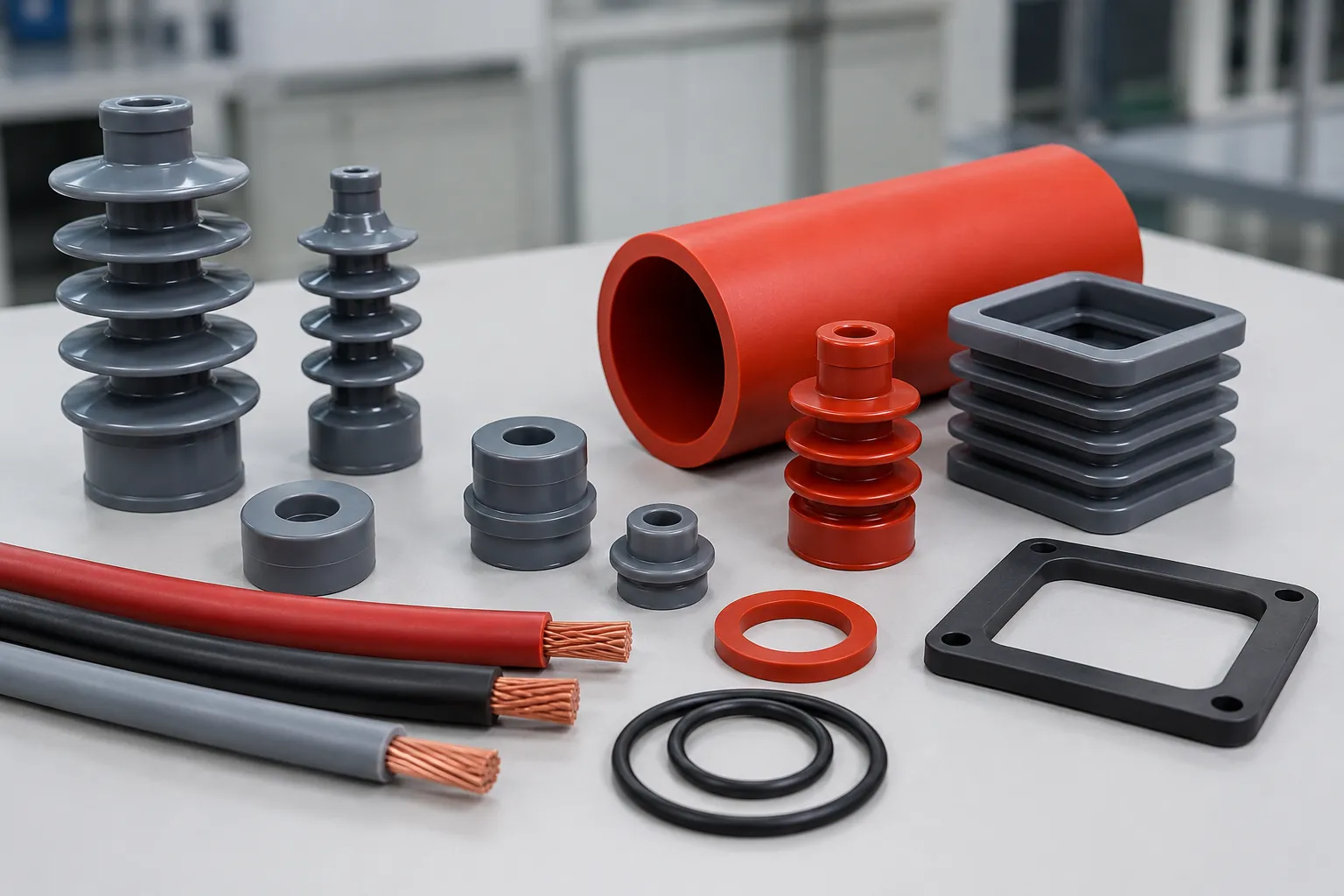
Is Silicone Rubber a Conductor or an Insulator?
Standard silicone rubber is normally considered an electrical insulator. It has high resistance to electrical current and can be formulated to provide stable dielectric properties across a broad range of operating conditions.
This insulating behavior makes silicone rubber useful around conductors, terminals, cables and electrical equipment where current must remain confined to a defined conductive path.
However, the answer changes when conductive fillers are added. Carbon-based materials, metal particles and other functional fillers can create electrical pathways through the silicone matrix. The resulting material may become antistatic, semiconductive or highly conductive depending on the formulation.
Why Is Silicone Rubber Usually an Electrical Insulator?
Electrical conduction requires mobile charge carriers that can move through a material. Metals such as copper conduct electricity easily because electrons can move relatively freely through their structure.
Silicone rubber behaves very differently. Its polymer structure does not naturally provide the same type of continuous path for charge movement. As a result, properly formulated silicone rubber strongly resists electrical current.
The siloxane backbone also gives silicone rubber useful thermal and environmental stability. This allows an electrical insulation component to remain flexible even when exposed to heat, cold, vibration or weathering.
This combination of electrical resistance and elastomeric flexibility is one of the main reasons silicone rubber is widely used in electrical engineering.
Electrical Properties of Silicone Rubber
Calling silicone rubber an insulator is only the beginning. Electrical-grade silicone rubber is usually evaluated using several different properties because no single test completely describes insulation performance.
| Электрические свойства | Что измеряется | Почему это важно |
|---|---|---|
| Объёмное удельное сопротивление | Resistance to current flowing through the bulk material | Indicates how strongly silicone rubber resists electrical conduction |
| Удельное поверхностное сопротивление | Resistance to current flowing along the material surface | Important where moisture or contamination may be present |
| Диэлектрическая прочность | Electric field the insulation can withstand before breakdown | Important for cables and high-voltage components |
| Диэлектрическая проницаемость | Electrical response of the material to an electric field | Important in electrical and electronic design |
| Dissipation Factor | Electrical energy loss under alternating voltage | Relevant to AC insulation performance |
| Tracking Resistance | Resistance to progressive surface electrical degradation | Especially important for outdoor high-voltage silicone rubber |
These values depend on the actual silicone compound. Two materials with the same Shore A hardness can have very different electrical properties.
What Is Volume Resistivity in Silicone Rubber?
Volume resistivity describes how strongly silicone rubber resists electrical current passing through the material itself.
Electrical insulation grades are designed to have very high volume resistivity. This means current cannot easily travel through the rubber from one surface to another.
Conductive silicone rubber is formulated in the opposite direction. Conductive fillers reduce resistivity and create pathways that allow charge to move through the compound.
When reviewing a silicone rubber datasheet for an electrical application, volume resistivity is therefore one of the first properties to check.
What Is Dielectric Strength of Silicone Rubber?
Dielectric strength describes the ability of silicone rubber to withstand an electric field without electrical breakdown.
This is different from volume resistivity. A material may strongly resist normal leakage current but still fail if the electric field becomes high enough.
For cable insulation, molded electrical components and high-voltage products, dielectric strength needs to be considered together with insulation thickness, geometry and electric-field distribution.
Sharp metal edges, voids, air gaps and thin insulation sections can concentrate electrical stress even when the silicone material itself has good dielectric properties.
What Happens When Silicone Rubber Electrically Breaks Down?
Electrical breakdown occurs when the applied electric field exceeds the ability of the insulation system to resist current flow.
At that point, a conductive discharge path can form through or across the material. The resulting damage may be permanent.
This does not mean silicone rubber suddenly behaves like an ordinary metal conductor. Breakdown is an insulation failure caused by excessive electrical stress.
For this reason, high-voltage design must consider material properties together with thickness, surface distance, electrode geometry and operating environment.
Что такое проводящая силиконовая резина?
Conductive silicone rubber is silicone rubber that has been deliberately modified so electrical charge can move through the material.
The silicone polymer still provides the flexible elastomer matrix, but electrically conductive particles are dispersed throughout the compound.
When enough conductive particles contact or approach one another, they form an interconnected network through the silicone rubber.
The resulting material can combine electrical conductivity with the flexibility, temperature resistance and sealing characteristics normally associated with silicone rubber.
How Is Silicone Rubber Made Conductive?
Conductivity is usually created by adding functional fillers to the silicone compound.
Carbon-based fillers are widely used when controlled electrical resistance is required. Metal-containing fillers may be selected when much higher conductivity or electromagnetic shielding performance is needed.
The filler type is only one part of the formulation. Particle size, particle shape, loading level, dispersion and interaction with the silicone polymer all influence final conductivity.
Increasing conductive filler content can also change Shore hardness, tensile strength, elongation, viscosity and molding behavior. Conductive silicone therefore needs to be engineered as a complete compound rather than simply mixing conductive powder into ordinary silicone rubber.
Insulating vs Antistatic vs Semiconductive vs Conductive Silicone Rubber
Silicone rubber can be designed across a very broad electrical resistance range. Different electrical functions require different compound designs.
| Silicone Rubber Type | Электрические характеристики | Typical Function |
|---|---|---|
| Изоляционный силиконовый каучук | Very high resistance | Prevents unwanted current flow |
| Antistatic Silicone Rubber | Controlled charge dissipation | Reduces accumulation of static electricity |
| Полупроводниковый силиконовый каучук | Регулируемое промежуточное сопротивление | Electric-field control and specialized electrical interfaces |
| Проводящая силиконовая резина | Relatively low electrical resistance | Conductive seals, contacts and EMI shielding |
These categories should not be confused. A material designed to dissipate static charge is not necessarily conductive enough for an EMI gasket, and a high-voltage insulating silicone should not be replaced with a semiconductive compound.
Does Black Silicone Rubber Conduct Electricity?
Not necessarily. Black color does not prove that silicone rubber is conductive.
Carbon black and other dark fillers may be used for pigmentation, reinforcement, UV resistance or conductivity. The electrical effect depends on the particular filler and how much is used.
A black silicone rubber cable component may be highly insulating, while another black compound may be deliberately semiconductive.
Electrical resistance should therefore be confirmed from technical data or testing rather than estimated from appearance.
Проводит ли прозрачная силиконовая резина электричество?
Clear and translucent silicone rubber is usually associated with electrically insulating formulations because high levels of conventional conductive fillers tend to make a compound opaque.
However, transparency is not a formal electrical specification.
If silicone rubber is being selected for electrical insulation, properties such as volume resistivity and dielectric strength should still be reviewed even when the material appears clear.
Does Silicone Rubber Conduct Electricity When Wet?
The silicone rubber itself may remain highly insulating, but moisture can significantly affect surface electrical behavior.
Pure water is not the only concern. Real outdoor moisture often contains salts, dust and other contaminants that can create conductive surface films.
This means a wet silicone rubber surface can carry leakage current even though current is still strongly resisted through the bulk material.
The distinction between bulk insulation and surface insulation is especially important for outdoor electrical equipment.
Hydrophobicity of Silicone Rubber
Silicone rubber is widely used outdoors partly because its surface can be strongly hydrophobic.
Instead of spreading into a continuous water film, water tends to form separate droplets on a hydrophobic silicone surface.
This can reduce the formation of continuous conductive paths across the insulation surface.
For high-voltage composite insulators, hydrophobicity and hydrophobicity recovery are important performance characteristics because the silicone housing is continuously exposed to rain, humidity and environmental pollution.
Hydrophobicity does not replace correct electrical design, but it is an important advantage of silicone rubber in outdoor insulation.
Does Temperature Affect the Electrical Properties of Silicone Rubber?
Yes. Electrical properties can change as temperature changes.
Silicone rubber is attractive for electrical applications because suitable formulations can maintain useful mechanical and dielectric properties across a broad temperature range.
However, high temperature affects molecular motion and can change electrical resistance. Long-term heat aging may also change the compound structure and physical properties.
This is particularly important for silicone rubber used near motors, heaters, high-power cables, battery systems and power electronics.
Electrical data measured at room temperature should therefore not automatically be assumed to represent every operating temperature.
Does Silicone Rubber Thickness Affect Electrical Insulation?
Yes. The thickness and geometry of silicone rubber insulation strongly affect the performance of the complete electrical system.
A thicker insulating layer generally increases the distance through the material between conductive parts, but simply increasing thickness does not solve every electrical problem.
Voids, cracks, thin sections and sharp conductive edges can create local electric-field concentrations.
In high-voltage components, material selection and component geometry must therefore be designed together.
Does Shore Hardness Affect Electrical Insulation?
Shore hardness and electrical insulation describe different material properties.
Shore A hardness measures resistance to indentation, while electrical properties describe how the compound interacts with electric current and electric fields.
A Shore A 60 insulating silicone rubber and a Shore A 60 conductive silicone rubber can feel mechanically similar while behaving completely differently electrically.
| Недвижимость | О чем идет речь |
|---|---|
| Твёрдость по Шору | Resistance to indentation |
| Объёмное удельное сопротивление | Resistance to electrical current through the material |
| Диэлектрическая прочность | Устойчивость к электрическому пробою |
Electrical silicone rubber should therefore never be specified by hardness alone.
How Vulcanization Affects Silicone Rubber Electrical Properties
HTV and HCR silicone rubber must be properly vulcanized before their final properties are achieved.
During curing, silicone polymer chains form a three-dimensional crosslinked network. The finished rubber develops its intended mechanical and physical characteristics.
Under-curing, poor mixing or contamination can affect the consistency of the final material. For electrically critical silicone compounds, process control is therefore important.
Electrical testing should be conducted on material processed under representative curing conditions.
HTV and HCR Silicone Rubber for Electrical Applications
HTV and HCR silicone rubber are important industrial materials for electrical insulation.
HCR means High Consistency Rubber and describes the gum-like consistency of the uncured silicone compound. HTV means High Temperature Vulcanizing and refers to the heat-curing process used to create the final elastomer.
These materials can be extruded or molded into cable insulation, connector parts, electrical seals and high-voltage components.
Electrical-grade HTV compounds may combine high resistivity with mechanical properties such as tear strength, elongation and weather resistance.
Silicone Rubber for Wire and Cable Insulation
Wire and cable are major applications for insulating silicone rubber.
During manufacturing, uncured HTV silicone compound is extruded around a conductor and then passed through a curing system. Vulcanization converts the compound into a flexible crosslinked insulation layer.
Silicone rubber is particularly useful for cables that need to remain flexible while operating at elevated or low temperatures.
Electrical performance is only one requirement. Cable compounds may also need suitable tensile strength, elongation, tear resistance, heat aging and flame performance.
Silicone Rubber in Cable Grommets and Connectors
Silicone rubber is also widely used around cables rather than directly as the cable insulation.
Silicone cable grommets protect the cable jacket where wires pass through metal or plastic panels. Connector seals help prevent moisture and contamination from entering electrical connection areas.
In these components, silicone rubber combines mechanical flexibility with electrically insulating behavior.
The rubber does not replace the primary cable insulation, but it can provide an additional protective and insulating interface around the cable system.
Силиконовый каучук в электрических системах электромобилей и новых энергетических транспортных средств
Electric vehicles expose elastomer components to electrical stress, heat, vibration, moisture and repeated thermal cycling.
Silicone rubber is therefore used in many EV and NEV systems where flexible insulation or sealing is required.
| EV / NEV Application | Роль силиконовой резины | Important Properties |
|---|---|---|
| Высоковольтный кабель | Flexible electrical insulation | Dielectric strength, heat resistance and flexibility |
| Высоковольтный разъем | Sealing and electrical isolation | Insulation, compression set and tear strength |
| Battery Enclosure | Герметизация от воздействия окружающей среды | Compression recovery and electrical compatibility |
| Силовая электроника | Flexible insulation and sealing | Temperature stability and dielectric properties |
Conductive silicone may also be used in EV electronics when grounding or electromagnetic shielding is required, so material function must always be clearly specified.
Силиконовый каучук в высоковольтных композитных изоляторах
One of the most demanding electrical applications for silicone rubber is the housing of composite insulators used in transmission and distribution systems.
The silicone rubber housing surrounds an FRP core and provides the external insulation surface.
The material must remain electrically insulating while resisting rain, pollution, UV exposure, ozone and electrical surface stress.
Important properties include hydrophobicity, tracking resistance, erosion resistance and weather aging.
Tracking and Erosion Resistance of Silicone Rubber
Outdoor high-voltage insulation is exposed to conditions that are very different from indoor cable insulation.
When a contaminated surface becomes wet, leakage current can flow across parts of the insulation. Local drying may then produce dry-band discharges.
Repeated electrical discharges can gradually damage the silicone surface.
Tracking describes the formation of a conductive surface path, while erosion describes physical loss or degradation of insulation material.
High-voltage silicone rubber compounds therefore require dedicated resistance to both tracking and erosion.
Проводящая силиконовая резина для экранирования электромагнитных помех
Although silicone rubber is commonly used as an insulator, conductive silicone has important uses in electronic equipment.
One example is EMI shielding gaskets. These components are installed between conductive enclosure surfaces and must maintain electrical continuity across the joint.
The silicone elastomer provides compression and sealing, while conductive fillers provide the electrical path needed for electromagnetic shielding.
Conductive silicone therefore performs the opposite electrical function from cable insulation even though both materials use silicone rubber as the polymer matrix.
Can Contamination Make Silicone Rubber Conductive?
Contamination can reduce surface insulation performance even when the silicone rubber itself remains highly resistive.
Salt, carbon dust, metallic particles, process residue and ionic contamination can create unintended conductive paths.
This is important during manufacturing as well as during service.
Electrical silicone parts should therefore be produced, handled and stored in a controlled manner when surface insulation is critical.
Can Aging Change Silicone Rubber Electrical Performance?
Yes. Long-term environmental exposure can influence electrical and mechanical properties.
Heat, UV radiation, ozone, chemicals and electrical stress can gradually change the surface or bulk material.
Silicone rubber is valued because suitable formulations provide strong aging resistance, but critical electrical applications should still evaluate performance after representative aging.
For example, high-voltage outdoor silicone may need tracking and erosion tests, while cable insulation may require heat-aging and dielectric testing after exposure.
How Is Silicone Rubber Electrical Performance Tested?
Different tests are used depending on whether the silicone rubber is intended as an insulator or conductor.
| Тест | Purpose |
|---|---|
| Объёмное удельное сопротивление | Evaluates resistance through the silicone rubber |
| Удельное поверхностное сопротивление | Evaluates electrical resistance along the material surface |
| Диэлектрическая прочность | Determines breakdown resistance under an electric field |
| Диэлектрическая проницаемость | Characterizes response to an electric field |
| Tracking and Erosion Test | Evaluates resistance to electrical surface degradation |
| Resistance Measurement | Evaluates conductive or semiconductive silicone compounds |
ASTM D257 is commonly used for electrical resistance and resistivity measurements, while ASTM D149 is widely associated with dielectric strength testing. High-voltage outdoor silicone may also be evaluated using application-specific IEC methods.
How to Choose Silicone Rubber for Electrical Applications
The first step is to define whether the component must be insulating, antistatic, semiconductive or conductive.
For an insulating application, volume resistivity and dielectric strength are important starting points. For outdoor high-voltage insulation, surface properties such as tracking resistance and hydrophobicity also become critical.
The operating temperature must then be defined because electrical and mechanical properties can change with temperature and aging.
Mechanical requirements should also be considered. Hardness, tear strength, tensile strength, elongation and compression set affect how the finished part performs during installation and service.
If the silicone contacts coolant, oil or another chemical, compatibility should be evaluated under realistic temperature and exposure conditions.
Finally, the finished molded or extruded silicone rubber should be validated rather than relying only on the properties of an uncured compound.
Silicone Rubber vs Other Electrical Insulation Materials
Silicone rubber is not the only electrical insulation material available. Plastics, ceramics, epoxy systems and other elastomers can also provide excellent dielectric properties.
The advantage of silicone rubber is its ability to combine electrical insulation with elastomeric flexibility.
| Material Characteristic | Silicone Rubber Advantage |
|---|---|
| Гибкость | Remains elastomeric and can accommodate movement |
| Диапазон температур | Suitable grades remain flexible across broad temperature conditions |
| Outdoor Exposure | Good UV, ozone and weather resistance |
| Герметизация | Can combine electrical insulation and environmental sealing |
| Complex Shapes | Can be molded and extruded into many component geometries |
This combination makes silicone rubber especially useful where a rigid electrical insulator would not provide sufficient flexibility or sealing capability.
Frequently Asked Questions About Silicone Rubber
Is silicone rubber a conductor or an insulator?
Standard silicone rubber is generally an electrical insulator. However, conductive fillers can be added to produce antistatic, semiconductive or conductive silicone rubber.
Проводит ли силиконовая резина электричество?
Normal insulating silicone rubber conducts electricity very poorly. Conductive grades are specifically formulated to reduce electrical resistance.
Why is silicone rubber an electrical insulator?
The silicone polymer structure does not naturally provide the mobile charge pathways found in highly conductive materials such as metals.
Can silicone rubber be made conductive?
Yes. Carbon-based fillers, metal particles and other electrically conductive materials can be incorporated into silicone rubber to create conductive pathways.
Is black silicone rubber conductive?
Not necessarily. Black silicone can be insulating or conductive depending on the type and amount of filler used.
Is clear silicone rubber electrically insulating?
Clear silicone is commonly insulating, but transparency alone does not define electrical performance. Technical data should be checked.
Does wet silicone rubber conduct electricity?
Moisture and contaminants can lower surface resistance and create leakage-current paths even when the silicone rubber bulk remains insulating.
Does silicone rubber have high dielectric strength?
Electrical-grade silicone rubber can provide useful dielectric strength, but the exact value depends on the compound, thickness and test conditions.
Does Shore hardness determine electrical insulation?
No. Shore hardness measures indentation resistance and does not directly determine electrical conductivity or dielectric performance.
Is silicone rubber used for cable insulation?
Yes. HTV silicone rubber is widely used for flexible cable insulation in applications requiring electrical insulation and temperature resistance.
Используется ли силиконовый каучук в электромобилях?
Yes. Silicone rubber can be used in high-voltage cables, connector seals, battery sealing systems and power-electronics components.
Is silicone rubber used for high-voltage insulators?
Yes. Specialized HTV silicone rubber is widely used for the housing and weather sheds of composite insulators.
What is conductive silicone rubber used for?
Conductive silicone can be used for EMI shielding gaskets, grounding components, conductive seals and specialized electrical contacts.
Can silicone rubber protect against electric shock?
Only electrical protective equipment specifically designed, tested and rated for the relevant voltage should be relied upon for personal shock protection. Ordinary silicone rubber products should not be treated as certified safety equipment.