
Temperature Range of Silicone Rubber
Silicone rubber is widely selected for industrial applications because it can remain flexible and functional across a much broader temperature range than many conventional elastomers. It is used in electrical insulation, composite insulators, wire and cable, EV systems, seals, food-processing components and high-temperature molded parts.
But there is no single temperature limit that applies to every silicone rubber compound. A general-purpose grade, an electrical HTV silicone, a food-contact HCR compound and a specially formulated high-temperature silicone can have very different long-term temperature capabilities.
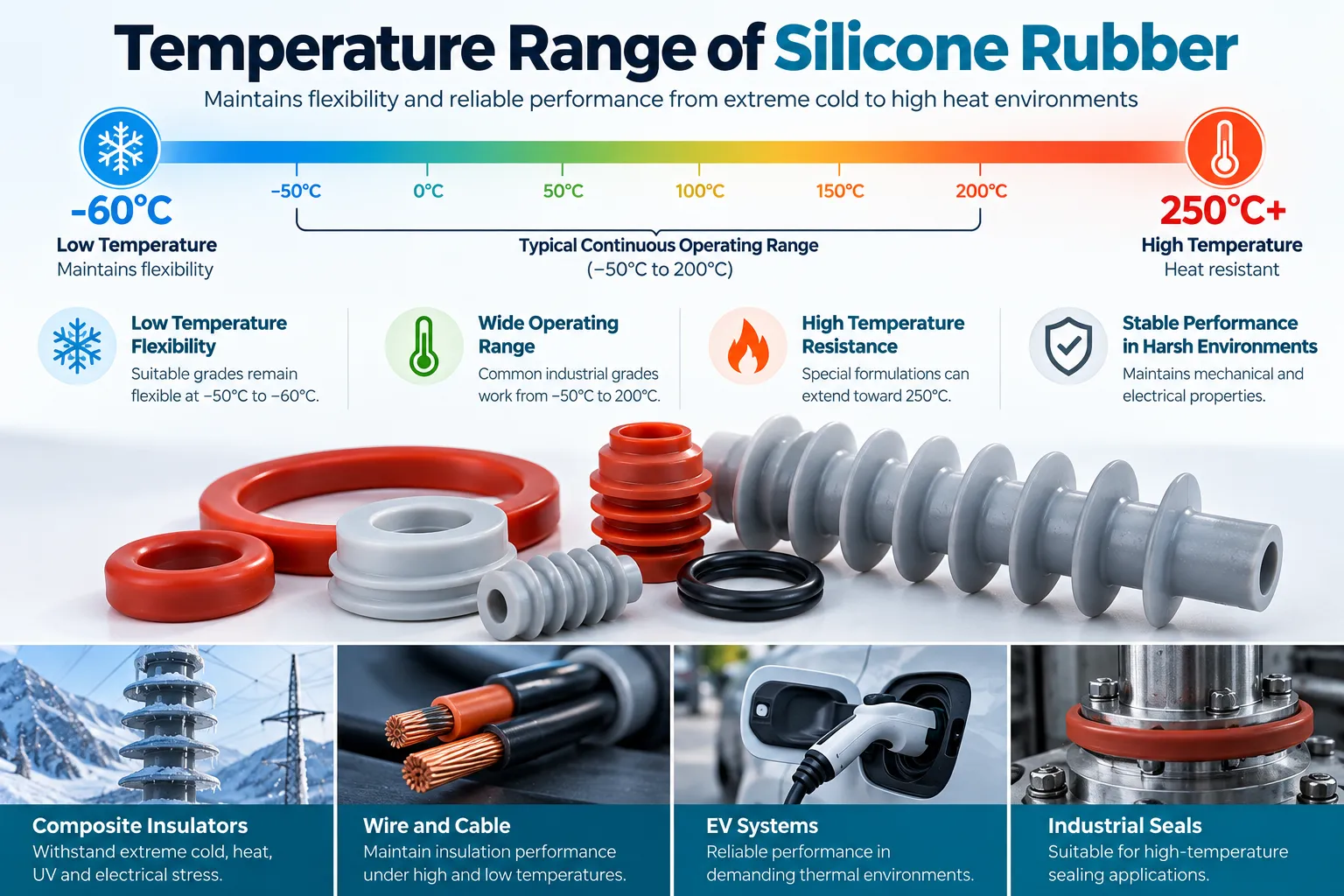
As a practical starting point, many industrial silicone rubber grades operate across approximately -50°C to 200°C, while suitable formulations may extend toward -60°C at the low end or approximately 250°C for elevated-temperature service. Short temperature peaks may be higher for selected compounds, but these should never be confused with continuous operating limits.
This guide explains the temperature range of silicone rubber, what controls its heat resistance, what happens when silicone becomes too hot or too cold, and how to select the correct grade for real industrial applications.
What Is the Typical Temperature Range of Silicone Rubber?
Silicone rubber is known for maintaining useful elasticity over a broad temperature range. However, the exact limits depend on polymer structure, fillers, stabilizers, curing system, exposure time and the mechanical requirements of the finished part.
Approx. -50°C to -60°CMany suitable silicone grades retain flexibility at temperatures where conventional rubbers become significantly harder.
Up to about 180°C–200°CA common working region for many industrial silicone compounds, subject to actual grade qualification.
Approx. 200°C–250°CSpecialized formulations may be developed for more demanding continuous thermal environments.
Potentially above 250°CPossible for selected grades and short exposure periods, but highly dependent on formulation and load.
Silicone Rubber Temperature Range at a Glance
| Temperature Condition | General Behavior of Silicone Rubber | Что следует учитывать |
|---|---|---|
| Below -60°C | Some grades may become increasingly stiff | Low-temperature formulation and flexibility requirements |
| -60°C to -20°C | Suitable grades can retain good flexibility | Compression, bending and sealing performance |
| -20°C to 150°C | Comfortable operating region for many silicone compounds | Application-specific mechanical and electrical properties |
| 150°C to 200°C | Common high-temperature service region for industrial silicone | Long-term heat aging becomes increasingly important |
| 200°C to 250°C | Requires more careful grade selection | Special high-temperature formulation and aging data |
| Above 250°C | Usually limited to specialized or short-term exposure | Peak duration, mechanical load and permanent property changes |
These ranges should be used as general engineering guidance rather than fixed limits. A material should be qualified under the actual operating conditions of the finished component.
Why Can Silicone Rubber Withstand High Temperatures?
The strong thermal performance of silicone rubber comes largely from its siloxane polymer backbone.
Unlike many conventional organic elastomers that rely primarily on carbon-carbon polymer backbones, silicone contains repeating silicon-oxygen bonds. This structure contributes to its thermal stability and its ability to retain flexibility over a wide range of temperatures.
However, the polymer backbone is only one part of the material. Commercial silicone rubber is a formulated compound containing reinforcing fillers, processing aids, curing ingredients and potentially heat stabilizers or other functional additives.
Continuous Temperature vs Maximum Temperature
One of the most important things to understand when evaluating silicone rubber temperature resistance is the difference between continuous service temperature and maximum short-term temperature.
A silicone rubber compound that survives a brief exposure at 250°C does not necessarily mean it can operate continuously at 250°C for thousands of hours.
Temperature and time work together. As exposure temperature increases, thermal aging generally accelerates, and useful service life may decrease.
What Happens to Silicone Rubber at High Temperatures?
Silicone rubber usually does not suddenly fail when it passes one exact temperature. Thermal aging is normally progressive.
Over time, high-temperature exposure can change the crosslinked polymer network and alter physical properties.
For this reason, high-temperature silicone selection should be based on retained properties after aging rather than only the initial material datasheet.
What Happens When Silicone Rubber Gets Too Hot?
When silicone rubber is exposed beyond the temperature capability of its formulation for too long, several forms of degradation may occur.
The material may gradually lose elasticity, become harder, develop surface cracking or suffer significant changes in tensile strength and elongation.
At more severe temperatures, thermal decomposition can occur and the silicone structure can no longer provide the original mechanical performance.
Can Silicone Rubber Work at -60°C?
Suitable silicone rubber grades can remain flexible at temperatures around -50°C to -60°C, which is a major advantage over many conventional elastomers.
Low-temperature performance is especially important in outdoor electrical equipment, aerospace systems, transportation, cold-region infrastructure and industrial seals.
However, low-temperature capability should not be evaluated only by whether the material remains physically intact.
The finished component may need to bend, seal, compress or absorb movement at low temperatures.
| Low-Temperature Requirement | Что следует оценивать |
|---|---|
| Герметизация | Whether the material can remain compliant enough to maintain contact pressure |
| Bending | Flexibility without cracking during movement |
| Compression | Response and recovery at low temperature |
| Электроизоляция | Electrical properties throughout cold-temperature service |
| Thermal Cycling | Performance through repeated heating and cooling |
Does Silicone Rubber Become Brittle in Cold Weather?
Silicone rubber is valued because it generally retains flexibility at temperatures where many conventional rubber materials become significantly stiffer.
That does not mean every silicone formulation performs identically at extreme cold temperatures.
Hardness, polymer chemistry, fillers and component geometry can influence low-temperature flexibility.
For demanding cold-climate applications, prototype parts should be evaluated under the actual minimum operating temperature rather than relying only on room-temperature data.
Temperature Range of HTV Silicone Rubber
HTV silicone rubber is widely used in industrial applications requiring heat resistance, electrical insulation and durable mechanical performance.
Many HTV/HCR compounds are suitable for continuous use around 180°C to 200°C, while specially formulated high-temperature grades can extend further depending on the required service life.
HTV compounds are commonly used in:
Temperature Range of HCR Silicone Rubber
HCR, or high consistency rubber, describes a high-viscosity silicone material commonly processed through extrusion, compression molding or injection molding.
Because HCR is a processing category rather than one fixed formulation, there is no single HCR temperature range.
A general-purpose HCR compound and a specialized heat-resistant HCR compound may have significantly different thermal-aging behavior even if their Shore A hardness is identical.
When choosing HCR for a high-temperature application, evaluate the actual compound's heat-aging data rather than assuming all HCR provides the same performance.
Temperature Range of Liquid Silicone Rubber
Liquid silicone rubber, or LSR, can also provide excellent high- and low-temperature performance.
LSR is usually processed using automated liquid injection molding and is commonly used for seals, electrical components, medical parts, food-contact products and precision molded components.
Its temperature capability depends on the formulation rather than the fact that it is liquid before curing.
A cured LSR component and a cured HCR component may have similar thermal limits even though their production methods are completely different.
HTV/HCR vs LSR: Which Has Better Temperature Resistance?
Neither HTV/HCR nor LSR is automatically more heat resistant simply because of its processing form.
| Factor | HTV / HCR | LSR |
|---|---|---|
| Форма материала | High-consistency gum-like compound | Flowable two-component material |
| Типичный процесс обработки | Extrusion, compression molding, injection molding | Liquid injection molding |
| Термостойкость | Depends on formulation | Depends on formulation |
| Low-Temperature Flexibility | Depends on formulation | Depends on formulation |
| Selection Priority | Processing + finished-part performance | Processing + finished-part performance |
The correct choice should begin with production method and finished-part requirements rather than temperature alone.
How Formulation Changes Silicone Rubber Heat Resistance
The temperature range of silicone rubber is not determined solely by the base polymer. The complete formulation strongly influences long-term thermal performance.
Polymer Selection
The molecular structure and molecular weight of the silicone polymer influence mechanical and thermal behavior.
Армирующий кремнезем
Silica reinforcement contributes to mechanical strength but also changes processing and aging characteristics.
Heat-Stabilizing Additives
Special high-temperature compounds can use additives designed to improve property retention during prolonged thermal exposure.
Functional Fillers
Electrical, flame-retardant or other specialized filler packages may alter the balance between heat resistance and mechanical properties.
Система отверждения
The type and degree of crosslinking influence how the cured silicone behaves during thermal aging.
A high-temperature silicone compound therefore needs to be formulated as a complete material system rather than simply adding a single heat-resistant ingredient.
Does Shore A Hardness Affect Silicone Rubber Temperature Range?
Shore A hardness does not directly determine the temperature range of silicone rubber.
A 40 Shore A high-temperature silicone may retain its properties better after thermal aging than a 70 Shore A general-purpose silicone.
Hardness can change during thermal aging, but a higher initial hardness does not automatically mean better heat resistance.
Heat Aging Is More Important Than Maximum Temperature
For most industrial applications, the most useful question is not “What is the highest temperature silicone rubber can survive?”
A better question is:
Heat-aging testing can compare properties before and after thermal exposure.
| Недвижимость | Why It Matters After Heat Aging |
|---|---|
| Твёрдость | Shows whether the material becomes significantly harder or softer |
| Прочность на разрыв | Shows changes in mechanical strength |
| Elongation | Indicates retained flexibility |
| Прочность на разрыв | Important for thin or highly stressed components |
| Остаточная деформация при сжатии | Critical for high-temperature seals |
| Electrical Properties | Important for electrical insulation after prolonged heating |
Temperature Range of Silicone Rubber for Composite Insulators
Composite insulators experience outdoor temperature changes together with electrical stress, UV exposure, pollution, moisture and mechanical loading.
The silicone rubber housing must remain flexible through seasonal temperature changes while maintaining hydrophobicity, tracking and erosion resistance and mechanical integrity.
In hot climates, solar radiation can raise the housing surface temperature above ambient conditions. In cold environments, the silicone must tolerate low-temperature contraction and repeated thermal cycling.
For this application, temperature resistance should therefore be evaluated together with outdoor aging and electrical performance.
Temperature Range of Silicone Rubber for Wire and Cable
Silicone rubber is widely used in cable insulation where elevated-temperature performance and flexibility are required.
Cable insulation may experience heat generated by electrical current, surrounding machinery or high ambient temperatures.
The silicone needs to retain dielectric properties and mechanical flexibility after prolonged thermal exposure.
For cable applications, buyers should evaluate:
Temperature Range of Silicone Rubber in EV High-Voltage Systems
EV high-voltage systems expose silicone components to changing thermal environments created by batteries, cables, power electronics, charging systems and ambient conditions.
Silicone rubber may be used in high-voltage cable insulation, connector seals, protective boots and other electrically insulating components.
The material needs to combine thermal stability with electrical insulation, flexibility and mechanical durability.
Temperature cycling can be especially important because an EV component may repeatedly move between relatively cold ambient conditions and elevated operating temperatures.
Temperature Range of Food Grade Silicone Rubber
Food grade silicone is widely used in baking products, seals, tubing and food-processing components because suitable formulations can provide both flexibility and heat resistance.
However, food-contact compliance and high-temperature capability are separate requirements.
A silicone rubber compound can have excellent thermal stability without having the necessary food-contact documentation. Likewise, a food-contact compound qualified for one condition should not automatically be assumed suitable for repeated oven exposure at a much higher temperature.
For food applications, confirm both:
High-Temperature Silicone Rubber vs Regular Silicone Rubber
High-temperature silicone rubber is generally formulated to retain useful mechanical properties for longer periods under elevated-temperature conditions.
| Comparison | General-Purpose Silicone | High-Temperature Silicone |
|---|---|---|
| Primary Design Goal | Balanced processing and general performance | Improved long-term thermal stability |
| Heat Stabilizers | Standard formulation | May use specialized stabilizing systems |
| Continuous Heat | Suitable for normal silicone operating environments | Designed for more demanding elevated-temperature service |
| Термическое старение | Application dependent | Greater emphasis on property retention |
| Cost | Generally more economical | May cost more due to specialized formulation |
A high-temperature grade should be selected only where the additional thermal capability provides meaningful value to the application.
How Temperature Affects Compression Set
Compression set is especially important for silicone rubber seals and gaskets.
A seal can initially look normal but gradually lose its ability to recover after being compressed for long periods at elevated temperature.
Higher temperature generally accelerates the processes that contribute to permanent deformation.
For hot sealing applications, the buyer should evaluate compression-set performance at temperatures relevant to the actual service environment rather than relying only on room-temperature hardness.
How Temperature Affects Tear Strength and Elongation
Mechanical properties measured at room temperature do not remain perfectly constant across the complete silicone rubber temperature range.
At low temperature, the material may become firmer. At elevated temperatures or after prolonged thermal aging, elongation and tear performance can change.
This is particularly important for flexible boots, thin molded sections, composite insulator sheds and components that must be stretched during installation.
High-temperature applications should therefore consider mechanical performance after aging, not simply the initial test results.
Temperature Cycling Can Be Harder Than Constant Temperature
A component that operates continuously at one stable temperature can behave differently from a component repeatedly exposed to heating and cooling.
Thermal cycling creates repeated expansion and contraction in the silicone rubber and surrounding materials.
This can place additional stress on bonded interfaces, seals, cable connections and composite structures.
How to Choose Silicone Rubber for a Specific Temperature
The correct silicone grade should be selected around actual operating conditions rather than a single maximum-temperature number.
Common Mistakes When Specifying Silicone Rubber Temperature
Using Only the Maximum Temperature
A short-term maximum temperature does not tell you how the material will perform after months or years of continuous heat exposure.
Ignoring Exposure Time
Temperature and duration must always be evaluated together.
Assuming All Silicone Rubber Is the Same
General-purpose, electrical, food-contact and high-temperature compounds can have different thermal-aging characteristics.
Ignoring Mechanical Load
A material that survives high temperature without external stress may perform differently when compressed, stretched or bent continuously.
Confusing Heat Resistance with Flame Resistance
A silicone rubber material can tolerate elevated temperatures without meeting a required flame-retardancy classification.
Ignoring the Finished Part
Wall thickness, geometry, bonding and surrounding materials can influence real-world thermal performance.
Heat Resistance and Flame Resistance Are Not the Same
Silicone rubber is generally known for good heat resistance, but this should not be confused with flame resistance.
Heat resistance describes the ability of a material to maintain useful properties under elevated temperature.
Flame resistance describes its behavior when exposed to ignition or flame under a specified test method.
If a project requires a specific flame classification, a flame-retardant silicone grade and appropriate test evidence should be selected separately.
What Should Buyers Include in a Silicone Rubber RFQ?
When temperature performance is important, an RFQ should provide more information than simply requesting “high-temperature silicone.”
Temperature-Resistant Silicone Rubber from Yakows
Yakows supplies HTV/HCR silicone rubber, liquid silicone rubber and custom silicone compounds for applications that require reliable performance across demanding temperature conditions.
Material options can be evaluated for high-temperature industrial components, composite insulators, wire and cable, EV systems, food-contact products and other molded or extruded applications.
Rather than selecting silicone rubber only by a maximum temperature claim, Yakows can evaluate the combination of continuous operating temperature, peak temperature, hardness, tensile strength, elongation, tear strength, electrical properties and processing requirements.
For manufacturers replacing an existing material, providing the current grade, actual operating temperature and observed failure mode can help identify whether the problem is related to thermal aging, hardness change, compression set, processing or another material property.
Часто задаваемые вопросы
What is the temperature range of silicone rubber?
Many industrial silicone rubber grades operate approximately from -50°C or -60°C up to around 180°C–200°C. Specialized high-temperature formulations may extend toward approximately 250°C, while short-term temperature capability can be higher depending on the compound and application.
What is the maximum temperature for silicone rubber?
There is no universal maximum temperature. General-purpose grades and specialized high-temperature compounds have different limits, and continuous service should be distinguished from short-term peak exposure.
Can silicone rubber withstand 200°C?
Many industrial silicone compounds are designed for service around this temperature region, but actual suitability depends on formulation, required lifetime, mechanical load and retained properties after heat aging.
Can silicone rubber withstand 250°C?
Selected high-temperature silicone formulations may be suitable around 250°C under specified conditions. The required exposure duration and heat-aging data should be confirmed for the exact material.
Can silicone rubber withstand 300°C?
Some specialized silicone materials may tolerate brief exposure at very high temperatures, but 300°C should not be treated as a normal continuous operating temperature for standard silicone rubber. Application-specific testing is essential.
How cold can silicone rubber get?
Suitable silicone rubber grades can retain useful flexibility around -50°C to -60°C. Specialized formulations may provide different low-temperature capability.
Does silicone rubber become brittle in cold temperatures?
Silicone generally retains flexibility better than many conventional elastomers at low temperature, although stiffness still increases as temperatures approach the material's lower service limit.
Does higher Shore A silicone have better heat resistance?
No. Shore A hardness and heat resistance are separate properties. A softer specialized high-temperature compound can outperform a harder general-purpose silicone during thermal aging.
Which silicone rubber is best for high temperature?
The best grade depends on continuous and peak temperature, service life, mechanical load, processing method and any electrical, food-contact or flame requirements.
Is HCR more heat resistant than LSR?
Not automatically. Both HCR and LSR can be formulated for demanding temperature conditions. The exact compound formulation determines thermal performance.
Does heat affect silicone rubber electrical insulation?
Prolonged thermal aging can change material properties, so electrical applications should verify dielectric and mechanical performance after relevant aging conditions.
How should I compare silicone rubber temperature ratings?
Compare continuous temperature, peak temperature, exposure duration and retained mechanical or electrical properties under equivalent test conditions rather than comparing a single maximum number.