
Electrical Insulation Guide
What Is Silicone Rubber Insulator?
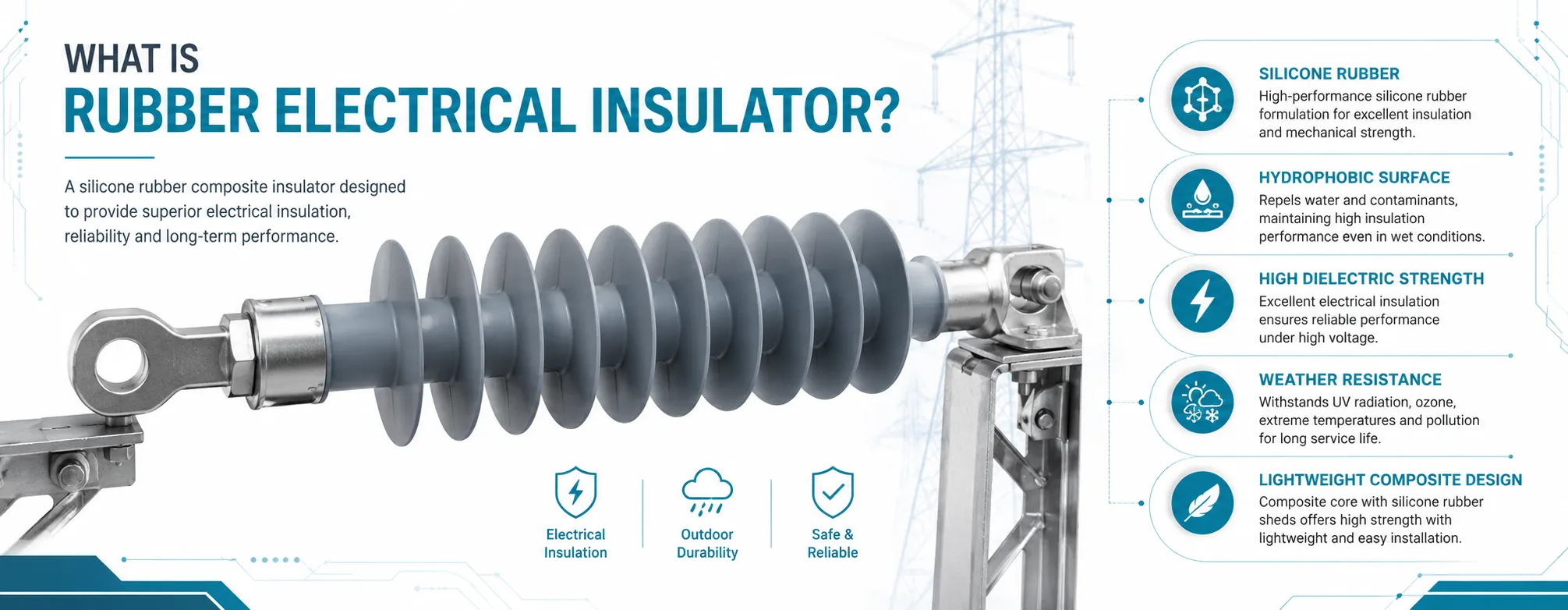
What Is a Rubber Electrical Insulator?
A rubber electrical insulator is an insulating component made from an elastomeric material that prevents unwanted electrical current from passing between conductive parts. It also provides mechanical support, environmental protection and separation between energized conductors and grounded structures.
Rubber insulation is used in power transmission, distribution equipment, electrical connectors, cable accessories, switchgear, transformers and industrial electrical systems. Depending on the application, the insulator may be molded as a housing, sleeve, shed, boot, gasket, cover or complete composite-insulator assembly.
Modern outdoor insulators commonly use silicone rubber because it combines electrical insulation with flexibility, hydrophobicity and resistance to weathering. Silicone rubber is particularly useful where equipment is exposed to moisture, pollution, ultraviolet radiation and temperature changes.
Basic Function
A rubber electrical insulator separates conductive components, limits leakage current and protects electrical systems from flashover, contamination and environmental exposure.
How Does a Rubber Electrical Insulator Work?
Electrical current naturally follows conductive paths. A rubber insulator creates a high-resistance barrier between energized equipment and surrounding conductive structures. This helps keep current within the intended conductor or circuit.
The insulating material must resist electrical stress across its surface and through its body. Surface performance is especially important outdoors because rain, salt, industrial pollution and dust can create partially conductive layers on an insulator.
Many outdoor rubber insulators use multiple sheds or ribs. These features increase the creepage distance, which is the distance electrical leakage must travel along the surface between two conductive points.
Dielectric Insulation
The dielectric properties of rubber allow it to resist current flow under an applied voltage. The required dielectric performance depends on voltage level, material thickness, geometry, contamination and operating environment.
Creepage Distance
Creepage distance is an important consideration for outdoor electrical insulation. A longer surface path can reduce the risk of leakage current and flashover in wet or polluted environments.
Mechanical Support
An electrical insulator must often support conductor weight, tension, vibration and wind loading. In a composite insulator, the internal core provides mechanical strength while the silicone rubber housing provides electrical and environmental protection.
Why Is Silicone Rubber Used for Electrical Insulators?
Silicone rubber electrical insulators are widely used because silicone maintains useful electrical and physical properties under demanding outdoor conditions. It can remain flexible across a broad temperature range and resists degradation from ozone, sunlight and moisture.
One of the most valuable characteristics of silicone rubber is surface hydrophobicity. A hydrophobic surface causes water to form droplets instead of spreading into a continuous film. This can help reduce surface leakage current during rain, fog or humid conditions.
Silicone rubber may also transfer some hydrophobic behavior to contamination deposited on its surface. This characteristic makes it attractive for polluted industrial, coastal and desert environments.
Silicone Rubber Composite Insulator
A silicone rubber composite insulator usually consists of a fiberglass-reinforced core, metal end fittings and a molded silicone rubber housing. The core carries the mechanical load, while the silicone housing protects the core and forms the weather sheds.
Composite construction can provide lower weight than traditional porcelain or glass insulators. The lighter weight can simplify transportation, installation and replacement on transmission and distribution structures.
HTV Silicone Rubber Insulator
An HTV silicone rubber insulator uses high-temperature-vulcanized silicone rubber. HTV silicone is commonly processed through injection molding or compression molding to form a durable housing around the insulator core.
The formulation may include reinforcing silica, pigments, flame-retardant additives and other ingredients selected to improve electrical, mechanical and environmental performance.
Silicone Rubber Insulator Coating
Silicone rubber can also be applied as a coating to certain existing insulator surfaces. A properly designed coating may improve hydrophobicity and contamination performance, but surface preparation and coating quality are critical.
Key Properties of Electrical Insulating Rubber
High Electrical Resistance
Electrical insulating rubber limits current flow through the material and helps isolate energized components from ground.
Диэлектрическая прочность
Silicone rubber dielectric strength describes the material's ability to resist electrical breakdown under an applied electric field. Actual performance depends on formulation, thickness, defects and test conditions.
Гидрофобная поверхность
Silicone rubber naturally repels water, helping prevent the formation of continuous conductive films on outdoor insulators.
Tracking Resistance
Tracking is the formation of a conductive path across an insulating surface. A suitable silicone formulation must resist tracking caused by electrical stress and contamination.
Erosion Resistance
Electrical discharges and dry-band arcing can gradually erode the insulator surface. Formulation and shed design influence resistance to this damage.
Устойчивость к погодным воздействиям
Silicone rubber resists ultraviolet exposure, ozone, rain and temperature cycling, making it suitable for long-term outdoor use.
Low-Temperature Flexibility
Silicone remains flexible in cold conditions where some other elastomers may harden or crack.
Lightweight Construction
Composite silicone insulators are generally lighter than comparable porcelain designs, reducing handling and structural loads.
Common Types of Rubber Electrical Insulators
Silicone Rubber Line Insulator
A silicone rubber line insulator supports overhead conductors while electrically separating them from poles or towers. Common configurations include suspension, tension, post and pin-type insulators.
Композитный подвесной изолятор
A composite suspension insulator is used on overhead transmission and distribution lines. It normally includes a fiberglass core, silicone sheds and metal end fittings.
Silicone Post Insulator
A silicone post insulator provides rigid support for busbars, conductors or switchgear components. It may be installed in substations, distribution equipment and railway electrification systems.
Hollow Composite Insulator
Hollow composite insulators are used around equipment such as bushings, current transformers, voltage transformers and surge arresters. The hollow structure houses internal electrical components or insulating media.
Rubber Insulating Boot
A rubber insulating boot covers terminals, connectors and cable joints to reduce accidental contact and protect against moisture, dust and contamination.
Electrical Insulating Sleeve
An electrical insulating sleeve fits around conductors, connections or components. Silicone sleeves are selected where flexibility, heat resistance and environmental durability are required.
Insulating Mats and Sheets
Electrical insulating rubber sheets and mats are used around switchboards, substations and maintenance areas. These products are different from structural line insulators and must be selected according to their specified electrical rating.
Silicone Rubber vs Porcelain and Glass Insulators
Полимерный изолятор и фарфоровый изолятор
The choice between a polymer insulator and porcelain insulator depends on voltage, pollution severity, mechanical loading, maintenance practices and service history.
Silicone composite insulators are often preferred where low weight and pollution performance are important. Porcelain remains widely used because of its long service history, rigidity and established inspection procedures.
Neither material is automatically superior for every installation. Product design, manufacturing quality and correct application are more important than material name alone.
How Silicone Rubber Insulators Are Manufactured
Manufacturing normally begins with the mechanical core and end fittings. For a composite line insulator, a fiberglass rod is prepared and connected to metal fittings that transfer mechanical loads.
The silicone rubber housing is then molded around the core or manufactured separately and assembled according to the product design. Injection molding is commonly used to create a continuous housing with integrated weather sheds.
Important manufacturing controls include core preparation, fitting attachment, silicone mixing, molding temperature, curing time, bonding and prevention of trapped air or contamination.
1
Material Preparation
Select and prepare the silicone rubber compound, fiberglass core and metal fittings.
2
Core Assembly
Attach the end fittings to the core using a controlled mechanical assembly process.
3
Housing Molding
Mold the silicone rubber housing and weather sheds around the prepared core.
4
Curing
Cure the silicone under controlled temperature and time conditions.
5
Inspection and Testing
Inspect dimensions, surfaces, interfaces, markings and required electrical or mechanical performance.
Rubber Electrical Insulator Applications
Overhead Transmission Lines
Composite silicone insulators support conductors on transmission towers while maintaining electrical separation under high voltage.
Распределительные сети
Silicone post and suspension insulators are used on poles, crossarms and compact distribution structures.
Электроподстанции
Post insulators, bushings and hollow composite insulators support and protect energized substation equipment.
Surge Arresters
Silicone rubber housings protect surge-arrester components from moisture, contamination and mechanical damage.
Cable Accessories
Silicone rubber is used in cable terminations, joints, stress cones, insulating boots and connector covers.
Электрификация железных дорог
Lightweight silicone composite insulators are used in overhead railway systems where vibration, contamination and restricted installation space may be important.
Industrial Electrical Equipment
Silicone rubber seals, sleeves and insulation components protect motors, transformers, connectors and high-voltage equipment.
How to Select a Rubber Electrical Insulator
1. Confirm the Voltage Level
Specify system voltage, impulse requirements, temporary overvoltage and insulation coordination requirements.
2. Define Creepage Distance
Select creepage distance according to pollution severity, humidity, altitude and installation environment.
3. Review Mechanical Loading
Consider tensile, bending, torsional, compression, wind and conductor loads.
4. Evaluate Pollution Conditions
Coastal salt, industrial emissions, dust and agricultural contamination can affect surface leakage performance.
5. Check Temperature Range
Confirm that the silicone formulation and complete assembly can tolerate local environmental temperatures.
6. Select the Insulator Type
Choose suspension, tension, post, pin, hollow or cable-accessory insulation according to the installation.
7. Review Material Testing
Request information about tracking, erosion, weathering, mechanical strength and electrical testing.
8. Confirm Manufacturing Quality
Review core sealing, fitting attachment, housing bonding, traceability and factory quality controls.
9. Consider Maintenance
Determine inspection intervals, cleaning requirements and replacement criteria for the service environment.
10. Verify Applicable Standards
Specify the relevant project, national and international electrical-insulator requirements before ordering.
Common Causes of Rubber Insulator Failure
Отслеживание и эрозия
Pollution, moisture and electrical stress can create leakage current and dry-band arcing. Repeated arcing may produce tracking or surface erosion.
Повреждения жилья
Cuts, punctures, animal damage, poor handling or installation tools can damage silicone sheds and expose internal components.
Попадание влаги
If moisture enters the interface between the housing, core and end fitting, it may reduce mechanical or electrical reliability.
Разрыв сердечника
Mechanical overload, manufacturing defects, improper installation or long-term degradation can damage the internal fiberglass core.
End-Fitting Corrosion
Coastal, chemical and high-humidity environments can corrode metal fittings if the material and protective finish are unsuitable.
Неправильный выбор товара
Insufficient creepage distance, inadequate mechanical rating or an unsuitable silicone formulation can shorten service life even when the product is manufactured correctly.
Inspection Note
Rubber insulators should be inspected according to the equipment owner's maintenance procedures. Surface appearance alone may not reveal every internal defect.
Часто задаваемые вопросы
Is rubber a good electrical insulator?
Many rubber formulations provide high electrical resistance, but only materials designed and tested for electrical insulation should be used in electrical equipment.
Why is silicone rubber used in high-voltage insulators?
Silicone rubber provides hydrophobicity, weather resistance, flexibility and good electrical-insulation properties.
What is a silicone rubber composite insulator?
It is an insulator consisting of a load-bearing core, metal end fittings and a protective silicone rubber housing with weather sheds.
Is silicone rubber better than porcelain?
Silicone is lighter and more hydrophobic, while porcelain offers rigidity and a long operating history. The best choice depends on the application.
Can ordinary silicone rubber be used as electrical insulation?
General-purpose silicone should not automatically be used in high-voltage systems. The compound and finished component must meet the required electrical and environmental performance.
What is tracking resistance?
Tracking resistance is the ability of an insulating surface to resist the development of a permanent conductive path under electrical and environmental stress.
What is the purpose of insulator sheds?
Sheds increase creepage distance and help manage water and contamination on the insulator surface.
How long does a silicone rubber insulator last?
Service life depends on material quality, voltage stress, pollution, weather, mechanical loading, installation and maintenance.
Choose Electrical Insulation for the Complete Environment
A rubber electrical insulator prevents unwanted current flow while supporting and protecting energized equipment. Silicone rubber is widely used because it combines electrical insulation, hydrophobicity, flexibility and outdoor weather resistance.
Reliable performance depends on the complete insulator design, including the silicone formulation, creepage distance, mechanical core, end fittings, interfaces and manufacturing quality.
When selecting a silicone rubber electrical insulator, evaluate voltage, pollution, mechanical loading, climate, testing requirements and long-term maintenance rather than choosing by material name alone.