
Why Silicone Rubber Is Used for Pastry Brush Silicone Manufacturing
Silicone rubber has become one of the most important materials in modern pastry brush silicone manufacturing. It provides the flexibility required for spreading butter, oil, egg wash, glaze, and sauce while also offering heat resistance, moisture resistance, easy cleaning, and compatibility with food-contact applications.
A well-designed silicone pastry brush must remain soft enough to follow the surface of bread, cakes, pastries, and cookware, but strong enough to retain its bristles during repeated use. Manufacturers must therefore select the correct silicone rubber grade, hardness, curing system, bristle geometry, handle structure, molding method, and food-contact compliance program.
What Is Pastry Brush Silicone?
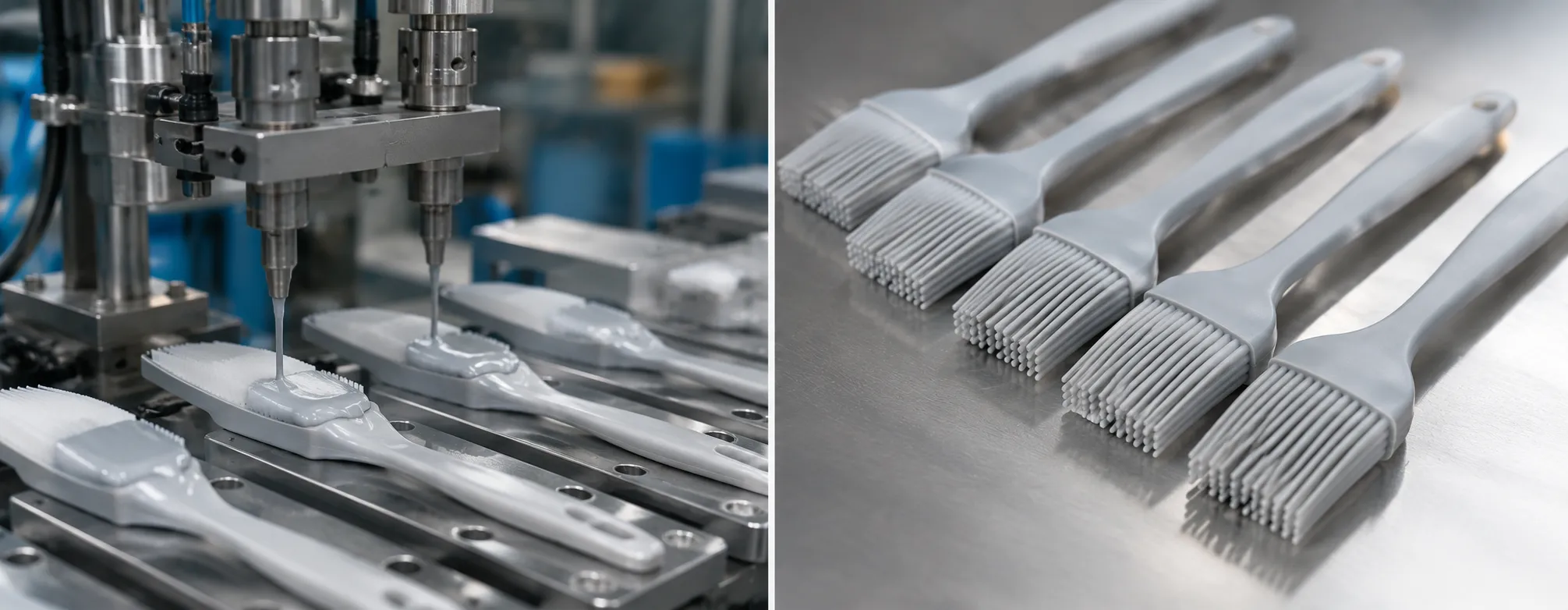
Pastry brush silicone refers to the flexible silicone rubber used to manufacture the bristle head, coating, grip, or integrated body of a silicone pastry brush. Unlike traditional pastry brushes made with natural or synthetic fibers, a silicone brush normally uses molded elastomeric bristles.
These bristles may be arranged in rows, tapered fingers, flat blades, or multi-level flexible structures. Their purpose is to collect and distribute a controlled amount of liquid over food or cookware without scratching the surface.
The silicone rubber can be molded as a separate brush head and assembled onto a plastic, wood, or metal handle. It can also be overmolded directly around a compatible handle insert. Some products use a one-piece silicone design that reduces joints and creates a continuous washable surface.
Why Silicone Rubber Is Suitable for Pastry Brushes
A pastry brush is exposed to a demanding combination of heat, food oils, moisture, repeated bending, cleaning chemicals, and mechanical contact. Silicone rubber offers a useful balance of properties that addresses these conditions.
| Silicone rubber property | Benefit for a pastry brush |
|---|---|
| Heat resistance | Supports brushing near warm cookware, baked products, grills, and heated food. |
| Elastic flexibility | Allows bristles to bend, spread, and return toward their original shape. |
| Moisture resistance | Helps the brush tolerate repeated washing, rinsing, and contact with liquid ingredients. |
| Release characteristics | Supports easier removal of oil, glaze, butter, and food residue during cleaning. |
| Pigmentability | Allows manufacturers to produce coordinated colors and product ranges. |
| Molding precision | Supports consistent bristle shapes, thin flexible sections, and integrated sealing details. |
| Weather and aging resistance | Helps preserve elasticity and appearance during storage and repeated use. |
| Food-contact formulation options | Allows manufacturers to select grades designed for repeated contact with food. |
Heat Resistance During Baking and Cooking
Heat resistance is one of the main reasons silicone rubber is selected for pastry brush silicone products. A brush may contact warm baking trays, hot pans, freshly baked bread, heated butter, barbecue sauce, or food surfaces close to an oven or grill.
Food-contact silicone formulations for kitchenware are commonly designed to operate across a broad temperature range. Selected grades may be specified from approximately -60°C to 220°C, although the permitted temperature depends on the exact formulation, exposure time, component thickness, mechanical load, and applicable compliance conditions.
Silicone rubber does not soften and melt in the same way as many conventional thermoplastics. After curing, it forms a crosslinked elastomeric structure. Excessive heat can still cause gradual hardening, discoloration, property loss, or decomposition, so the finished pastry brush must have a clearly defined operating-temperature rating.
Manufacturers should test the actual brush rather than relying only on the general temperature capability of silicone rubber. The brush head, internal insert, adhesive, handle, pigment, and overmolded interface may each have different thermal limits.
Flexibility and Controlled Brushing Performance
A traditional fiber brush uses many individual hairs to hold and distribute liquid. A silicone pastry brush must create similar spreading performance through molded flexible bristles. The elasticity of silicone rubber allows these bristles to bend across irregular surfaces and recover after the load is removed.
Silicone hardness is an important design variable. A very soft formulation may feel comfortable but may not spread thick glaze effectively. A harder compound may provide greater control but can feel stiff and may not conform well to delicate pastry surfaces.
The best result normally comes from balancing material hardness with bristle length, thickness, taper, spacing, root geometry, and the number of bristle rows. Long, thin bristles bend easily, while shorter and thicker bristles apply greater spreading force.
Small ribs, channels, or textured surfaces can be molded into the bristles to retain more liquid. These features must remain easy to clean and should not create deep areas where food residue can accumulate.
Food-Contact Requirements
Not every silicone rubber compound is automatically suitable for a pastry brush. Food-contact suitability depends on the complete formulation, including the silicone polymer, fillers, catalyst, crosslinker, pigment, processing aids, and any secondary treatment.
In the United States, rubber articles intended for repeated food contact may be evaluated under 21 CFR 177.2600. In Germany and other markets that refer to BfR guidance, Recommendation XV covers silicones used for food-contact applications.
Compliance should be confirmed for the exact material grade, color, manufacturing process, cure conditions, post-curing conditions, and intended food-contact environment. A general statement that a product is made from silicone is not sufficient evidence of compliance.
Manufacturers should obtain supporting documentation from the raw-material supplier and conduct the required extraction, migration, sensory, or finished-article testing. The applicable program may depend on whether the brush contacts aqueous food, acidic ingredients, fats, oils, alcohol-containing products, or food at elevated temperatures.
The expression “FDA approved silicone” should also be used carefully. In many industrial purchasing documents, it is more accurate to state that the selected material is formulated or tested to comply with the applicable requirements of a particular food-contact regulation.
Why LSR Is Common in Pastry Brush Silicone Manufacturing
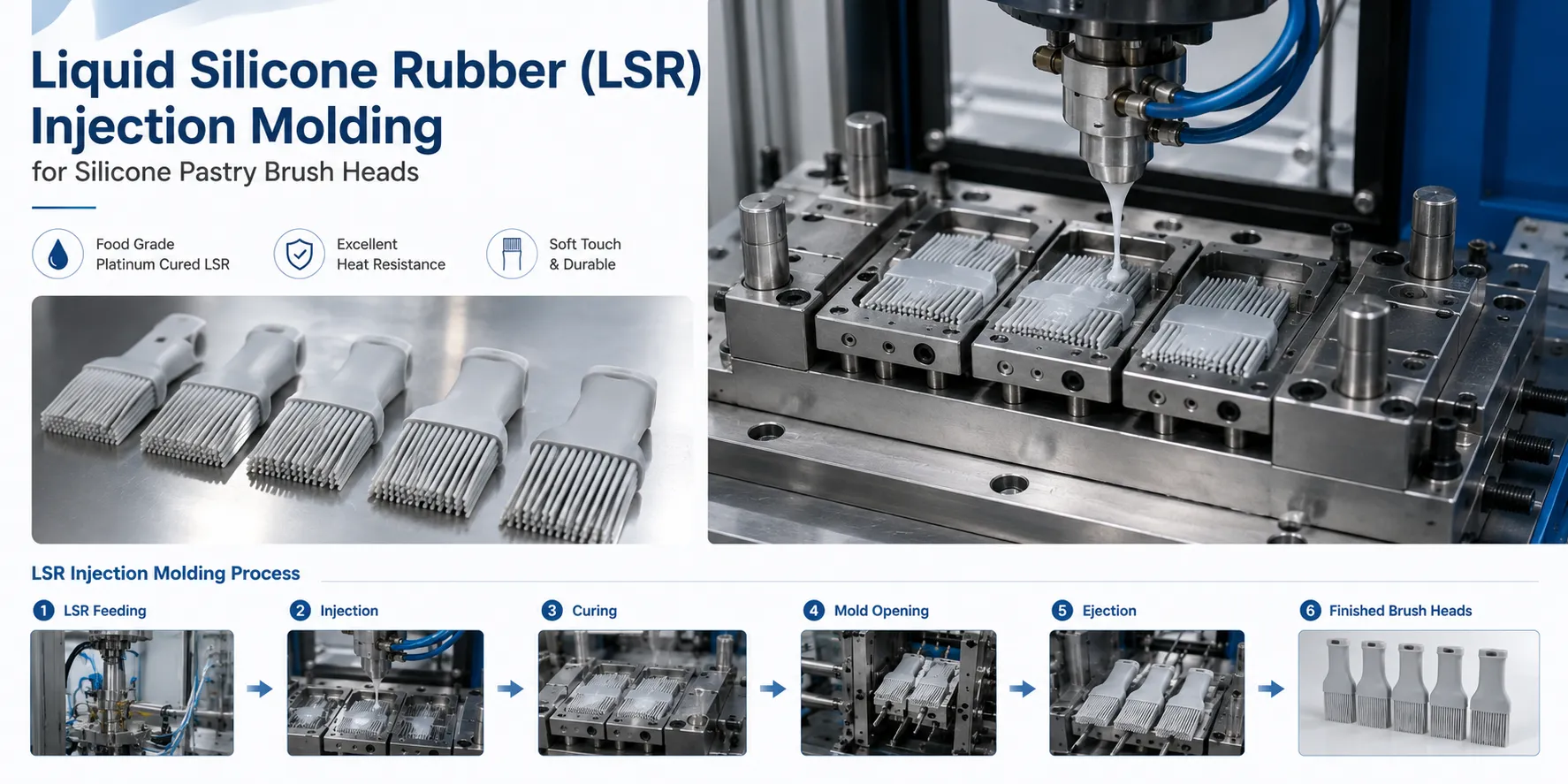
Liquid Silicone Rubber, commonly abbreviated as LSR, is frequently selected for molded kitchen utensils. It is normally supplied as a two-component liquid system that is metered, mixed, injected into a heated mold, and rapidly cured.
The low viscosity of uncured LSR allows it to fill narrow mold cavities and reproduce thin, flexible bristles. This makes it suitable for pastry brush heads containing many repeated details.
Automated liquid injection molding also helps manufacturers maintain a controlled mixing ratio and repeatable production cycle. Multi-cavity molds can produce several brush heads in each cycle, supporting efficient production for large retail or private-label orders.
LSR can also support insert molding and overmolding. A plastic or metal handle insert can be positioned in the mold before injection, allowing the silicone to cure around the insert and create a mechanical or chemical connection.
The mold must be manufactured accurately because liquid silicone can flow through very small gaps. Parting-line control, venting, runner design, mold temperature, injection pressure, and clamping force all influence flash and finished bristle quality.
Using HCR for Silicone Pastry Brush Components
High Consistency Rubber, or HCR, may also be used in pastry brush silicone manufacturing. HCR has a firm, gum-like consistency before curing and can be processed through compression molding, transfer molding, or specialized injection molding.
HCR can be suitable for thicker brush heads, handles, grips, seals, and lower-volume products. Compression molding may also be practical for custom kitchen tools, prototypes, promotional products, and designs that do not require extremely thin bristles.
Both platinum-cured and peroxide-cured HCR grades are available. For food-contact products, the manufacturer must select an appropriate formulation and follow the required curing and post-curing procedure.
LSR is often preferred for fine, complex bristle geometry and highly automated production, while HCR may be appropriate for robust molded parts and flexible manufacturing volumes. The best material depends on the brush design and production strategy.
One-Piece and Overmolded Brush Designs
One-Piece Silicone Construction
A one-piece silicone pastry brush combines the handle surface and brush head into a continuous structure. This can reduce visible joints and provide a smooth external surface.
A fully silicone structure may contain an internal rigid insert to improve handle strength. The silicone rubber provides the external grip and bristles, while the insert carries bending loads during use.
Silicone Head with a Separate Handle
Another common design uses a removable or permanently attached silicone brush head combined with a stainless steel, plastic, or wooden handle. This configuration allows the manufacturer to use different materials for appearance, rigidity, cost, and branding.
The connection between the brush head and handle must resist twisting and pulling. Mechanical locking features, holes, ribs, undercuts, collars, or compatible bonding systems may be incorporated into the design.
Silicone Overmolding
Overmolding places a prepared insert inside the silicone mold before injection or compression molding. The silicone then forms around selected areas of the insert.
Successful overmolding requires compatible substrate materials, controlled surface preparation, stable insert positioning, and an appropriate silicone grade. Mechanical interlocks are often used even when chemical adhesion is expected.
Pastry Brush Silicone Manufacturing Process
- Product design:
Define brush width, bristle length, bristle spacing, handle shape, color, weight, and target application. - Material selection:
Choose a food-contact silicone rubber grade with suitable hardness, tear strength, heat resistance, colorability, and processing behavior. - Tooling development:
Design mold cavities, gates, vents, parting lines, insert supports, ejection features, and flash-control surfaces. - Material preparation:
Meter and mix LSR components or prepare the required HCR compound and pigment system. - Molding and curing:
Inject or compress the silicone into a heated mold and maintain the required cure conditions. - Demolding:
Remove the brush without tearing thin bristles or deforming the handle connection. - Post-curing when required:
Apply the specified secondary heat treatment to stabilize the material or support regulatory requirements. - Finishing:
Remove flash, inspect bristle edges, assemble separate handles, and apply permitted markings. - Cleaning and packaging:
Clean the finished product according to the approved procedure and protect it from contamination before shipment.
Quality Control for Silicone Pastry Brushes
Quality inspection should evaluate both the silicone material and the finished utensil. A compound can meet its raw-material specification while the molded brush still fails because of incomplete curing, air entrapment, flash, weak bristle roots, or poor attachment to the handle.
- Visual inspection:
Check color consistency, contamination, short molding, bubbles, surface defects, and excess flash. - Hardness testing:
Confirm that the cured silicone provides the intended balance of softness and control. - Tensile and tear testing:
Evaluate the mechanical strength of the selected silicone formulation. - Bristle pull testing:
Confirm that individual bristles and bristle groups resist tearing from the brush head. - Handle attachment testing:
Measure pull-off and rotational resistance between the silicone head and the handle. - Heat-aging testing:
Check appearance, elasticity, hardness, and mechanical integrity after elevated-temperature exposure. - Cleaning-cycle testing:
Evaluate the brush after repeated washing or dishwasher cycles under the intended use conditions. - Food-contact testing:
Complete the applicable extraction, migration, sensory, or documentation requirements.
Choosing the Right Pastry Brush Silicone
Material selection should begin with the finished product requirement rather than with a generic request for food-grade silicone. Two compliant silicone compounds can have very different hardness, flow, tear strength, cure speed, transparency, and molding performance.
- Define the intended temperature:
Include normal food temperature, brief contact with hot cookware, cleaning temperature, and storage conditions. - Select the required hardness:
Match silicone softness to the bristle design and expected brushing force. - Review tear strength:
Thin molded bristles require sufficient resistance to tearing at their roots. - Confirm food-contact compliance:
Obtain documentation for the exact compound, pigment, curing system, and market. - Choose LSR or HCR:
Consider geometry, production volume, automation, tooling, and required surface finish. - Evaluate handle compatibility:
Verify adhesion, mechanical locking, heat resistance, and chemical compatibility. - Test the real product:
Validate brushing performance, heat exposure, washing, food contact, and long-term durability.
Часто задаваемые вопросы
Why is silicone rubber used for pastry brushes?
Silicone rubber combines heat resistance, flexibility, moisture resistance, molding precision, release characteristics, and food-contact formulation options. These properties make it suitable for reusable pastry brush bristles and handles.
Is every silicone pastry brush food safe?
No. Suitability depends on the exact silicone compound, pigment, curing process, manufacturing controls, regulatory documentation, and finished-product testing.
Is LSR suitable for pastry brush silicone manufacturing?
Yes. Liquid Silicone Rubber is particularly suitable for automated production of thin bristles, complex details, integrated handles, and high-volume molded brush heads.
Can HCR be used to manufacture a silicone pastry brush?
Yes. High Consistency Rubber can be compression molded or injection molded into brush heads, grips, and thicker utensil components.
What hardness is best for pastry brush silicone?
There is no universal hardness. The correct value depends on bristle length, thickness, spacing, brush width, ingredient viscosity, and the desired balance between softness and spreading control.
Can silicone pastry brushes be used with hot food?
Food-contact silicone rubber can be formulated for elevated temperatures, but the user must follow the temperature rating specified for the complete finished brush.
Заключение
Silicone rubber is used for pastry brush silicone manufacturing because it provides the flexibility, heat resistance, moisture resistance, molding precision, and food-contact performance required for a reusable kitchen utensil.
LSR is particularly effective for high-volume production of thin, detailed brush bristles, while HCR can be used for compression-molded heads, handles, grips, and robust kitchenware components. One-piece molding and overmolding also give manufacturers flexibility in hygiene, appearance, handling, and structural design.
A successful silicone pastry brush depends on more than selecting a material described as food grade. Manufacturers must verify the exact compound, pigment, curing conditions, brush geometry, handle connection, food-contact compliance, cleaning performance, and finished-product durability.