
Conductive Rubber: How It Works and Its Uses in Electrical Systems
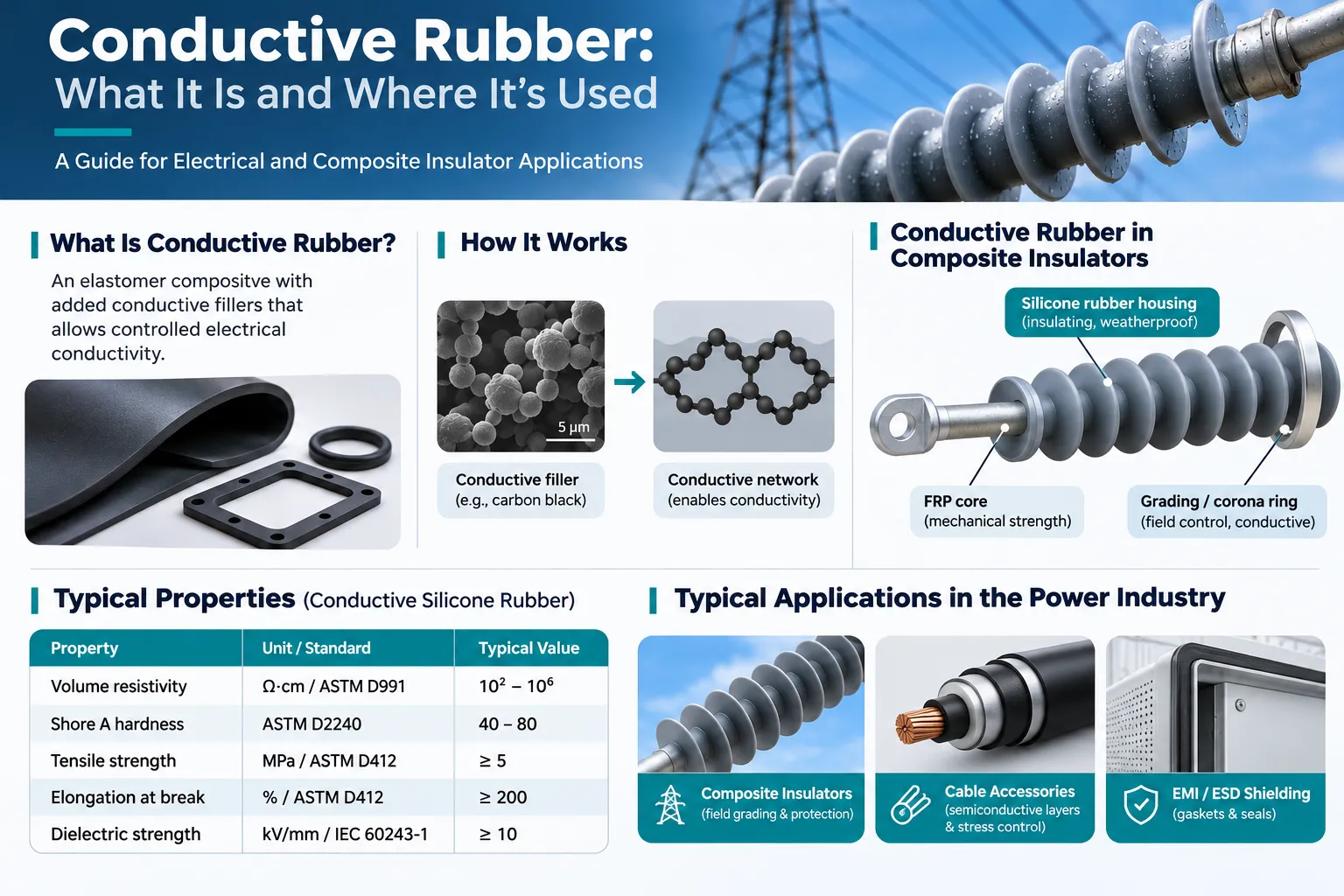
Conductive rubber is an elastomeric material formulated to allow controlled electrical current flow. Unlike conventional insulating rubber, it contains conductive fillers or other engineered conductive structures that create electrical pathways through the material.
Electrically conductive rubber is used in EMI shielding gaskets, antistatic components, electrical contacts, cable accessories and specialized electrical field-control systems. Conductive silicone rubber is particularly useful when an application requires a combination of electrical functionality, flexibility, temperature resistance and environmental durability.
In high-voltage power equipment, however, it is essential to distinguish conductive, semiconductive and electrically insulating rubber. Composite insulator sheds and housings normally require insulating silicone rubber, whereas specially designed conductive or field-grading materials may be used in selected interfaces or related electrical components.
This guide explains how conductive rubber works, which fillers provide conductivity, how electrical resistivity is measured, where conductive elastomers are used and how engineers can select the appropriate material for power transmission and industrial applications.
Electrical Silicone Rubber Materials for Power Applications
Electrical systems use different silicone rubber compounds for insulation, sealing and specialized electrical functions. Select the material according to its actual role in the finished component.
YK-3160 HTV Silicone Rubber for Composite Insulators
Electrical insulating HTV/HCR compounds for composite insulator housings and sheds. Developed for dielectric performance, outdoor exposure, hydrophobicity and molding requirements.
Material function: Electrical insulation
Silicone Rubber for Insulators, Wire & Cable
Electrical-grade compound solutions for composite insulators, surge arrester housings, cable insulation and cable-related components.
Material function: Application-dependent electrical insulation
Conductive or semiconductive material requirements must be specified separately from insulating-grade silicone rubber.
Cao su dẫn điện là gì?
Conductive rubber refers to natural or synthetic elastomer compounds that have been engineered to conduct electricity at a defined level. Conductivity is usually introduced through carbon-based particles, metal-based fillers, conductive fibers or other functional materials.
Conventional silicone rubber is generally an effective electrical insulator. In contrast, conductive silicone rubber contains a designed network of electrically active materials that allows charge carriers to move through the compound.
The material can provide electrical functionality while retaining some of the mechanical benefits associated with elastomers, including flexibility, resilience, sealing capability and conformity to irregular contact surfaces.
Electrical behavior depends on filler type, loading, dispersion, curing and the finished component's operating conditions. Therefore, conductive rubber should be specified using measurable properties rather than described simply as either conductive or nonconductive.
How Does Rubber Become Electrically Conductive?
Most unfilled rubber polymers do not have enough freely moving charge carriers to support substantial electrical conduction. Manufacturers can alter this behavior by adding electrically conductive materials to the elastomer.
Conductive Filler Networks
When conductive particles are sufficiently dispersed and interconnected, they form pathways through which electrical charge can move. This transition is often associated with the electrical percolation threshold.
Below this threshold, the compound may remain relatively resistive. As the conductive filler network develops, electrical resistivity can decrease significantly.
The threshold varies according to the filler structure, particle geometry, concentration, polymer matrix, dispersion quality and manufacturing conditions.
Common Conductive Fillers
| Loại chất làm đầy | Electrical Function | Engineering Considerations |
|---|---|---|
| Conductive Carbon Black | Forms carbon-based conductive networks. | Loading, structure, dispersion, resistivity consistency and mechanical trade-offs. |
| Graphite | Provides conductive carbon pathways. | Particle shape, loading, contact resistance and dispersion. |
| Metal or Metal-Coated Particles | Supports conductive contacts and selected shielding functions. | Cost, corrosion compatibility, particle stability and environmental exposure. |
| Conductive Fibers or Wires | Creates engineered conductive paths through an elastomer structure. | Orientation, compression, contact geometry and long-term durability. |
| Functional Ceramic Fillers | Can provide nonlinear field-dependent conductivity in specialized systems. | Electric-field response, temperature dependence and high-voltage qualification. |
Filler selection must be based on the required electrical function. A compound intended for EMI shielding is not automatically suitable for high-voltage field grading, and a static-dissipative compound is not necessarily suitable for carrying substantial operating current.
Key Electrical Properties of Conductive Rubber
Electrical resistivity is one of the most useful parameters for comparing conductive rubber compounds. Nevertheless, resistivity alone cannot describe every electrical function or guarantee performance in a finished assembly.
Điện trở suất thể tích
Volume resistivity measures the opposition to electrical current through the bulk material. It is commonly expressed in ohm-centimeters (Ω·cm) or ohm-meters (Ω·m).
For a uniform specimen with an appropriate electrode arrangement, resistance is related to material resistivity, current path length and cross-sectional area:
R = ρ × L / A
Where R is electrical resistance, ρ is volume resistivity, L is the current path length and A is the cross-sectional area.
This simplified relationship illustrates why two products made from the same rubber compound may exhibit different measured resistance values when their dimensions differ.
Electrical Conductivity
Electrical conductivity represents the ability of a material to conduct current and is the reciprocal of resistivity. It can be expressed as σ = 1/ρ when consistent units are used.
Surface and Contact Resistance
Surface resistance describes current flow along a material surface, while contact resistance describes the electrical resistance at an interface between components.
Contact resistance is important for conductive sealing and EMI applications because a conductive compound may still perform poorly if it does not establish reliable electrical contact with the mating surface.
Resistance Under Mechanical Compression
Conductive elastomer components are often compressed during assembly. The resulting change in filler contacts, geometry and interface pressure may alter their electrical resistance.
For this reason, measuring a flat material sample may not be enough. Finished components should be evaluated under representative compression and operating conditions.
Conductive Rubber Technical Parameters: What Engineers Should Specify
The following table identifies the main properties to request when evaluating conductive rubber for industrial or electrical applications. The acceptance values must be established for the specific formulation and component; there is no universal specification that covers every conductive rubber product.
| Tham số | Unit / Method | Importance | Specification Consideration |
|---|---|---|---|
| Điện trở suất thể tích | Ω·cm / ASTM D991 where applicable | Bulk electrical conduction. | Define target range and test conditions. |
| Điện trở tiếp xúc | Ω / Assembly-specific test | Electrical continuity at interfaces. | Specify contact pressure, electrodes and geometry. |
| Điện trở bề mặt | Ω / Appropriate resistance method | Surface charge movement. | Define humidity, voltage and conditioning. |
| Độ cứng | Shore A / ASTM D2240 | Indentation and sealing behavior. | Set target hardness and tolerance. |
| Độ bền kéo | MPa / ASTM D412 | Mechanical integrity under tension. | Set a minimum appropriate to the part. |
| Độ giãn dài khi đứt | % / ASTM D412 | Stretchability before failure. | Consider installation and service strain. |
| Độ bền kéo | kN/m / ASTM D624 | Resistance to tearing. | Specify test geometry and acceptance value. |
| Độ biến dạng vĩnh viễn do nén | % / ASTM D395 | Recovery after sustained compression. | Define temperature, time and compression. |
| Temperature Performance | °C / Grade-specific testing | Electrical and mechanical stability. | Specify minimum, continuous and peak temperature. |
| Field-Dependent Conductivity | Conductivity vs. electric field | Specialized high-voltage field grading. | Define the operating electric field and temperature range. |
ASTM D991 is specifically relevant to volume-resistivity measurements of conductive and antistatic rubber. The selected standard and electrode arrangement must match the material and the purpose of the test. Testing an insulating compound, conductive gasket or nonlinear field-grading formulation may require different procedures.
Conductive Rubber in Composite Insulators and Power Transmission
Composite insulators are used in overhead transmission and distribution systems to support electrical conductors while maintaining the required insulation between energized equipment and supporting structures.
A typical composite insulator contains a fiberglass-reinforced polymer core, an external polymeric housing with weather sheds, and metal end fittings. Each component has a separate mechanical or electrical role.
Why Composite Insulator Housings Must Be Electrically Insulating
The silicone rubber housing and weather sheds form part of the external insulation system. They provide the required surface insulation geometry, protect the core and help maintain performance in wet or polluted outdoor environments.
Electrical-grade silicone rubber for these housings is selected for properties such as dielectric strength, volume resistivity, hydrophobicity, tracking resistance, erosion resistance and outdoor aging performance.
Making the entire housing electrically conductive would undermine its intended insulating function. Therefore, ordinary conductive rubber must not be substituted for a composite insulator housing compound.
Where Conductive or Field-Grading Materials May Be Relevant
Electric-field concentration can occur around electrodes, end fittings and transitions between materials. Selected high-voltage components use carefully engineered field-control techniques to manage these stresses.
Specialized resistive or semiconductive elastomeric materials may be considered in particular engineered interfaces or adjacent electrical assemblies where their function is explicitly defined.
However, this should not be confused with the usual design of an overhead composite insulator. Metal grading or corona rings are widely used to influence the external electric-field distribution, and conductive elastomeric layers are not a universal feature of composite insulator construction.
Material Roles in a Composite Insulator System
| Component | Material Direction | Main Function |
|---|---|---|
| FRP Core | Insulating fiber-reinforced polymer | Provides mechanical strength and forms part of the insulation structure. |
| Housing and Sheds | Electrical insulating silicone rubber | Provides external insulation, creepage distance and environmental protection. |
| Metal End Fittings | Conductive metal | Transfers mechanical load and connects to the electrical or supporting structure. |
| Grading / Corona Rings | Conductive metal where specified | Helps control the external electric-field distribution. |
| Specialized Interface Components | Design-dependent; may include functional elastomers | Performs a defined interface function after engineering validation. |
For manufacturers producing composite insulator housings, electrical insulating HTV/HCR silicone remains the primary material category to evaluate.
Electrical Insulation Silicone Rubber for Composite Insulators: YK-3160 Grade Comparison
The following Yakows YK-3160 grades illustrate specifications for electrically insulating composite insulator compounds. They are not conductive rubber grades and must not be used as substitutes for a specified conductive or semiconductive material.
| Tham số | YK-3160D | YK-3160Z | YK-3160G |
|---|---|---|---|
| Độ cứng | 65 ± 3 Shore A | 65 ± 3 Shore A | 60 ± 3 Shore A |
| Độ bền kéo | ≥ 4.0 MPa | ≥ 4.5 MPa | ≥ 5.0 MPa |
| Độ giãn dài khi đứt | ≥ 220% | ≥ 220% | ≥ 240% |
| Dielectric Breakdown Field | ≥ 20 kV/mm | ≥ 21 kV/mm | ≥ 22 kV/mm |
| Electrical Function | Insulating | Insulating | Insulating |
These listed values are from the YK-3160 product information and serve as initial material-selection data, not as a finished-insulator voltage rating. Confirm the latest grade-specific technical data, test conditions and project requirements before material approval.
Conductive and Semiconductive Rubber in High-Voltage Cable Accessories
High-voltage cable accessories provide one of the clearest applications for purpose-designed conductive and semiconductive elastomeric materials.
A power cable normally has multiple functional layers. The conductor carries current, the insulation separates energized components, and semiconductive screens help establish controlled electrical interfaces.
At a cable joint or termination, the screen geometry changes. This can create regions of concentrated electric field that require a designed stress-control solution.
Semiconductive Screens
Semiconductive materials are used in cable designs to help maintain controlled electrical interfaces around the insulation system. Their resistivity requirements differ from both highly conductive metals and insulating polymers.
Stress-Control Components
Stress-control components help manage electric-field concentrations near cable screen interruptions and other critical transitions. Depending on the accessory design, this function may be provided through geometric, resistive, refractive or nonlinear field-grading approaches.
Nonlinear Field-Grading Rubber
Some specialized polymer composites are engineered so their conductivity changes with electric-field strength. Such formulations can be used to influence field distribution in suitable high-voltage applications.
These systems are substantially different from ordinary conductive carbon-filled EMI gaskets. Selection requires electrical modeling and qualification under the intended voltage, geometry, temperature and aging conditions.
Conductive or semiconductive cable-accessory materials should never be substituted solely because two suppliers report similar Shore A hardness or a single room-temperature resistance value.
Other Industrial Uses of Conductive Rubber
EMI and RFI Shielding Gaskets
Conductive rubber gaskets are used around electronic enclosures, connectors and equipment interfaces where electrical continuity and electromagnetic shielding are required. The material must provide suitable contact with the mating surfaces while accommodating compression and environmental exposure.
Electrostatic Dissipation
Static-dissipative elastomers are used where controlled discharge of accumulated electrostatic charge is required. Their resistance targets depend on the application and applicable safety requirements.
Electrical Contacts and Flexible Components
Conductive elastomers can be used in specialized flexible contact structures where rigid conductors are unsuitable. Contact pressure, mechanical cycling and surface condition can affect their electrical performance.
Industrial Sensors and Functional Elastomers
Some conductive rubber compounds are developed for devices whose resistance changes with deformation or pressure. These materials require a different performance specification from conventional shielding or power-insulation compounds.
Conductive Rubber vs. Insulating Silicone Rubber
These two material categories are designed to perform different electrical functions. Their suitability must be assessed against the final component, not only the shared word “rubber.”
| Tài sản | Conductive / Semiconductive Rubber | Cao su silicone cách nhiệt |
|---|---|---|
| Primary Electrical Role | Controlled current flow, dissipation, shielding or field control | Restricting unwanted electrical conduction |
| Electrical Resistivity | Selected to meet a defined conductive or semiconductive range | High resistivity is normally required |
| Filler Strategy | Conductive carbon, metal or specialized functional fillers | Insulating reinforcement and application-specific mineral filler systems |
| Cách sử dụng thông thường | EMI gaskets, semiconductive interfaces and specialized field grading | Composite insulator sheds, housings and cable insulation |
| Main Qualification Focus | Resistivity, interface continuity, contact behavior and application-specific electrical response | Dielectric strength, tracking, erosion, aging and mechanical performance |
Electrical conductivity is also different from thermal conductivity. A silicone rubber compound formulated to transfer heat is not automatically electrically conductive, because thermally conductive insulating fillers can be used in certain formulations.
How Is Conductive Silicone Rubber Manufactured?
Conductive silicone rubber manufacturing begins with selection of a silicone polymer system and the conductive filler package. Compounding and processing must create the desired electrical pathways while maintaining acceptable elastomer properties.
Formulation and Filler Selection
The required electrical performance determines the general direction of filler selection. Engineers must evaluate resistivity, mechanical performance, environmental compatibility and processability together.
Mixing and Dispersion
Mixing distributes fillers within the silicone matrix. Dispersion affects electrical pathway formation and batch-to-batch consistency. Poor dispersion can produce localized areas with different conductivity or mechanical properties.
Molding or Extrusion
Suitable compounds may be compression molded, injection molded or extruded according to their formulation and the intended product. Processing conditions influence dimensions, surface appearance and the distribution of conductive filler networks.
Curing and Quality Verification
Curing produces the elastomeric network, but the finished material must also retain its specified electrical behavior. Quality control should include appropriate resistance or resistivity measurements together with mechanical-property testing and, where relevant, tests after compression or aging.
What Can Cause Conductive Rubber to Fail?
Conductive rubber failure is not limited to visible tearing or cracking. A product may retain its physical shape while no longer meeting its electrical specification.
| Potential Issue | Possible Cause | Recommended Evaluation |
|---|---|---|
| Resistivity Variation | Filler dispersion, batch variation or processing differences | Test multiple locations and production batches under controlled conditions |
| High Contact Resistance | Insufficient contact pressure, oxidation, contamination or incompatible interface | Measure assembled contact resistance under representative compression |
| Mechanical Cracking | Unsuitable formulation, excessive deformation or aging | Review tensile, elongation, tear and cyclic loading requirements |
| Temperature-Dependent Drift | Changes in conductive networks or polymer response | Measure electrical behavior across the intended temperature range |
| Electrical Field Concentration | Incorrect component geometry, interfaces or field-grading design | Conduct electrical modeling and relevant high-voltage qualification tests |
Testing Standards for Conductive Rubber and High-Voltage Silicone
Material testing should be selected according to the electrical function. Conductive rubber, insulating silicone and finished composite insulators are evaluated using different types of tests.
| Standard | Test Scope | Ứng dụng |
|---|---|---|
| ASTM D991 | Volume resistivity of conductive and antistatic rubber products | Conductive elastomer material evaluation |
| ASTM D257 | DC resistance or conductance of insulating materials | Appropriate insulating material evaluations |
| ASTM D2240 | Durometer hardness | Mechanical material specification |
| ASTM D412 | Rubber tensile properties | Tensile strength and elongation |
| IEC 60587 | Tracking and erosion resistance of insulating materials | Relevant insulating silicone material qualification |
| IEC 61109 | Composite insulator definitions, tests and acceptance criteria | Applicable finished composite insulator qualification |
The latest applicable edition, test method and acceptance criteria should be confirmed for the project. Material-level resistivity testing does not replace finished-component electrical qualification.
How to Choose Conductive Rubber for Electrical Applications
Material selection begins by defining the exact function the rubber must perform. A specification for static dissipation is not interchangeable with a specification for EMI shielding or high-voltage field grading.
- Identify the electrical function. Determine whether the requirement is conductivity, semiconductive behavior, shielding, electrical contact or insulation.
- Specify electrical properties. Define the required resistivity, resistance, field dependence or shielding performance using appropriate units.
- Define operating conditions. Include temperature, humidity, outdoor exposure and mechanical loading.
- Match the processing method. Confirm whether the compound will be molded, extruded, die-cut or assembled as a component.
- Evaluate interfaces. Consider contact pressure, mating metals, corrosion compatibility and electrical field concentration.
- Validate the finished assembly. Conduct appropriate electrical and mechanical testing under representative operating conditions.
For composite insulators, verify that the requested product is genuinely an insulating housing compound. If the project instead calls for a specialized conductive or semiconductive interface, that requirement must be defined and reviewed separately by the equipment design team.
What Should OEMs Include in a Conductive Rubber RFQ?
Providing complete technical information helps prevent confusion between conductive, semiconductive and insulating rubber materials.
| RFQ Item | Information to Provide |
|---|---|
| Component Type | Composite insulator housing, cable accessory, field-grading part, gasket or other component |
| Electrical Function | Conductive, semiconductive, antistatic, shielding or insulating |
| Electrical Specification | Volume resistivity, resistance, dielectric requirements or field-dependent behavior |
| Mechanical Requirements | Hardness, tensile strength, elongation, tear strength and compression set |
| Quy trình sản xuất | Compression molding, injection molding, extrusion or another defined process |
| Service Conditions | Voltage, temperature, humidity, outdoor conditions and expected lifetime |
| Quantity and Documents | Estimated demand, target samples, TDS and applicable test reports |
Silicone Rubber Materials for Composite Insulators and Power Equipment
Yakows provides HTV/HCR silicone rubber compounds for electrical insulation applications, including composite insulator housings, polymer-housed surge arresters and related power equipment.
For composite insulator production, the YK-3160 series offers different combinations of Shore A hardness, mechanical strength and dielectric properties for technical comparison and molding trials.
Share your component drawing, required material function, target properties and manufacturing process for a material review. Conductive or semiconductive material requests should be identified explicitly, as they are not interchangeable with the listed insulating grades.
Request Material Specifications & Samples →
Email: info@yakows.com
Frequently Asked Questions About Conductive Rubber
What is conductive rubber?
Conductive rubber is an elastomeric material designed to allow electrical conduction through added conductive fillers or engineered conductive structures.
Cao su silicone có dẫn điện không?
Conventional silicone rubber is generally electrically insulating. Conductive silicone rubber is produced using formulations designed to introduce controlled electrical pathways.
Cao su dẫn điện được dùng để làm gì?
Applications include EMI shielding gaskets, static-dissipative components, electrical contacts, cable interfaces and specialized electrical field-control systems.
What makes conductive silicone rubber conductive?
Conductive fillers such as carbon black, graphite or selected metal-based particles can form conductive pathways in the silicone matrix when the formulation and dispersion are suitable.
What is the difference between conductive and semiconductive rubber?
They are selected for different electrical behaviors and resistance requirements. Semiconductive rubber is designed for controlled electrical behavior in applications such as selected cable screens or interfaces, while conductive rubber may be designed for lower-resistance contacts or shielding. Exact classifications depend on the application standard.
Is conductive rubber used for composite insulator sheds?
Ordinary composite insulator sheds are designed to be electrically insulating. Conductive rubber must not replace the silicone housing material. Specialized conductive or field-grading materials are separate, design-dependent components.
Why are semiconductive materials used in cable accessories?
They help establish controlled electrical interfaces. Some specialized semiconductive or nonlinear materials also support electric-field management around critical transitions in high-voltage cable accessories.
What is volume resistivity in conductive rubber?
Volume resistivity describes opposition to current flow through the bulk material. It is typically reported in Ω·cm or Ω·m under specified test conditions.
Which standard is used to test conductive rubber?
ASTM D991 addresses volume-resistivity measurement for conductive and antistatic rubber. Other methods may be required for surface resistance, contact resistance, mechanical properties or completed electrical assemblies.
Can conductive rubber and insulating silicone rubber have the same hardness?
Yes. Similar Shore A hardness does not imply similar electrical properties. The filler system, formulation and electrical tests determine whether the materials serve conductive or insulating functions.
Technical References
- MAJR – Conductive Rubber: What It Is and Where It's Used
- ASTM D991 – Volume Resistivity of Conductive and Antistatic Rubber
- Nonlinear Electrical Conduction in Polymer Composites for Field Grading in High-Voltage Applications
- Review of the Performance of High-Voltage Composite Insulators
- Yakows – YK-3160 Electrical Insulation Silicone Rubber