
SILICONE RUBBER MATERIAL ENGINEERING
How to Measure Silicone Rubber Tear Strength and Evaluate Material Performance
Silicone rubber tear strength measures the ability of a cured silicone elastomer to resist the initiation and propagation of a tear under specified mechanical testing conditions. It is an important property for molded and extruded silicone components exposed to stretching, sharp edges, localized stress, repeated deformation and difficult demolding conditions.
For industrial manufacturers, tear strength is more than a number on a technical datasheet. It affects the reliability of sealing lips, flexible profiles, cable accessories, molded components and composite insulator housings. A material with suitable tear resistance can help reduce damage during manufacturing, handling and installation.
However, tear strength must be evaluated together with tensile strength, elongation, hardness, curing conditions and application requirements. This guide explains how silicone rubber tear strength is measured, which factors influence its performance, how to interpret ASTM and ISO test results, and how to select the right HTV/HCR silicone rubber compound.
YAKOWS MATERIAL SOLUTIONS
High Tear Strength Silicone Rubber for Industrial Manufacturing
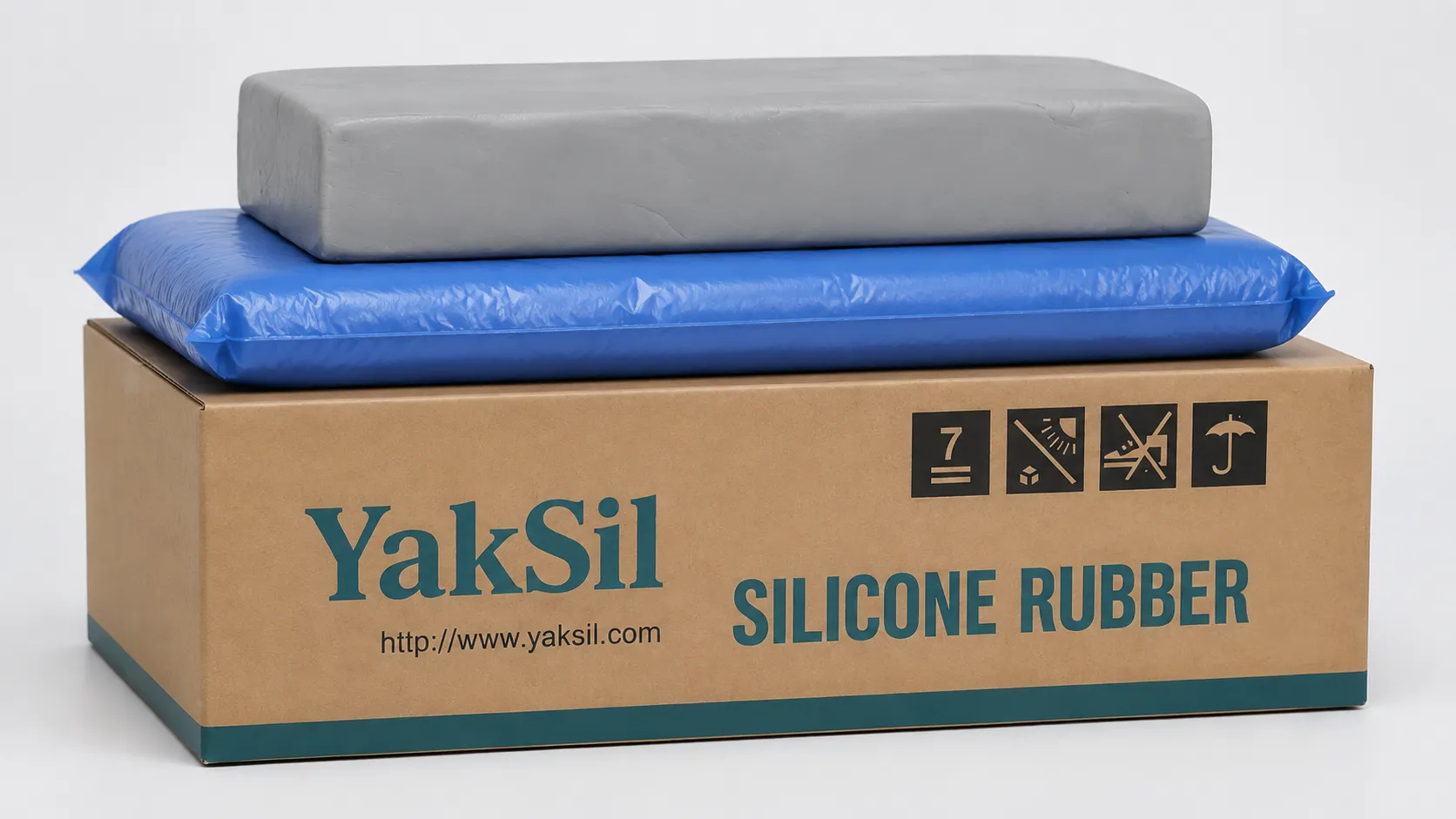
Yakows supplies HTV/HCR silicone rubber compounds for industrial molding, extrusion, electrical insulation and demanding mechanical applications. Material selection can be matched to hardness, tear resistance, tensile properties and production requirements.
Cao su silicone có độ bền xé cao
Formulations for flexible molded components, seals, profiles, complex geometries and products requiring improved resistance to tear propagation.
Cao su silicone HTV / HCR
Heat-cured silicone rubber compounds for compression molding, transfer molding, injection molding and selected extrusion processes.
Silicone Rubber for Composite Insulators
Electrical-grade HTV/HCR compounds balancing tear resistance, tensile properties, dielectric performance, tracking resistance and outdoor durability.
Need a specific tear strength, hardness or processing profile?
1. What Is Silicone Rubber Tear Strength?
Tear strength is the resistance of a rubber material to the growth of a cut, notch or existing crack when a mechanical force is applied.
Unlike a tensile test, which evaluates how a specimen behaves when stretched, a tear test focuses on the force required to initiate or propagate a tear through a specimen with a defined geometry.
Silicone rubber is naturally flexible, but flexibility does not automatically mean high tear resistance. A material may stretch considerably before breaking while still being vulnerable to crack propagation around a small cut or sharp edge.
Tear Initiation and Tear Propagation
Two related failure mechanisms are important when evaluating silicone rubber.
- Tear initiation: The force or stress required to create a tear at a defined stress concentration or notch.
- Tear propagation: The resistance to continued growth of an existing tear as the material is subjected to mechanical loading.
Different test specimen geometries emphasize different aspects of tear behavior. This is why a reported tear strength value should always include its test method and specimen type.
2. Why Is Tear Strength Important in Silicone Rubber Applications?
Many silicone rubber components do not fail because the entire part is stretched beyond its maximum tensile strength. Instead, damage often begins at a small defect, thin edge, hole, groove or sharp transition.
When a localized stress concentration develops, a small cut may grow into a larger tear. This can lead to leakage, loss of mechanical integrity, production rejection or premature component failure.
| Ứng dụng | Typical Mechanical Challenge | Why Tear Strength Matters |
|---|---|---|
| Composite Insulator Sheds | Thin edges, complex shed geometry and handling stress. | Helps resist the propagation of localized cuts and mechanical damage. |
| Industrial Seals | Stretching during installation and stress around sealing lips. | Helps reduce tearing around edges, grooves and mounting features. |
| Silicone Tubing | Repeated bending, pulling and contact with surrounding components. | Supports resistance to cuts and tear propagation. |
| Cable Accessories | Stretching and deformation during installation. | Helps maintain mechanical integrity around openings and interfaces. |
| Complex Molded Parts | Deep undercuts, thin sections and difficult demolding. | Can reduce tearing during removal from the mold. |
| Flexible Boots and Bellows | Repeated stretching and bending during service. | Helps prevent small defects from developing into larger tears. |
3. Silicone Rubber Tear Strength vs. Tensile Strength
Tear strength and tensile strength are both important mechanical properties, but they measure different failure behaviors. They should not be used interchangeably when selecting silicone rubber compounds.
| Tài sản | Chỉ số này đo lường điều gì | Common Unit | Engineering Significance |
|---|---|---|---|
| Độ bền kéo | Resistance to tear initiation or propagation in a specified test specimen. | N/mm or kN/m | Important for notches, thin sections, edges and mechanical damage. |
| Độ bền kéo | Maximum tensile stress before specimen failure. | MPa | Evaluates resistance to tensile loading. |
| Độ giãn dài khi đứt | Percentage increase in specimen length before failure. | % | Evaluates stretching capability. |
| Độ cứng | Resistance to indentation. | Bờ A | Describes how firm or soft the cured material is. |
| Độ biến dạng vĩnh viễn do nén | Residual deformation after specified compression and recovery conditions. | % | Important for long-term sealing performance. |
Does Higher Tensile Strength Mean Higher Tear Strength?
Not necessarily. A silicone rubber compound may have good tensile strength but still exhibit relatively low tear resistance under a particular test geometry.
This difference is important because crack propagation is influenced by local stress concentration, polymer deformation, filler reinforcement and the structure of the cured network.
For industrial purchasing, compare tear strength, tensile strength, elongation and hardness together. The best grade is the one that satisfies the actual component requirements rather than maximizing a single laboratory value.
4. How Is Silicone Rubber Tear Strength Tested?
Silicone rubber tear strength is normally measured using a universal testing machine or tensile testing machine fitted with suitable grips and standardized test specimens.
The specimen is prepared according to the selected standard, conditioned under specified conditions and pulled at a controlled speed until the material tears.
Basic Tear Strength Calculation
For test methods that express tear strength as force normalized by specimen thickness, the general relationship is:
T = F / dF = the force defined by the applicable test method
d = the measured specimen thickness
The force used in the calculation depends on the specimen type. For some specimens it is the maximum force; for tear-propagation specimens it may be the mean or median force over the specified tearing region.
Common Tear Strength Units
Tear strength is commonly reported in N/mm or kN/m.
1 N/mm = 1 kN/m.
These units express force per unit specimen thickness. They are not the same as tensile strength in MPa.
For example, a reported value of 12 kN/m is numerically equivalent to 12 N/mm. However, it should only be compared with another result if the test method, specimen geometry and conditions are compatible.
5. ASTM D624 vs. ISO 34-1: Silicone Rubber Tear Test Methods
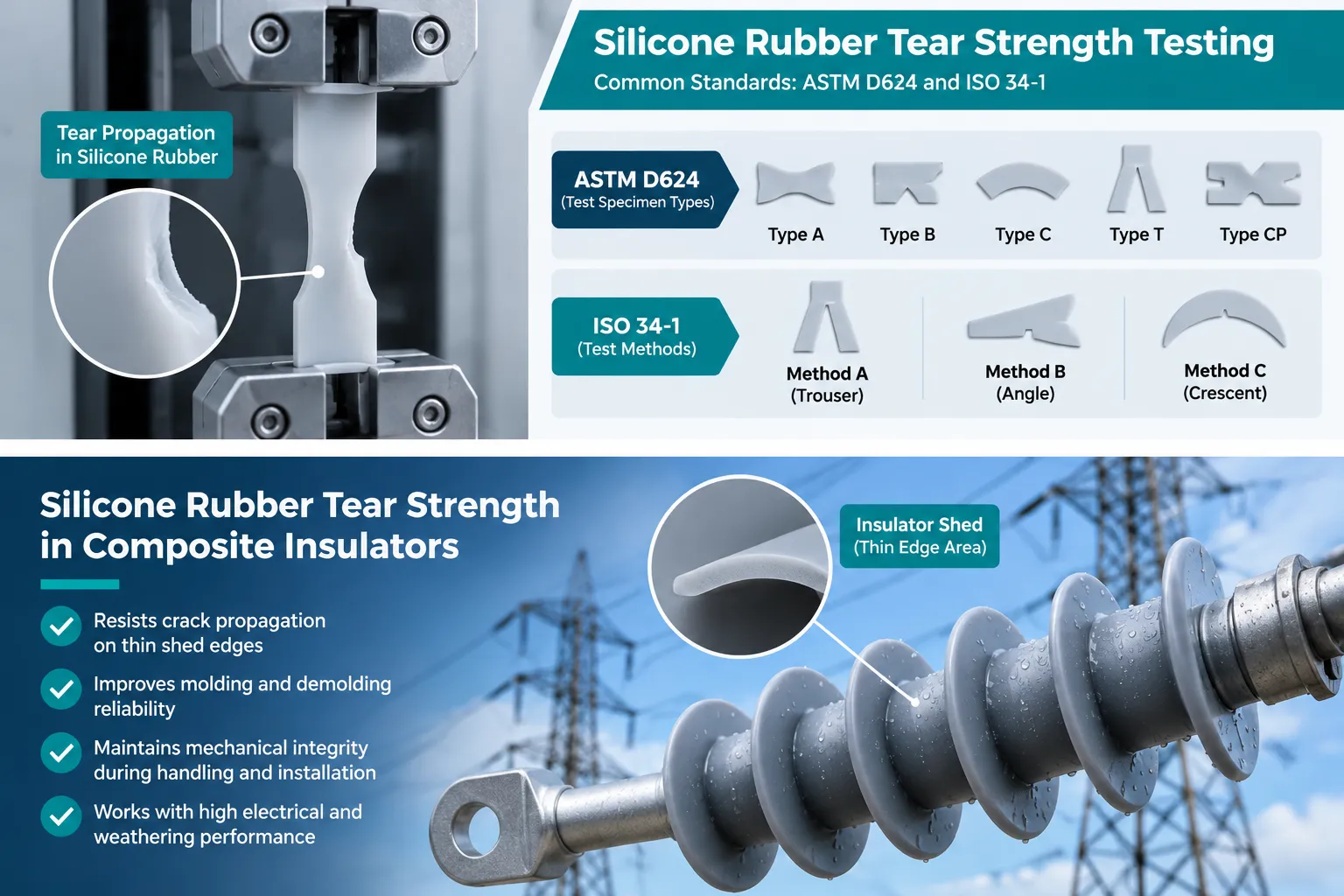
ASTM D624 and ISO 34-1 are widely referenced standards for measuring the tear strength of vulcanized or thermoplastic rubber. They use defined specimen geometries and testing procedures to improve measurement consistency.
ASTM D624
ASTM D624 covers tear-strength testing for conventional vulcanized rubber and thermoplastic elastomers. It includes five specimen types: A, B, C, T and CP.
Types A, B and C use maximum force divided by specimen thickness. Types T and CP evaluate the force required to propagate a tear and use the force measure defined by the applicable calculation procedure.
ISO 34-1
ISO 34-1:2022 specifies three methods for determining tear strength:
- Method A: Trouser test piece.
- Method B: Angle test piece, with or without a specified nick.
- Method C: Crescent test piece with a nick.
ASTM and ISO specimen labels are not interchangeable. For example, ASTM Type A and ISO Method A do not mean the same specimen geometry. Always state the actual standard and specimen type when comparing test results.
| Comparison Item | ASTM D624 | ISO 34-1:2022 |
|---|---|---|
| Scope | Conventional vulcanized rubber and thermoplastic elastomers. | Vulcanized or thermoplastic rubber. |
| Specimen Types | A, B, C, T and CP. | Methods A, B and C. |
| Specimen Geometry | Defined tear-test geometries. | Trouser, angle and crescent. |
| Result | Calculated according to specimen type. | Calculated according to the selected method. |
| Comparison Factors | Specimen, thickness, force calculation and test conditions. | Geometry, stretching speed, temperature and grain effects. |
For reliable supplier comparison, request the standard edition, specimen type, test temperature, specimen preparation and curing conditions. A test result without this information is incomplete for engineering evaluation.
6. What Factors Affect Silicone Rubber Tear Strength?
Tear resistance is determined by the complete silicone rubber formulation and manufacturing process. Several material and processing factors can influence how a crack initiates and propagates.
1. Silicone Polymer Structure
The molecular weight, molecular-weight distribution and polymer structure influence the mechanical behavior of silicone rubber.
High-consistency silicone compounds commonly use high-molecular-weight silicone gums. Polymer chain entanglement and the resulting network structure contribute to the material's ability to deform and distribute stress around a crack.
2. Reinforcing Silica
Reinforcing silica is a key ingredient in many HTV/HCR silicone rubber compounds. Properly selected silica can improve tensile strength, tear resistance and other mechanical properties.
Its reinforcing efficiency depends on particle characteristics, surface area, surface treatment, polymer interaction and dispersion quality.
Adding more filler does not automatically increase tear strength. Excessive loading or unsuitable filler interactions can affect elasticity, processability and the overall mechanical balance.
3. Filler Dispersion
Uniform filler distribution is essential for consistent mechanical performance. Poor dispersion or agglomeration can create localized weak regions where cracks may initiate more easily.
Controlled mixing and homogenization help achieve a more consistent silicone rubber compound.
4. Crosslink Density and Curing System
During vulcanization, silicone polymer chains form a crosslinked network. The resulting network affects hardness, elongation, tensile strength and tear behavior.
Insufficient curing may prevent the material from reaching its intended mechanical performance. Excessive crosslinking can restrict deformation and may reduce selected mechanical properties, depending on the formulation.
5. Hardness and Formulation Balance
Hardness alone cannot predict tear strength. Two compounds with the same Shore A hardness can exhibit different tear resistance because of differences in polymer selection, reinforcing filler systems and cure chemistry.
Material selection should therefore be based on actual test data rather than hardness as a substitute for mechanical performance.
6. Manufacturing Consistency
Mixing conditions, processing temperature, curing time, material storage and production controls can influence the final properties of silicone rubber.
For OEM customers, consistent tear performance between production batches is just as important as achieving a good initial laboratory result.
7. Tear Strength of Different Silicone Rubber Types
Silicone rubber is available in several material forms and curing systems. Tear resistance varies by individual grade and formulation rather than being determined by the material category alone.
| Material Type | Physical Form | Quy trình xử lý tiêu biểu | Tear Strength Considerations |
|---|---|---|---|
| HTV / HCR | Solid, high-consistency silicone compound. | Compression, transfer, suitable injection molding and extrusion. | High-tear grades can be formulated for demanding mechanical and molding requirements. |
| LSR | Liquid, commonly two-component. | Liquid injection molding. | Tear resistance depends on the selected formulation and finished-part geometry. |
| RTV | One-part or two-part systems. | Casting, sealing and application-specific curing. | Mechanical properties vary widely with chemistry, formulation and curing conditions. |
Cao su silicone HTV có độ bền kéo cao
HTV/HCR silicone rubber is widely used for industrial molded and extruded components requiring a balance of mechanical strength, flexibility and heat resistance.
High-tear HTV formulations are especially useful for thin-wall parts, deep undercuts, flexible seals and components that experience substantial deformation during demolding.
Yakows offers high-tear HTV/HCR silicone rubber options across selected hardness levels. The final grade should be evaluated using its own technical datasheet and production trial results.
Explore Yakows High Tear Strength Silicone Rubber →
Does LSR Always Have Lower Tear Strength Than HTV?
No. Neither HTV/HCR nor LSR is automatically superior in tear resistance. A specialized LSR formulation may outperform a general-purpose HTV compound in a particular test, while a high-tear HCR grade may be more suitable for another application.
Compare the exact grade, test method, specimen type and curing conditions rather than assuming one silicone type always has higher tear strength.
8. Silicone Rubber Tear Strength in Composite Insulator Applications
Composite insulators are widely used in power transmission and distribution systems. Their construction normally includes a fiberglass-reinforced polymer core, metal end fittings and an external silicone rubber housing with weather sheds.
The silicone rubber housing provides the external insulating surface and environmental protection. Its mechanical properties must remain suitable during molding, demolding, transportation, installation and long-term outdoor service.
Why Does Tear Strength Matter for Composite Insulator Sheds?
Composite insulator sheds contain thin edges and complex profiles. During manufacturing, the silicone compound must fill the mold and release from the tooling without damaging these features.
During handling and installation, local mechanical forces may also act on shed edges or other exposed sections. If a cut or defect develops, sufficient tear resistance helps limit further crack propagation.
Tear Strength Is Only One Part of Electrical-Grade Silicone Performance
High tear strength alone does not make a silicone rubber compound suitable for high-voltage composite insulators.
Electrical-grade silicone rubber must also be evaluated for:
- Dielectric strength: Resistance to electrical breakdown under specified conditions.
- Hydrophobicity: Water-repellent surface behavior that helps limit continuous conductive water films.
- Tracking resistance: Resistance to the formation of conductive surface paths under electrical stress.
- Erosion resistance: Ability to withstand material loss under electrical discharge and environmental exposure.
- Weathering resistance: Durability under UV radiation, ozone, moisture and temperature changes.
- Mechanical properties: Tear strength, tensile strength, elongation and appropriate hardness.
For composite insulator manufacturers, the objective is to select a balanced electrical-grade HTV/HCR silicone compound that combines mechanical integrity with reliable insulation performance and stable molding behavior.
9. Yakows YK-3160 Silicone Rubber: Tear Strength and Technical Data
Yakows YK-3160 is an electrical-grade HTV/HCR silicone rubber series developed for composite insulator sheds, housings and related high-voltage outdoor insulation components.
The published product information provides three grade directions with different mechanical and electrical characteristics.
| Technical Property | YK-3160D | YK-3160Z | YK-3160G |
|---|---|---|---|
| Độ cứng | 65 ± 3 Shore A | 65 ± 3 Shore A | 60 ± 3 Shore A |
| Độ bền kéo | ≥ 10 kN/m | ≥ 10 kN/m | ≥ 12 kN/m |
| Độ bền kéo | ≥ 4.0 MPa | ≥ 4.5 MPa | ≥ 5.0 MPa |
| Độ giãn dài khi đứt | ≥ 220% | ≥ 220% | ≥ 240% |
| Breakdown Field Strength | ≥ 20 kV/mm | ≥ 21 kV/mm | ≥ 22 kV/mm |
These are the published values for the YK-3160 product series, not a universal silicone rubber benchmark. Before comparing them with another supplier's figures, request the current grade-specific TDS to confirm the tear-test standard, specimen type, curing conditions and acceptance criteria.
The YK-3160G grade has the highest published tear-strength value in this comparison, while grade selection should still consider the complete mechanical and electrical requirements of the finished insulator.
10. How to Improve the Tear Strength of Silicone Rubber
Improving tear resistance requires a balanced approach to formulation, compounding, curing and product design.
Optimize the Silicone Polymer System
Select a polymer system appropriate for the target mechanical performance and manufacturing process. Polymer molecular characteristics influence the behavior of the cured elastomer and the way it deforms around a crack.
Use an Appropriate Reinforcing Silica System
Reinforcing silica can improve tear resistance when its characteristics and loading are properly matched to the silicone polymer. The formulation must also retain suitable elongation and processing behavior.
Improve Filler Dispersion
Consistent mixing and homogenization help reduce agglomeration and localized weak areas within the compound.
Control Vulcanization Conditions
Appropriate curing conditions are necessary to achieve the intended crosslink structure. Undercuring or unsuitable post-curing conditions may affect mechanical performance.
Review Mold Design and Demolding
Sharp edges, deep undercuts, thin sections and excessive removal force can cause tearing even when a suitable compound is used. Mold geometry, release behavior and demolding procedures should be reviewed together with the material.
Validate After Aging
For demanding applications, evaluate tear strength after relevant heat aging, weathering or other specified exposure conditions. Initial room-temperature performance alone may not represent long-term service behavior.
11. How to Select the Right Silicone Rubber Tear Strength Grade
Industrial buyers should define the finished component requirements before comparing silicone rubber suppliers. A higher tear-strength number is not automatically the best choice if the material cannot meet the required processability, hardness or electrical performance.
| Yếu tố lựa chọn | Information to Confirm |
|---|---|
| Đơn đăng ký cuối cùng | Seal, gasket, composite insulator, cable accessory, tubing or molded component. |
| Độ cứng | Target Shore A value and acceptable tolerance. |
| Độ bền kéo | Required value, standard, specimen geometry and test conditions. |
| Tính chất cơ học | Tensile strength, elongation, compression set and dimensional requirements. |
| Phương pháp xử lý | Compression molding, transfer molding, injection molding or extrusion. |
| Operating Environment | Temperature, UV, ozone, moisture, chemical exposure and mechanical cycling. |
| Electrical Requirements | Dielectric strength, tracking, erosion, hydrophobicity and applicable qualification tests. |
| Yêu cầu thương mại | Sample availability, order quantity, packaging, lead time and recurring supply. |
What Should You Request from a Silicone Rubber Supplier?
- Grade-specific technical datasheet.
- Tear strength with the exact test method and specimen type.
- Hardness, tensile strength and elongation results.
- Curing conditions and recommended processing information.
- Relevant heat-aging or application-specific test reports.
- Sample material for production trials.
- Batch consistency and quality-control documentation.
When an existing silicone component is tearing during production, photographs of the damaged area, mold geometry and current process conditions can also help the supplier identify whether the main issue is material selection, tooling or manufacturing control.
YAKOWS · HTV / HCR SILICONE RUBBER
Looking for Silicone Rubber with Higher Tear Resistance?
Yakows supplies HTV/HCR silicone rubber compounds for industrial molding, extrusion and electrical insulation applications. Our material range includes high-tear formulations and specialized electrical-grade compounds for composite insulator manufacturers.
Share your target hardness, tear-strength requirement, test method, production process and final application. Our team can help evaluate suitable grades, technical documentation and sample options.
Request a Grade Recommendation →
Email: info@yakows.com
Frequently Asked Questions About Silicone Rubber Tear Strength
What is the tear strength of silicone rubber?
It is the resistance of cured silicone rubber to tear initiation or propagation under a specified test method. The result depends on the formulation, specimen geometry, test conditions and curing process.
What unit is used for silicone rubber tear strength?
Tear strength is commonly expressed in N/mm or kN/m. These units are numerically equivalent. Tear strength is different from tensile strength, which is normally expressed in MPa.
What is the difference between ASTM D624 and ISO 34-1?
Both standards measure rubber tear strength, but they use different specimen classifications and procedures. ASTM D624 includes types A, B, C, T and CP, while ISO 34-1:2022 specifies trouser, angle and crescent methods.
Does higher Shore A hardness mean higher tear strength?
No. Hardness measures resistance to indentation, while tear strength measures resistance to tearing. Two silicone rubber compounds with the same Shore A hardness can have very different tear performance.
Can high tear strength silicone rubber be used for composite insulators?
Yes, provided that the selected compound also meets the electrical, environmental and mechanical requirements of the insulator design. Tear resistance is only one part of electrical-grade silicone performance.
Which silicone rubber type has the highest tear strength, HTV or LSR?
Neither type is automatically stronger. High-tear formulations can be developed in both systems. Compare the exact grade and equivalent test conditions.
What affects the tear resistance of silicone rubber?
Important factors include polymer structure, reinforcing silica, filler dispersion, crosslink density, curing conditions, specimen geometry and manufacturing consistency.
How can manufacturers reduce silicone rubber tearing during demolding?
Evaluate the compound's tear strength, curing conditions, mold geometry, undercuts, release behavior and demolding force. Material improvement and tooling adjustments should be considered together.
Is tear strength the same as tensile strength?
No. Tensile strength measures the stress a specimen withstands before breaking under tension. Tear strength evaluates the resistance to the growth of a cut or crack under a defined test.
What should I check before purchasing high-tear silicone rubber?
Confirm the exact grade, test standard, specimen type, tear-strength value, hardness, tensile properties, processing method and application-specific requirements. Sample testing is recommended before bulk production.
Technical References
- ASTM D624 – Standard Test Method for Tear Strength of Conventional Vulcanized Rubber and Thermoplastic Elastomers
- ISO 34-1:2022 – Rubber, Vulcanized or Thermoplastic: Determination of Tear Strength
- Instron – ASTM D624 Tear Strength Testing Guide
- ZwickRoell – ASTM D624 Tear Growth Test
- Yakows – YK-3160 HTV Silicone Rubber for Composite Insulators