
3 Forms of Silicone Rubber
Silicone rubber is available in several material forms developed for different manufacturing processes, component designs, curing conditions, and production volumes. The three main forms of silicone rubber are HCR (High Consistency Rubber), LR/LSR (Liquid Rubber or Liquid Silicone Rubber), and RTV (Room Temperature Vulcanising silicone).
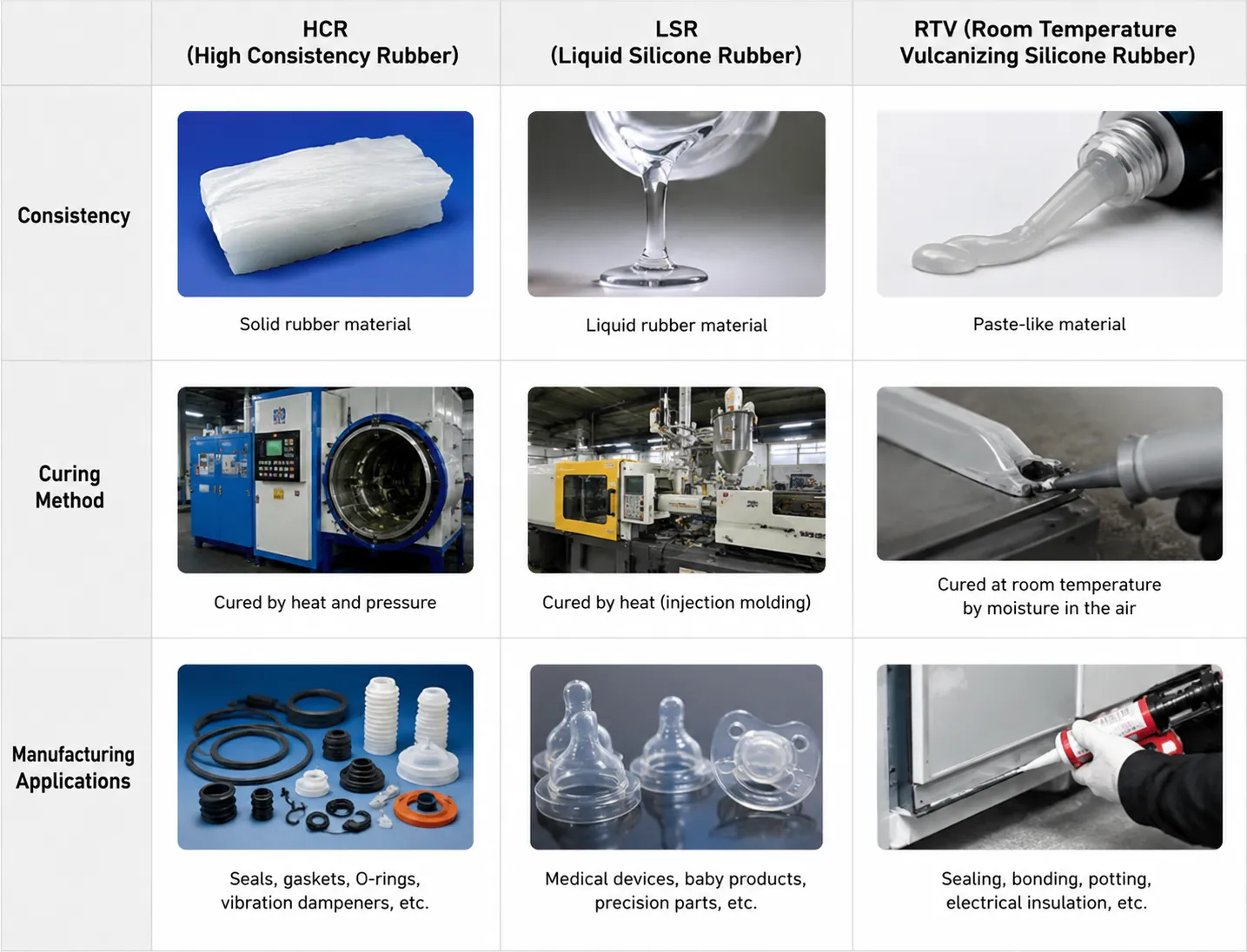
Although these materials share the characteristic performance of silicone elastomers, they differ significantly before curing. HCR is a firm, gum-like compound, LSR is a pumpable two-component liquid, and RTV is generally supplied as a pourable liquid or non-sag paste that cures at room temperature. Understanding these differences helps manufacturers choose the correct silicone for electrical insulation, automotive components, medical devices, industrial seals, electronics, consumer products, and power-industry applications.
What Is Silicone Rubber?
Silicone rubber is a synthetic elastomer based on a polymer structure containing alternating silicon and oxygen atoms. Organic groups attached to the polymer backbone allow the material to be formulated for different levels of hardness, flexibility, transparency, thermal stability, electrical insulation, chemical resistance, and mechanical performance.
A typical silicone rubber formulation contains silicone polymer, reinforcing fillers, crosslinking agents, catalysts, pigments, and optional functional additives. Heat stabilisers, flame-retardant materials, electrically conductive fillers, thermal-conductivity additives, and processing aids may be included when required by the application.
Silicone rubber is valued for its ability to remain flexible across a broad temperature range. It also provides resistance to ozone, ultraviolet radiation, moisture, weathering, and repeated heating and cooling. These properties make silicone useful in demanding outdoor, electrical, automotive, medical, food-processing, and industrial environments.
The final performance of a silicone component depends on more than the general material family. Polymer type, filler content, curing chemistry, manufacturing conditions, part geometry, post-curing, and quality control all influence the finished product.
Overview of the 3 Forms of Silicone Rubber
| Silicone form | Uncured consistency | Typical curing method | Common processing methods |
|---|---|---|---|
| HCR (High Consistency Rubber) | Firm, solid, and gum-like | Heat curing with peroxide or platinum systems | Compression moulding, transfer moulding, extrusion, calendering, and injection moulding |
| LR/LSR (Liquid Silicone Rubber) | Flowable and pumpable two-part liquid | Platinum-catalysed addition curing in a heated mould | Liquid injection moulding, automated dispensing, coating, and overmoulding |
| RTV (Room Temperature Vulcanising) | Pourable liquid, flowable compound, or non-sag paste | One-part moisture curing or two-part room-temperature curing | Dispensing, sealing, bonding, potting, encapsulation, coating, and casting |
The material consistency before curing strongly influences the production process. HCR must be mechanically shaped under pressure, LSR is pumped and injected into a heated mould, and RTV can usually be applied directly to a component or poured into a mould at room temperature.
1. HCR: High Consistency Rubber
HCR stands for High Consistency Rubber. It is also called solid silicone rubber, gum silicone rubber, or heat-cured silicone rubber. Before curing, HCR has a firm consistency similar to modelling material or uncured conventional rubber.
HCR is made from high-molecular-weight silicone polymers combined with reinforcing silica and other ingredients. It may be supplied as sheets, strips, blocks, rolls, or preformed pieces. The material maintains its shape during handling and must be forced into the required geometry through moulding, extrusion, or calendering.
HCR Compression Moulding
Compression moulding is one of the most established methods for processing HCR. A measured amount of uncured silicone is placed into an open, heated mould. The mould closes and applies pressure, causing the silicone to fill the cavity. Heat then activates the curing system and converts the compound into an elastic component.
Compression moulding is suitable for gaskets, diaphragms, seals, electrical components, membranes, large industrial parts, and components with relatively simple geometries. It is also practical for prototypes, customised products, and moderate production volumes.
HCR Extrusion
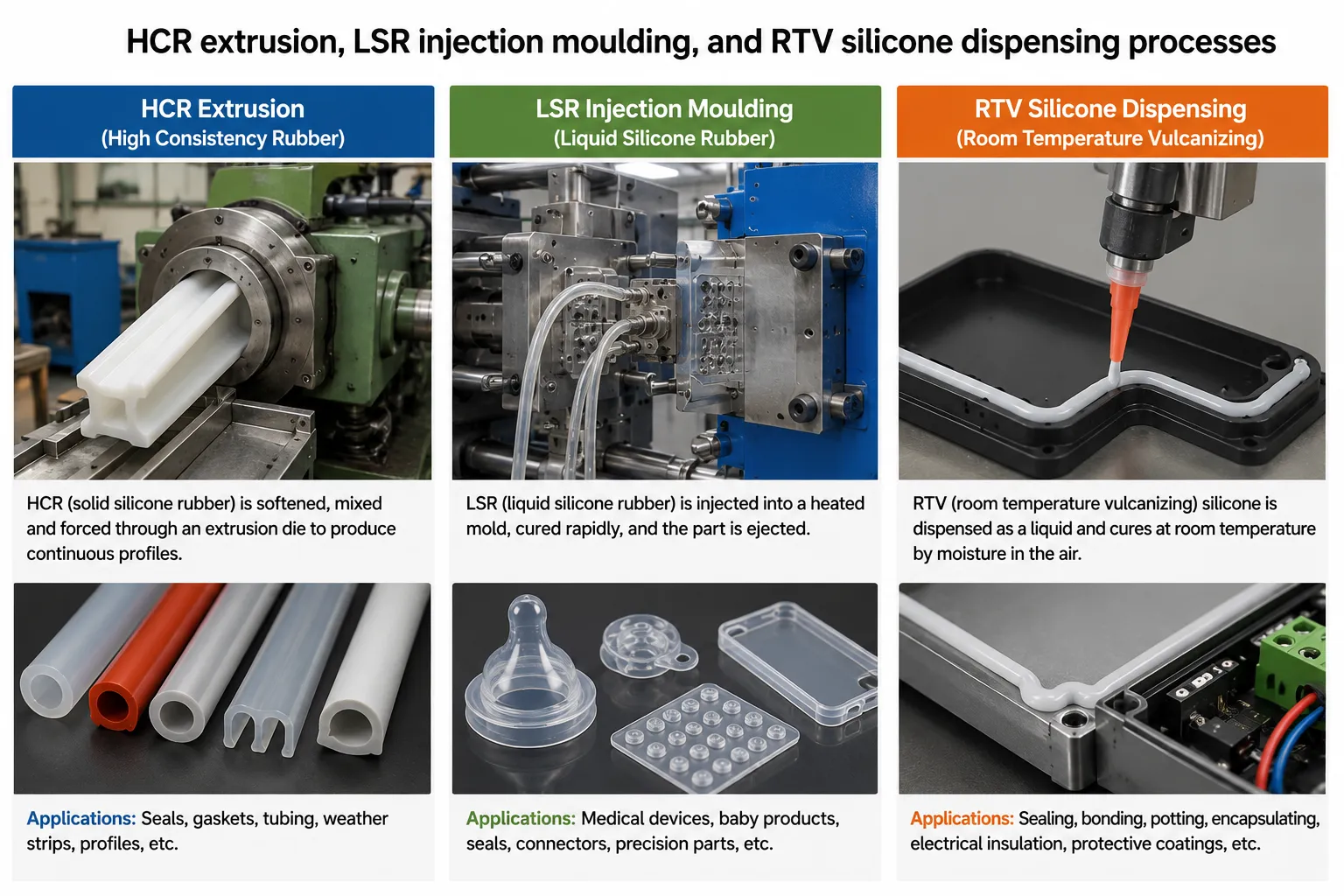
HCR extrusion is widely used to manufacture continuous silicone products. The uncured compound is pushed through a shaped die to create a profile, tube, cord, strip, hose, or cable covering. The extruded material then passes through a heated curing system.
Common curing equipment includes hot-air ovens, infrared systems, microwave systems, and continuous heating tunnels. After curing, the profile may be cut, joined, printed, coated, inspected, or subjected to secondary post-curing.
HCR Calendering and Moulding
Calendering processes HCR between controlled rollers to produce sheets of a specified thickness. Silicone sheet can be supplied directly or converted into die-cut gaskets, insulation pads, membranes, and protective layers.
HCR may also be processed by transfer moulding or specialised injection-moulding equipment. The selected method depends on component size, geometry, production volume, dimensional requirements, and tooling investment.
Key Characteristics of HCR
- Versatile processing:
HCR can be extruded, moulded, calendered, bonded, cut, and fabricated. - Broad hardness range:
Formulations are available for flexible seals and firmer structural components. - Strong mechanical performance:
Selected grades provide useful tensile strength, elongation, tear resistance, and compression-set performance. - Continuous-profile production:
HCR is highly suitable for tubing, cords, hoses, cable insulation, and sealing profiles. - Large component capability:
Compression moulding can produce substantial industrial seals and diaphragms.
Typical HCR Applications
HCR is commonly used for O-rings, flat gaskets, extruded profiles, tubing, hoses, rollers, diaphragms, membranes, oven seals, appliance components, automotive boots, connector seals, industrial seals, and vibration-control components.
In the electrical and power industries, HCR may be used for high-temperature wire insulation, cable profiles, terminal protection, electrical boots, insulating components, outdoor seals, and protective covers. Special electrical-grade formulations may be developed for dielectric strength, weather resistance, tracking resistance, or flame performance.
2. LR/LSR: Liquid Silicone Rubber
LSR stands for Liquid Silicone Rubber. It is generally supplied as a two-component system, commonly identified as Part A and Part B. The two components have a relatively low viscosity and can be pumped directly from drums, pails, or cartridges.
One component usually contains the catalyst, while the other contains the crosslinking ingredients. The components remain separate during storage and are accurately metered and mixed shortly before injection or dispensing.
Most LSR materials use platinum-catalysed addition curing. After the two parts are mixed, the silicone remains workable while kept relatively cool. It cures rapidly after entering a heated mould.
How LSR Injection Moulding Works
LSR production begins with pumping equipment that feeds Part A and Part B at a controlled ratio. Pigment or another additive may be introduced during the metering stage. The components then pass through a mixer to create a uniform material.
The mixed silicone enters an injection unit and is forced into a closed, heated mould. Because uncured LSR is highly flowable, it can fill narrow channels, thin walls, small details, and complex multi-cavity tooling.
Heat inside the mould causes the silicone to crosslink. Once curing is complete, the mould opens and the finished component is removed. Production cells may use robotic handling, automatic demoulding, camera inspection, and fully automated packaging.
Key Characteristics of LSR
- Automated processing:
Pumping, mixing, injection, curing, and demoulding can be integrated into a controlled production cell. - Complex component design:
Its flowability helps reproduce thin walls, fine details, and intricate sealing features. - Consistent material dosing:
Metering equipment provides controlled mixing ratios and repeatable production. - Efficient production cycles:
Heated tooling supports rapid curing and high-volume manufacturing. - Insert moulding:
LSR can be moulded around compatible metal, glass, plastic, or electronic inserts. - Multi-component moulding:
Selected LSR materials can be combined with compatible thermoplastics to create integrated parts.
Typical LSR Applications
LSR is widely used for medical seals, respiratory components, valves, membranes, baby-care products, kitchenware, wearable-device components, automotive connector seals, sensor protection, electronic components, lighting systems, and precision industrial products.
Automotive and new-energy applications include high-voltage connector seals, battery-system components, charging connectors, lighting seals, sensor membranes, and thermal-management parts. LSR is particularly suitable when the component contains several small sealing details within one moulded geometry.
Medical and food-contact LSR grades are available for applications requiring controlled manufacturing, traceability, cleanliness, and compliance with relevant regulations. Suitability must always be confirmed for the exact grade and intended contact conditions.
3. RTV: Room Temperature Vulcanising Silicone
RTV stands for Room Temperature Vulcanising. Unlike heat-cured HCR and LSR, RTV silicone can form an elastomer at room temperature. It is available as one-component RTV-1 and two-component RTV-2 systems.
RTV materials may be supplied as self-levelling liquids, pourable compounds, brushable coatings, or non-sag pastes. This variety allows the silicone to be applied directly to joints, housings, electrical components, moulds, assemblies, and repair areas.
RTV-1: One-Component Silicone
RTV-1 is supplied as a ready-to-use material. It is normally dispensed directly from a cartridge, tube, pail, or automated dispensing system. Most RTV-1 products cure after exposure to moisture in the surrounding air.
Curing begins at the exposed surface and gradually progresses into the material. The cure rate depends on product chemistry, temperature, humidity, bead dimensions, and access to atmospheric moisture.
RTV-1 silicone is commonly used for sealing, bonding, formed-in-place gasketing, conformal coating, appliance assembly, automotive maintenance, cable-entry protection, and environmental sealing.
RTV-2: Two-Component Silicone
RTV-2 is supplied as two components that must be mixed before use. Once combined, the silicone cures throughout the mixed volume. This makes RTV-2 suitable for thicker castings, encapsulation, potting, mould making, and applications where moisture access is limited.
RTV-2 systems may use condensation or addition curing. Formulations are available with different viscosities, working times, cure speeds, hardness levels, transparency, and mechanical characteristics.
Key Characteristics of RTV Silicone
- Room-temperature curing:
RTV generally does not require a heated production mould. - Direct application:
It can be dispensed directly onto housings, joints, circuit boards, and industrial assemblies. - Wide viscosity selection:
Products range from free-flowing liquids to non-sag sealing pastes. - Flexible production volumes:
RTV is suitable for prototypes, maintenance, customised components, and production assembly. - Potting and encapsulation:
Pourable RTV can surround electrical and electronic components to provide environmental protection. - Mould-making capability:
RTV-2 silicone is widely used to reproduce detailed prototypes, industrial parts, models, and tooling surfaces.
Typical RTV Applications
RTV silicone is used for formed-in-place gaskets, electrical enclosures, control cabinets, sensor assemblies, circuit-board coatings, electronic potting, LED protection, appliance sealing, automotive repair, industrial maintenance, construction joints, prototypes, and mould making.
In power and electrical equipment, RTV materials can seal cable entries, protect terminals, encapsulate electronic modules, coat outdoor insulation, and create moisture-resistant barriers. The selected grade must be compatible with the metals, plastics, coatings, and electrical components in the assembly.
HCR vs. LSR vs. RTV
The correct silicone form is determined primarily by how the component will be manufactured. HCR is suitable for extrusion, compression moulding, calendering, and robust industrial rubber components. LSR is designed for automated liquid injection moulding and complex precision parts. RTV is appropriate for direct dispensing, sealing, bonding, coating, potting, casting, and room-temperature production.
Choose HCR When
- Continuous extruded profiles or tubing are required.
- The component is suitable for compression or transfer moulding.
- Large seals, sheets, hoses, or industrial rubber parts are needed.
- The manufacturer already operates conventional rubber-processing equipment.
Choose LSR When
- High-volume automated production is required.
- The design includes thin walls or complex details.
- Repeatable multi-cavity moulding is important.
- The component includes inserts or integrated sealing features.
Choose RTV When
- The silicone must cure directly on an assembly.
- Heating and high-pressure moulding are impractical.
- The application involves potting, sealing, coating, or casting.
- Prototype, maintenance, or customised production is required.
Industrial Applications of the 3 Forms
Power and Electrical Equipment
HCR is commonly used for cable insulation, extruded electrical profiles, connector boots, and weather-resistant seals. LSR can produce precision insulator components, cable accessories, connector seals, and complex electrical protection parts. RTV is frequently applied as a sealant, coating, potting material, or environmental barrier.
Automotive and Electric Vehicles
Automotive HCR applications include hoses, gaskets, boots, vibration-control parts, and under-hood seals. LSR is used for precision connector seals, sensor components, lighting systems, and battery-related parts. RTV products are used for bonding, formed-in-place gasketing, electronic protection, and maintenance.
Medical and Healthcare Products
Medical-grade LSR is widely used for precision moulded components, valves, seals, masks, and wearable-device parts. HCR may be used for tubing, seals, and moulded elastomer components. Selected RTV-2 products can support potting, casting, dental, prosthetic, or specialised healthcare applications.
Industrial Manufacturing
Industrial manufacturers use HCR for profiles, sheets, rollers, seals, and diaphragms. LSR supports automated production of detailed components and integrated seals. RTV provides a practical solution for equipment sealing, electrical protection, repair, mould making, and low-volume component casting.
How to Select the Right Silicone Rubber Form
- Define the manufacturing process.
Determine whether the product will be extruded, moulded, dispensed, coated, potted, or cast. - Review component geometry.
Consider wall thickness, detail level, part size, undercuts, inserts, and required tolerances. - Estimate production volume.
High-volume automated production may favour LSR, while customised or lower-volume work may suit HCR or RTV. - Set performance requirements.
Specify hardness, tensile strength, elongation, tear resistance, compression set, and temperature range. - Evaluate the operating environment.
Consider heat, cold, weather, ultraviolet exposure, moisture, chemicals, voltage, pressure, and mechanical movement. - Confirm regulatory requirements.
Food-contact, medical, electrical, automotive, and fire-related applications may require specialised certified grades. - Check substrate compatibility.
For bonding, coating, overmoulding, and potting, evaluate adhesion and compatibility with surrounding materials. - Produce representative samples.
Test the actual material, process, geometry, and service conditions before approving production.
Frequently Asked Questions
What are the three main forms of silicone rubber?
The three main forms are HCR (High Consistency Rubber), LSR (Liquid Silicone Rubber), and RTV (Room Temperature Vulcanising silicone).
What is the main difference between HCR and LSR?
HCR is a firm, gum-like material processed by extrusion or high-pressure moulding. LSR is a pumpable two-part liquid commonly processed by automated liquid injection moulding.
Does RTV silicone need heat to cure?
RTV is formulated to cure at room temperature. One-part RTV generally reacts with atmospheric moisture, while two-part RTV cures after its components are mixed.
Which silicone is suitable for high-volume precision moulding?
LSR is commonly selected for high-volume precision moulding because it supports automated metering, mixing, injection, rapid heat curing, and multi-cavity production.
Which silicone form is used for extruded tubing?
HCR is widely used to manufacture extruded silicone tubing, hoses, cords, cable insulation, and continuous sealing profiles.
Conclusion
The 3 forms of silicone rubber—HCR, LR/LSR, and RTV—provide different processing routes for producing silicone components. HCR is a high-consistency material suited to extrusion, calendering, and conventional moulding. LSR is a two-component liquid designed for automated injection moulding and detailed precision parts. RTV cures at room temperature and is used for sealing, bonding, potting, coating, casting, and mould making.
Selecting the correct form requires a clear understanding of component geometry, production volume, processing equipment, curing conditions, service environment, and regulatory requirements. The final material should always be validated in the real manufacturing process and end-use application.