
High Tear Strength Silicone Rubber for Demanding Industrial Applications
High tear strength silicone rubber is engineered for molded and extruded components that must withstand difficult demolding, repeated flexing, stretching, thin-wall geometries and long-term mechanical stress. These HTV/HCR silicone compounds combine strong tear resistance with the heat resistance, weatherability, elasticity and processing stability required in demanding B2B manufacturing environments.
What Is High Tear Strength Silicone Rubber?
A high tear strength grade is developed for applications where standard silicone rubber may be vulnerable to edge damage, crack growth, tearing during mold release or repeated deformation during service.
High tear strength silicone rubber is a specially formulated silicone elastomer with enhanced resistance to tear initiation and tear propagation. In practical manufacturing terms, this means the material is better able to tolerate stress around thin edges, holes, ribs, corners, undercuts and other geometries that concentrate mechanical load.
For many industrial silicone components, the most critical moment is not only long-term service but also production itself. Parts with complex geometry can be stretched significantly during demolding. If the silicone compound has insufficient tear resistance, small defects can develop around thin sections and then propagate into larger failures. A well-designed high tear strength HTV silicone rubber helps reduce this risk.
Tear strength should never be evaluated as an isolated number. The most useful material selection combines tear resistance with tensile strength, elongation, hardness, cure behavior, processability, mold release, temperature resistance and the real mechanical demands of the finished component.
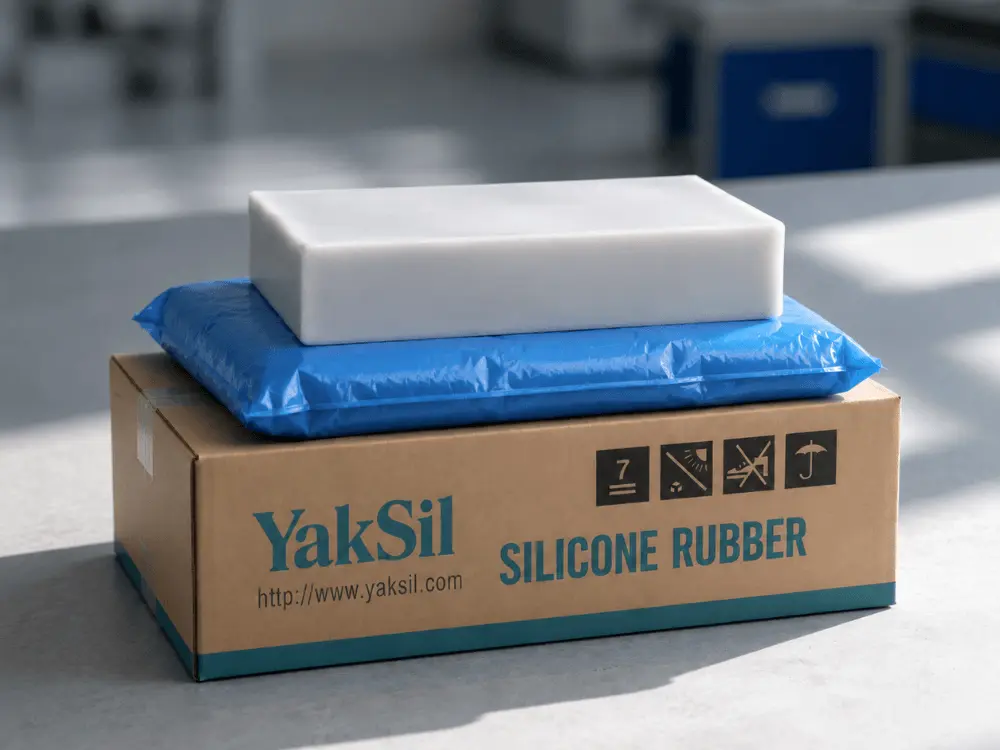
Yakows YK Series
The Yakows YK Series high tear strength silicone rubber is developed for industrial applications that require a strong balance of tear resistance, tensile performance, elongation and stable HTV/HCR processing. The series covers multiple hardness levels so manufacturers can select a compound according to finished-part flexibility, geometry and mechanical load.
HTR grades are intended for compression molding, transfer molding, injection molding and selected extrusion applications. The material can be supplied in standard or customized colors, with compound adjustments available for specific processing and end-use requirements.
Soft and flexible grade for parts requiring high elongation and strong resistance to tearing.
Balanced high-tear grade for seals, profiles and general industrial molded components.
Higher mechanical strength for demanding molded, extruded and electrical silicone components.
Firm high-strength grade for components requiring greater modulus and dimensional stability.
- High tear resistance
- Strong tensile performance
- Excellent elastic recovery
- Wide hardness selection
- Custom color options
- Industrial HTV/HCR processing

Core Properties of High Tear Strength HTV Silicone Rubber
Industrial buyers normally evaluate the entire mechanical profile, not just one headline value. A balanced formulation supports both reliable molding and long-term part durability.
High Tear Resistance
Helps resist crack growth around thin walls, notches, openings, corners and localized stress points. This is one of the most important properties for difficult mold release and repeated deformation.
Strong Tensile Performance
Supports molded parts that must maintain structural integrity during handling, assembly, installation and long-term use under mechanical load.
Excellent Elongation and Elastic Recovery
Suitable for components exposed to stretching, bending, vibration, repeated movement or flexing, while allowing the material to recover toward its original geometry.
Stable Heat and Weather Resistance
HTV/HCR silicone rubber naturally provides strong resistance to heat, ozone, UV radiation, moisture and long-term environmental aging.
Application-Specific Compounding
Hardness, color, cure system, electrical performance, heat resistance and processing behavior can be adjusted according to the finished product and production method.

Where High Tear Strength Silicone Rubber Is Used
A high tear strength silicone compound is most valuable when the geometry, process or operating environment creates greater mechanical stress than a conventional general-purpose silicone grade is designed to handle.

Electrical Insulation Components
High tear strength silicone rubber is used for protective and insulating components that may be stretched during assembly or exposed to environmental and mechanical stress over long service periods.
- Electrical insulation housings
- Cable accessories and protective components
- Flexible insulating parts
- Selected high-voltage silicone components

Seals, Gaskets, Bellows and Flexible Components
Silicone seals often experience stretching, compression and repeated movement during installation and use. High tear strength can help improve durability in parts with thin lips, sealing edges or complex contours.
- Industrial gaskets
- O-rings and flexible seals
- Membranes and bellows
- Protective boots and covers

Automotive and Complex Molded Parts
High tear strength HTV silicone rubber is suitable for components that combine heat resistance, flexibility and demanding geometry. Stronger tear performance can help during both manufacturing and use.
- Connector seals and grommets
- Protective boots and covers
- Thin-wall molded parts
- Complex industrial silicone components
Processing High Tear Strength Silicone Rubber
The best formulation depends on the production route. Tear resistance must be balanced with viscosity, cure behavior, mold filling and release characteristics.
For Complex Geometry and Repeatable Production
High tear strength silicone rubber can be useful when injection-molded parts have ribs, undercuts, deep cavities or thin sections that are mechanically stressed during mold release. The compound must also provide suitable flow and cure speed for the molding cycle.
For Conventional HTV / HCR Silicone Processing
Compression molding remains widely used for solid silicone rubber. High tear strength grades can help reduce damage during demolding while supporting flexible industrial components, seals and insulation parts.
For Selected Continuous Profiles
Depending on the compound design, high tear strength silicone rubber may also be adapted for extrusion applications where profile integrity, flexibility and mechanical durability are important.
Yakows YK Series High Tear Strength Silicone Rubber
The YK Series is structured around four hardness levels to provide a practical choice between flexibility, elongation, tear resistance and dimensional stability. The table below gives preliminary target values for product-page development.
Confirm each value against the final Yakows TDS and internal test report before commercial publication. Typical values are not intended as specification limits.
| Property / Test Method | YK-40 | YK-50 | YK-60 | YK-70 |
|---|---|---|---|---|
| Hardness Shore A · ISO 48-4 | 40 ± 3 | 50 ± 3 | 60 ± 3 | 70 ± 3 |
| Density g/cm³ · ISO 1183-1 | 1.12 | 1.15 | 1.17 | 1.19 |
| Tensile Strength MPa · ISO 37 | ≥ 9.0 | ≥ 10.0 | ≥ 10.5 | ≥ 10.0 |
| Elongation at Break % · ISO 37 | ≥ 650 | ≥ 620 | ≥ 580 | ≥ 520 |
| Tear Strength N/mm · ISO 34-1 | ≥ 35 | ≥ 40 | ≥ 43 | ≥ 45 |
| Appearance Visual | Translucent | Translucent | Translucent | Translucent |
| Standard Processing Grade dependent | Molding / Extrusion | Molding / Extrusion | Molding / Extrusion | Molding / Extrusion |
Values shown are preliminary development targets for the Yakows YK Series page and can vary with curing system, cure conditions, pigmentation and test specimen preparation. Replace with verified Yakows production data before the page is used as a commercial technical specification.
For soft, elastic components where high elongation and tear resistance are the primary requirements.
A versatile hardness for molded parts, seals, profiles and general-purpose high-tear applications.
Designed for parts requiring a stronger combination of tear resistance, tensile strength and stability.
For firmer components where dimensional stability and resistance to mechanical deformation are important.
Custom High Tear Strength Silicone Rubber Compounds
Different products require different mechanical and processing balances. The following parameters are commonly discussed when specifying a custom HTV/HCR silicone rubber compound.
| Property | Customization Direction | Why It Matters |
|---|---|---|
| Hardness | Application-specific Shore A range | Influences flexibility, sealing force, feel, demolding and overall mechanical behavior. |
| Tear Strength | General, enhanced or high-tear formulations | Important for thin sections, sharp transitions, undercuts and repeated deformation. |
| Tensile Strength & Elongation | Balanced according to end-use requirements | Provides a more complete picture of mechanical durability than tear strength alone. |
| Curing System | Peroxide or application-specific cure package | Affects processing window, post-cure needs and final material properties. |
| Processing Route | Injection, compression or selected extrusion | Flow, cure speed, release behavior and compound handling must match the production equipment. |
| Special Performance | Heat, weathering, electrical or flame-retardant options | Allows the compound to match the actual service environment instead of only the molding process. |
High Tear Strength Silicone Rubber vs. Standard Silicone Rubber
The difference becomes most meaningful when the finished part has a demanding geometry or is subjected to mechanical strain during manufacturing, assembly or long-term service.
High Tear Strength Silicone Rubber
Preferred when mechanical durability and resistance to tear propagation are priority requirements.
- Thin-wall molded parts
- Complex geometries and undercuts
- Difficult demolding conditions
- Repeated stretching or flexing
- Higher durability expectations
Standard Silicone Rubber
Suitable for less demanding parts where geometry and mechanical stress are comparatively simple.
- Simple molded component shapes
- Limited deformation during service
- Low-stress mold release
- General-purpose sealing applications
- Applications without elevated tear requirements
Why Tear Strength Matters in Silicone Rubber
Silicone rubber is naturally flexible, but flexibility alone does not guarantee resistance to tearing. A component can stretch significantly and still fail if a small cut or notch begins to propagate. For this reason, high tear strength silicone rubber is often selected when a molded part contains localized stress points or when the product must undergo repeated deformation.
In industrial design, tear resistance becomes more important as wall thickness decreases and geometric complexity increases. Holes, slots, sharp transitions, thin lips and undercuts can all concentrate stress. If these features are combined with aggressive demolding or repeated flexing, a standard silicone grade may not provide sufficient protection against crack growth.
High Tear Strength for Thin-Wall Silicone Components
Thin-wall silicone products are particularly sensitive to edge damage because there is less material available to distribute mechanical load. During mold release, even a small amount of localized stretching can create a tear at the thinnest point. A high tear strength HTV silicone rubber can help improve manufacturing stability and reduce the likelihood of rejected parts caused by tearing around these features.
However, improving tear performance should not come at the expense of processing. If the compound becomes too difficult to flow, cure or release, production efficiency may suffer. This is why industrial compound development typically focuses on a balanced mechanical profile rather than maximizing a single laboratory value.
High Tear Strength Silicone Rubber for Demolding
Demolding can be one of the highest mechanical stress events in the life of a silicone component. Parts with deep cavities, internal features or undercuts may need to be deformed substantially before they can be removed from the tool. The material must tolerate this temporary deformation without tearing.
A suitable high tear strength silicone compound can help improve mold-release reliability, especially when combined with appropriate tool design, mold surface treatment, cure conditions and process control. Material choice and mold design should therefore be considered together.
Balancing Tear Strength, Tensile Strength and Elongation
Tear strength, tensile strength and elongation are related but distinct material characteristics. Tear strength describes resistance to the growth of an existing cut or tear. Tensile strength reflects how much pulling stress the material can withstand before failure, while elongation describes how far the material can stretch relative to its original length.
A high-performance silicone rubber compound should be selected based on the combination of these values and the real product geometry. A material with very high elongation may still perform poorly if a notch begins to propagate easily. Likewise, excellent tear strength is not enough if the compound does not meet the required hardness, thermal performance or processability.
How to Select the Right High Tear Strength Silicone Rubber
Start with the finished application rather than the material data sheet. Define the product geometry, target hardness, manufacturing process, operating temperature, expected deformation and any relevant electrical, weathering or regulatory requirements.
For B2B projects, it is also useful to provide information about the current material, known production problems and any specific failure modes such as tearing during demolding, edge cracking, poor elastic recovery or insufficient durability. These details allow a silicone rubber manufacturer to recommend or develop a more suitable HTV/HCR compound for evaluation.
High Tear Strength Silicone Rubber FAQ
What is high tear strength silicone rubber?
It is a silicone elastomer formulated to provide greater resistance to tear initiation, crack propagation and mechanical damage than a general-purpose silicone rubber compound.
Is high tear strength silicone rubber available as HTV or HCR?
Yes. High tear strength grades are commonly supplied as HTV/HCR silicone rubber for compression molding, injection molding and selected extrusion processes.
When should I choose a high tear strength silicone rubber?
It is especially useful for thin-wall components, complex geometries, undercuts, difficult demolding conditions and parts exposed to repeated stretching, flexing or mechanical stress.
Can high tear strength silicone rubber improve demolding?
It can help reduce tearing during demolding when the part is stretched or distorted, but mold design, cure conditions, release behavior and process control remain equally important.
Does higher tear strength always mean better silicone rubber?
No. The best compound balances tear strength with tensile strength, elongation, hardness, heat resistance, curing behavior and processing requirements for the actual application.
Can high tear strength silicone rubber be customized?
Yes. Depending on the manufacturer, hardness, color, cure system, mechanical properties, electrical performance, thermal resistance and processing behavior can be adjusted to suit the application.
Specify High Tear Strength Silicone Rubber Around the Application
For material evaluation, prepare the required hardness, processing method, finished-part geometry, operating conditions and target mechanical properties. This helps the silicone rubber supplier recommend a more suitable compound instead of relying on a single tear-strength number.