
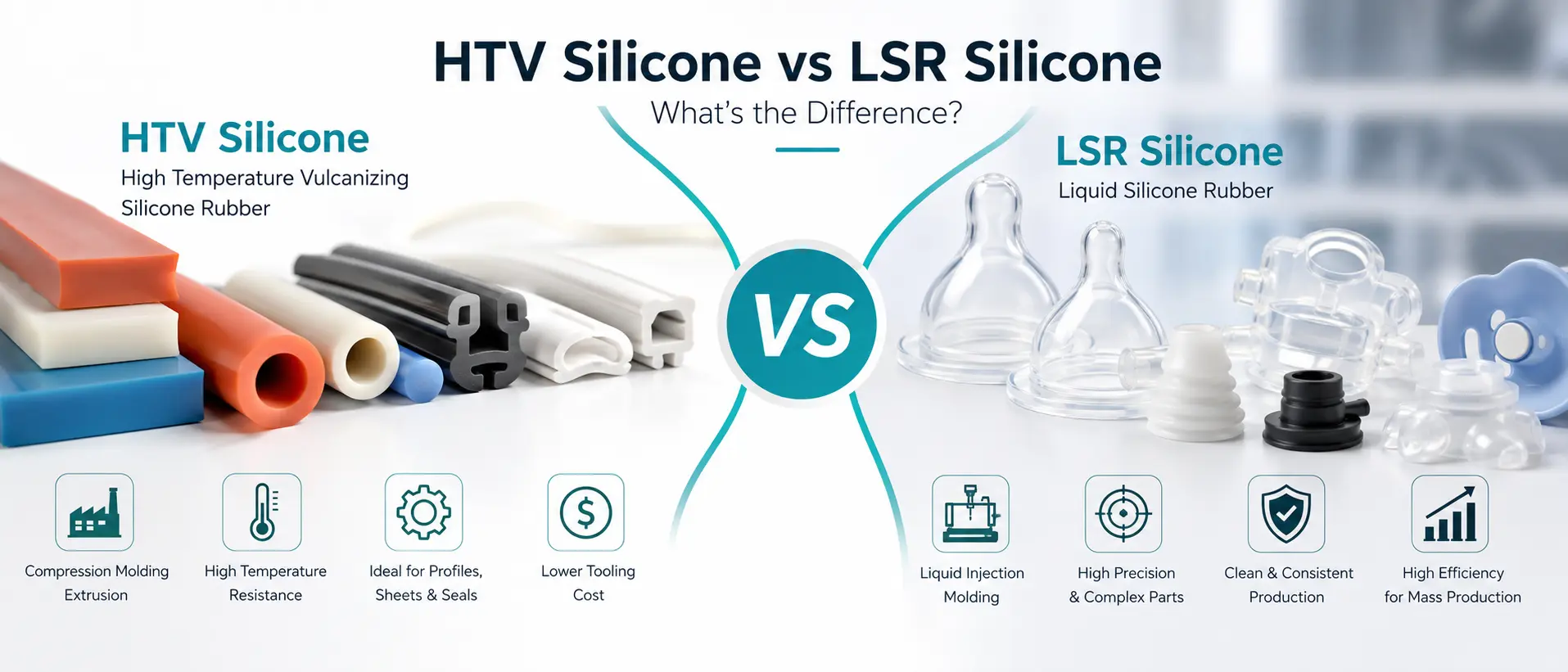
What is the Difference Between HTV and LSR Silicone?
Silicone rubber is widely used in automotive, medical, electronics, consumer goods, food-contact products, and industrial sealing applications. However, many buyers still ask: what is the real difference between HTV silicone and lsr silicone?
1. Basic Material Difference
The most important difference between HTV and LSR silicone lies in the physical form of the raw material. HTV stands for High Temperature Vulcanizing silicone rubber. It is usually supplied as a solid, gum-like, high-consistency compound. Because of its solid form, HTV silicone often requires mixing, preforming, cutting, or mechanical processing before curing.
LSR stands for Liquid Silicone Rubber. It is a two-component liquid silicone material, usually supplied as Part A and Part B. These two components are metered, mixed, and injected into a heated mold through automatic liquid silicone injection molding equipment. This makes LSR especially suitable for high-volume production and precision molded silicone parts.
2. HTV Silicone vs LSR Silicone Comparison Table
| Comparison Item | HTV Silicone Rubber | LSR Silicone Rubber |
|---|---|---|
| Full Name | High Temperature Vulcanizing Silicone Rubber | Liquid Silicone Rubber |
| Material Form | Solid, gum-like, high-consistency compound | Flowable two-part liquid silicone |
| Common Processing Method | Compression molding, transfer molding, extrusion, calendering | Liquid injection molding, automated LIM process |
| Curing System | Peroxide-cured or platinum-cured grades | Usually platinum-cured addition system |
| Production Efficiency | Suitable for small to medium production runs | Ideal for high-volume automated production |
| Tooling Cost | Generally lower mold and equipment investment | Higher initial mold and machine investment |
| Design Complexity | Suitable for simple or medium-complexity parts | Excellent for complex, thin-wall, tight-tolerance parts |
| Typical Applications | Silicone gaskets, tubes, seals, profiles, sheets, rollers | Medical parts, baby products, precision seals, electronic components |
3. Manufacturing Process Difference
HTV silicone rubber is commonly processed by compression molding, transfer molding, extrusion, and calendering. These processes are suitable for custom silicone gaskets, silicone extrusion profiles, heat-resistant silicone sheets, industrial silicone seals, and electrical insulation silicone parts.
In compression molding, a pre-measured piece of HTV silicone compound is placed into a heated mold. Pressure and heat are then applied to complete the vulcanization process. This method is relatively flexible and cost-effective for customized parts, prototypes, and lower-volume production.
LSR silicone is mainly processed through liquid silicone rubber injection molding. The two liquid components are pumped into a static mixer, injected into a heated mold, and cured rapidly. Because the whole process can be highly automated, LSR is ideal for precision silicone injection molding, multi-cavity molds, thin-wall silicone parts, and overmolding applications.
4. Performance Difference
Both HTV silicone and LSR silicone provide excellent heat resistance, flexibility, weather resistance, aging resistance, UV resistance, electrical insulation, and chemical stability. In many applications, the final performance depends not only on the type of silicone, but also on the formulation, hardness, curing system, filler package, and post-curing process.
HTV silicone is often selected when the product requires strong mechanical properties, extrusion capability, large-size profiles, or flexible batch production. It performs well in automotive silicone hoses, high-temperature silicone seals, silicone sponge profiles, electrical cable insulation, and industrial rubber rollers.
LSR silicone is preferred for parts requiring high precision, clean production, excellent repeatability, low contamination risk, and complex geometry. It is commonly used in medical silicone injection molding, baby care silicone products, wearable device silicone parts, waterproof electronic seals, and two-shot silicone overmolding.
5. Cost Difference
The cost difference between HTV silicone and LSR silicone depends largely on production volume, mold design, labor cost, part complexity, and quality requirements.
For low-volume or medium-volume projects, HTV silicone is often more economical because the tooling cost and equipment investment are usually lower. It is suitable for custom silicone parts, large seals, extruded profiles, silicone sheets, and products that do not require extremely fast cycle times.
For high-volume production, LSR silicone may become more cost-effective in the long term. Although the initial mold and injection molding equipment investment is higher, automated production can reduce labor cost, shorten cycle time, improve consistency, and reduce material waste.
6. How to Choose the Right Silicone
Choose HTV silicone rubber if your project requires extrusion, calendering, compression molding, lower tooling cost, large simple parts, custom silicone profiles, or flexible batch production. HTV is also suitable when the part design is relatively simple and manual or semi-automatic processing is acceptable.
Choose LSR silicone rubber if your project requires high precision, high-volume output, tight tolerances, clean molding, thin-wall design, multi-cavity tooling, or overmolding with plastic or metal inserts. LSR is especially valuable for medical, infant care, electronics, and precision sealing applications.
7. Typical Applications
Common HTV Silicone Applications
- Custom silicone gaskets and seals
- High-temperature silicone rubber profiles
- Automotive silicone hoses
- Silicone rubber sheets and rolls
- Electrical insulation silicone parts
- Industrial silicone tubing
- Silicone sponge profiles
Common LSR Silicone Applications
- Medical-grade silicone molded parts
- Baby care silicone products
- Food-grade silicone components
- Precision silicone seals
- Waterproof electronic silicone parts
- Wearable device silicone components
- Two-shot silicone overmolding parts
8. Related Long-Tail Keywords
HTV silicone rubber vs LSR silicone rubber, difference between HTV and LSR silicone, liquid silicone rubber injection molding, HTV silicone compression molding, high temperature vulcanizing silicone rubber applications, LSR silicone for medical parts, food-grade liquid silicone rubber, custom HTV silicone gasket, high-consistency silicone rubber manufacturing, silicone rubber material selection guide, LSR overmolding with plastic, platinum-cured LSR silicone, peroxide-cured HTV silicone, silicone rubber for automotive seals, silicone rubber for electronics waterproofing, high-volume silicone injection molding, custom silicone extrusion profiles, HTV silicone vs liquid silicone for industrial parts.
9. Conclusion
The main difference between HTV and LSR silicone is material form, processing method, production efficiency, tooling investment, and application suitability. HTV silicone is a solid high-consistency rubber that is ideal for extrusion, compression molding, transfer molding, and cost-effective custom production.
LSR silicone is a two-part liquid silicone designed for automated injection molding, fast curing, high precision, and large-scale manufacturing. In simple terms, HTV silicone is often better for custom, extruded, or lower-volume silicone rubber products, while LSR silicone is usually better for high-volume, complex, tight-tolerance molded silicone parts.