
Silicone Rubber Material Guide
What Is Dimethyl Silicone?
Dimethyl silicone generally refers to silicone materials based primarily on polydimethylsiloxane, or PDMS, in which methyl groups are attached to the silicon atoms along the siloxane polymer backbone. Depending on molecular weight, formulation and crosslinking, dimethyl silicone can exist as a low-viscosity fluid, a high-viscosity polymer gum or part of a cured silicone rubber system. In industrial silicone rubber manufacturing, dimethylsiloxane units form the basic structure of many HTV, HCR and other silicone elastomers.
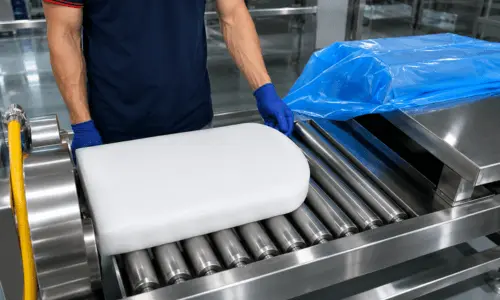
What Is Dimethyl Silicone?
Dimethyl silicone is a general term used for silicone polymers in which methyl groups are the main organic groups attached to a silicon-oxygen polymer backbone.
The basic repeating structure is commonly associated with polydimethylsiloxane, usually abbreviated as PDMS.
A simplified repeating unit can be represented as:
In this structure, the polymer backbone consists of alternating silicon and oxygen atoms, while two methyl groups are attached to each dimethylsiloxane silicon atom.
The word “dimethyl” therefore refers to the two methyl groups associated with the silicon atom in the basic dimethylsiloxane unit.
dimethyl silicone is a methyl-substituted polysiloxane material, and PDMS is the most common chemical term used to describe this basic polymer structure.
Is Dimethyl Silicone the Same as PDMS?
In many technical contexts, dimethyl silicone refers to a material based on polydimethylsiloxane (PDMS).
However, the terminology should be used carefully.
PDMS describes a polymer structure. “Dimethyl silicone” may be used more broadly in industry to describe silicone fluids or polymer materials dominated by dimethylsiloxane units.
The finished commercial material may also contain:
- Vinyl-functional silicone units
- Reinforcing silica
- Crosslinkers
- Peroxide curing agents
- Platinum catalysts
- Heat stabilizers
- Pigments
- Flame-retardant additives
- Electrical or thermal functional fillers
Therefore, a finished silicone rubber product should not automatically be described as chemically pure PDMS.
Why Is It Called Dimethyl Silicone?
Silicone polymers contain a silicon-oxygen-silicon backbone rather than the carbon-carbon backbone found in many conventional organic polymers.
Organic groups are attached to the silicon atoms.
When these organic substituents are predominantly methyl groups, the material belongs to the methyl silicone family.
In a basic dimethylsiloxane unit, each silicon carries two methyl groups.
| Part of Structure | Main Component | Function in the Name |
|---|---|---|
| Polymer backbone | Silicon and oxygen | Siloxane |
| Organic substituents | Methyl groups | Methyl |
| Two methyl groups | Two CH₃ groups associated with silicon | Dimethyl |
Dimethyl Silicone vs Dimethicone
The terms dimethyl silicone, PDMS and dimethicone are sometimes used in overlapping contexts, but their use depends on the industry.
Dimethicone is a common name, particularly in cosmetics and personal-care applications, for certain polydimethylsiloxane materials.
PDMS is the more general chemical abbreviation for polydimethylsiloxane.
Dimethyl silicone is often used as an industrial description for methyl-substituted silicone materials, especially silicone fluids.
| Term | Typical Meaning | Common Context |
|---|---|---|
| Dimethyl silicone | Silicone material based mainly on dimethylsiloxane units | Industrial silicone terminology |
| PDMS | Polydimethylsiloxane | Chemistry, engineering and material science |
| Dimethicone | Name commonly associated with PDMS materials | Cosmetics and personal care |
For industrial silicone rubber selection, it is usually more useful to identify the exact polymer type, compound grade, curing system and finished properties rather than relying only on the name “dimethyl silicone.”
Is Dimethyl Silicone a Liquid or a Rubber?
It can be either, depending on molecular weight and formulation.
This is one of the most important points when discussing dimethyl silicone.
A relatively low-molecular-weight PDMS can exist as a silicone fluid.
As polymer chain length and molecular weight increase, the material becomes increasingly viscous and can eventually exist as a very high-viscosity silicone gum.
After suitable formulation and crosslinking, silicone polymers can form elastic silicone rubber.
| Material Form | Typical Physical State | Typical Use |
|---|---|---|
| Dimethyl silicone fluid | Flowable liquid | Lubrication, release, damping, processing and formulation |
| High-viscosity silicone polymer | Very viscous or gum-like | Raw polymer for elastomer formulation |
| Uncured silicone compound | Processable gum or compound | Extrusion and molding |
| Crosslinked silicone rubber | Elastic solid | Seals, tubing, cables, gaskets and electrical parts |
What Is Dimethyl Silicone Fluid?
Dimethyl silicone fluid is one of the most common commercial forms of dimethyl silicone.
It generally consists of linear polysiloxane chains in which methyl groups dominate the organic substituents.
Silicone fluid can be produced over a broad range of viscosities.
Low-viscosity grades flow easily, while high-viscosity grades are much thicker.
Typical industrial characteristics associated with dimethyl silicone fluids include:
- Low surface tension
- Water repellency
- Useful viscosity stability over temperature changes
- Release properties
- Lubricating behavior
- Electrical insulating capability in suitable grades
- Thermal stability within the limits of the selected fluid grade
These properties explain why dimethyl silicone fluids are used in release agents, lubricants, damping systems, defoaming formulations and other industrial applications.
Dimethyl Silicone Fluid vs Silicone Rubber
A silicone fluid and a silicone rubber may share a similar dimethylsiloxane chemical foundation, but they behave very differently.
| Property | Dimethyl Silicone Fluid | Silicone Rubber |
|---|---|---|
| Physical state | Liquid | Elastic solid after curing |
| Polymer network | Normally not a permanent elastomer network | Chemically crosslinked |
| Main material property | Viscosity | Hardness and mechanical properties |
| Typical processing | Pumping, blending, coating or filling | Extrusion or molding followed by curing |
| Typical products | Lubricants, release agents and damping fluids | Seals, tubing, gaskets and electrical components |
viscosity is a key specification for dimethyl silicone fluid, while Shore hardness, tensile strength, elongation and compression set are more relevant to cured silicone rubber.
How Is Dimethyl Silicone Related to Silicone Rubber?
Dimethylsiloxane units form the basic polymer structure of many conventional silicone elastomers.
However, practical silicone rubber formulations normally contain more than a simple unmodified dimethyl silicone polymer.
Commercial silicone rubber may include small amounts of reactive groups, reinforcing silica, processing additives and a curing system.
These components allow the material to be processed and then converted into a mechanically useful crosslinked elastomer.
This distinction is especially important for HTV and HCR silicone rubber.
What Is MQ Silicone?
In silicone rubber classification, MQ refers to methyl silicone based on polydimethylsiloxane.
The polymer contains dimethylsiloxane units in which two methyl groups are associated with the silicon atoms in the siloxane backbone.
MQ therefore represents the basic methyl silicone polymer family.
However, many modern silicone rubber compounds use vinyl-modified methyl silicone polymers rather than completely unmodified MQ.
What Is VMQ Silicone?
VMQ is one of the most important silicone rubber polymer families.
VMQ is based mainly on dimethylsiloxane units, but a small number of methyl groups are replaced by vinyl groups.
These vinyl groups provide reactive sites that are useful for crosslinking and elastomer manufacturing.
This means that industrial silicone rubber may still be overwhelmingly based on dimethyl silicone chemistry even though the finished polymer is technically classified as VMQ rather than pure MQ.
MQ vs VMQ Silicone
| Feature | MQ | VMQ |
|---|---|---|
| Main polymer structure | Polydimethylsiloxane | Predominantly dimethylsiloxane with vinyl functionality |
| Main organic group | Methyl | Methyl with a small amount of vinyl |
| Use in elastomers | Basic silicone polymer chemistry | Common basis for practical silicone rubber |
| Crosslinking capability | Depends on polymer end groups and curing chemistry | Vinyl groups provide useful reactive sites for curing |
Why Are Vinyl Groups Added to Dimethyl Silicone Rubber?
A practical silicone rubber needs a controlled method of forming a three-dimensional crosslinked network.
Vinyl functionality provides reactive sites that can participate in commonly used silicone curing reactions.
Only a relatively small proportion of the polymer needs to contain vinyl functionality, while the majority of the chain can remain based on dimethylsiloxane units.
This allows manufacturers to retain the general characteristics associated with methyl silicone while creating a polymer that can be efficiently converted into an elastomer.
What Is Dimethyl Silicone HCR?
HCR means High Consistency Rubber.
HCR silicone uses very high-molecular-weight silicone polymers with long polymer chains.
Before curing, the material has a high-consistency, gum-like form rather than behaving as a free-flowing liquid.
The base polymer may be predominantly composed of dimethylsiloxane units with controlled vinyl functionality for curing.
The polymer is then compounded with reinforcing fillers and other ingredients to achieve the required processing and finished-rubber properties.
HCR is commonly processed by:
- Extrusion
- Compression molding
- Transfer molding
- Calendering
- Specialized high-consistency injection molding
What Is HTV Dimethyl Silicone Rubber?
HTV means High Temperature Vulcanizing.
In an HTV silicone system, a high-consistency silicone compound is shaped and then heated to activate the curing reaction.
The predominantly dimethylsiloxane polymer structure becomes part of a crosslinked elastomer network.
After vulcanization, the material no longer behaves like the original processable gum.
It becomes a dimensionally stable silicone rubber component with controlled hardness, tensile properties, elongation and elastic recovery.
How Is Dimethyl Silicone Rubber Cured?
Silicone rubber based predominantly on dimethylsiloxane chemistry can use different curing systems depending on polymer functionality and compound design.
Two important industrial technologies are peroxide curing and platinum-catalyzed addition curing.
Peroxide Curing
Organic peroxide curing is widely used in industrial HCR and HTV silicone rubber.
Heating activates the peroxide system and initiates crosslinking within the silicone compound.
Platinum Addition Curing
Platinum-catalyzed systems use reactive silicone functionality to create a crosslinked network through an addition reaction.
This curing technology is widely used for LSR and is also available for selected HCR materials.
| Feature | Peroxide Cure | Platinum Addition Cure |
|---|---|---|
| Main curing system | Organic peroxide | Platinum catalyst |
| Common material form | HTV / HCR | LSR and selected HCR |
| Heat | Required | Normally used to accelerate curing in industrial processing |
| Process control | Peroxide selection and cure conditions | Contamination and cure inhibition require attention |
What Properties Does Dimethyl Silicone Have?
The properties of dimethyl silicone depend strongly on whether the material is a fluid, high-viscosity polymer or crosslinked rubber.
It is therefore better to discuss properties by material form rather than assuming that every dimethyl silicone product behaves in the same way.
| Property | Dimethyl Silicone Fluid | Crosslinked Silicone Rubber |
|---|---|---|
| Flow behavior | Flows according to viscosity | Elastic solid |
| Water repellency | Generally useful | Can provide hydrophobic surfaces depending on formulation |
| Temperature behavior | Good stability for suitable grades | Broad temperature capability depending on compound |
| Electrical properties | Useful insulating behavior in suitable fluid grades | Can be formulated for electrical insulation |
| Mechanical strength | Not an elastomer property | Developed through reinforcement and crosslinking |
| Hardness | Not normally specified by Shore A | Commonly specified by Shore A |
Is Dimethyl Silicone Heat Resistant?
Dimethyl silicone materials are known for useful thermal stability, but the allowable temperature depends on material type and formulation.
A dimethyl silicone fluid and an HTV silicone rubber should not be assigned the same temperature limit simply because both contain dimethylsiloxane units.
Fluid viscosity, molecular weight, stabilizers, crosslink density, fillers and exposure conditions all influence high-temperature behavior.
For silicone rubber, heat resistance should be evaluated using the actual cured compound and relevant heat-aging data.
Check the exact fluid or elastomer grade and the intended exposure time.
Is Dimethyl Silicone Water Resistant?
Methyl silicone materials generally have hydrophobic characteristics.
Dimethyl silicone fluids are commonly used where water repellency and surface modification are useful.
Crosslinked silicone rubber can also provide water-resistant and weather-resistant performance.
However, the water resistance of a complete molded component also depends on:
- Material formulation
- Surface condition
- Seal geometry
- Compression
- Bonding interfaces
- Pressure
- Temperature
A hydrophobic polymer does not automatically guarantee a leak-proof product.
Is Dimethyl Silicone Electrically Insulating?
Many dimethyl-silicone-based materials have useful electrical insulating characteristics.
This is one reason silicone materials are used in cables, electrical equipment, connectors and high-voltage insulation systems.
However, electrical performance depends on formulation.
Silicone rubber can intentionally be formulated as:
- Electrical insulating silicone
- Semiconductive silicone
- Electrically conductive silicone
- Tracking- and erosion-resistant high-voltage silicone
Therefore, the term “dimethyl silicone” alone does not guarantee a particular dielectric property.
Is Dimethyl Silicone Transparent?
Unfilled dimethyl silicone polymers can be clear and colorless.
However, commercial silicone rubber usually contains reinforcing fillers and other additives.
As a result, finished silicone rubber may be:
- Transparent
- Translucent
- Milky white
- Black
- Gray
- Red
- Orange
- Any specially compounded color
Appearance therefore depends on the complete formulation rather than the PDMS polymer alone.
Dimethyl Silicone Viscosity
Viscosity is one of the most important specifications for dimethyl silicone fluids.
Silicone fluids can be manufactured across a broad viscosity range by controlling polymer chain length and molecular weight.
Lower-viscosity material flows more easily, while higher-viscosity material moves more slowly and provides greater resistance to flow.
Viscosity affects suitability for applications such as:
- Lubrication
- Damping
- Release coatings
- Defoaming formulations
- Surface treatment
- Process additives
Dimethyl Silicone Viscosity vs Silicone Rubber Hardness
Viscosity and hardness are not the same property.
Viscosity describes resistance to flow and is mainly used for liquids and uncured materials.
Shore hardness describes indentation resistance of a cured elastomer.
| Property | Viscosity | Shore Hardness |
|---|---|---|
| Main question | How easily does the material flow? | How strongly does the cured rubber resist indentation? |
| Typical material | Silicone fluid or uncured liquid | Cured silicone rubber |
| Common units | mPa·s or mm²/s depending on test | Shore A, Shore 00 or another durometer scale |
What Is Reinforced Dimethyl Silicone Rubber?
High-molecular-weight silicone polymer alone does not provide all the mechanical performance required by industrial rubber components.
Reinforcing silica is therefore commonly used in silicone rubber compounding.
Fillers can significantly influence:
- Shore hardness
- Tensile strength
- Elongation
- Tear strength
- Extrusion behavior
- Molding behavior
- Compression set
This is why the performance of a finished silicone rubber compound can be very different from the properties of an unfilled dimethyl silicone polymer.
Dimethyl Silicone vs Methylphenyl Silicone
Not all silicone polymers contain only methyl groups.
Some silicone materials replace part of the methyl functionality with phenyl groups.
These modifications can change temperature behavior, optical properties and other material characteristics.
| Silicone Type | Main Organic Groups | Why It Is Used |
|---|---|---|
| Dimethyl silicone | Primarily methyl groups | General silicone fluids and base polymer chemistry |
| Methylphenyl silicone | Methyl + phenyl groups | Modified temperature and optical performance |
| Vinyl methyl silicone | Primarily methyl + small vinyl content | Practical crosslinkable silicone rubber |
| Fluorosilicone | Includes fluorinated organic groups | Improved resistance to selected fuels and chemicals |
Dimethyl Silicone vs Fluorosilicone
Standard methyl silicone rubber provides excellent performance for many general industrial and electrical applications, but it is not always the best choice for aggressive fuels, oils or solvents.
Fluorosilicone introduces fluorinated organic groups into the silicone polymer structure to improve resistance to selected hydrocarbon media.
The correct choice therefore depends on the application.
A higher-cost fluorosilicone should not be selected automatically if standard silicone already provides sufficient fluid compatibility.
What Is Dimethyl Silicone Used For?
Dimethyl silicone is used across many industries because the polymer can be supplied in multiple physical forms.
Applications depend strongly on whether the material is a fluid, gum, compound or crosslinked rubber.
| Material Form | Typical Application | Important Property |
|---|---|---|
| Silicone fluid | Lubrication | Viscosity stability and low surface interaction |
| Silicone fluid | Release agent | Low surface tension and release behavior |
| Silicone fluid | Damping | Controlled viscosity |
| HTV silicone rubber | Extruded tubing | Flexibility and temperature performance |
| HTV silicone rubber | Industrial seals | Elastic recovery and compression set |
| HTV silicone rubber | Wire and cable | Electrical insulation and flexibility |
| Specialized silicone rubber | Composite insulator housing | Electrical insulation, weather and tracking resistance |

Dimethyl Silicone in Seals and Gaskets
Silicone elastomers based predominantly on methyl silicone chemistry are widely used for seals and gaskets.
The cured rubber can provide a useful combination of flexibility, temperature capability and long-term environmental resistance.
Important specifications include:
- Shore A hardness
- Compression set
- Tensile strength
- Elongation
- Tear strength
- Heat aging
- Fluid compatibility
The term “dimethyl silicone” alone does not provide enough information to select a sealing material.
Dimethyl Silicone in Tubing and Extruded Profiles
HCR silicone compounds are commonly extruded into tubing, cords and custom profiles.
During manufacturing, the high-consistency silicone compound passes through an extrusion die that defines the product geometry.
The extrudate is then cured to create a crosslinked elastic structure.
Compound hardness, extrusion stability, curing speed, tear resistance and final dimensions all need to be controlled.
Dimethyl Silicone in Wire and Cable
Silicone rubber is widely used for flexible wire and cable insulation where temperature resistance and electrical performance are important.
An HTV silicone compound can be extruded around a conductor and then vulcanized continuously.
Important properties for cable compounds include:
- Electrical insulation
- Tensile strength
- Elongation
- Tear resistance
- Heat aging
- Extrusion stability
- Flame performance where required
Electrical-grade silicone therefore requires much more than a basic dimethyl silicone polymer.
Dimethyl Silicone in EV and NEV Applications
Silicone rubber is used in electric and new energy vehicle systems for sealing, insulation and component protection.
Typical applications include:
- Battery enclosure gaskets
- High-voltage connector seals
- Charging-system seals
- Flexible cable insulation
- Power-electronics sealing components
For these applications, engineers should evaluate the complete compound rather than specifying only dimethyl silicone.
Compression set, electrical performance, temperature cycling and coolant compatibility may all be important.
Dimethyl Silicone in Composite Insulators
HTV silicone rubber is also used to manufacture the housing and weather sheds of high-voltage composite insulators.
The silicone polymer system is typically based predominantly on methyl silicone chemistry, but the finished compound contains reinforcing and functional ingredients designed for demanding outdoor electrical service.
Important properties include:
- Hydrophobicity
- Hydrophobicity recovery
- Electrical insulation
- Tracking resistance
- Erosion resistance
- UV resistance
- Ozone resistance
- Tear strength
- Bonding performance with the FRP core system
High-voltage applications require a dedicated electrical-grade silicone rubber formulation.
Is Dimethyl Silicone Suitable for High-Voltage Insulation?
Dimethylsiloxane-based silicone polymers provide an important foundation for many electrical silicone materials, but the base polymer alone does not define high-voltage performance.
A composite insulator or other outdoor high-voltage component requires a complete compound engineered to resist electrical and environmental stress.
Fillers and additives can significantly influence:
- Tracking resistance
- Erosion resistance
- Arc-related surface degradation
- Hydrophobic behavior
- Mechanical strength
- Long-term weather resistance
This is an important example of why polymer chemistry and finished compound performance should not be treated as the same thing.
Can Dimethyl Silicone Be Conductive?
The base silicone polymer is commonly associated with electrical insulation, but silicone rubber can be modified with conductive fillers.
Depending on formulation, the finished material can be designed as:
- Insulating silicone rubber
- Antistatic silicone
- Semiconductive silicone
- Electrically conductive silicone
Carbon-based fillers, metal particles and other conductive systems may be used depending on application requirements.
Therefore, electrical resistance should always be specified separately from the term dimethyl silicone.
Can Dimethyl Silicone Be Flame Retardant?
Silicone rubber compounds can be formulated for improved flame performance.
Flame retardancy is not determined by the dimethyl silicone polymer alone.
The complete compound design, fillers, additives, part thickness and test method influence the final result.
If a cable, EV component or electrical part requires a specific flame classification, the actual tested silicone grade should be selected.
Is Dimethyl Silicone Chemically Resistant?
Dimethyl silicone materials can provide useful chemical stability in many environments, but they are not universally resistant to every chemical.
Compatibility can change significantly with:
- Chemical type
- Concentration
- Temperature
- Exposure time
- Mechanical stress
- Silicone formulation
A material that performs well in air or water may swell or lose properties in certain hydrocarbons, oils, solvents or aggressive chemicals.
For critical sealing applications, compatibility should be tested using the actual fluid and operating temperature.
How to Choose a Dimethyl Silicone Material
Selecting the correct dimethyl silicone product begins with defining the material form and application.
- Determine whether you need a fluid or a rubber.
A silicone oil and a cured silicone elastomer are fundamentally different products. - Define the manufacturing process.
Determine whether the material will be pumped, coated, extruded, compression molded or injection molded. - For fluids, define viscosity.
Viscosity is one of the main parameters controlling flow and processing behavior. - For rubber, define Shore hardness.
Select hardness according to the required deformation and support. - Check the polymer type.
Confirm whether the material is MQ, VMQ, PVMQ, FVMQ or another silicone system. - Choose the curing system.
For silicone rubber, evaluate peroxide or platinum curing where applicable. - Review mechanical properties.
Check tensile strength, elongation, tear strength and compression set. - Define operating temperature.
Use data for the actual grade rather than one generic silicone temperature range. - Check chemical compatibility.
Test oils, fuels, coolants and other media under realistic conditions. - Review electrical requirements.
Use an electrical-grade formulation when dielectric performance is required. - Confirm flame requirements.
Select a tested flame-retardant grade if necessary. - Evaluate environmental exposure.
Consider UV, ozone, water, humidity and outdoor aging. - Check bonding requirements.
Overmolding onto metals, plastics or FRP may require dedicated primers and process controls. - Run production trials.
Verify processing behavior and curing on the actual equipment. - Test the finished product.
Validate performance under actual service conditions.
Questions to Ask a Dimethyl Silicone Supplier
- Is the product a silicone fluid, polymer gum or rubber compound?
- Is the base polymer PDMS?
- Does the polymer contain vinyl functionality?
- Is the silicone classified as MQ or VMQ?
- What is the viscosity?
- For rubber compounds, what is the Shore A hardness?
- Is the material HTV, HCR, LSR or RTV?
- What curing system is recommended?
- Is the compound peroxide cured or platinum cured?
- Is post-curing required?
- What tensile and elongation data are available?
- What is the tear strength?
- What compression-set data are available?
- What temperature range applies to the actual grade?
- What chemical compatibility data are available?
- Is the material electrically insulating or conductive?
- Is a flame-retardant version available?
- Is the material suitable for high-voltage insulation?
Frequently Asked Questions About Dimethyl Silicone
What is dimethyl silicone?
Dimethyl silicone generally refers to silicone materials based primarily on polydimethylsiloxane, in which methyl groups are attached to the silicon atoms along the siloxane backbone.
What is the chemical name of dimethyl silicone?
Polydimethylsiloxane, abbreviated PDMS, is the chemical name commonly associated with the basic dimethyl silicone polymer structure.
What does PDMS mean?
PDMS stands for polydimethylsiloxane, a polysiloxane polymer built primarily from repeating dimethylsiloxane units.
Is dimethyl silicone the same as silicone oil?
Not always. Dimethyl silicone can refer to silicone fluids, but high-molecular-weight dimethylsiloxane polymers are also important raw materials for silicone elastomers.
Is dimethyl silicone the same as dimethicone?
Dimethicone is a name commonly used for certain PDMS materials, particularly in cosmetic and personal-care applications. Industrial terminology may instead use PDMS or dimethyl silicone.
Is dimethyl silicone a rubber?
It can form part of a silicone rubber system, but dimethyl silicone itself may also exist as a fluid or high-viscosity polymer. Rubber behavior develops after suitable formulation and crosslinking.
What is MQ silicone?
MQ refers to methyl silicone or PDMS in which two methyl groups are associated with the silicon atoms of the siloxane structure.
What is VMQ silicone?
VMQ is predominantly methyl silicone in which a small amount of methyl functionality has been replaced with vinyl groups to provide useful reactive sites for silicone rubber curing.
Why does silicone rubber contain vinyl groups?
Vinyl functionality provides reactive sites that can participate in crosslinking reactions used to convert silicone compounds into elastic rubber.
Is HTV silicone based on dimethyl silicone?
Many conventional HTV and HCR silicone rubber systems are based predominantly on dimethylsiloxane polymer chemistry, often with a small amount of vinyl functionality and additional fillers, additives and curing ingredients.
Is dimethyl silicone heat resistant?
Dimethyl silicone materials have useful thermal stability, but the actual temperature capability depends on whether the material is a fluid or rubber, its formulation and the duration of exposure.
Is dimethyl silicone waterproof?
Dimethyl silicone has hydrophobic characteristics, but the waterproof performance of a finished component also depends on part design, sealing pressure, interfaces and processing quality.
Is dimethyl silicone electrically insulating?
Many dimethyl-silicone-based materials provide useful electrical insulation, but silicone can also be deliberately compounded to be conductive or semiconductive.
Can dimethyl silicone be transparent?
Unfilled PDMS can be transparent, but commercial silicone rubber contains fillers and additives that may make the finished material translucent, opaque or colored.
What is dimethyl silicone fluid used for?
Typical uses include lubrication, release, damping, surface treatment, defoaming and other industrial applications that benefit from controlled viscosity and silicone surface properties.
What is the difference between silicone fluid viscosity and silicone rubber hardness?
Viscosity describes resistance to flow in a liquid, while Shore hardness describes indentation resistance of a cured elastomer.
Can dimethyl silicone be used for seals?
Crosslinked silicone rubber based predominantly on methyl silicone chemistry is widely used for seals and gaskets, but the exact compound should be selected according to hardness, compression set, temperature and chemical compatibility.
Can dimethyl silicone be used in composite insulators?
Dimethylsiloxane-based polymer chemistry is important in HTV silicone rubber, but composite insulators require specialized high-voltage compounds with tracking, erosion, weather and electrical insulation performance.