
Is Silicone Heat Resistant?
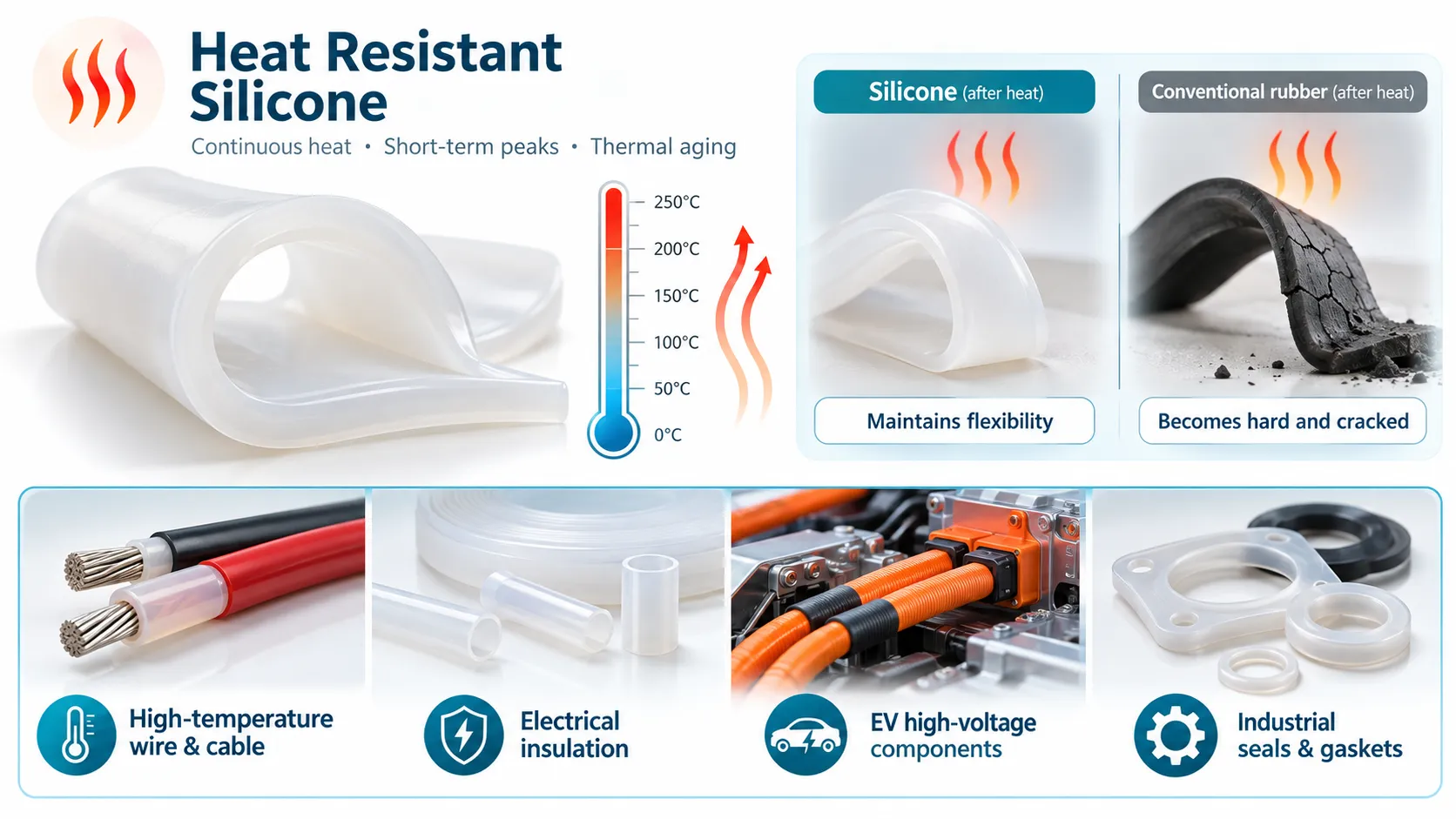
Yes. Heat resistant silicone is widely used because silicone rubber can maintain flexibility and useful mechanical properties at temperatures that cause many conventional elastomers to harden, crack or degrade more quickly. This is why silicone appears in wire and cable, electrical insulation, EV systems, industrial seals, ovens, food-processing equipment and other hot environments.
However, “heat resistant” does not mean unlimited temperature resistance. The actual performance of silicone depends on the compound formulation, exposure time, curing system, mechanical load and operating environment. A silicone rubber part that survives a short temperature peak may behave very differently under months or years of continuous heat.
This article explains how heat resistant silicone works, what happens to silicone rubber during thermal aging, how continuous and peak temperatures differ, and what engineers and buyers should consider when choosing a silicone compound for high-temperature applications.
Why Is Silicone Heat Resistant?
The thermal stability of silicone rubber comes largely from its siloxane backbone, which consists of alternating silicon and oxygen atoms. This structure behaves differently under heat from the carbon-based backbones found in many conventional organic rubbers.
The result is an elastomer that can remain flexible over a broad temperature range and retain useful electrical and mechanical properties under elevated-temperature conditions.
But the polymer backbone is only the starting point. Commercial heat resistant silicone compounds also contain reinforcing silica, processing aids, pigments, stabilizers, fillers and a curing system. These ingredients influence how the material performs after prolonged heating.
What Does “Heat Resistant Silicone” Actually Mean?
The term heat resistant silicone can refer to several different forms of thermal performance, and they should not be treated as identical.
When comparing silicone grades, buyers should therefore ask what temperature the material must withstand, for how long, and which properties must remain within specification afterward.
How Much Heat Can Silicone Rubber Handle?
There is no single temperature number that applies to every silicone rubber compound. Different formulations are designed for different service environments.
Many industrial silicone materials are used successfully at elevated temperatures, but the acceptable continuous operating temperature depends on the grade, part design, mechanical load and required service life. Specialized compounds may be formulated for more demanding thermal conditions than general-purpose silicone.
Short-term peak temperature can also be considerably different from continuous-use temperature. A material may tolerate a brief heat spike without visible failure but lose elongation or sealing performance if exposed continuously to the same temperature.
| Thermal Condition | What It Means | Why It Matters |
|---|---|---|
| Continuous Service | Normal long-duration operating temperature | Most important for service life |
| Short-Term Peak | Brief exposure above the normal operating range | Useful for overload or process excursions |
| Heat Aging | Controlled prolonged exposure in testing | Shows how properties change over time |
| Thermal Cycling | Repeated heating and cooling | Can stress seals, interfaces and bonded components |
What Happens to Silicone Rubber Under Long-Term Heat?
Silicone rubber does not need to melt or burn before heat begins affecting its performance. Long-term thermal exposure can gradually change the material even while it still looks normal.
Depending on the formulation, hardness may increase while elongation decreases. Tensile strength and tear resistance can also change. In sealing applications, compression recovery may deteriorate over time.
This is why thermal-aging data can be more useful than a single maximum-temperature claim.
Continuous Heat Is More Demanding Than a Short Temperature Peak
One of the most common mistakes in silicone selection is using a short-term temperature capability as if it were a continuous-service rating.
A brief exposure may not allow enough time for significant material degradation. Continuous exposure, however, gives thermal-aging processes time to accumulate.
For example, a gasket that survives a temporary heat spike may still lose compression recovery if held near that temperature continuously for months.
Heat Resistant Silicone vs Fire Resistant Silicone
Heat resistance and fire resistance are related but different.
Heat resistant silicone is designed to remain functional under elevated temperatures. Fire-resistant or flame-retardant silicone is designed around ignition, burning and self-extinguishing behavior under defined flame-test conditions.
A silicone material can have excellent long-term thermal stability without meeting a particular flame classification.
| Property | Main Question |
|---|---|
| Heat Resistance | Will the material retain useful properties after prolonged elevated-temperature exposure? |
| Flame Resistance | How does the material behave when exposed directly to an ignition source? |
| Heat Aging | How much do hardness, tensile strength and elongation change over time? |
| Fire Performance | Does the material meet a required flammability test or classification? |
For more detail, see How Fire Resistant Is Silicone Rubber?
Heat Resistant Silicone in Wire and Cable
Wire and cable is one of the most important applications for heat resistant silicone because cable insulation may operate near heaters, motors, industrial equipment or high-current electrical systems.
Silicone rubber is especially useful when insulation must remain flexible after prolonged heating. In addition to thermal stability, cable grades may require dielectric strength, extrusion stability and flame performance.
| Cable Requirement | Why It Matters |
|---|---|
| Heat Aging | Helps maintain flexibility and mechanical strength over time. |
| Electrical Insulation | Provides dielectric separation around the conductor. |
| Extrusion Stability | Supports smooth surface and consistent wall thickness. |
| Flexibility | Helps the cable tolerate routing, vibration and movement. |
Heat Resistant Silicone in Electrical Insulation
Electrical equipment generates heat during normal operation. Current flow, switching, environmental exposure and poor ventilation can all increase component temperature.
Silicone rubber is widely used in insulating boots, cable accessories, covers, molded parts and other electrical components because it can combine dielectric performance with thermal stability.
For high-voltage applications, the compound may also need hydrophobicity, tracking resistance and erosion resistance.
Composite Insulators in Hot Outdoor Environments
Composite insulators are exposed simultaneously to electrical stress, sunlight, UV radiation, rain, pollution and temperature cycling.
The silicone housing needs to retain both mechanical integrity and surface electrical performance during years of outdoor service.
In hot climates, solar heating can significantly raise the surface temperature of power equipment, making thermal aging another important factor in silicone compound selection.
Heat Resistant Silicone in EV High-Voltage Systems
Electric vehicles contain many heat-generating components, including batteries, inverters, motors, charging systems and high-voltage cable assemblies.
Silicone rubber may be used in cable insulation, connector seals, grommets, boots and insulating components because it can maintain flexibility under temperature cycling while also providing electrical insulation.
High-Voltage Cable
Needs flexibility, insulation and thermal aging resistance.
Connector Seals
Require compression recovery under heat and repeated temperature cycling.
Insulating Boots
Need tear strength, flexibility and electrical protection.
Battery Components
May require sealing and insulation near thermally active assemblies.
See Silicone Rubber in EV High-Voltage Systems for more detail.
Industrial Seals and Gaskets
Seals and gaskets are among the most common uses of heat resistant silicone. They can be found in machinery, heating systems, process equipment, enclosures and high-temperature industrial assemblies.
For these parts, heat resistance must be considered together with compression set. A gasket can remain visually intact yet stop sealing effectively if it no longer recovers after prolonged compression and heating.
Ovens and Heating Equipment
Silicone rubber is widely used in oven-door seals, heating cabinets, industrial dryers and other equipment where flexible sealing must be maintained at elevated temperature.
Repeated heating and cooling can be demanding because the silicone itself and the surrounding metal components expand and contract at different rates.
For this reason, thermal cycling and compression behavior can be just as important as the headline service temperature.
Food Processing and Baking Applications
Heat resistant silicone is also common in food-processing seals, tubing, baking molds and other components exposed to heat.
These applications require more than temperature performance. If the material contacts food, it may also need documentation relevant to the target market, such as FDA 21 CFR, LFGB or BfR requirements.
Automotive and Under-Hood Applications
Automotive components can experience high temperatures near engines, power electronics, exhaust-adjacent areas and other heat-generating systems.
Silicone rubber is used in boots, grommets, seals, hoses and electrical protection parts where temperature stability is important.
However, under-hood environments may also include oils, fuels and aggressive fluids. Chemical resistance should therefore be evaluated together with heat resistance rather than assuming temperature is the only concern.
Aerospace and Transportation
Aerospace, railway and other transportation systems may use heat resistant silicone in sealing, vibration-control and insulation applications.
These applications often require performance across a wide temperature range, not only at high temperatures.
Flame, smoke, mechanical and environmental requirements may also apply depending on the component and industry standard.
Industrial Rollers, Profiles and Sheets
Heat resistant silicone can be processed into sheets, rollers, tubing, cords and extruded profiles for industrial equipment.
HTV and HCR Heat Resistant Silicone
HTV/HCR silicone rubber is widely used for high-temperature industrial components because it can be compression molded, extruded, calendered and processed using established rubber manufacturing equipment.
Different grades can be formulated around different priorities. A cable compound may emphasize extrusion stability and heat aging. A molded seal may prioritize compression set. An electrical grade may need tracking resistance together with thermal stability.
This is why two HCR or HTV compounds with identical hardness can still provide very different performance at elevated temperature.
What Makes One Silicone Compound More Heat Resistant?
Several formulation variables influence long-term heat resistance.
Does Harder Silicone Resist Heat Better?
Not necessarily. Shore A hardness does not directly determine thermal resistance.
A 70 Shore A general-purpose silicone can show poorer heat-aging retention than a 50 Shore A compound specifically formulated for elevated-temperature service.
Hardness describes stiffness of the cured material. Heat resistance depends on polymer structure, filler system, crosslinking and stabilizer package.
When comparing materials, buyers should look at post-aging hardness, tensile strength and elongation rather than assuming harder silicone automatically performs better under heat.
Does Silicone Melt at High Temperature?
Cured silicone rubber is a crosslinked elastomer, so it does not behave like a conventional thermoplastic that simply softens and melts into a liquid.
Under excessive thermal exposure, silicone instead undergoes chemical degradation. It can lose mechanical strength, harden, crack or eventually decompose.
This difference helps explain why silicone remains dimensionally useful at temperatures where some thermoplastic materials soften significantly.
How Is Heat Resistant Silicone Tested?
Heat-aging tests expose cured silicone samples to controlled elevated temperatures for a defined period and then compare their properties before and after exposure.
The most useful measurements often include hardness, tensile strength and elongation.
| Test Property | What It Shows |
|---|---|
| Hardness Change | Whether the material becomes significantly firmer after heat exposure |
| Tensile Retention | How much strength remains after aging |
| Elongation Retention | Whether the material still has useful flexibility |
| Compression Set | Whether a sealing material can recover after heat and compression |
| Visual Condition | Whether cracking, hardening or surface deterioration is visible |
Heat Aging Should Match the Real Application
A heat-aging test is useful only when its conditions are relevant to the finished product.
A cable insulation compound, for example, may require strong elongation retention after thermal aging. A gasket may be more sensitive to compression set. A composite insulator may need to retain both mechanical and electrical surface properties.
The correct test program therefore depends on the actual failure mode that matters in service.
How to Choose Heat Resistant Silicone
The best way to select heat resistant silicone is to define the service environment before comparing material grades.
What Should Buyers Include in an RFQ?
A supplier can recommend a more appropriate heat resistant silicone grade when the operating conditions are clearly defined.
Heat Resistant Silicone Rubber from Yakows
Yakows supplies HTV/HCR silicone rubber compounds for high-temperature industrial applications, including wire and cable, electrical insulation, composite insulators, EV components, seals, food-contact products and custom molded parts.
Different applications require different thermal priorities. Cable compounds may need heat aging together with stable extrusion. Industrial seals may require compression recovery. Electrical compounds may need thermal stability together with dielectric, tracking and erosion performance.
Customers can provide the application, processing method, target hardness, continuous and peak temperature, mechanical properties, electrical requirements and order volume so that a suitable heat resistant silicone compound can be evaluated.
Frequently Asked Questions
Is silicone heat resistant?
Yes. Silicone rubber generally provides strong heat resistance compared with many conventional elastomers, but the exact temperature capability depends on the formulation, exposure time and service conditions.
What is heat resistant silicone?
Heat resistant silicone is a silicone compound designed to retain useful mechanical, sealing or electrical properties during prolonged elevated-temperature exposure.
Can silicone rubber withstand continuous heat?
Yes, suitable grades can withstand prolonged elevated temperatures, but continuous-service capability should be evaluated separately from short-term peak temperature.
Does silicone melt when heated?
Cured silicone rubber is crosslinked and does not melt like a conventional thermoplastic. Under excessive heat it instead undergoes thermal degradation.
Does silicone become brittle under heat?
Prolonged excessive heat can increase hardness and reduce elongation, eventually making the material less flexible or more prone to cracking.
Is heat resistant silicone fireproof?
No. Heat resistance and fire resistance are different properties. A heat-resistant silicone does not automatically meet a flame-retardant or fire classification.
Can heat resistant silicone be used for cable insulation?
Yes. HTV/HCR silicone is widely used for high-temperature wire and cable insulation where flexibility and dielectric performance are required.
Can heat resistant silicone be used for food contact?
Suitable silicone grades can be used for food-contact applications, but food-contact compliance and thermal performance must be evaluated separately.
Does harder silicone resist heat better?
Not necessarily. Shore A hardness does not directly determine thermal resistance. Heat-aging performance depends more on the formulation and crosslink structure.
How should heat resistant silicone be selected?
Define continuous temperature, peak temperature, exposure time, processing method, hardness, mechanical requirements and any electrical, food-contact or flame requirements.