
Urethane Rubber vs Silicone Rubber
Urethane rubber vs silicone rubber is a common material-selection question because both are flexible elastomers, both can be molded into complex shapes, and both are used for industrial parts, molds, seals and protective components. However, they behave very differently once temperature, abrasion, outdoor exposure, electrical insulation and long-term aging become important.
Urethane rubber generally stands out for abrasion resistance, toughness and load-bearing mechanical performance. Silicone rubber is usually selected when temperature stability, weather resistance, electrical insulation, flexibility and long-term outdoor performance are more important.
Neither material is universally better. The right choice depends on the final product, operating temperature, mechanical stress, production method and environment. This guide compares urethane rubber and silicone rubber from an industrial purchasing and engineering perspective.
What Is Urethane Rubber?
Urethane rubber is an elastomer based on polyurethane chemistry. Depending on formulation and processing method, polyurethane elastomers can range from relatively soft and flexible materials to very hard, tough compounds.
Urethane rubber is widely used where mechanical durability is important. Rollers, wheels, abrasion-resistant components, bumpers, industrial linings, scraper blades, molded parts and casting materials are common examples.
One of its strongest advantages is the ability to combine elasticity with high wear resistance and relatively high load-bearing capability.
What Is Silicone Rubber?
Silicone rubber is an elastomer built around a siloxane polymer backbone containing alternating silicon and oxygen atoms. This chemistry gives silicone a very different performance profile from polyurethane-based rubber.
Silicone rubber is especially valued for heat resistance, low-temperature flexibility, electrical insulation, UV resistance, ozone resistance and long-term outdoor stability.
Industrial silicone is available in several forms, including HTV/HCR silicone for extrusion and molding, LSR for liquid injection molding and RTV silicone for sealing, potting and mold-making applications.
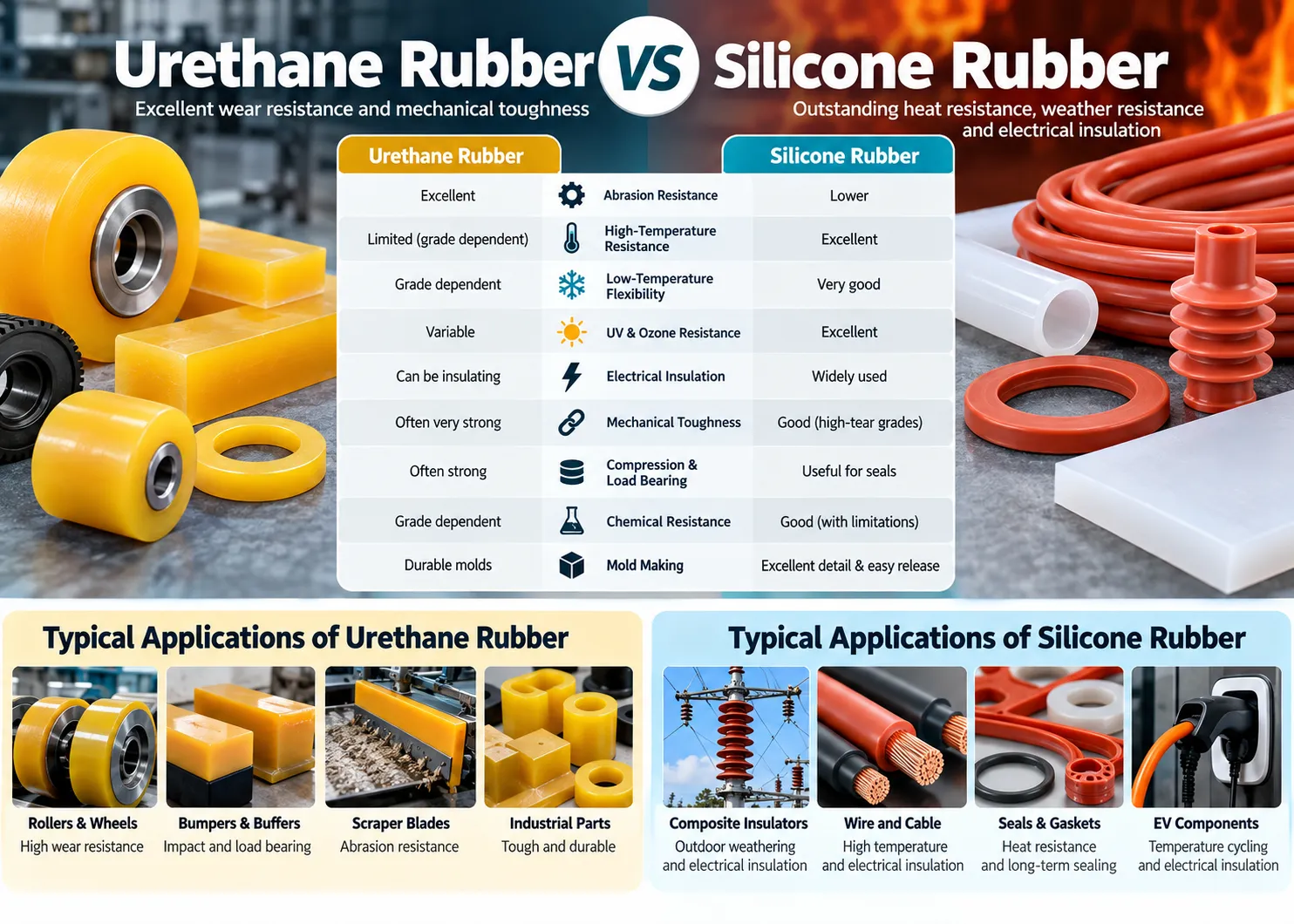
Urethane Rubber vs Silicone Rubber at a Glance
| Property | Urethane Rubber | Silicone Rubber |
|---|---|---|
| Abrasion Resistance | Generally excellent | Usually lower than polyurethane |
| High-Temperature Resistance | Depends strongly on formulation and is generally more limited | One of silicone rubber's major strengths |
| Low-Temperature Flexibility | Depends on urethane chemistry and grade | Generally very good |
| UV & Ozone Resistance | Can vary significantly by formulation | Generally excellent |
| Electrical Insulation | Can be insulating depending on formulation | Widely used for demanding electrical insulation |
| Tear & Mechanical Toughness | Often very strong | Can be excellent in high-tear grades but generally selected for different priorities |
| Compression & Load Bearing | Often strong for mechanically loaded parts | Useful for seals, but not usually selected primarily for heavy wear applications |
| Outdoor Weathering | Grade dependent | Generally a major advantage |
| Mold Making | Used for durable molds and casting applications | Widely used where flexibility, detail reproduction and easy release are important |
The Biggest Difference: Mechanical Wear vs Environmental Stability
The simplest way to understand the comparison is to look at the main strengths of each material.
Urethane rubber is frequently chosen for mechanical toughness. If a component is being dragged, rolled, scraped, compressed or exposed to repeated abrasive contact, polyurethane elastomers can perform very well.
Silicone rubber is often selected when the environment is the bigger challenge. Heat, UV radiation, ozone, electrical stress, outdoor weathering and wide temperature changes are areas where silicone has major advantages.
Which Has Better Heat Resistance?
For elevated-temperature service, silicone rubber generally has a significant advantage.
Silicone is widely used in wire and cable, ovens, heating equipment, EV components, industrial seals and electrical insulation because suitable grades can maintain flexibility and useful properties under prolonged heat.
Urethane rubber can also be formulated for elevated temperatures, but long-term heat exposure can be more challenging because polyurethane chemistry is highly dependent on polymer structure and formulation.
Which Performs Better at Low Temperature?
Silicone rubber is well known for maintaining flexibility at low temperatures. This broad operating-temperature range is one reason it is used in aerospace, transportation, electrical and outdoor applications.
Urethane rubber performance at low temperature varies significantly with chemistry. Some polyurethane systems remain flexible, while others become noticeably stiffer.
If the component must move, seal or bend through repeated hot-to-cold temperature cycles, low-temperature flexibility should be evaluated directly rather than assumed from hardness alone.
Which Has Better Abrasion Resistance?
Abrasion resistance is one of the major areas where urethane rubber often has an advantage.
Polyurethane elastomers are commonly selected for wheels, rollers, liners, scraper blades and other parts that experience repeated rubbing or wear.
Silicone rubber is generally not selected as the first-choice material for severe abrasion. Its strengths are usually heat, electrical insulation, flexibility and environmental resistance rather than continuous mechanical wear.
Which Has Better Tear Strength?
Both materials can be formulated for strong tear performance, but polyurethane elastomers are widely recognized for mechanical toughness.
Silicone rubber can also achieve high tear strength, especially in specialized HTV/HCR and LSR compounds. High-tear silicone is used in molded boots, seals, bellows and parts that must stretch during assembly or demolding.
Tear strength should therefore be compared using actual material data rather than relying only on the polymer family.
Urethane Rubber vs Silicone Rubber for Outdoor Use
Outdoor service introduces UV radiation, ozone, moisture, temperature cycling and weathering.
Silicone rubber is particularly strong in this environment. Its resistance to UV and ozone is one reason it is widely used on power grids, composite insulators, cable accessories and outdoor electrical equipment.
Polyurethane can also be used outdoors, but UV stability depends strongly on the specific urethane chemistry and stabilizer system. Some grades may discolor or change properties more quickly than others.
| Outdoor Factor | Urethane Rubber | Silicone Rubber |
|---|---|---|
| UV Exposure | Highly formulation dependent | Generally excellent resistance |
| Ozone | Depends on formulation | Generally excellent |
| Rain & Humidity | Grade dependent | Widely used in outdoor electrical systems |
| Thermal Cycling | Depends strongly on polymer type | Generally well suited |
Electrical Insulation: Silicone Rubber Has a Major Role
Electrical insulation is one of the strongest industrial reasons to choose silicone rubber.
Silicone compounds are widely used in composite insulators, cable insulation, cable accessories, high-voltage connectors, EV components and electrical boots.
Depending on the grade, important properties may include dielectric strength, volume resistivity, hydrophobicity, tracking resistance and erosion resistance.
Urethane materials can also provide electrical insulation in certain applications, but silicone rubber has a particularly established role in demanding high-voltage and outdoor electrical systems.
Why Silicone Rubber Is Used in Composite Insulators
Composite insulators are exposed to electrical stress, rain, pollution, UV radiation and long-term outdoor weathering.
Silicone rubber is valuable because its surface is hydrophobic, helping reduce continuous water-film formation under wet conditions. Specialized electrical silicone compounds can also be formulated for tracking and erosion resistance.
These requirements are quite different from the mechanical-wear environments where urethane rubber typically provides its biggest advantages.
Urethane Rubber vs Silicone Rubber for Wire and Cable
In cable systems, the decision depends on what the layer needs to do.
Silicone rubber is widely used as insulation where flexibility, high-temperature performance and dielectric properties are important.
Polyurethane materials are also found in cable systems, particularly where mechanical protection, abrasion resistance and toughness are important. In many designs, these materials may serve different layers or functions rather than directly replacing each other.
| Cable Requirement | Often Favors |
|---|---|
| High-Temperature Electrical Insulation | Silicone rubber |
| Abrasion-Resistant Outer Protection | Polyurethane materials may be attractive |
| Flexibility Across Wide Temperatures | Silicone rubber |
| Mechanical Wear Resistance | Urethane often has an advantage |
Urethane Rubber vs Silicone Rubber in EV Components
Electric vehicles require several different elastomer functions, so both material families can appear in the same vehicle.
Silicone rubber is commonly selected for high-voltage insulation, cable systems, connector seals, boots and components exposed to temperature cycling.
Polyurethane elastomers may be attractive where mechanical protection, abrasion resistance or structural toughness is more important.
The decision should therefore begin with the component function rather than asking which material is “better” for EVs overall.
Which Material Is Better for Seals and Gaskets?
Both urethane rubber and silicone rubber can be used for sealing, but their strengths are different.
Silicone is especially useful for seals exposed to heat, outdoor weathering, electrical environments or wide temperature changes.
Urethane seals may be preferred where mechanical wear, pressure resistance or abrasion is a dominant concern.
Which Material Is Better for Mold Making?
Both polyurethane rubber and silicone rubber are widely used for mold making, but they are chosen for different reasons.
Silicone mold rubber is popular because it can reproduce fine details, remain flexible around undercuts and often release many casting materials easily.
Urethane mold rubber is also widely used and may provide excellent tear strength and durability, but release agents and master compatibility can become more important depending on the system.
| Mold-Making Factor | Urethane Rubber | Silicone Rubber |
|---|---|---|
| Fine Detail Reproduction | Very good | Excellent |
| Flexibility | Depends on grade | Available across a wide range |
| Release Behavior | Release agent may be important | Often naturally favorable with many casting materials |
| Abrasion & Toughness | Often strong | Depends on silicone grade |
| High-Temperature Casting | Grade dependent | Often attractive where thermal resistance is required |
Which Material Handles Repeated Flexing Better?
The answer depends on the type of flexing and the formulation.
Silicone rubber is particularly useful when flexibility must be maintained across a wide temperature range or after environmental aging.
Urethane rubber can provide excellent toughness under repeated mechanical stress but may behave differently depending on hardness, chemistry and service temperature.
For bellows, boots and flexible electrical covers, the combination of tear strength, elongation and environmental aging should be evaluated together.
Chemical Resistance Is More Complicated Than a Simple Winner
Chemical resistance varies significantly within both polyurethane and silicone rubber families.
Some urethane formulations perform very well against certain oils, fuels or industrial chemicals, while others may be more sensitive to water, hydrolysis or specific solvents depending on chemistry.
Silicone rubber also has limitations with certain oils, fuels, concentrated chemicals and solvents.
Water and Hydrolysis Resistance
Water exposure can affect polyurethane systems differently depending on whether the elastomer uses polyester-based, polyether-based or other polyurethane chemistry.
Hydrolysis can become an important consideration in continuously wet or humid environments.
Silicone rubber generally performs well in moisture and weather exposure, which supports its widespread use in outdoor electrical and industrial sealing applications.
However, the complete environment should still be evaluated because water may be present together with heat, pressure, chemicals or electrical stress.
How Hard Can Urethane and Silicone Rubber Be?
Both materials are available across multiple hardness ranges, but hardness should not be used as the only comparison point.
A hard polyurethane and a hard silicone can have completely different modulus, rebound, abrasion resistance, tear behavior and thermal properties even when their Shore hardness values appear similar.
Likewise, a soft silicone compound can have very different compression and aging behavior from a soft urethane compound.
Always compare the full mechanical-property profile and the relevant service conditions.
Which Has Better Compression Performance?
The answer depends on the type of load and the formulation.
Urethane rubber can perform very well under heavy mechanical loading and is often selected for bumpers, wheels and load-bearing elastomer components.
Silicone rubber is widely used for compression seals, especially where the seal must remain flexible after prolonged heat or outdoor exposure.
For sealing applications, compression set is particularly important because a gasket can remain visually intact while gradually losing sealing force.
Processing Urethane Rubber vs Silicone Rubber
The two material families can require very different manufacturing methods.
Cast polyurethane systems may begin as reactive liquid components that are mixed and poured into molds. Thermoplastic polyurethane is processed differently again.
Industrial silicone rubber may be supplied as high-consistency HTV/HCR compound, liquid silicone rubber or RTV systems.
Production equipment can therefore determine which material family is practical before other properties are even compared.
Urethane Rubber vs Silicone Rubber for High-Temperature Applications
If the application involves sustained elevated temperature, silicone rubber will often be considered first.
Typical applications include high-temperature cable insulation, oven seals, electrical insulation, heating equipment, industrial gaskets and EV electrical components.
The correct silicone grade should still be selected using heat-aging data rather than only a maximum-temperature claim.
Urethane Rubber vs Silicone Rubber for Electrical Applications
For demanding electrical insulation, silicone rubber has a particularly strong industrial position.
Electrical silicone compounds can be formulated to combine dielectric strength, volume resistivity, hydrophobicity, heat resistance and outdoor weathering performance.
This combination is why silicone is widely used around power transmission, composite insulators, cable accessories and high-voltage equipment.
Polyurethane systems may still be useful for potting, protection or mechanically durable electrical components, depending on the application.
Urethane Rubber vs Silicone Rubber for Food-Contact Applications
Both material families can potentially be formulated for certain food-contact uses, but suitability must be confirmed for the exact grade.
Silicone rubber is especially common in baking molds, seals, tubing, kitchenware and food-processing components because of its heat resistance and flexibility.
Buyers should verify the required food-contact documentation rather than assuming that all silicone or polyurethane is automatically food grade.
What About Flame Resistance?
Neither polyurethane nor silicone should automatically be described as fireproof.
Silicone rubber has strong heat resistance, but heat resistance and flame retardancy are different properties. Specialized silicone compounds can be formulated to meet specific flame-performance requirements.
Polyurethane materials can also use flame-retardant systems, but the required test and complete formulation must be considered.
If a project requires UL 94 or another flame standard, verify the exact material, thickness and supporting test information.
Which Material Lasts Longer?
Service life depends on the failure mechanism.
A silicone part may last longer outdoors because UV, ozone and temperature cycling are the main stresses. A urethane component may last longer in a machine where abrasion and heavy mechanical wear dominate.
The correct question is therefore not “Which rubber lasts longer?” but “Which degradation mechanism will dominate in this application?”
Which Material Is More Expensive?
Material price varies significantly with grade, hardness, additives, curing chemistry, order volume and supplier.
Specialized conductive, high-tear, electrical, food-contact or flame-retardant compounds can cost more than general-purpose grades regardless of polymer family.
Purchase price should also not be evaluated alone. Processing speed, scrap rate, mold life, service life and maintenance cost can be more important than the raw-material cost per kilogram.
When Should You Choose Urethane Rubber?
Urethane rubber is worth considering when mechanical toughness is the dominant design requirement.
When Should You Choose Silicone Rubber?
Silicone rubber becomes especially attractive when temperature, electrical or environmental performance is the priority.
How to Choose Between Urethane Rubber and Silicone Rubber
The most reliable selection process starts with the real operating environment rather than the material name.
What Should Buyers Include in an RFQ?
A supplier can recommend the correct elastomer much more accurately when the actual application is clearly defined.
Industrial Silicone Rubber from Yakows
Yakows supplies HTV/HCR silicone rubber compounds for electrical insulation, composite insulators, wire and cable, EV systems, high-temperature components, food-contact applications and industrial molding.
For applications where silicone rubber is being compared with urethane rubber, the most important step is identifying which failure mechanism matters most. High temperature, outdoor weathering and electrical insulation usually lead to a different material choice than severe abrasion or heavy mechanical loading.
Customers can provide the application, processing method, hardness, operating temperature, electrical properties, mechanical requirements and order volume so that an appropriate silicone rubber grade can be evaluated.
Frequently Asked Questions
What is the main difference between urethane rubber and silicone rubber?
Urethane rubber is generally known for abrasion resistance and mechanical toughness, while silicone rubber is especially strong in high temperature, weathering and electrical insulation applications.
Is urethane rubber stronger than silicone rubber?
Urethane often provides greater abrasion resistance and mechanical toughness, but strength depends on the specific compound and the property being compared.
Is silicone rubber better for high temperatures?
Silicone rubber is generally better suited to sustained elevated-temperature service and is widely used in heat-resistant industrial applications.
Which is better for outdoor use?
Silicone rubber generally offers excellent UV, ozone and weather resistance, making it particularly suitable for long-term outdoor applications.
Which is better for abrasion resistance?
Urethane rubber generally has the advantage in severe abrasion and mechanical wear applications.
Which is better for electrical insulation?
Silicone rubber is widely used for demanding electrical insulation, including composite insulators, high-voltage cable systems and EV components.
Which is better for mold making?
Both can be used. Silicone rubber is widely chosen for flexibility, fine-detail reproduction and release characteristics, while urethane molds can provide strong mechanical durability depending on the casting system.
Can urethane rubber replace silicone rubber?
Sometimes, but only if temperature, weathering, electrical, chemical and mechanical requirements are all compatible with the urethane grade.
Can silicone rubber replace urethane rubber?
Sometimes, but silicone may not provide the same abrasion resistance or load-bearing mechanical performance required in severe wear applications.
Which material lasts longer?
It depends on the environment. Silicone often performs better under heat and outdoor weathering, while urethane can last longer where abrasion and mechanical wear dominate.